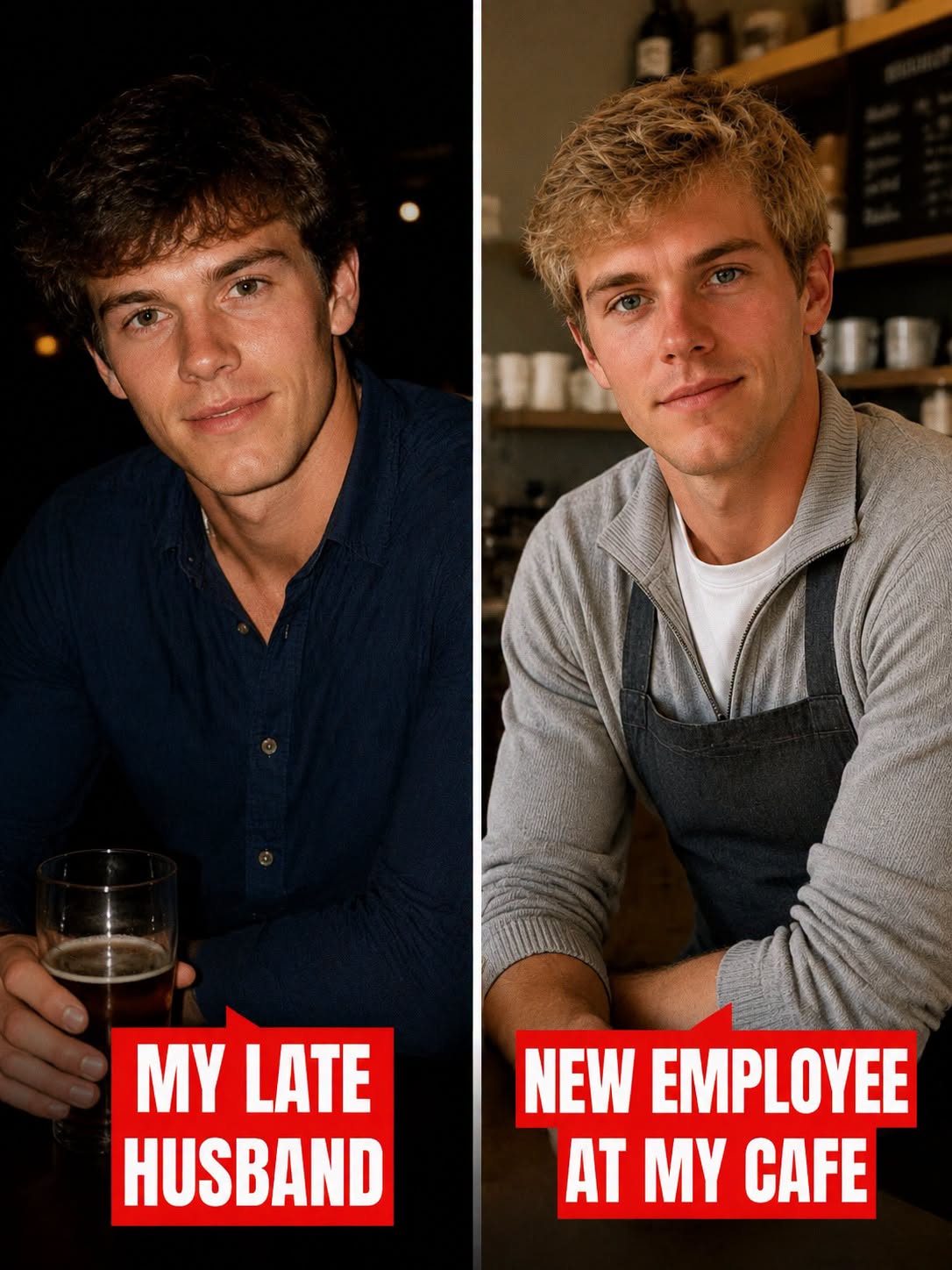

Part 1: The Dream Margaret Refused to Abandon
The little brass bell above the café door gave a cheerful ring as Margaret Ellis unlocked it for the very first time.
Morning sunlight poured through the front windows, spilling warm golden light across polished wooden tables and the freshly mopped floor. The scent of roasted coffee beans mingled with butter, cinnamon, and warm pastries that had come out of the oven less than an hour earlier. It was exactly the atmosphere she and her husband had imagined during countless late-night conversations over the past twenty years.
Only one thing was missing.
John.
Margaret stood quietly behind the counter, running her fingertips across its smooth surface before looking toward the framed photograph resting beside the antique espresso machine.
John smiled back at her from the picture, his eyes filled with the same gentle warmth she had fallen in love with decades earlier.
“We finally did it,” she whispered.
Her voice trembled.
“I just wish you were here to see it.”
For a long moment, she remained still, allowing herself to remember.
For years, they had talked about opening a neighborhood coffee shop—a place where strangers could become friends, where people could slow down from busy lives, and where every customer would feel like family.
Life, however, had always found a reason to delay the dream.
There had been bills.
Unexpected repairs.
Medical expenses.
Then John’s illness.
The last three years of his life had been spent moving between hospitals, treatments, and endless doctor’s appointments. Margaret had become his caregiver without ever complaining, determined to make every remaining day comfortable for him.
When John passed away, she believed the dream had died with him.
But weeks later, while organizing his paperwork, she found a neatly folded envelope.
Inside was a handwritten note.
“If I’m not here to see our café, promise me you’ll open it anyway.”
She had cried harder reading those words than she had at the funeral.
Every dollar they had saved together—and nearly all of her remaining savings—had gone into making this place a reality.
Now there was no turning back.
Margaret straightened her apron, took a deep breath, flipped the sign to OPEN, and unlocked the door.
“I can do this,” she murmured.
“I have to.”
Only yesterday, her neighbor Helen had stopped by during the final preparations.
“You really should hire someone,” Helen had suggested gently while helping arrange coffee mugs.
Margaret shook her head immediately.
“No.”
“Margaret…”
“I’ve handled bigger challenges than running a café.”
Helen frowned.
“You don’t have to prove anything.”
“I do.”
Margaret looked around the empty shop with quiet determination.
“I spent years taking care of John every single day. I learned how to manage medications, hospital schedules, insurance paperwork, and everything else life threw at us.”
She smiled sadly.
“If I could survive that…I can survive making coffee.”
Helen wanted to argue.
Instead, she simply hugged her.
“I hope you’re right.”
Margaret hoped so too.
For the first fifteen minutes after opening, everything felt manageable.
A young couple ordered cappuccinos.
An elderly man wanted black coffee and blueberry pie.
Two college students shared a cinnamon roll while studying near the window.
Margaret smiled with growing confidence.
Maybe she really could do this alone.
Then, just after nine o’clock, everything changed.
A local blogger had apparently posted glowing photos of the café online.
Within minutes, customers began pouring through the entrance.
The little bell above the door never stopped ringing.
Families.
Office workers.
Teenagers.
Retirees.
Neighbors curious about the new café.
The line stretched nearly to the sidewalk.
Margaret hurried from the register to the espresso machine before racing toward the pastry display.
“What can I get started for you?”
“One vanilla latte!”
“I ordered a mocha!”
“Excuse me, we’ve been waiting fifteen minutes.”
“I asked for oat milk.”
“I’m sorry,” Margaret answered breathlessly.
“I’ll be right with you.”
She scribbled orders on small paper tickets, but her handwriting became rushed and messy.
Some tickets slipped beneath others.
Some disappeared entirely.
Soon, confusion spread through the café.
A cappuccino landed on the wrong table.
Someone who ordered a blueberry muffin received a chocolate croissant instead.
A customer waiting for tea was handed an iced coffee.
“I’m terribly sorry,” Margaret apologized again and again.
Her smile remained polite, but panic was growing inside her.
A middle-aged businessman glanced at his watch before standing.
“I don’t have another twenty minutes.”
He walked out.
Another customer sighed loudly.
“The coffee smells wonderful…”
“…but this place needs help.”
A woman quietly whispered to her friend,
“She’s trying.”
“Yes.”
“But she can’t do it alone.”
Another customer shook his head.
“I give this place a week.”
Those words struck Margaret harder than she expected.
Every criticism echoed inside her long after the customers had gone.
By closing time, she could barely stand.
The once spotless café looked exhausted.
Empty plates covered several tables.
Coffee grounds littered the counter.
Dirty cups filled the sink.
Margaret slowly locked the front door before leaning against it with tired eyes.
She had imagined opening day a hundred different ways.
None of them had ended like this.
She looked once more at John’s photograph.
“I’m sorry.”
Her voice cracked.
“I disappointed us.”
The following morning, Margaret arrived before sunrise.
The café was silent except for the steady hum of refrigerators.
She brewed herself a cup of coffee and sat alone at one of the corner tables.
Eventually, she accepted something she had stubbornly refused to admit.
Helen had been right.
She needed help.
An hour later, Margaret printed a simple hiring notice.
HELP WANTED
Friendly café assistant.
No experience required.
Reliable and willing to learn.
She taped it to the front window.
Throughout the morning, applicants trickled in.
The first man talked almost nonstop.
“I actually have incredible leadership skills. Honestly, I could probably manage the entire café if you wanted. Customers love me. I once sold thirty raffle tickets in one afternoon—”
Margaret politely interrupted.
“Thank you. We’ll let you know.”
The second applicant barely looked up from his phone.
“So…what’s the pay?”
“What are the responsibilities?”
He shrugged.
“I guess whatever.”
Margaret thanked him and showed him the door.
A third interview had been scheduled for noon.
The applicant never arrived.
By late afternoon, Margaret was beginning to wonder whether she had made another mistake.
Perhaps no one suitable existed.
Perhaps she truly was meant to struggle alone.
As the evening sun cast long shadows across the café floor, she flipped the sign to CLOSED.
Just as she reached for the light switch, the bell above the door chimed one final time.
A young man stepped inside.
He appeared to be in his mid-twenties.
His clothes were clean but simple.
His smile was relaxed without seeming overconfident.
Most striking of all were his calm eyes.
They carried an unusual kindness that immediately caught Margaret’s attention.
“Sorry,” he said politely.
“I know you’re closing.”
Margaret gave a tired smile.
“We are.”
“I saw the hiring sign outside.”
He extended his hand.
“Hi.”
“I’m Andrew.”
“I was wondering if you’re still looking for someone.”
Margaret sighed.
“I am.”
“But it’s been a very long day.”
“I’m honestly not sure I have the energy for another interview.”
Andrew nodded with understanding.
“I completely understand.”
“I can come back tomorrow.”
Before Margaret could answer, the front bell rang once more.
A man in a business suit hurried inside, looking uncertain as he scanned the menu.
“I’ve never been here before,” the customer admitted.
“What do you recommend?”
Margaret opened her mouth.
She hadn’t yet recovered from the exhausting day.
Before she could respond, Andrew stepped forward naturally.
“Depends.”
He smiled warmly.
“Do you like sweeter coffee, or something stronger?”
“I usually drink regular coffee.”
“Then I’d recommend our caramel latte.”
“It has just enough sweetness without covering the espresso.”
“And if you’re hungry…”
Andrew glanced toward the pastry display.
“The carrot cake pairs perfectly with it.”
The customer smiled.
“You make that sound pretty convincing.”
Andrew laughed softly.
“I’ve always believed good coffee deserves good company.”
“I’ll take both.”
Margaret stood silently behind the counter, watching the interaction unfold.
Nothing about Andrew felt forced.
He wasn’t using rehearsed sales lines.
He simply knew how to make someone feel comfortable.
The customer left smiling.
Margaret found herself smiling too.
For the first time since opening day, she felt a tiny spark of hope.
She looked back at Andrew.
“Well…”
“I suppose I could give you a chance.”
His face brightened immediately.
“Really?”
“Come tomorrow morning.”
“We’ll see how things go.”
Andrew nodded enthusiastically.
“Thank you.”
“You won’t regret it.”
As he walked toward the door, Margaret watched him leave.
She couldn’t explain why.
She had met dozens of people over the years.
Yet something about Andrew felt strangely familiar.
She simply couldn’t figure out why.

Part 2: A Familiar Presence
Andrew arrived at the café the next morning fifteen minutes early.
The sky was still painted in soft shades of pink and orange as Margaret unlocked the front door. She noticed him waiting outside with a clean apron folded neatly over one arm and a notebook tucked into his jacket pocket.
“You really are early,” Margaret observed.
“My father always said that if you’re on time, you’re already late,” Andrew replied with an easy smile.
Margaret nodded without commenting. She handed him an apron and pointed toward the espresso machine.
“Let’s see what you can do.”
Andrew listened carefully as Margaret explained how the café operated. She showed him how to prepare each drink, organize the pastry display, clean the coffee grinder, and greet customers. Unlike the applicants before him, he never interrupted or pretended to know more than he did.
Instead, he watched closely.
Asked thoughtful questions.
Repeated instructions to make sure he understood.
By the time the first customers arrived, Margaret was cautiously optimistic.
Throughout the morning, Andrew worked steadily without rushing. When the line grew longer, he stayed calm instead of panicking. He greeted every customer with genuine warmth.
“Good morning.”
“What can I make for you today?”
“If it’s your first visit, I’d recommend our cinnamon latte. It’s quickly becoming a favorite.”
Customers responded to him almost instantly.
Some laughed at his quiet jokes.
Others stayed longer than they had planned, chatting while enjoying their drinks.
One elderly woman smiled as Andrew carried her tray to the table.
“Young man,” she said, “it’s nice to see someone with manners these days.”
Andrew chuckled.
“My grandmother would’ve been disappointed if I forgot them.”
Margaret overheard the exchange while preparing drinks.
For reasons she couldn’t explain, hearing him speak that way stirred something inside her.
John used to say almost exactly the same thing.
She quickly pushed the thought aside.
It was only a coincidence.
Days turned into weeks.
Business slowly improved.
Customers who had visited during the chaotic opening returned and were pleasantly surprised.
“The service is much faster now.”
“I love the atmosphere.”
“Who made this latte? It’s excellent.”
Margaret noticed that regular customers were beginning to ask specifically for Andrew.
At first, that bothered her more than she expected.
This had been her dream.
Her café.
Yet people seemed drawn to the young man she had hired.
She never admitted those feelings aloud.
Instead, she buried them beneath constant criticism.
“Andrew, those cups should face the other direction.”
“You wiped that table too quickly.”
“The pastries need to be arranged more evenly.”
“You should smile a little less and focus more.”
Andrew simply nodded each time.
“You’re right.”
“I’ll fix it.”
Not once did he argue.
Not once did he complain.
His patience only made Margaret feel guiltier, though she refused to show it.
One rainy afternoon, after closing, Andrew stayed behind to help clean.
“You can go home,” Margaret said while stacking dishes.
“I’ve got it.”
“So do I,” Andrew answered.
“You’ve been on your feet all day.”
Before she could object, he picked up a broom and quietly swept the floor.
Margaret watched from the corner of her eye.
There was something strangely familiar about the way he worked.
Every movement was careful.
Every task was completed before starting another.
Even the way he folded the cleaning towels reminded her of someone.
John.
Her chest tightened.
For twenty years, John had folded every kitchen towel into perfect squares.
Margaret had teased him endlessly about it.
“You know no one’s grading your towels,” she’d often laugh.
John would grin.
“Maybe not.”
“But neat things make life feel calmer.”
Now, watching Andrew fold towels the exact same way, Margaret felt goosebumps rise along her arms.
She shook her head.
Stop it.
People share habits.
It doesn’t mean anything.
Still…
She couldn’t ignore the feeling.
As the weeks passed, more similarities appeared.
Andrew always stirred coffee clockwise.
John had done that.
Andrew hummed softly while washing dishes.
John had done that too.
Andrew thanked suppliers by name.
John never forgot a name either.
Even his quiet laugh carried an oddly familiar rhythm.
One afternoon, Margaret accidentally found herself staring at him.
Andrew looked up from the espresso machine.
“Everything okay?”
Margaret blinked.
“Yes.”
“You just…”
She stopped herself.
“Never mind.”
Andrew smiled politely and returned to work.
That evening, after closing, Margaret remained alone inside the café.
She picked up John’s framed photograph from the shelf.
“You would’ve liked him,” she whispered.
“He’s kind.”
“Hardworking.”
“He reminds me of you more every day.”
A tear slipped down her cheek before she quickly wiped it away.
“I must be imagining things.”
The following Saturday became the busiest day since the grand opening.
Nearly every table was occupied.
Orders came in faster than either of them could prepare.
Despite the pressure, Andrew handled everything with remarkable composure.
He remembered regular customers by name.
He knew who preferred skim milk.
Who always ordered blueberry muffins.
Who needed sugar-free syrup.
Margaret couldn’t believe how naturally he connected with everyone.
Late that afternoon, while carrying a box of coffee beans into storage, she climbed a small ladder to reach the top shelf.
“I’ll do that,” Andrew called from across the room.
“It’s fine,” Margaret answered.
“I’ve done this a hundred times.”
She stretched a little farther.
The heavy box shifted unexpectedly.
The ladder wobbled.
Before she could react, one leg slipped.
The world seemed to tilt beneath her.
She crashed onto the floor.
A sharp cry escaped her lips.
Pain exploded through her left leg.
The box landed beside her with a loud thud.
For several seconds, she couldn’t breathe.
“Margaret!”
Andrew dropped everything and rushed toward her.
He knelt beside her immediately.
“Don’t move.”
“I’m fine,” she insisted through clenched teeth.
“No, you’re not.”
He examined her carefully without touching the injured leg.
“Can you stand?”
Margaret tried.
The moment she placed weight on her foot, another wave of pain shot upward.
She gasped.
“I…can’t.”
Andrew immediately pulled out his phone.
“I’m calling an ambulance.”
“No.”
Margaret shook her head.
“Too expensive.”
“I’ll drive you.”
She wanted to protest again.
Instead, another stab of pain answered for her.
Within minutes, Andrew carefully helped her into his car, making sure her injured leg remained supported throughout the drive.
At the hospital, doctors quickly sent her for X-rays.
After what felt like forever, the physician returned carrying the scans.
“You’ve fractured your lower leg.”
Margaret closed her eyes.
“I was afraid of that.”
“The good news,” the doctor continued, “is that surgery won’t be necessary.”
“But you absolutely cannot put weight on it for several weeks.”
Margaret sighed.
“My café…”
“It will survive.”
“Your leg won’t if you ignore our instructions.”
Andrew remained beside her the entire appointment.
He listened carefully as the doctor explained medication schedules, follow-up visits, and recovery exercises.
When they finally returned to the parking lot, Margaret looked exhausted.
“You didn’t have to stay,” she said quietly.
“I know.”
Andrew smiled.
“I wanted to.”
He drove her home in silence.
The familiar little house felt unusually empty as Margaret unlocked the front door.
Without John, every room seemed larger than it really was.
Andrew helped her inside and carefully settled her onto the living room sofa.
“Comfortable?”
“I’ll survive.”
He glanced toward the kitchen.
“I’ll make some tea.”
“You don’t need to.”
“I know.”
“But I’m making it anyway.”
A few minutes later, he returned carrying two steaming mugs.
Margaret accepted hers with a grateful smile.
The warmth felt comforting after the long afternoon.
After several quiet moments, Andrew finally spoke.
“I can run the café while you recover.”
Margaret looked up immediately.
“That’s not necessary.”
“You should rest.”
“I’ll be at work tomorrow.”
Andrew stared at her in disbelief.
“Margaret…”
“My leg is broken.”
“So?”
She answered almost stubbornly.
“The café needs me.”
“The café needs its owner healthy.”
“I’ll manage.”
“You can barely walk.”
“I’ve managed worse.”
Andrew leaned forward.
“Then at least let me drive you.”
“No.”
“I don’t need anyone taking care of me.”
His expression softened.
“You’ve spent your whole life taking care of everyone else.”
“Maybe it’s okay to let someone help for once.”
Margaret looked away.
She couldn’t explain why those words unsettled her so deeply.
Perhaps because they sounded exactly like something John would have said.
She cleared her throat.
“I appreciate the offer.”
“But I’ll manage.”
Andrew let out a quiet sigh.
“All right.”
“If that’s what you want.”
He stood and walked toward the front door before pausing.
“If you change your mind…”
“I’m only one phone call away.”
After he left, Margaret sat alone in the silent house.
She stared at John’s photograph resting on the fireplace mantel.
Then she replayed Andrew’s words in her mind.
You’ve spent your whole life taking care of everyone else.
John had said almost those exact words years ago after she’d worked herself sick caring for his mother.
Margaret slowly shook her head.
“No…”
“It can’t be.”
She didn’t know what unsettled her more.
The growing list of similarities…
Or the strange comfort she felt every time Andrew was near.

Part 3: The Secret John Took to His Grave
Margaret hardly slept that night.
Every time she closed her eyes, she saw Andrew standing in her living room, telling her she had spent her life caring for everyone else.
The words followed her into the darkness.
John had said the same thing years earlier.
Not something similar.
The exact same thing.
By morning, Margaret had convinced herself she was allowing grief to control her imagination. She was lonely, exhausted, and still adjusting to life without her husband. It was natural that she would search for pieces of him in other people.
Andrew was simply kind.
That was all.
Determined to prove that she could still take care of herself, Margaret rose earlier than usual and reached for her crutches.
The bedroom was on the second floor, and the staircase seemed far steeper than it had the day before. She carefully lowered one foot onto the first step, gripping the railing with both hands.
“I can manage,” she whispered.
She descended slowly.
One step.
Then another.
Halfway down, the rubber tip of her crutch slipped against the polished wood.
Margaret lost her balance.
She reached for the railing, but her fingers closed around empty air.
Her body fell hard against the stairs before she landed at the bottom with a cry.
Pain tore through her broken leg.
For several moments, she remained on the floor, breathing unevenly and fighting back tears.
The doctor had warned her.
Andrew had warned her.
But she had been too proud to listen.
After struggling upright, Margaret realized she could not possibly drive. She called a taxi, hating the helplessness in her own voice as she gave the driver the café address.
The car arrived twenty minutes later.
Unfortunately, the driver was new to town.
Instead of turning toward the center, he followed the wrong road and carried Margaret farther from the café.
“No, no,” she said, looking through the window. “You were supposed to turn back there.”
The driver glanced anxiously at the navigation screen.
“I’m sorry. It told me to continue.”
“Please turn around.”
By the time they reached the correct street, traffic had become heavy. Margaret checked the time repeatedly, imagining customers standing outside the locked shop.
She finally asked the driver to stop several blocks away.
“I can walk from here.”
“Are you sure?” he asked, looking at her cast.
Margaret had no choice.
Each step on the crutches sent pain through her arms and shoulders. Sweat gathered along her forehead despite the cool morning air. By the time she reached the café, she was out of breath and close to tears.
Then she stopped.
The front door was open.
Warm light glowed through the windows.
Inside, customers sat at the tables, drinking coffee and enjoying pastries as though it were an ordinary morning.
The brass bell rang when Margaret entered.
She stared around in disbelief.
Every table was clean.
The pastry shelves were full.
Fresh coffee filled the air.
Behind the counter, Andrew moved calmly between the register and the espresso machine.
“One caramel latte and one black coffee,” he told a customer. “I’ll bring them to your table.”
Only after completing the order did he notice Margaret.
His expression immediately changed.
“What are you doing here?”
Margaret looked around.
“Did you do all this by yourself?”
“Yes.”
Andrew placed a lid on the cup in front of him.
“It wasn’t hard.”
Margaret stared at him, unable to decide whether she felt grateful, embarrassed, or relieved.
“You opened without me.”
“I knew you would try to come.”
“You had no right.”
“I know.”
His answer surprised her.
Andrew looked at the exhaustion on her face and lowered his voice.
“But I also knew the customers would be waiting. You worked too hard to build this place for one difficult morning to damage it.”
Margaret’s anger faded.
He had protected the café.
Not because he wanted control, but because he understood what it meant to her.
After a long silence, she nodded toward the tables.
“You seem to have everything under control.”
“I told you I could manage.”
Margaret pressed her lips together.
Then, with as much dignity as she could gather, she said, “Andrew, don’t plan anything after work.”
He looked worried.
“Am I being fired?”
“No.”
She nearly smiled.
“You’ll drive me home.”
Andrew’s face relaxed.
“Okay, boss.”
For the first time since hiring him, Margaret sat in the corner of the café and allowed someone else to take care of the work.
Watching Andrew move among the customers, she understood something she had spent months refusing to accept.
Needing help did not make her weak.
Trusting someone did not mean surrendering everything she had built.
That evening, Andrew drove her home.
Margaret was visibly exhausted when they arrived. She had barely made it into the living room before sinking onto the sofa.
“You should rest,” Andrew said.
“I need to clean.”
Andrew looked around the house.
A few dishes rested in the sink, and dust had begun gathering along the floor.
“I’ll do it.”
“You’ve already worked all day.”
“So have you.”
Margaret hesitated.
Every instinct told her to refuse.
But the fall on the stairs had frightened her more than she wanted to admit.
“Fine,” she said. “Only the dishes.”
Andrew smiled.
“Of course.”
He washed the dishes.
Then he swept the floor.
Then he wiped down the kitchen counters while Margaret watched from the sofa.
“That is more than the dishes,” she pointed out.
“I got carried away.”
Despite herself, Margaret laughed.
The sound surprised both of them.
It was the first real laugh that had filled the house since John’s death.
When the cleaning was finished, Andrew opened the refrigerator.
“Have you eaten?”
“I’m not hungry.”
“That wasn’t my question.”
Margaret raised an eyebrow.
“You sound very confident in someone else’s kitchen.”
“I make excellent lasagna.”
The claim caught her attention.
“John used to say that.”
Andrew froze for only a second.
Then he turned back toward the refrigerator.
“Maybe he was right.”
Margaret watched him carefully as he gathered tomatoes, cheese, herbs, and pasta sheets.
The preparation seemed oddly familiar.
He added a small amount of sugar to the tomato sauce.
John had always done that.
He crushed the herbs between his fingers before adding them.
John had done that too.
Finally, he placed the lasagna in the oven and cleaned the counter while it baked.
Soon the kitchen filled with the rich aroma of tomatoes, melted cheese, garlic, and basil.
Margaret’s heart began beating faster.
When Andrew served dinner, she lifted her fork with a trembling hand.
She took one bite.
Then she stopped.
The flavor pulled her backward through time.
Sunday evenings.
John standing over the stove.
Music playing softly from the radio.
The two of them laughing as he insisted the recipe was a family secret.
Margaret slowly lowered her fork.
“This tastes exactly like my husband’s lasagna.”
Tears filled her eyes.
Andrew’s face lost its easy expression.
For the first time since she had met him, he looked frightened.
“Where did you learn this recipe?” Margaret asked.
Andrew remained silent.
“Answer me.”
“My mother taught me.”
“Who is your mother?”
Andrew looked down.
“Her name was Laura Bennett.”
Margaret searched her memory.
The name meant nothing to her.
“Was?”
“She died three years ago.”
“I’m sorry.”
Margaret studied him.
“How did she know John’s recipe?”
Andrew’s hands tightened around the edge of the table.
“Because John taught it to her.”
The room became painfully still.
Margaret could hear the kitchen clock ticking.
“How did my husband know your mother?”
Andrew reached into his jacket pocket and removed an old photograph.
He placed it carefully on the table.
Margaret picked it up.
John stood in the picture.
He was much younger, perhaps in his early thirties, but there was no mistaking him. Beside him stood a young woman holding a baby.
Margaret looked at the photograph.
Then at Andrew.
The same eyes.
The same jaw.
The same quiet expression.
Her hands began to shake.
“Who are you?”
Andrew swallowed.
“My name is Andrew Bennett.”
“I know your name.”
Margaret’s voice sharpened.
“Who are you to John?”
Andrew’s eyes filled with tears.
“He was my father.”
The words struck Margaret like another fall.
She pushed the photograph away.
“No.”
“I’m sorry.”
“No.”
Margaret shook her head fiercely.
“John and I were married for thirty-two years. He would never—”
“He didn’t betray you.”
Andrew spoke quickly.
“Not while he was married to you.”
Margaret stared at him.
Andrew struggled to keep his voice steady.
“My mother met John before the two of you were married. They were young. Their relationship ended before she discovered she was pregnant.”
“Then why didn’t he tell me?”
“He didn’t know at first.”
Andrew looked toward the photograph.
“My mother raised me alone. She contacted him when I was five.”
Twenty years.
Margaret’s chest tightened.
John had hidden a son from her for twenty years.
“He knew,” she whispered.
Andrew nodded.
“He knew.”
The betrayal felt unbearable.
Margaret had believed they shared everything.
Every dream.
Every fear.
Every mistake.
Yet for two decades, John had carried a life she knew nothing about.
“Did he see you?”
“Sometimes.”
“How often?”
“Once or twice a year when I was younger. Later, we spoke more often.”
Margaret stood instinctively, forgetting her injury until pain forced her back into the chair.
“He lied to me.”
“He was afraid.”
“Do not defend him.”
“I’m not.”
Andrew’s tears finally fell.
“I asked him many times to tell you. He always said he would, but he never found the courage.”
Margaret looked at the picture again.
“Did he support you?”
“Yes.”
“With our money?”
Andrew hesitated.
“Some of it.”
The answer cut deeply.
Margaret turned away, pressing a hand over her mouth.
John had hidden phone calls, visits, and payments.
How many times had he said he was working late?
How many unexplained expenses had she ignored?
How many moments in their marriage had been built around a secret?
“Why did you come to my café?” she asked.
Andrew wiped his face.
“Before he died, my father wrote to me.”
He pulled a folded letter from his pocket.
“He told me about the café. He said opening it was your shared dream. He asked me to make sure you weren’t alone.”
Margaret stared at the letter but did not take it.
“So you applied for the job because of him.”
“Yes.”
“You lied to me too.”
“I didn’t know how to tell you.”
“That was his excuse.”
Andrew flinched.
Margaret immediately regretted the cruelty in her tone, but the pain inside her was too fresh.
She pointed toward the door.
“Leave.”
“Margaret—”
“Please.”
Andrew slowly stood.
He placed the letter and photograph on the table.
Before leaving, he turned back.
“I didn’t come here to take anything from you.”
His voice broke.

“I came because my father loved you. And because, even though you didn’t know I existed, you were the person he spoke about more than anyone.”
The door closed behind him.
Margaret sat alone for nearly an hour before reaching for the letter.
The handwriting was unmistakably John’s.
My dear Margaret,
If you are reading this, then the truth I was too afraid to tell you has finally reached you.
Andrew is my son.
I learned about him five years after we married. I wanted to tell you immediately, but I was ashamed that I had kept any part of my past from you. Every year I waited made the truth harder to speak.
You deserved honesty.
Andrew deserved to be acknowledged.
Instead, fear made me fail both of you.
Please do not blame him for my cowardice. He asked for nothing except the chance to know his father.
I cannot ask you to forgive me. I only ask that you judge Andrew by the man he became, not by the secret I forced him to carry.
He has your strength, Margaret.
Perhaps that is why I always believed the two of you would understand each other.
Margaret pressed the letter against her chest and wept.
She cried for the husband she loved.
For the trust he had broken.
For the son who had lived at the edge of their marriage without ever being invited inside.
And for Andrew, who had quietly entered her life carrying a burden that had never belonged to him.
The next morning, Margaret asked a neighbor to drive her to the café.
Andrew was not there.
She waited through opening.
Then lunch.
By late afternoon, she began to fear he would never return.
Just before closing, the bell rang.
Andrew stepped inside to collect his apron.
Margaret looked at him across the empty café.
“I read the letter.”
He nodded.
“I understand if you never want to see me again.”
Margaret looked at John’s photograph beside the espresso machine.
“I am angry with him.”
“You have every right to be.”
“And I’m angry with you.”
“I know.”
“But you didn’t create the lie.”
Andrew remained silent.
Margaret took a breath.
“I can’t forgive twenty years of secrets in one night.”
“I’m not asking you to.”
She looked around the café they had learned to run together.
Then she pointed toward his apron.
“Put that back on.”
Andrew stared at her.
“Are you sure?”
“No.”
A tearful smile touched her face.
“But I’m willing to try.”
Andrew’s eyes filled with relief.
He tied the apron around his waist and stepped behind the counter.
Margaret never stopped loving John.
But she no longer pretended that love made him perfect.
In time, she learned that forgiveness did not erase betrayal. It simply prevented betrayal from controlling everything that came afterward.
Andrew remained at the café.
Months later, they added John’s lasagna to the lunch menu.
Margaret insisted it be called Andrew’s Lasagna.
When he objected, she smiled.
“Some traditions deserve a new name.”
The café became more successful than Margaret had ever imagined.
Customers came for coffee, pastries, and the warmth that seemed to live inside the little shop.
Few of them knew that the woman behind the counter and the young man beside her had been brought together by a twenty-year secret.
To strangers, they looked like family.
Eventually, that was exactly what they became.