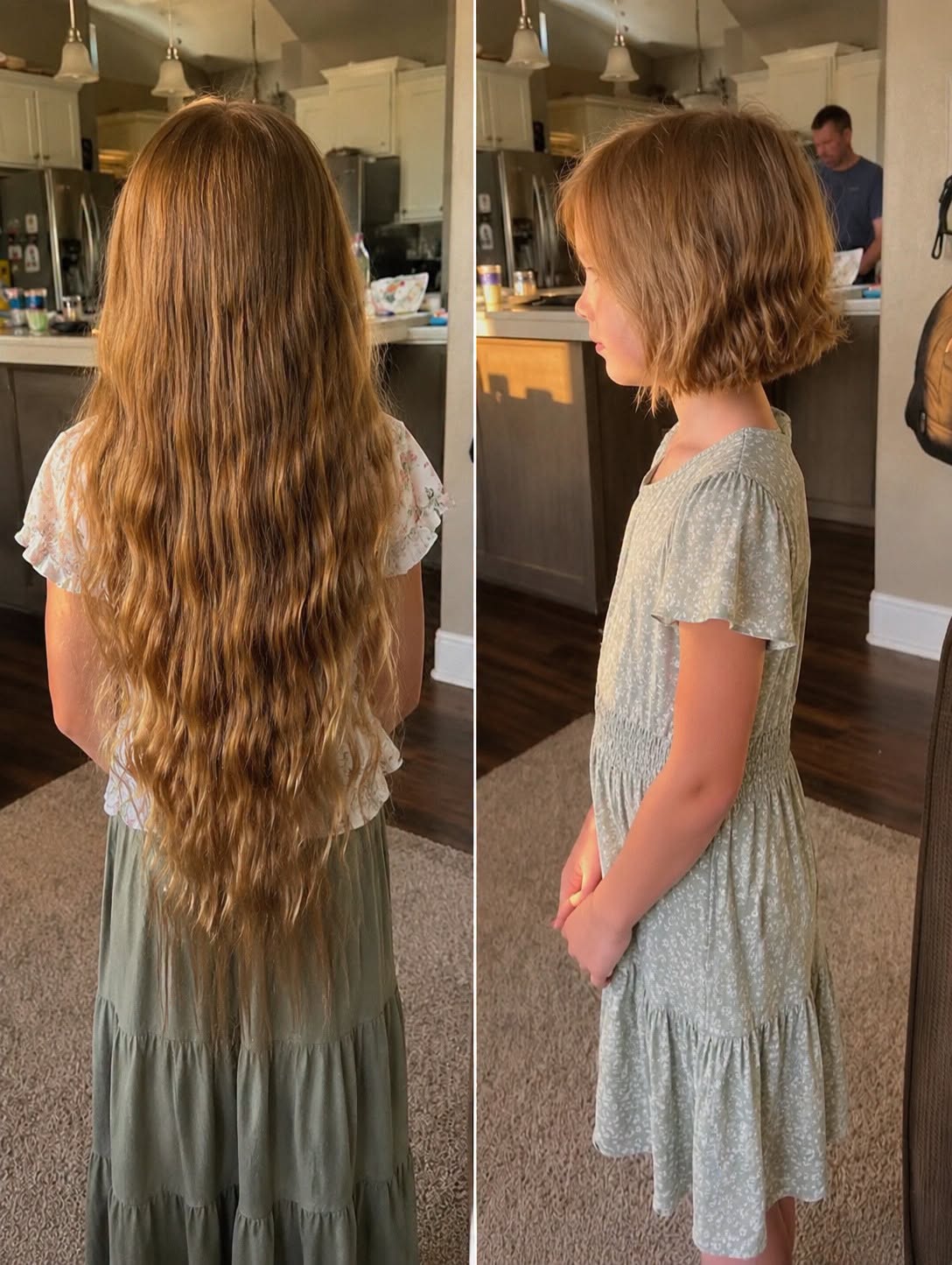

For as long as I could remember, my daughter had treated her hair like a treasure.
Not because anyone had told her it was beautiful.
Not because she loved compliments.
It was simply part of who she was.
Ever since Maya was a toddler, she refused to let anyone cut more than the tiniest amount from the ends. Every three or four months, I would sit her on the old wooden chair in our kitchen with a towel draped around her shoulders while she stared at herself in the mirror with the concentration of a lawyer watching someone sign an important contract.
“Only the ends,” she’d remind me.
“I know.”
“Promise?”
“I promise.”
Even after hearing that promise dozens of times, she still watched every movement of my scissors. If I paused for even a second, she’d glance nervously into the mirror.
“Mom… that wasn’t too much, was it?”
I always smiled.
“No, Rapunzel. Exactly half an inch.”
She would finally relax.
By the time Maya turned ten, her thick dark hair reached well below her waist. On humid mornings it seemed to develop a personality of its own. Washing it took forever. Drying it seemed to take even longer.
Every evening after dinner she would sit on the floor between my knees while I patiently brushed every knot out from the bottom upward.
Sometimes she’d read.
Sometimes she’d tell me stories about school.
Sometimes we’d simply sit in comfortable silence.
It became our routine.
Felix joked that our bathroom looked more like a salon than a family home because there were brushes, hair ties, conditioners, and detangling sprays everywhere.
He never called her Maya inside the house.
To him, she was always Rapunzel.
“Rapunzel! Breakfast!”
“Rapunzel! Your tower needs cleaning!”
“Rapunzel! Stop leaving wet towels on the bathroom floor!”
She always pretended to groan.
“Dad…”
But I caught the little smile she tried to hide every single time.
Once, Felix absentmindedly called from the living room.
“Maya, can you grab the mail?”
She walked halfway down the hallway before stopping dramatically.
“You forgot something.”
“What?”
“The Rapunzel part.”
Felix laughed.
“My mistake. Rapunzel, would you honor your father by retrieving the mail?”
She bowed dramatically before marching outside.
That tiny exchange told me everything I needed to know.
Her hair wasn’t just hair.
It was woven into her confidence.
Into the image she carried of herself.
That mattered because school wasn’t nearly as gentle with her as home was.
Maya had never been one of those children who filled every room with noise.
She was quiet.
Thoughtful.
The kind of child who would rather spend recess finishing a chapter of a fantasy novel than chasing games across the playground.
She only raised her hand when she knew the answer beyond any doubt.
She apologized when someone else bumped into her.
She thanked cafeteria workers every afternoon.
She noticed lonely children before most adults did.
Unfortunately, children like Maya often become easy targets.
The teasing had started two years earlier.
Nothing dramatic at first.
Small comments.
Whispers.
Giggles that stopped whenever a teacher approached.
One boy called her hair “the curtain.”
Another laughed that she looked like she was hiding behind it.
Several children thought it was funny to tug her braid as they walked past.
One afternoon she came home with her carefully braided hair completely undone.
I asked what had happened.
“Oh…”
She shrugged.
“It just came loose.”
I believed her until I noticed fingerprints tangled in the strands.
Later she admitted someone had yanked it during recess while everyone laughed.
Felix was furious.
The next morning we met with her teacher.
She assured us it had already been addressed.
“They’ve been warned.”
A few weeks later it happened again.
This time another student snapped her hair tie and ran away laughing.
Another meeting followed.
Then another.
Eventually we sat across from Principal Susan herself.
She listened carefully.
She sounded genuinely concerned.
“I promise we’ll keep a closer eye on things.”
The same promises returned every time.
“We’re monitoring the situation.”
“The students have been spoken to.”
“It won’t happen again.”
Gradually the obvious bullying seemed to disappear.
No more pulled braids.
No more broken hair ties.
No more tears during homework.
Maya even stopped asking if she could stay home on days when she shared physical education with that particular group of children.
Slowly…
I convinced myself everything had improved.
Looking back now, I realize I misunderstood something important.
Children don’t always stop being cruel.
Sometimes they simply become quieter about it.
Sometimes they find new ways.
Sometimes the child being hurt decides it isn’t worth telling the adults anymore.
I wish I had understood that sooner.
The afternoon everything changed began like any other Tuesday.
I was chopping onions in the kitchen while chicken roasted in the oven.
Music played softly from the speaker on the counter.
I kept checking the clock because Maya’s bus usually dropped her off at exactly 3:42.
Right on schedule, I heard the front door unlock.
“Maya?” I called.
Normally the response came instantly.
“Mom! What’s for dinner?”
Or…
“Can I have a snack?”
Or…
“I forgot my homework folder again.”
That day…
Nothing.
Just the dull thud of her backpack landing against the hallway wall.
I frowned.
“Maya?”
Still silence.
I wiped my hands on a dish towel and walked toward the living room.
She stood just inside the doorway.
Her backpack still hung from both shoulders.
Her winter coat remained completely zipped despite the warm spring afternoon.
The hood covered her head so deeply I couldn’t even see most of her face.
Something inside me tightened immediately.
Mothers notice these things.
Sometimes before logic catches up.
“Sweetheart?”
She didn’t answer.
Instead she stared at the floor.
I took another step.
“Did something happen?”
A tiny shake of her head.
“So why are you wearing your hood inside?”
Nothing.
I reached toward her.
She instinctively stepped backward.
That frightened me more than anything else.
“Maya…”
My voice softened.
“Please look at me.”
Slowly, she lifted her face.
Her eyes were swollen.
Red.
She’d been crying for a long time.
My heartbeat accelerated.
“Did someone hurt you?”
Another tiny shake of her head.
I wasn’t convinced.
Not even a little.
“What happened at school?”
Silence.
I gently reached for the edge of her hood.
She flinched.
Actually flinched.
As though she wanted to stop me.
“What happened?” I whispered.
Still no answer.
Carefully, I pulled the hood back.
For one impossible second…
My brain refused to understand what my eyes were seeing.
Then the world seemed to tilt beneath me.
Her hair…
It was gone.
Not trimmed.
Not shortened.
Gone.
The beautiful waist-length hair I had brushed that very morning had been hacked away in rough, uneven chunks that barely reached her shoulders.
One side sat noticeably higher than the other.
Jagged pieces stuck awkwardly out near the back.
The ends looked torn instead of cleanly cut, as if someone had attacked them with dull scissors.
The braid that had rested against her back every day of her life had disappeared.
My knees gave out.
I collapsed onto the hardwood floor.
“Oh… my God…”
Maya’s composure shattered.
She burst into tears.
I instinctively reached toward her hair before stopping myself halfway.
My hands were shaking too badly to touch her.
“Who did this?”
She cried harder.
“Sweetheart…”
My own voice cracked.
“Who cut your hair?”
Nothing.
Only sobbing.
The panic rising inside me quickly turned into anger.
Hot.
Immediate.
Protective.
Every conversation with the school flooded back into my mind.
Every promise.
Every assurance.
Every report that “the situation had improved.”
I imagined children cornering her inside a bathroom while she begged them to stop.
I imagined someone laughing while hacking away the one thing she treasured most.
“Maya…”
I repeated, louder this time.
“Tell me who did this.”
Upstairs, Felix must have heard my voice.
His footsteps thundered across the hallway.
“What happened?”
He hurried downstairs two steps at a time.
Then he saw Maya.
His face drained of color.
His eyes dropped to her uneven haircut.
For several seconds he couldn’t even speak.
Finally, in a voice I had rarely heard from him, he asked one question.
“…Who did this?”

Maya stared at the carpet.
Felix looked at me.
I could see the fury building behind his eyes.
Without another word, he grabbed his car keys from the hallway table.
“I’m going to that school.”
“It’s already closed,” I said automatically.
“Then I’ll call Susan.”
His phone was already in his hand.
“No,” I said, forcing myself to think. “Wait.”
He stopped.
“We need to know who we’re looking for first.”
I stood, walked over to Maya, and gently placed both hands on her shoulders.
“Sweetheart… please.”
She wouldn’t meet my eyes.
“Was it the same kids who used to pull your braid?”
No response.
“Did they trap you somewhere?”
Silence.
“Did someone force you?”
Felix muttered something under his breath that I rarely heard him say.
His grip tightened around his phone.
“I’m calling the police.”
Those five words changed everything.
For the first time since she’d come home…
Maya looked up.
Maya’s frightened eyes darted between the two of us.
“No.”
The word came out as little more than a whisper.
Felix froze with his thumb hovering over his phone.
“No?” he repeated.
She shook her head desperately, tears spilling down her cheeks.
“Then tell us who did it,” he said, his voice still firm but softer now. “Honey, we can’t help you if we don’t know.”
His anger wasn’t directed at her, but she was only ten years old. To her, anger was simply loud, and loud felt frightening.
I could see her shrinking into herself.
I wrapped an arm around her shoulders.
“Maya, sweetheart, we’re not angry with you. We’re scared. Please tell us what happened.”
For a long moment, the only sound in the room was her uneven breathing.
Every terrible possibility flashed through my mind.
Had someone cornered her in the bathroom?
Had a group of children held her down?
Had the teachers missed everything?
The memories came rushing back one after another.
The broken hair ties.
The whispers.
The afternoons she’d begged to stay home.
The meetings where adults smiled sympathetically and assured us everything was under control.
I felt sick.
“Please,” I whispered. “Just tell us.”
Instead of speaking, Maya slowly slipped one shoulder out of her backpack.
She knelt on the floor.
Her fingers trembled as she unzipped the front pocket.
From inside, she carefully pulled out a folded piece of paper that had been crumpled and flattened so many times it barely held its shape.
She held it toward me without saying a word.
I took it.
My heart pounded so hard I could barely unfold it.
For one terrible second I expected to see a cruel message.
Or a note from a teacher.
Or the names of the children responsible.
Before I could read the first sentence, Maya quietly spoke four words.
“He shouldn’t feel alone.”
The room went completely still.
Felix slowly lowered his phone.
“…Who shouldn’t feel alone?” he asked.
I unfolded the paper.
Across the top, written in careful, uneven handwriting, were the words:
“To Maya’s parents,”
The letter continued.
“My name is Liam. I am new in Maya’s class.”
“I wanted to thank you for your daughter.”
“I had cancer, and the medicine made all my hair fall out.”
“Some kids make jokes about my head.”
“Maya is the only person who sits with me every day.”
“She tells them to stop when they laugh.”
“Today I told her my mom and dad are trying to collect enough donated hair so I can get a real-hair wig.”
“We don’t have enough yet.”
“I told Maya she didn’t have to help.”
“She said she wanted to.”
“Please don’t be mad at her.”
“She is the kindest person in our class.”
“Liam.”
The words blurred almost immediately.
I blinked hard.
Then read the letter again.
And again.
Each sentence chipped away at the anger that had consumed me only moments earlier.
By the time I reached the signature for the third time, tears were running freely down my face.
Felix gently took the paper from my hands.
I watched his expression change line by line.
The fury disappeared.
Confusion replaced it.
Then heartbreak.
Finally…
Pride.
He looked at Maya.
“You… cut your own hair?”
She nodded.
“At school?”
Another nod.
“In the bathroom?”
“Yes.”
My voice barely worked.
“Why didn’t you tell us?”
She twisted her fingers together.
“I thought…”
She swallowed.
“I thought you’d say no.”
I knelt beside her.
“We wouldn’t have said no because we didn’t care.”
“I know.”
“We would’ve asked questions.”
“We would’ve found a salon.”
“We would’ve made sure everything was safe.”
She looked at the floor.
“I didn’t have time.”
“What do you mean?”
Her eyes drifted toward Liam’s letter.
“They made him cry again today.”
The story came out slowly, interrupted by tears and long pauses.
Liam had joined Maya’s class about six weeks earlier after finishing chemotherapy.
His treatment had saved his life.
But it had taken his hair.
Every morning he walked into school with a smooth bald head that immediately drew attention.
At first, children simply stared.
Some whispered.
Others pointed.
Then the jokes started.
The same group that had once mocked Maya found a new target.
They asked Liam whether he polished his head every morning.
One boy laughed whenever sunlight reflected off his scalp.
Someone called him an egg.
Another child slid farther down the lunch bench and loudly asked whether cancer was contagious.
Each joke was followed by laughter.
Teachers often stepped in once they noticed.
But children are experts at timing.
Cruelty usually happened in the moments adults weren’t watching.
Maya understood something most children didn’t.
She knew exactly what it felt like to become the joke everyone expected.
She remembered every tug on her braid.
Every whisper behind her back.
Every morning she’d wished she could disappear before entering school.
So instead of looking away…
She sat beside Liam.
At first they hardly spoke.
One afternoon Liam noticed the fantasy novel resting on her desk.
“I’ve read that one,” he’d said shyly.
“No way.”
“I like the dragon better than the prince.”
“Me too.”
That tiny conversation became friendship.
Soon they ate lunch together every day.
When someone mocked Maya’s hair, Liam told them to leave her alone.
When someone mocked Liam’s bald head, Maya quietly moved her chair closer to his instead of pretending not to hear.
The day before, Liam had told her about the organization that made real-hair wigs for children recovering from cancer.
His parents were collecting suitable hair donations.
There still wasn’t enough.
That conversation stayed with Maya all night.
She lay awake thinking about it.
The next morning, while Felix and I were busy getting ready for work, she quietly opened the kitchen junk drawer.
She took the large household scissors.
Wrapped them inside her sweater.
Slipped them into her backpack.
“I kept touching my braid all morning,” she whispered.
“I knew I’d miss it.”
I reached for her hand.
She squeezed mine.
“Then at lunch…”
She hesitated.
“I went into the girls’ bathroom.”
She tied her hair into two thick ponytails.
She remembered seeing someone do it in a video about hair donations.
Then she began cutting.
The scissors were old.
Dull.
Not meant for hair.
The first ponytail took forever.
Her hand became sore.
The blades kept slipping.
The second ponytail shifted halfway through.
One side ended up much shorter than the other.
She panicked.
Standing alone inside the tiny bathroom stall, she tried fixing it herself.
Each cut only made everything worse.
When she finally looked in the mirror…
She barely recognized herself.
She almost cried right there.
Instead, she wrapped the two long ponytails carefully inside paper towels.
Secured them with elastic bands.
Placed them inside her backpack.
Pulled her hood over her head.
Walked back to class.
No teacher noticed.
No one asked why she kept her hood on until dismissal.
Only Liam realized something had changed.
When she showed him what she’d done, he stared in shock.
“You actually did it?”
She nodded.
“I wanted you to stop feeling alone.”
He didn’t know what to say.

Instead, before leaving school, he sat down and wrote the letter now resting in Felix’s hands.
As Maya finished telling us everything, silence settled over the room once again.
The kind of silence filled with emotions too complicated for words.
I looked at her uneven haircut.
At the child sitting in front of me.
Only that morning she’d walked out of our house carrying something she’d protected for years.
By afternoon…
She had willingly given it away.
Not because she wanted a different hairstyle.
Not because someone forced her.
But because another child was hurting.
Felix slowly sat down on the couch.
He opened his arms.
Without hesitation, Maya climbed into his lap the same way she had when she was five years old.
He held her tightly.
So tightly.
His voice cracked.
“What you did for Liam…”
He paused.
“…was one of the kindest things I’ve ever seen.”
She looked up hopefully.
“So you’re not mad?”
He smiled sadly.
“I am.”
Her face fell.
“I’m mad that you took scissors to school.”
“I’m mad because you could’ve been badly hurt.”
“I’m mad because you tried carrying something this big by yourself.”
He brushed a short strand of hair away from her face.
“But I’m also unbelievably proud of the little girl who cared so much about someone else’s pain.”
She buried her face against his shoulder and began crying again.
“So…”
she mumbled.
“You can be both?”
He kissed the top of her head.
“Parents can be both.”
For the first time since walking through the front door…
She laughed.
It was small.
Wet with tears.
But it was still laughter.
I searched inside her backpack.
Hidden beneath two school folders were the carefully wrapped ponytails.
Despite the uneven cuts, most of the length remained intact.
I lifted them carefully, suddenly understanding how difficult that decision must have been.
Hours earlier, I had believed someone had stolen something precious from my daughter.
Now I realized the truth was even more extraordinary.
No one had taken it.
She had chosen to give it away.
And somehow…
That made the sacrifice even more beautiful.
Felix held Maya until her breathing finally steadied.
For several long minutes, none of us moved.
The late afternoon sunlight stretched across the living room floor, illuminating the uneven strands of Maya’s newly shortened hair. Only hours earlier, I would have given anything to undo what had happened.
Now I wasn’t sure I wanted to.
Not because I liked the haircut.
I didn’t.
It was jagged, uneven, and far from what anyone would choose.
But every uneven strand told the story of a little girl who had placed someone else’s pain above her own appearance.
I sat beside them on the couch and gently stroked Maya’s back.
“I’m sorry,” she whispered.
“I should’ve told you.”
“You should have,” I answered honestly.
She lowered her head.
“I didn’t want you to stop me.”
Felix nodded.
“And that’s exactly why you needed us. We would never have stopped you from helping Liam.”
She looked up hopefully.
“You wouldn’t?”
“No.”
He smiled gently.
“We would’ve found a way to do it safely.”
“We would’ve made an appointment.”
“We would’ve talked to Liam’s parents.”
“We would’ve made sure your donation could actually be used.”
He gently touched one of the uneven ends.
“What scared us wasn’t your kindness.”
“It was how much danger you put yourself in.”
She nodded.
“I know.”
“You could’ve cut your hand.”
“I know.”
“You could’ve hurt another student.”
“I know.”
“You carried all of this by yourself because you thought we wouldn’t understand.”
Fresh tears welled in her eyes.
“I didn’t want Liam to cry anymore.”
That single sentence broke whatever composure I still had.
I pulled her into my arms.
“You have the biggest heart of anyone I’ve ever met.”
That evening, we carefully placed the two ponytails into a clean zippered bag before driving to a nearby salon.
The stylist welcomed us with her usual cheerful smile.
Then she saw Maya.
“What happened?”
Instead of answering immediately, I handed her Liam’s letter.
She read it quietly.
By the time she reached the last line, she removed her glasses and wiped her eyes.
“Oh, sweetheart…”
she said softly to Maya.
“…that may be the kindest reason I’ve ever heard.”
She examined the uneven haircut carefully.
“The good news is that most of the donated hair stayed intact.”
“The bad news…”
She smiled apologetically.
“…is that I can’t make this even without taking it considerably shorter.”
Maya reached up and touched the ragged ends.
“That’s okay.”
The stylist spent nearly an hour carefully reshaping what remained.
She softened the harsh edges.
Blended the uneven layers.
Created a neat chin-length bob that framed Maya’s face beautifully.
When she finally turned the chair toward the mirror, Maya stared at herself for several seconds.
She tilted her head one way.
Then the other.
Finally she asked quietly,
“I look… different.”
“You do,” I admitted.
She looked uncertain.
“Bad different?”
I smiled.
“No.”
“You look different.”
“You look beautiful.”
“And nothing about your haircut changes the person you’ve always been.”
Felix grinned.
“You’ll always be Rapunzel to us.”
Maya laughed.
“Even with short hair?”
“Especially with short hair.”
The next morning, the three of us walked into the school together.
This time we weren’t arriving as frightened parents.
We were arriving with questions that deserved real answers.
Principal Susan welcomed us into her office.
The surprise on her face was genuine when she saw Maya.
“My goodness…”
“What happened?”
“No one reported any of this.”
“No one could have,” I replied calmly.
“She hid it until she came home.”
Susan invited Maya to tell the story herself.
She listened without interrupting once.
When Maya finished, the principal folded her hands together.
“First,” she said kindly, “bringing scissors to school was unsafe.”
Maya nodded immediately.
“I know.”
“I’m sorry.”
Susan smiled gently.
“I appreciate your honesty.”
Then she looked toward Felix and me.
“I also appreciate that your daughter cared enough to help another child.”
Felix leaned forward.
“We’re grateful for that.”
“But this conversation isn’t only about the scissors.”
Susan’s expression became serious.
“It’s about bullying.”
He continued.
“My daughter was teased for years.”
“Now Liam is being targeted.”
“How many other children are suffering quietly because adults mistake cruelty for teasing?”
The room fell silent.
I described every incident Maya had experienced over the past two years.
The pulled braid.
The insults.
The broken hair ties.
The days she’d begged not to attend school.
Then Maya described what Liam endured every day.
The egg jokes.
The comments about his bald head.
Children moving away from him at lunch.
Pretending he might somehow spread cancer.
Susan took notes throughout the entire conversation.
She never interrupted.
She never defended the school.
She never offered excuses.
Finally she closed her notebook.
“This isn’t teasing.”
She looked directly at us.
“This is bullying.”
“And we’ve clearly failed to recognize how deeply it’s affecting these children.”
For the first time during any meeting we’d had with the school…
I believed someone was truly listening.
Susan asked whether we’d allow her to contact Liam’s parents.
We agreed.
That same afternoon we returned to the school.
Waiting inside the office were Liam and his parents, Noella and Duncan.
Liam immediately smiled when he saw Maya.
His smile looked different from the nervous one he’d worn in the school pictures she’d shown us.
It looked lighter.
Hopeful.
Noella crossed the room and hugged Maya without saying a word.
When she finally stepped back, tears filled her eyes.
“Liam talks about you every single day.”
Duncan cleared his throat several times before speaking.
“We knew you were kind.”
“We didn’t realize you’d been protecting our son.”
Maya shook her head.
“I didn’t protect him.”
“They still laughed.”
Liam looked at her.
“But you stayed.”
“You sat beside me.”
“You never acted embarrassed.”
“You made me feel normal.”
The room became quiet again.
Carefully, Maya lifted the bag containing her ponytails and handed it to Noella.
“We don’t know if they’ll work.”
Noella accepted it with both hands as though it were something priceless.
“They’ll always matter.”
She held the bag against her chest.
“Whether they become part of Liam’s wig or someone else’s… your gift has already changed our family.”
Several days later, the organization evaluated the donation.
Most of Maya’s hair met the required length and condition.
It wasn’t enough to create an entire wig by itself.
But it could become an important part of one.
That news planted an idea.
A week later, Felix and I met with Principal Susan again.
“If one ten-year-old girl was willing to give up something she’d treasured her entire life…”
I said,
“…then surely the adults in this community can do more than simply talk.”
Susan smiled.
“I was hoping you’d say that.”
Together, they organized a school-wide hair donation drive.
Licensed salons volunteered their time.
A nonprofit organization partnered with the school.
Families received detailed information explaining how donated hair would help children undergoing cancer treatment.
Students who couldn’t donate hair were invited to raise funds to cover the cost of creating and fitting wigs.
The response exceeded everyone’s expectations.
Three weeks later, the school gymnasium buzzed with excitement instead of whispers.
Parents lined up beside students.
Teachers volunteered.
Older siblings came to donate.
One father had spent nearly four years growing his hair specifically so he could donate it someday.
A music teacher cut off nearly twelve inches she’d worn since college.
Children who preferred not to cut their hair made handmade cards filled with encouraging messages for pediatric cancer patients.
The atmosphere wasn’t sad.
It was joyful.

Every donation represented hope.
Maya didn’t cut her hair again.
Instead, she proudly stood beside Liam at the registration table.
She carefully labeled each donated ponytail.
Checked every consent form.
Thanked every family.
Watching her smile, I realized she no longer seemed bothered by her own short haircut.
She had stopped looking in mirrors.
She had started looking at people.
By the end of the event, the organization had collected enough suitable hair to begin creating Liam’s custom wig, along with several others for children receiving treatment.
Nearly two months passed.
One crisp Monday morning, Noella called.
“It’s ready.”
She invited us to meet outside the school before classes began.
When we arrived, Liam stood beside his parents wearing his new wig.
It was dark brown.
Soft.
Perfectly fitted.
He kept nervously smoothing it with both hands.
“I can’t stop touching it,” he admitted.
“You don’t have to,” Felix laughed.
“You’ve earned that right.”
Liam looked at Maya.
His confidence suddenly disappeared.
“Do I look weird?”
Maya studied him with complete seriousness.
She walked over.
Adjusted one tiny strand near his forehead.
Then smiled.
“No.”
“You look exactly like the Liam I eat lunch with every day.”
His face lit up.
The two of them walked toward the school entrance together.
Side by side.
Neither one speaking.
Neither one needing to.
Other students noticed.
Some smiled.
A few waved.
No one laughed.
Principal Susan had kept her promise.
The school introduced stronger reporting procedures.
Teachers received additional training on recognizing appearance-based bullying and social exclusion.
Students participated in classroom discussions about empathy, bystander responsibility, and the lasting effects of cruel words.
The school didn’t become perfect overnight.
Children still argued.
Mistakes still happened.
But something important had changed.
Adults were paying attention before small hurts became lasting wounds.
Several months later, Maya’s hair had grown past her chin.
One evening she sat on the floor between my knees again while I brushed it.
The routine that once took nearly twenty minutes now lasted less than sixty seconds.
“No tangles,” I teased.
She grinned.
“I kind of miss them.”
“I don’t.”
We both laughed.
As I brushed the last few strands into place, I realized how wrong I’d been.
For years, I believed the most beautiful thing about my daughter was the long dark hair she’d spent a decade protecting.
I couldn’t have been more mistaken.
Hair grows back.
Compassion leaves a mark that never fades.
The most beautiful thing about Maya had never fallen past her waist.
It had always lived inside her heart.
When she walked through our front door that afternoon with her hair hacked off in uneven pieces, I believed someone had stolen something precious from my little girl.
I was ready to blame strangers.
Ready to call the police.
Ready to fight anyone who had hurt her.
The truth was something I never could have imagined.
No one had taken her greatest treasure.
She had chosen to give it away.
Not because she stopped loving her hair.
Not because it didn’t matter anymore.
But because she knew that a gift only has real meaning when it costs you something.
And in that moment, my ten-year-old daughter taught every adult around her—including me—that kindness is measured not by what we have, but by what we’re willing to give so someone else never has to feel alone again.