
Aug
The scent of rosemary and roasted onions filled the house when I opened the front door. Under any other circumstances, it would have smelled like comfort. That afternoon, it became the smell I would forever associate with the moment my family nearly came apart.
PART ONE: HELP WITH CONDITIONS
My name is Nathan Cole. At the time, my wife, Emily, and I were living in Cedar Grove, Maryland, with our six-week-old son, Owen. I worked as a systems analyst for a company outside the city, and the long commute often kept me away from home for ten or eleven hours at a stretch. Emily was still recovering from childbirth, surviving on interrupted sleep and learning the demanding rhythm of caring for a newborn.
When my mother, Patricia, offered to stay with us for a few months, I accepted before Emily had a real chance to answer. My mother presented the idea so generously that refusing seemed almost ungrateful. She arrived with two suitcases, a frozen casserole, and a cheerful promise that we would not have to worry about a thing.
For the first week, I believed her. She folded laundry, stocked the refrigerator, and held Owen while Emily showered. Each evening, she gave me a detailed report about everything she had done. I mistook that list for kindness. I did not notice that every favor was becoming a debt she expected Emily to repay.
The changes were quiet at first. Emily stopped calling her sister during the day. Her messages to me became shorter. If I asked whether she was all right, she said she was tired and quickly glanced toward the hallway, as though she was afraid someone might be listening. My mother always had an explanation ready. Emily was sensitive. Emily was overwhelmed. Emily needed firmer routines.
I wanted peace so badly that I accepted the easiest version of events. That is the part I still regret. I loved my wife, yet I trusted the familiar confidence of the woman who had raised me more than the worry I could see on Emily’s face.
One Monday night, I found Emily standing alone in the kitchen after midnight. Owen had finally fallen asleep against her shoulder. A basket of clean towels sat at her feet, and tears shone in her eyes. Before I could ask what was wrong, Patricia appeared in the doorway and said, ‘She is emotional because she refuses to rest when I tell her to.’
Emily looked at me for a long second. It was not agreement. It was a plea I failed to understand.
The next morning, she had slept for less than three hours. Her hands shook while she warmed Owen’s bottle. I offered to call in sick, but my mother laughed lightly and told me I was being dramatic. She said she had raised two children and knew how to manage a tired new mother.
I touched Emily’s shoulder and promised I would be home before dinner. Then I said the words that would haunt me: ‘Mom is here. Let her take care of you.’
As soon as I reached the office, uneasiness followed me from meeting to meeting. Emily did not answer my first message. Twenty minutes later, she did not answer the second. At noon, I called. The phone rang until voicemail. My mother finally sent a text saying Emily was busy preparing dinner and needed to learn how to organize her time.
Preparing dinner? Emily could barely stand that morning.
I closed my laptop, told my manager there was a family emergency, and drove home without waiting for a reply.
PART TWO: THE AFTERNOON EVERYTHING CHANGED
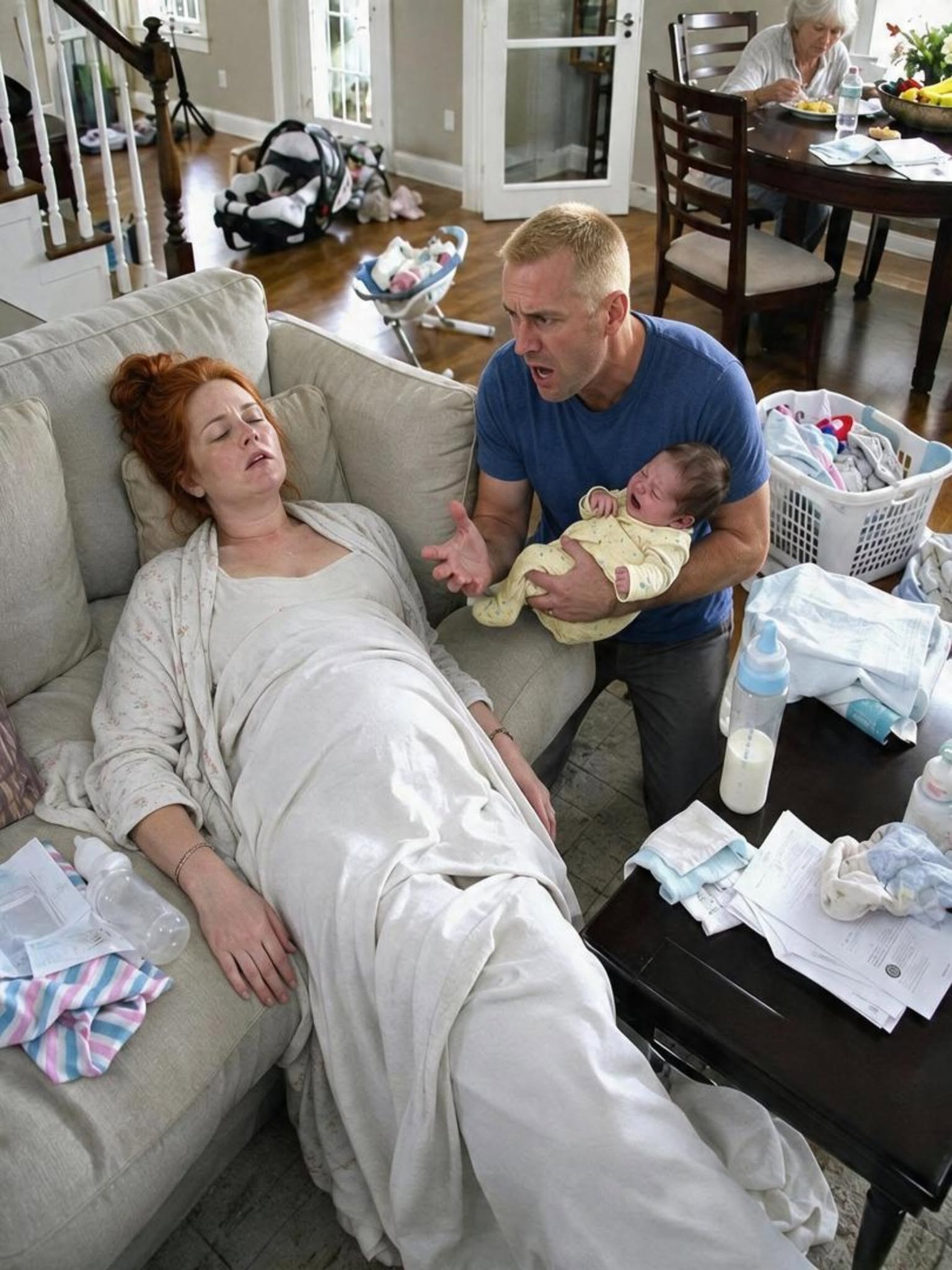
I heard Owen before I reached the porch. His cries were sharp and unbroken, the kind that meant he had been calling for someone for far too long. I unlocked the door and rushed inside.
The dining room table had been set with our best plates. A roast rested beneath a silver cover. My mother sat in front of it with a full glass of water, calmly cutting her food into neat pieces.
Owen was in his bassinet near the living room, red-faced and frantic. A few feet away, Emily lay motionless beside the couch. A bowl of unpeeled vegetables had tipped onto the rug.
For a moment, the entire room seemed to narrow around her. I dropped to my knees, called her name, and reached for my phone. She was breathing, but she did not respond. I called emergency services, then lifted Owen from the bassinet and held him against my chest while the dispatcher guided me through what to do.
My mother never left her chair.
‘She fainted because she likes attention,’ Patricia said, sounding irritated rather than frightened. ‘The meal was nearly finished. She could have waited another ten minutes.’
I stared at her. I had spent my whole life watching my mother control every room she entered. I had excused her sharp words as honesty and her demands as high standards. But with my wife unconscious on the floor and my son crying in my arms, every excuse collapsed at once.
‘You knew she needed help,’ I said.
Patricia placed her fork beside her plate. ‘What she needs is discipline.’
The paramedics arrived minutes later. One examined Emily while another asked questions. When I explained how little she had slept, the paramedic’s expression tightened. They took her to the hospital for evaluation, and Owen and I followed in our car after a neighbor agreed to stay at the house until the police could document the scene.
While I sat beside Emily’s hospital bed, my home-security app sent a movement alert. The camera showed Patricia opening the cabinet where we stored passports, insurance papers, and Owen’s birth certificate. She looked over her shoulder before reaching inside.
I called the officer who had taken my statement and asked him to return to the house. Then I changed the access code to our document lockbox from my phone. Patricia’s hand froze when the keypad rejected her. She looked directly into the camera, and for the first time, I saw not an overprotective mother but someone furious that she was losing control.
Emily woke later that afternoon. Her first word was Owen’s name. I placed him safely beside her and told her the doctors were monitoring her for severe exhaustion, dehydration, and low blood sugar. She pressed her face against his soft hair and began to cry.
When the nurse stepped out and the room became quiet, I asked the question I should have asked weeks earlier.
‘What has been happening when I leave?’

PART THREE: WHAT EMILY HAD BEEN AFRAID TO SAY
At first, Emily could not look at me. She said my mother had warned her that I would never believe an outsider over my own family. Patricia reminded her constantly that the house belonged to me, the paycheck came from me, and she could be replaced if she failed to keep everyone happy.
Every morning after I left, Patricia handed her a list. Vacuum the bedrooms. Wash the linens again. Prepare a proper lunch. Cook a complicated dinner. If Emily tried to rest while Owen slept, my mother found another task. If she called a friend, Patricia stood close enough to hear the conversation and later accused her of complaining about our family.
The cruelest part was the sleep. Emily explained that whenever she finally settled Owen in his crib, Patricia would enter the nursery, open the curtains, adjust his blanket, or speak loudly enough to wake him. Then she would tell Emily that a competent mother would know how to calm her own child.
‘She kept saying you were beginning to notice how useless I was,’ Emily whispered. ‘I thought if I told you, you would think I was making excuses.’
Shame washed through me, but I forced myself not to ask Emily to comfort me for my failure. This was not the moment for explanations. It was the moment to believe her.
‘I believe you,’ I said. ‘And I am sorry I made this house feel like a place where you had to prove what was happening.’
The footage supported everything she described. Our cameras had recorded Patricia entering the nursery again and again. Audio from the kitchen captured the cutting remarks she saved for the hours when I was gone. I copied every file to a secure folder and sent it to an attorney recommended by a colleague.
That evening, Emily was discharged with instructions to rest and follow up with her doctor. We did not return home. A close friend gave us the keys to her vacant guest apartment, and we stayed there while I arranged for Patricia to leave our house. I took emergency family leave, canceled the additional card my mother used on my account, removed her from every shared service, and changed every password she might know.
The next morning, our attorney confirmed the steps required to end Patricia’s stay. Two officers agreed to be present while I delivered the written notice and allowed her to collect essential belongings. I did not go alone because anger can make a person careless, and my first responsibility was getting back safely to Emily and Owen.
Patricia was waiting in the foyer when I arrived. Her suitcase stood beside her, but she had not packed it. The instant she saw the officers, her face changed. She began speaking loudly enough for the neighbors to hear.
‘Your wife has poisoned you against your own mother,’ she declared. ‘Bring her home so she can apologize.’
I placed the notice on the entry table. ‘Emily owes you nothing. You were invited here to help. Instead, you frightened her, exhausted her, and ignored her when she collapsed.’
She pointed toward my chest. ‘I am your mother. I come before anyone else.’
For years, that sentence would have pulled me back into obedience. This time, it only made the truth clearer.
‘Being my mother does not give you permission to harm my family,’ I said. ‘You are leaving today.’
PART FOUR: THE LAST THING SHE TOOK
Patricia shifted from outrage to tears, then from tears to threats. She said she would tell every relative that Emily had stolen her son. She claimed grandparents had automatic rights to a baby they barely knew. When none of it changed my answer, she finally packed one suitcase while the officers waited. A moving company collected the rest of her belongings later that week and placed them in storage under her name.
After she left, the house felt unnaturally still. I walked from room to room and saw signs of the life we had been living without understanding it: a chore list tucked beneath the sugar jar, Emily’s phone charger hidden in the guest-room drawer, and notes in my mother’s handwriting criticizing the way bottles had been washed.
In our bedroom closet, I found Emily’s small cedar keepsake box with its latch broken. The diamond pendant her grandmother had given her was missing.
Security footage showed Patricia slipping the necklace into her handbag shortly before the officers arrived. I filed a report and gave investigators the recording. Even then, my mother insisted the pendant belonged to her because she had ‘earned something’ for all the help she had provided.
A week later, Patricia began telling her version of the story online. She described herself as a devoted grandmother thrown into the street by a cruel son and a jealous daughter-in-law. Relatives who had not spoken to us in months sent messages demanding that I apologize. Some accused Emily of destroying our family.
My first impulse was to answer every lie. Emily stopped me. She did not want our lives turned into a public argument. But she also did not want Patricia to keep using silence as proof that she was innocent.
Together, we chose two short pieces of evidence that protected Emily’s privacy: an audio clip of Patricia ordering her to continue cooking after she said she felt faint, and a hallway recording showing my mother repeatedly entering the nursery after being asked to let Owen sleep. We sent them privately to the relatives who had confronted us, along with a simple message: ‘We will not debate our decision. These recordings explain why it was necessary.’
The accusations stopped almost immediately. A few relatives apologized. Others disappeared without another word. Both responses taught me something important: people who truly cared asked whether Emily and Owen were safe. People who cared only about appearances asked when we would make the scandal go away.
The police recovered the pendant after showing Patricia the recording. Emily held it in her palm for a long time when it was returned, but she did not put it back in the damaged box. She bought a new one and placed it inside with Owen’s hospital bracelet and the first photograph of the three of us.
‘This one will hold memories we choose,’ she said.
That sentence became the quiet beginning of our recovery.

PART FIVE: HOME, REBUILT
Healing did not happen in a single brave moment. It came through ordinary decisions repeated every day. I adjusted my schedule and worked from home more often. Emily accepted help from people who offered it without attaching conditions. Her sister visited on weekends, not to inspect the house, but to hold Owen while Emily slept. We met with a counselor who helped us understand how fear and guilt had been used to keep us quiet.
I also had to face an uncomfortable truth: removing my mother was only the first boundary. The harder work was changing the part of me that had been trained to excuse her. Whenever I felt guilty, I returned to the facts. Love does not demand silence in the presence of harm. Respect does not require surrender. A family title is not a license to control another person’s home.
Letters from Patricia began arriving every few weeks. Some contained apologies that turned into blame by the second paragraph. Others warned that I would regret choosing my wife over my mother. One included a list of everything she had ever bought for me, as though childhood meals and school shoes were loans that had finally come due.
At first, the sight of her handwriting tightened my chest. Eventually, I stopped opening the envelopes. Our attorney kept what was necessary for our records, and the rest went unopened into a locked file. Patricia could send words, but she could no longer decide what those words did to us.
Two years later, we celebrated Owen’s second birthday in our backyard. Blue paper lanterns hung from the fence. His hands were covered in chocolate frosting, and he laughed each time the dog tried to catch a fallen crumb. Friends filled the patio with the easy noise of people who did not need us to perform gratitude for their kindness.
Emily stood beside me with one hand resting on her pregnant belly. The frightened look I once saw in her eyes was gone. In its place was a steadiness that had been rebuilt through rest, honesty, and the certainty that her voice mattered in her own home.
I thought about the afternoon I had walked through the front door and finally seen what denial had cost us. I wished I had understood sooner. I wished Emily had never been made to feel alone. But regret no longer felt like a chain. It had become a responsibility: notice, listen, believe, and act.
After the guests left, I found one more unopened letter in the mailbox. I carried it to the office, placed it in the shredder, and watched the envelope become thin strips of paper. There was no triumph in the moment, only peace.
When I returned outside, Emily was gathering empty plates while Owen chased bubbles across the grass. I took the plates from her and looked around at the home that had once felt occupied by fear.
‘It feels like ours again,’ she said.
‘It is ours,’ I answered. ‘And no one gets to make you unsafe here again.’
The sun dropped behind the trees, turning the yard warm and gold. Owen reached for both of us, and we knelt to lift him together.
That evening, I understood that protecting a family does not always mean holding everyone together. Sometimes it means drawing a clear line between love and control. Sometimes it means closing a door, not out of revenge, but so the people inside can finally breathe.
Patricia had taught me that blood could create a bond. Emily and Owen taught me something more important: trust, safety, and compassion are what make that bond worthy of being called family.