
Aug
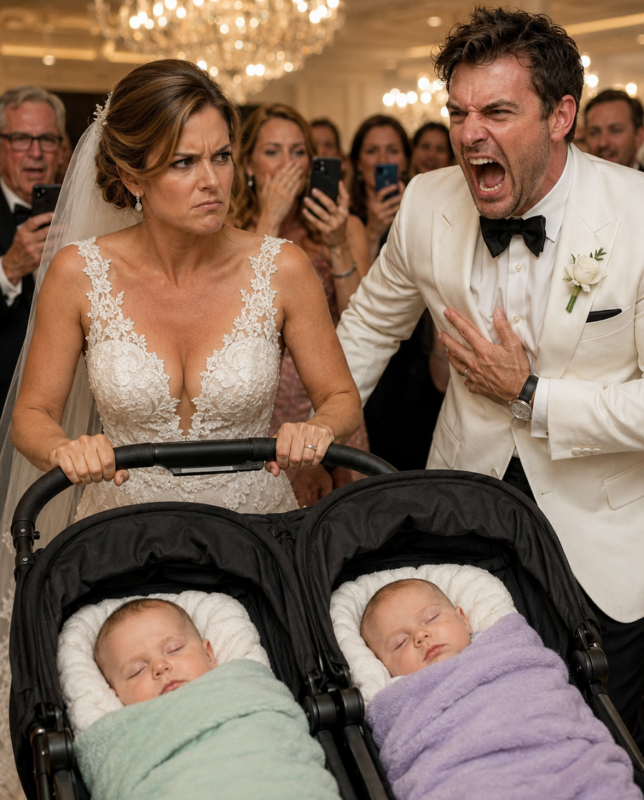
At his promotion gala, Daniel tried to send his exhausted wife and their twins out of sight. Minutes later, the company revealed the identity of the founder everyone had been waiting to meet.
Part One – The Woman He Wanted Hidden
The first time my husband asked security to remove me from a room, I was holding our ten-month-old twins in my arms.
Sophie had fallen asleep against my shoulder, one small fist tangled in the fabric of my gray dress. Sam was awake and restless, blinking at the chandeliers above us as if he had never seen anything so bright. Around us, hundreds of guests moved through the ballroom of the Hawthorne Hotel, dressed in black suits and jeweled gowns. A string quartet played near the marble staircase, waiters carried silver trays between clusters of executives, and a twenty-foot screen displayed the name of the company everyone had come to celebrate: AstraVale Solutions.
Daniel stood beneath that screen with a glass in his hand and a smile I had not seen at home in months. Tonight, he expected to be named vice president of regional strategy. He had rehearsed his acceptance speech in front of the bathroom mirror all week. I had helped him choose his tie, listened to every version, and told him I was proud of the work he had done.
But when he saw me near the entrance, pride was not what crossed his face. It was alarm.
He excused himself from a group of senior managers and hurried toward me. His smile remained fixed until he was close enough that no one else could hear.
“Anna, what are you doing here?” he whispered.
“The sitter canceled,” I said. “Your assistant told me families were welcome for the opening reception. I thought the twins and I could stay for your speech, then leave early.”
His eyes traveled from the diaper bag on my arm to the comfortable flats beneath my dress. For one painful second, I watched him calculate what I might cost him simply by being visible.
“You look exhausted,” he said. “And this is not a family picnic. These people have only ever seen me as focused and professional.”
“I am your wife, Daniel. I do not make you less professional.”
His jaw tightened. “Please don’t turn this into an argument. You used to understand how important presentation was. Since the twins, you have let everything go. I can’t have my simple, tired wife wandering into photographs while the board is deciding my future.”
The words landed quietly, which somehow made them hurt more. He glanced at my body and added, “You know pregnancy changed you. Why would you choose tonight to put that on display?”
I felt heat rise behind my eyes, but I would not cry in front of him. Not there. Not while our children rested between us.
Daniel lifted two fingers toward a security supervisor. “Could you help my wife to the private lounge? She is leaving.”
The supervisor took one step toward me, then stopped. His expression changed as he looked over my shoulder.
A woman’s voice came from behind me, calm and unmistakably amused. “I don’t think Mrs. Mercer will be leaving. The board has been waiting for her.”
Daniel turned. So did half the room.
Leah Price, AstraVale’s chief legal officer and my oldest friend, stood at the foot of the staircase. Beside her was Marcus Chen, the company’s chief executive. Both of them were smiling at me.
Daniel looked from Leah to Marcus, then back to me. For the first time that evening, his perfect confidence disappeared.
Part Two – The Life He Thought I Lived
To understand why Daniel was confused, you have to understand the version of me he had chosen to believe.
When we met six years earlier, I worked from a small home office and described myself as a software consultant. That was true, but incomplete. I wore ordinary clothes, drove a ten-year-old car, and preferred neighborhood cafes to expensive restaurants. Daniel assumed my work paid the bills and little more. I never corrected every assumption because, at first, his lack of interest in money felt like freedom.
I had already learned what wealth could do to relationships. My mother raised me alone and died just as the company I founded began to succeed. Within weeks of the funeral, relatives who had barely called us appeared with investment ideas, emergencies, and sudden affection. Reporters waited outside our office. Strangers sent marriage proposals to an email address meant for customer support. One man I had met twice gave an interview describing a future we had never discussed.
So Leah helped me place my ownership in Linden Holdings, a private trust company, while AstraVale hired Marcus to become its public chief executive. In the technology press, the founder was known only by the initials A.M. Employees called that hidden person “the North Star.” Most assumed A.M. was an older man or a distant investment group. I let them assume.
Daniel knew I had substantial premarital business interests protected by a trust. Our attorneys had made that clear before the wedding. He waved the subject away and said he did not care about numbers on paper. I loved him for that answer, and I mistook it for proof that the details would never matter.
I meant to tell him the whole truth after our first anniversary. Then his father became ill, and our life narrowed to hospital visits and family responsibilities. Later, when things settled, Daniel had begun comparing salaries and measuring success by titles. Each time I considered telling him, I wondered whether he would still see me or only what I owned.
That fear did not excuse my silence. I understood that. Secrets do not remain harmless simply because they began as protection. By the time I became pregnant with the twins, the truth between us had grown so large that I no longer knew how to place it gently on the table.
I stepped away from daily operations during the pregnancy but remained chair of the board. I joined meetings before sunrise, reviewed strategy while the babies napped, and signed decisions from a desk beside two bassinets. Daniel saw the closed laptop and the laundry basket. He never saw the billion-dollar contracts I had helped negotiate before breakfast.
What troubled me was not that he underestimated my income. It was how easily he began to underestimate me.

Part Three – Cracks Behind the Celebration
Daniel had not always been cruel. In our early years, he brought soup when I worked late and left notes beside my keyboard reminding me to rest. But as his career advanced, kindness became something he offered when it did not inconvenience him.
After the twins were born, he spoke of my exhaustion as a personal failure. If dinner was late, he sighed. If I asked him to take a night feeding, he reminded me that his work required a clear mind. He praised fathers at the office for “helping” with their children, as though caring for a family were a favor men performed rather than a responsibility they shared.
The comment about my body at the gala was not the first sharp remark. It was simply the first one he made while believing an entire ballroom might agree with him.
A month before the event, Marcus had told me the board planned to introduce the anonymous founder publicly. AstraVale was launching a program for parents returning to work, and the directors believed the story behind the company mattered. I agreed because I was tired of teaching our children that honesty was important while living behind a careful omission at home.
I planned to tell Daniel that morning. I even placed the trust documents and an old photograph of AstraVale’s first office on the kitchen table.
But he rushed past them. He was angry because his tuxedo shirt had not been collected from the cleaners, though he had never asked me to collect it. When I said I would attend the gala, his expression hardened.
“You should stay home,” he told me. “This night could change everything for us. I need people to see me at my best, not think about bottles and babies.”
“Everything for us?” I asked.
“You know what I mean. Once I get this promotion, you can stop pretending your little consulting projects matter.”
I looked at the folder on the table and slowly closed it.
That decision was not brave. Part of me wanted one final answer to a question I had been avoiding: if Daniel believed I had no title, no influence, and no fortune, would he still treat me with dignity? By the time he summoned security at the gala, I had my answer.
Leah approached and gently took the diaper bag from my arm. Marcus offered to carry Sam, but the baby buried his face against me, so Leah called the event coordinator to find a quiet room and a trusted childcare attendant for the next twenty minutes.
Daniel watched people respond to me with immediate care. He looked almost offended by their respect.
“What is happening?” he asked.
Leah’s gaze moved to the security supervisor, then back to Daniel. “The program is beginning. You may want to take your seat.”
“I asked Anna a question.”
I shifted Sophie carefully against my shoulder. “And I will answer it, Daniel. But not in a hallway where you just tried to have me removed.”
Part Four – The Name Behind AstraVale
Ten minutes later, I stood behind the stage curtain while the twins slept in a nearby suite with Leah’s assistant and the hotel childcare coordinator. My hands were trembling. Not because I feared the crowd, but because the truth I had protected for years was about to become public in the worst possible way.
Marcus walked to the center of the stage and began with the company’s history. AstraVale had started with four rented desks, a borrowed server, and an idea for software that could help small manufacturers reduce waste. He described the difficult first years, the payroll I covered from my savings, and the night our first major client nearly walked away. Then he spoke about the founder who had chosen privacy over recognition.
On the giant screen appeared an old photograph of four young people in a cramped office. I stood in the middle, twenty-seven years old, holding a handwritten sign that read ASTRAvale because we had not yet agreed which letters should be capitalized.
A murmur traveled through the ballroom.
Daniel stared at the screen. His face went still.
“Tonight,” Marcus said, “with her permission, we are finally able to thank the person who built the foundation beneath every achievement we celebrate. AstraVale’s founder, board chair, and majority owner – Anna Mercer.”
The applause rose before I stepped through the curtain. It sounded enormous, but my world had narrowed to the sight of my husband in the third row. The man who had wanted me hidden now looked as though he wished the floor would hide him.
I reached the lectern and waited for the room to settle.
“For years,” I began, “I believed anonymity allowed the work to speak louder than my name. Sometimes it did. Sometimes it also allowed people to invent a founder who looked more powerful than an ordinary woman working at a kitchen table.”
A few people smiled. I did not.
“A company reveals its values in small moments: who is heard in meetings, whose work is credited, whether parenthood is treated as a weakness, and how we speak to people when we believe they have nothing to offer us. Respect that depends on status is not respect. It is calculation.”
The room became very quiet.
I did not mention Daniel’s name. I did not need to. My purpose was not to turn a private wound into entertainment. It was to say aloud what I should have demanded long before that night.
I announced AstraVale’s new Returnship and Family Support Initiative, which would provide paid training, flexible schedules, and emergency childcare for employees rebuilding careers after caregiving. The idea had been shaped by hundreds of stories from parents across the company. It had also been shaped by the lonely nights when I answered board emails with one hand and rocked a crying baby with the other.
When I finished, the crowd stood. I saw engineers, receptionists, managers, and parents wiping their eyes. I also saw Daniel remain seated for half a second too long before rising with everyone else.
The master of ceremonies returned to the stage. The next item on the program should have been the leadership promotions. Instead, Marcus announced that those decisions would be postponed until the completion of an internal review.
I had not ordered that change. In fact, I had formally removed myself from any decision involving Daniel because he was my husband. But the board had already received complaints that he took credit from junior employees, dismissed staff with caregiving needs, and humiliated people he considered unimportant. What happened in the entrance hall had not created the problem. It had merely made the pattern impossible to ignore.
Part Five – What Was Left After the Applause
Daniel found me in the family suite after the program. Sophie was drinking a bottle in my arms, and Sam was asleep in a portable crib. Leah remained by the door until I told her I would be all right.
For several seconds, Daniel said nothing. His anger arrived before his apology.
“You own AstraVale?” he finally demanded. “You let me work there for four years without telling me?”
“I did not hire you, supervise you, or influence your promotions. You applied through an outside recruiter. When I learned where you had accepted the job, I disclosed our relationship to the ethics committee and stepped away from every matter connected to your division.”
“That is not an answer.”
“No,” I said. “It is context. The answer is yes. I should have told you the full truth years ago, and I am sorry I allowed fear to become secrecy.”
He paced across the room. “Was our whole marriage a test? Were you waiting to see if I loved you while you sat on a fortune?”
“No. I wanted a normal life, and then I became afraid that telling you would destroy it. That was my failure. But my silence did not make you tell security to remove the mother of your children. It did not make you ashamed of me.”
His expression shifted. “I was under pressure. If I had known who you were, I would never have spoken to you that way.”
The sentence ended our marriage more completely than the scene in the ballroom.
I looked at him and felt something inside me become calm. “That is exactly the problem, Daniel. You should not need to know a woman’s net worth before deciding she deserves kindness.”
He opened his mouth, but no defense came.
“If I were only the tired wife you believed I was,” I continued, “your words would still have been cruel. If I had no company, no trust, and no one waiting for me downstairs, I would still deserve to enter a room without being treated like your shame.”
I told him I would take the twins home and that he could stay with his brother for the next few days. We would speak later with a counselor and a mediator, when neither of us was standing inside the shock of that night.
He asked if the board would fire him.
Even then, part of him was still thinking about the title he had expected to receive.
“That decision is not mine,” I said. “And it should not be.”

Part Six – The Cost of Being Seen Clearly
The weeks that followed were not triumphant. There was no magical morning when wealth erased heartbreak, exhaustion, or the fear of raising two children across separate homes.
News of my identity spread quickly. Some articles called me brilliant. Others called me deceptive. People who had never sat at our kitchen table argued about whether Daniel was a victim, whether I had planned his humiliation, and whether a good wife would have revealed everything sooner.
I stopped reading after the third day.
In counseling, I did not pretend my choices were flawless. I had hidden a central part of my life from my husband. I had allowed old experiences to convince me that secrecy was safer than vulnerability. Daniel had the right to feel betrayed by that omission.
But accountability did not require me to accept his contempt. Two failures could exist in the same marriage, and one did not cancel the other.
The company’s review lasted six weeks. Investigators interviewed employees from Daniel’s division and examined years of evaluations and project records. The board concluded that he had repeatedly claimed disproportionate credit, discouraged flexible arrangements already protected by company policy, and retaliated in subtle ways against people who challenged him. He was offered a non-managerial role with a development plan. He resigned instead.
I abstained from every vote and received the same summary that was provided to senior leadership. Keeping my distance was painful, but necessary. I would not use ownership to rescue him, and I would not use it to punish him.
At home, separation made ordinary tasks feel unexpectedly heavy. I packed bottles for exchanges, learned to sleep through the silence when the twins were with their father, and sat alone after mediation sessions wondering how two people could build a family and still misunderstand each other so completely.
Daniel resisted at first. He blamed the board, the press, Leah, and me. Then, slowly, there was no one left to blame who could rebuild his life for him.
He began individual therapy. He apologized to three former team members without asking them to forgive him. He found a position at a smaller company where he had no grand title and no connection to me. Most importantly, he learned the twins’ schedules, attended pediatric appointments, and stopped referring to parenting as helping me.
Change did not restore our marriage. It did, however, make a healthier form of family possible.
Part Seven – Using My Own Name
Our divorce became final nine months after the gala. There was no dramatic courtroom battle. The business interests protected before our marriage remained separate, and we built a parenting plan centered on Sophie and Sam rather than our pride.
On the day I signed the final papers, I did not feel victorious. I felt sad for the life we had imagined and grateful that I no longer had to shrink myself to preserve it.
I also understood that I could not return to hiding.
For the first time, I took a permanent office at AstraVale. It was not the largest one. I chose a bright room near the product teams, with enough space for a play mat when the twins visited. I spent my first months listening to employees who had known the anonymous founder only as a signature on company documents.
The Returnship and Family Support Initiative opened in five cities. It offered twelve-week paid returnships, emergency childcare grants, and manager training built around measurable standards rather than slogans. Within a year, more than two hundred caregivers had reentered technical and operational roles. Several became managers themselves.
One of them was Priya Shah, an engineer who had left the workforce for four years to care for her mother. At the program’s first graduation, she told me, “I thought the gap on my resume had erased everything I knew. This place reminded me that experience does not disappear just because life asks us to use it somewhere else.”
Her words stayed with me because they described more than a career.
For years, I had believed that being a good wife required making my strength quiet enough that it never disturbed anyone. After the twins were born, I confused sacrifice with invisibility. I loved my family, but love was never supposed to require the erasure of the person doing the loving.
I began speaking publicly about leadership, privacy, and the complicated cost of hiding. I never used Daniel’s name. The lesson was larger than one failed marriage: character is revealed by how we treat people when we think they cannot reward us, promote us, or fight back.
That truth belonged in every home as much as it belonged in every boardroom.
Part Eight – One Year Later
One year after the gala, AstraVale held its annual celebration in the same hotel.
I almost chose another venue. Then I realized I did not want one painful memory to own the room forever.
This time, the entrance displayed photographs of employees and their families. A supervised children’s area had been set up beside the main ballroom, and no parent had to choose between being present at home and being recognized at work. Sophie and Sam, now unsteady toddlers, wore matching blue sweaters and spent most of the reception trying to escape toward the musicians.
Before I walked onstage, my phone lit up with a message from Daniel. He was waiting downstairs for his scheduled weekend with the twins.
Good luck tonight, he had written. I am sorry for the man I was in that room last year. I am working to be someone our children can respect.
I read the message twice. Then I replied, Thank you. They are ready, and Sam’s medicine is in the front pocket of the bag.
It was not a romantic ending. It was something quieter and, for our children, more useful: two people accepting the truth and choosing not to pass their worst habits to the next generation.
Marcus introduced me using my full name. I stepped onto the stage without a hidden title, without an invented founder standing between me and the world, and without needing anyone’s surprise to make me powerful.
From the back of the ballroom, Priya raised her hand in a small wave. Leah smiled from the front row. Around them sat hundreds of people whose work had built AstraVale alongside mine.
I looked at the audience and remembered the woman in the gray dress, holding two babies while her husband tried to move her out of sight. I no longer felt ashamed for her. I felt tenderness. She had been tired, yes, but she had never been small.
“Last year,” I told the room, “I said respect that depends on status is only calculation. This year, I want to add something. Dignity does not arrive when other people finally learn your value. It begins when you stop allowing their blindness to define it.”
The applause came again, warm and rising.
But this time, it was not the sound that mattered.
What mattered was that when I left the stage, I walked through the center of the room – not because I owned the company, but because I had finally stopped living as though I needed permission to be seen.