
Aug
PART 1
I came home from a three-day business trip carrying gifts for my wife and daughter—only to discover that my wife had passed away while I was gone.
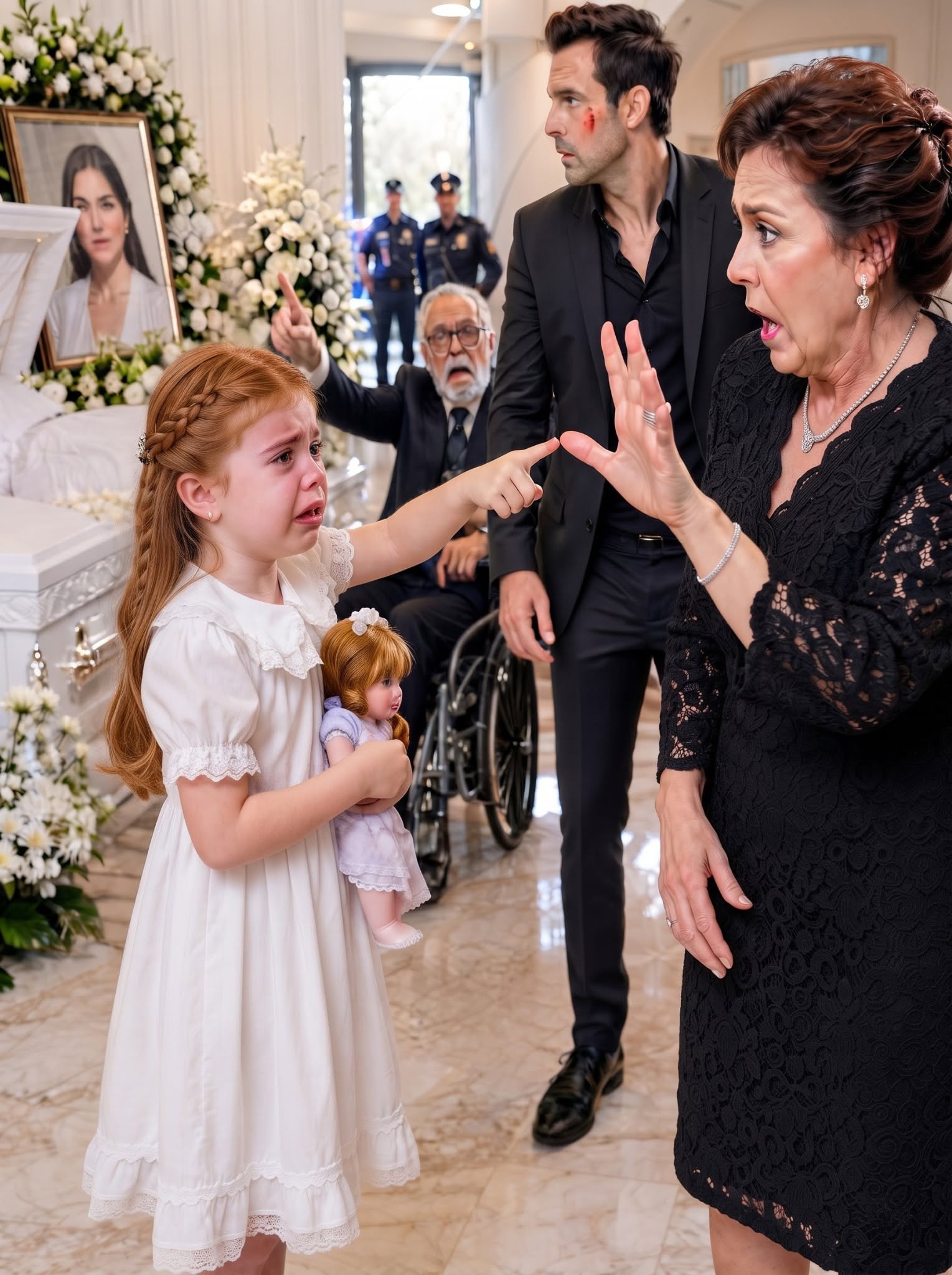
As my mother cried, “You came too late,” my six-year-old daughter grabbed my hand and whispered:
“Daddy… Uncle Derek scared Mommy… and Grandma took her phone.”
I didn’t understand the words at first. I only understood the coldness that moved through me when I saw the funeral flowers covering our front yard.
Rows of folding chairs stood beneath a white canopy. A black mourning ribbon was tied around our front gate. Beside the entrance, someone had placed a large portrait of Clara, my wife, smiling in the blue dress she had worn for Lily’s kindergarten graduation.
Inside my travel bag was a green silk scarf I had bought for Clara in Portland. It had tiny gold leaves along the edge, and I had spent twenty minutes choosing it because she once told me green made her feel “like spring had remembered her.”
For three days, I had imagined her waiting at the front door with Lily beside her.
Instead, I found my family preparing to bury her.
My mother, Teresa, rushed toward me with tearful eyes and wrapped both arms around my shoulders.
“You’re too late, Alex,” she said. “Clara passed away almost three days ago.”
For several seconds, I couldn’t make sense of the sentence.
“Why didn’t anyone tell me?”
“Your phone couldn’t be reached,” she replied. “Mr. Vance said your assignment couldn’t be interrupted.”
Mr. Warren Vance was the executive vice president of Northstar Logistics, the company where I had worked for nine years. He had personally signed the authorization for the high-security transportation assignment that had kept me on the road.
I looked past my mother at the living room.
Clara’s coffin stood in the center, surrounded by white lilies.
My Aunt Beatrice, who owned the local funeral home, checked her watch nervously.
“We need to leave for the cemetery before seven,” she said. “We shouldn’t delay things.”
“Why is everyone in such a hurry?” I asked.
No one answered.
Near the staircase sat my father, Arthur. After suffering a stroke two years earlier, he relied on a wheelchair and struggled to speak clearly. But his mind was still sharp, and he had never lost the ability to notice what other people missed.
The moment he saw me, he struck the armrest three times with his hand. Then he stared urgently toward the second floor.
My mother moved beside Clara’s coffin and began crying loudly.
“Why did you leave us, Clara?” she said. “We all cared about you.”
That was when Lily pulled away from her grandmother.
My daughter’s small hand pointed directly toward Teresa.
“Grandma isn’t telling the truth!” Lily cried.
Every conversation in the room stopped.
“Mommy didn’t leave us the way Grandma said!”
My younger brother, Derek, stood near the fireplace. The color drained from his face.
“Lily doesn’t understand what she saw,” my mother said quickly. “She has been through something frightening.”
I knelt in front of my daughter.
“Sweetheart, tell Daddy what happened.”
Lily wrapped both arms around my neck.
“Mommy kept calling your name,” she whispered. “Uncle Derek opened Mommy’s door. He scared her. He took her phone. Grandma closed the door and wouldn’t let us leave.”
Behind us, my father struck the side of his wheelchair again. This time, he pointed underneath his seat cushion.
Aunt Beatrice stepped between us.
“Alex, this isn’t the right time. Let Clara rest peacefully. You can discuss your family problems afterward.”
Something inside me went completely still.
I borrowed a relative’s phone and called 911.
My mother hurried toward me.
“Alex, stop! Family problems should stay inside the family!”
I looked directly into her eyes.
“When someone passes away under suspicious circumstances, it isn’t just a family problem.”
PART 2
Minutes later, police sirens sounded outside.
As the officers approached, I noticed Aunt Beatrice standing near the hallway, typing a message on her phone. Just before she turned off the screen, I saw four words:
He’s starting to suspect.
At the same moment, Derek quietly moved toward the back staircase.
I stepped in front of him.
“Nobody goes upstairs,” I said. “Nobody touches anything.”
Derek lowered his eyes. There was a faint mark across one side of his face, as if he had hurriedly tried to cover it with makeup.
Something had happened upstairs before I returned.
I just didn’t know how much my family had hidden—or why the executive who signed my paychecks was about to become part of the investigation.
Detective Marisol Reyes arrived with two officers and a medical examiner. She was calm, direct, and probably in her late forties. While the others secured the house, she asked me to step onto the porch.
“Tell me exactly what you know,” she said.
“My wife is dead. My daughter says my brother frightened her and my mother took her phone. My father is trying to point us upstairs. My aunt wants to rush the funeral. And someone just texted that I’m starting to suspect something.”
Detective Reyes glanced through the window at the crowded living room.
“Has anyone moved your wife’s belongings?”
“I don’t know.”
“Has anyone told you how she died?”
My mother answered from behind me.
“A sudden cardiac event. Clara had been under enormous pressure.”
“Who called emergency services?” Detective Reyes asked.
Teresa’s mouth tightened.
“There was no point. She was already gone.”
“That wasn’t my question.”
The silence that followed was the first honest thing I had heard since arriving home.
There had been no 911 call.
No ambulance report.
No hospital record.
According to my mother, Clara had become unresponsive in the upstairs bedroom, and the family had contacted Aunt Beatrice instead.
Detective Reyes asked everyone to remain in separate rooms. She sent Lily with a victim-services counselor and a neighbor she trusted. Before Lily left, she held my hand tightly.
“Daddy, I tried to help Mommy,” she said. “She told me to remember the number three.”
“What number three?”
Lily looked toward my father.
“Grandpa knows.”
Arthur lifted his hand from the wheelchair armrest and pointed beneath the cushion again.
This time Detective Reyes helped me search.

PART 3
Under the cushion, we found a small brass key, a folded grocery receipt, and a piece of blue thread tied around the key’s ring.
The receipt was from a hardware store three miles away. On the back, Clara had written one line in her neat handwriting:
“The third drawer. 11:40. Don’t trust the version they give you.”
I recognized the handwriting immediately. My knees weakened, and I had to grip the table.
“Where does the key go?” Detective Reyes asked.
My father pointed toward the second floor.
The officers searched Clara’s bedroom first. Her closet doors were open. One drawer had been pulled out and left crooked. A jewelry box sat on the floor, its lid broken—not damaged beyond repair, but clearly handled in a hurry.
The third drawer of Clara’s writing desk was locked.
The brass key fit perfectly.
Inside was a blue folder, a black flash drive, and a sealed envelope with my name on it.
I stared at the envelope for almost a minute before opening it.
Alex,
If you are reading this, I wasn’t able to reach you. Start with Route 17 and the 11:40 call. The person who says he is protecting your job may be the person using it against you.
I love you. Please believe Lily. Please listen to Arthur. And please don’t let anyone rush you into saying goodbye before you know the truth.
Love,
Clara
Under the letter was a printed list of fourteen Northstar invoices. Each one had been paid to a company called Cedar Peak Consulting. The amounts ranged from $8,200 to $48,600.
At the bottom of the page, Clara had circled one employee identification number.
Mine.
Detective Reyes read the documents without touching them.
“Did you know about these invoices?”
“No.”
“Did your wife work for Northstar?”
“She used to. She left eighteen months ago to stay home with Lily. But Clara had worked in the billing department for almost a decade. She could recognize a false route number from across a room.”
Detective Reyes nodded toward the flash drive.
“We’ll take this as evidence. Do you know what’s on it?”
“No.”
Arthur made a strained sound from the doorway.
He had managed to follow us upstairs with the help of an officer. His face was pale, but his eyes were fixed on the blue folder.
Detective Reyes crouched beside him.
“Mr. Mercer, can you tell us what happened?”
Arthur reached for the communication tablet strapped to his wheelchair. His fingers shook as he tapped the screen.
The device spoke each word in a flat electronic voice.
“Clara gave me the key.”
My breath caught.
Arthur continued typing.
“She came to me Tuesday morning. Derek followed her. She said, ‘If Alex comes home, he must find the drawer.’”
The room blurred in front of me.
“What happened after that?” Detective Reyes asked.
Arthur closed his eyes, gathering strength.
“Derek opened the bedroom door. Clara said no. Teresa took Clara’s phone. Clara asked for help. Then Clara held her chest and sat down.”
He stopped typing.
PART 4
I looked at Detective Reyes.
“They didn’t call 911.”
Arthur’s tablet spoke again.
“Teresa called Mr. Vance’s assistant.”
My mother began crying in the hallway.
“I didn’t know what else to do,” she said. “He told me Clara was having a panic episode. He said calling the police would destroy Alex’s career and put all of us at risk.”
“You believed him?” I asked.
“He knew things about your assignment. He knew your route, your return date, your supervisor’s name. He said Clara had stolen company property and that you could be blamed for it.”
Detective Reyes turned toward her.
“How long did you wait before getting medical help?”
Teresa covered her face.
“I don’t know. Maybe eighteen minutes. Maybe more.”
The medical examiner later concluded that Clara had suffered a serious cardiac event and that emergency assistance had been delayed. Because Clara had a documented heart-rhythm condition, the report could not state with certainty what caused the event. But it did establish that she had been conscious and responsive when the family first realized she was in distress.
That fact stayed with me more than anything else.
She had been calling my name.
She had been asking for help.
And everyone around her had been listening to someone else.
The flash drive contained a folder with sixty-two scanned pages. Clara had organized everything by date, amount, and person involved.
The first invoice was from January.
The last was dated the day before I left for my assignment.
Cedar Peak Consulting had no actual office. Its listed address was a mailbox in a strip mall in another state. The company had received more than $1.2 million from Northstar over fourteen months.
The invoices carried my employee number because they were filed under “special route verification,” a task I had performed many times. But my signature had been copied. The route records had been altered after I completed each delivery.
Someone had been using my work history to make the payments look legitimate.
Clara had found the original records through a former coworker. She had also discovered that Cedar Peak’s registered owner was the brother-in-law of Warren Vance.
The final file was an audio recording.
Detective Reyes played it through her department laptop.
Clara’s voice came first, quiet but steady.
“I’m not giving you the drive, Derek. You don’t work for Northstar, and you don’t have the right to take it.”
Derek answered, his voice trembling.
“You don’t understand what Vance can do.”
“Then tell him to speak to me himself.”
“He said Alex’s entire career is tied to those files.”
“That’s why I’m keeping them safe.”
There was the sound of a door opening. Then Teresa’s voice.
“Clara, please. Give us the folder and we can all move on.”
“Why are you helping him?” Clara asked.
No one answered for several seconds.
Then Derek said, “Because he promised to pay for Dad’s care.”
The recording ended.

PART 5
I looked at my mother.
She sank into a chair.
“Your father’s rehabilitation bills were almost $19,000,” she whispered. “Vance offered to cover them. He said Clara was trying to ruin the company because she was angry about leaving. I thought if we could get the drive, everything would stop.”
“Everything did stop,” I said. “Clara stopped breathing.”
My mother closed her eyes.
For the first time, she didn’t try to defend herself.
Derek had been the one who entered Clara’s room, but even he hadn’t expected the situation to become a medical emergency. He told investigators that Vance’s assistant had promised him $25,000 for retrieving the folder. Derek had debts from a failed home-renovation business, and he had convinced himself that taking papers from Clara’s desk was not truly harmful.
He had opened the door with a spare key after Clara refused to let him in. When she tried to move past him, he stepped into the hallway and blocked her path. That was the moment Lily saw him and became frightened.
Derek took Clara’s phone from the floor after it slipped from her hand. Teresa put it in her purse.
When Clara began struggling to breathe, Derek called Vance’s assistant instead of emergency services.
That decision became the line none of them could cross back over.
The next morning, Detective Reyes obtained records from Northstar. They showed that my assignment had been real, but the order making me unreachable had come directly from Vance’s office. My company phone had been sealed in a security pouch, and all outside calls had been routed through my supervisor.
There had been no legitimate reason to prevent my family from contacting me about a medical emergency.
There had also been no legitimate reason for Vance to know about Clara’s phone, the blue folder, or my exact return time.
Then investigators found the message Aunt Beatrice had sent.
It had gone to Vance’s assistant at 6:14 p.m., less than an hour before I arrived.
He’s starting to suspect.
The assistant had replied:
Keep the service moving. No delays. The director will handle Alex.
At first, Vance claimed he had never heard of Clara’s files. His attorney said the family had acted independently and that my wife’s death was a private tragedy.
But the evidence kept growing.
There were twenty-seven calls between Vance’s assistant and my mother during the three days I was away. There was a $6,500 transfer into Derek’s account. There was a $12,000 payment to Beatrice’s funeral home marked “expedited services.” And there was an email from Vance to my supervisor, sent four hours before I left:
“Mercer must remain off personal communications until the route is complete. His household situation is not to be discussed.”
The sentence was short.
Its consequences were not.
Two weeks after Clara’s funeral, Northstar’s board suspended Vance and ordered an independent audit. The audit uncovered forty-one additional payments to Cedar Peak and three other shell vendors. The losses exceeded $4.8 million.
Vance was later taken into custody on charges related to fraud, obstruction, and pressuring witnesses. He was not accused of physically harming Clara. His plan had been built around money, secrecy, and delay. But the prosecutor argued that he had created the conditions that kept her from receiving help and then tried to erase the evidence.
The court would decide the legal consequences.
I had to decide what to do with the people who shared my last name.
My mother pleaded guilty to withholding evidence and interfering with the investigation. She agreed to testify truthfully about Vance’s instructions. Derek accepted responsibility for his part and entered a rehabilitation program for financial counseling and compulsive debt behavior. Aunt Beatrice lost her funeral-home license after investigators found that she had altered the time listed on Clara’s service documents.
None of them asked me to forgive them quickly.
That mattered.
Teresa wrote Lily a letter every Sunday, but she never demanded a reply. Derek sent money toward Arthur’s care from every paycheck he earned. Beatrice closed the funeral home and began working at a hospice thrift store, where she quietly helped families who could not afford memorial arrangements.
I kept boundaries around Lily. She saw a counselor who understood grief, fear, and the confusion children feel when adults tell different versions of the same event.
PART 6
One afternoon, six months after Clara’s death, Lily asked me whether Grandma was still a bad person.
I was folding laundry in the living room. Clara’s green scarf lay across the back of a chair because I still couldn’t bring myself to put it away.
“People can make terrible choices,” I told her. “That doesn’t erase what they did. But it also means they have a chance to take responsibility and become safer.”
“Will Grandma become safe?”
“She is working on it.”
Lily thought about that.
“Mommy would want people to tell the truth.”
“Yes,” I said. “She would.”
The following spring, I left Northstar and started a small regional delivery company with two former coworkers. We built a rule into every contract: no assignment could prevent an employee’s family from reaching them during a medical emergency. It was a simple rule, printed in bold on the first page.
We named the company Clara Route.
Not because I wanted her death to become a slogan, but because Clara had spent her life believing that important things should arrive where they were supposed to go.
Truth was one of those things.
On the first anniversary of her funeral, I took Lily to the park where Clara used to read to her. Lily brought the new doll from my travel bag—the one I had carried home on the day everything changed.
She placed the doll on the bench and wrapped Clara’s green scarf around its shoulders.
“Mommy liked spring,” she said.
“She did.”
Arthur came with us. His speech had improved after months of therapy, though he still used his tablet when he became tired. He watched Lily arrange the scarf, then tapped a message.
The tablet spoke in its familiar electronic voice:
“Clara came home.”
I looked at him.
He tapped again.
“Her truth came home.”
I had once believed that bringing Clara home meant opening the front door and seeing her smile.
I still wished for that every morning.
But the truth had come home too. It had protected Lily from being told that her mother simply abandoned her. It had given Arthur a voice when others tried to move him out of the room. It had exposed the executive who thought money could control every person connected to him.
And it had taught me something I would never forget:
Sometimes the most dangerous lie is the one spoken in a calm voice by someone who says they are protecting the family.
Sometimes the bravest person in the room is a six-year-old child who notices that the story doesn’t make sense.
And sometimes, even after someone is gone, love keeps speaking through the details they left behind—the hidden key, the blue thread, the third drawer, and a note asking you not to let anyone rush you past the truth.
Clara never got to wear the green scarf.
But every spring, when the trees along Silver Creek turn bright again, Lily and I place it around the back of Clara’s favorite chair.
We leave the front door unlocked during the day.
We let the sunlight in