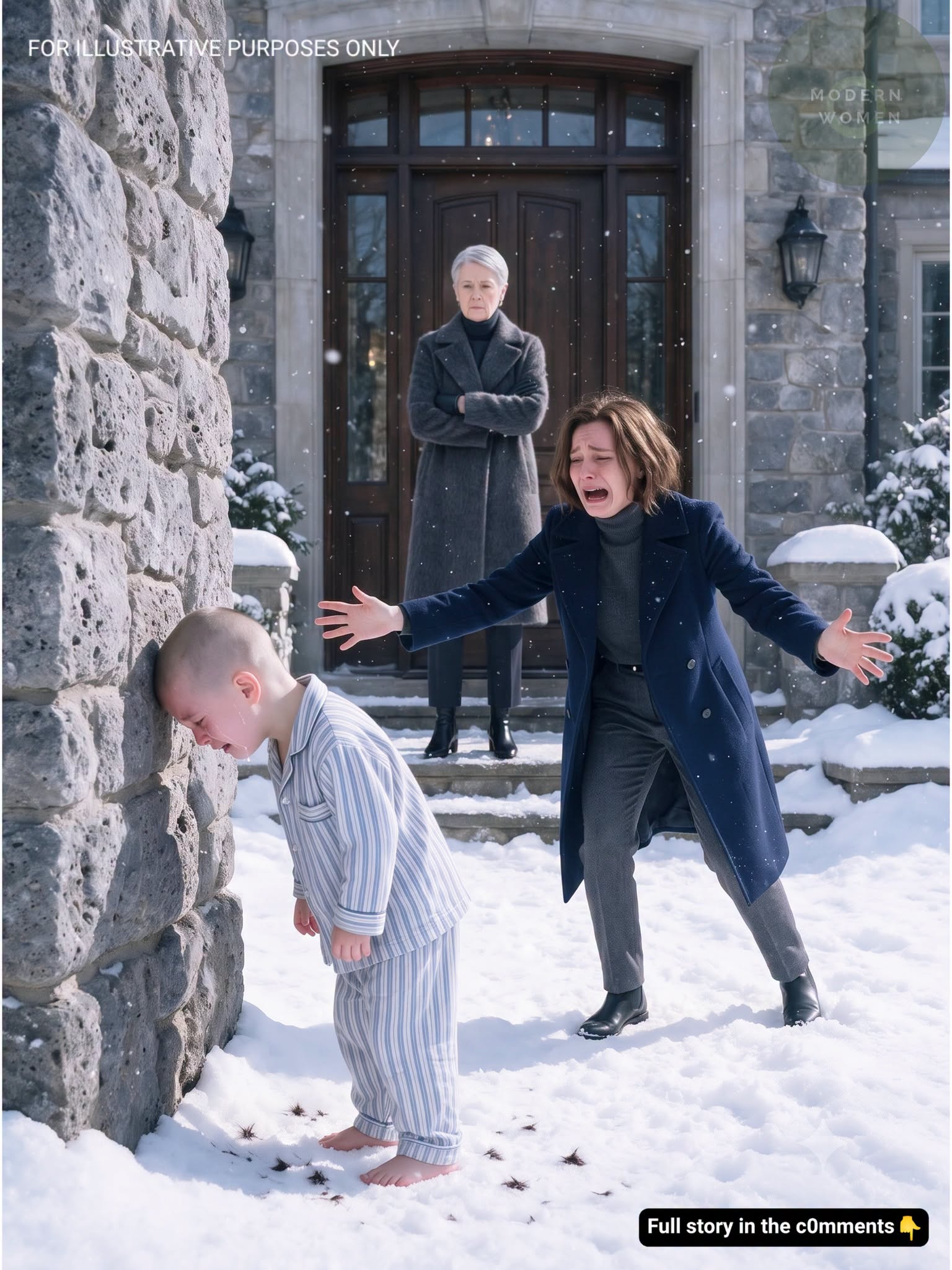
I came home from a business trip expecting my three-year-old daughter to run into my arms.
Instead, I found her standing barefoot on a freezing balcony, her head completely shaved, after my in-laws accused her of stealing a bracelet.
I thought proving her innocence would be enough.
Then an old security camera revealed the truth they had all tried to hide.

PART 1 – THE DAY THEY TRIED TO SHAME MY DAUGHTER
The first thing I noticed when I stepped onto the balcony was not the brutal January wind cutting through my coat.
It was my three-year-old daughter.
Louisa stood barefoot on the frozen concrete, wearing nothing but thin cotton pajamas. Her tiny arms were wrapped around her body, but they did little to stop the violent trembling that shook her from head to toe.
Her soft brown hair was gone.
Her head had been completely shaved.
For one terrible second, I could not move.
I had just returned to Columbus after spending an exhausting week working in Cincinnati. Every evening while I was away, Louisa had called me and reminded me not to forget the little chocolate bears she loved.
“Promise, Mommy?”
“I promise.”
I had pictured her racing down the hallway the moment I walked through the front door. I had imagined dropping my suitcase, kneeling on the floor, and letting her throw herself into my arms.
Instead, she slowly turned toward me with tears frozen against her cheeks.
“Mom…”
Her lower lip trembled.
“I didn’t take it.”
Her voice cracked beneath another sob.
Something inside me broke.
I rushed across the balcony, pulled off my coat, wrapped it around her small body, and lifted her against my chest. Her scalp felt frighteningly cold beneath my palm.
Her heart was beating so fast that I could feel it through her pajamas.
“How long have you been out here?” I whispered.
She only buried her face against my neck.
Before she could answer, my mother-in-law appeared in the doorway.
Lydia calmly dried her hands with a checkered kitchen towel, as though finding a shivering child on a winter balcony was perfectly normal.
“My gold bracelet disappeared this morning,” she said.
Her voice carried no guilt.
No panic.
Not even embarrassment.
“The one my mother left me.”
I stared at her, barely understanding the words.
“What does that have to do with Louisa?”
“She was the only person who went near my bedroom today.”
“My three-year-old daughter?”
I tightened my arms around Louisa.
“She can barely reach your nightstand. She certainly can’t reach the top of your dresser.”
From the living room, my sister-in-law Heather laughed without bothering to get up from the sofa.
“You’d be surprised what children can do when nobody is watching.”
She crossed one leg over the other and glanced toward us.
“Maybe she hid it in her backpack.”
Louisa clung more tightly to my neck.
That was when I realized she was not only crying because they had accused her.
She was crying because the adults around her had made her believe she had committed something unforgivable.
Lydia stepped closer.
“She takes after you.”
The contempt in her voice was unmistakable.
“You came into this family with nothing. Now your daughter steals things that don’t belong to her.”
I looked directly into her eyes.
“Don’t ever call my daughter a thief again.”
Lydia lifted her chin.
“And don’t ever touch her hair again,” I continued. “You had no right.”
Walter, my father-in-law, suddenly pushed his chair away from the dining table.
He crushed his cigarette into the ashtray and walked toward us.
“Lower your voice,” he warned. “You’re standing in my home.”
I refused to step back.
“This is not discipline.”
My voice shook, but I did not lower it.
“This is child abuse.”
The words had barely left my mouth when Walter’s hand struck my face.
The force of the blow sent me stumbling backward into the glass patio door. Pain exploded across my cheek, and the sharp taste of blood filled my mouth.
Louisa screamed.
Not because anyone had hit her again.
Because she had just watched her grandfather hit her mother.
Neither Lydia nor Heather moved.
Neither of them offered to help me.
They simply watched as though violence was the natural price of challenging them.
I slowly pushed myself upright.
And in that moment, something inside me became perfectly still.
The fear disappeared.
So did the urge to argue.
I carried Louisa into the bedroom and closed the door behind us.
My hands trembled as I opened the closet, but my decisions were clear.
I packed our passports.
Birth certificates.
Medical records.
My savings card.
A few changes of clothes.
Louisa’s medication.
Her favorite stuffed rabbit.
Everything that truly mattered fit into one suitcase.
When I rolled it toward the front door, Lydia stepped into my path.
“If you leave tonight,” she said, “don’t expect to come back.”
I looked at her calmly.
“I hope I never have to.”
A taxi was waiting downstairs.
My husband, Elmer, was away on a business trip in Indianapolis. Before climbing into the car, I sent him one message.
Your father hit me. Your mother shaved Louisa’s head because they accused her of stealing.
His reply appeared almost immediately.
Mom is upset. Just go back, apologize, and don’t make this bigger than it is. We’re family.
I stared at the screen until the words blurred.
My daughter had been humiliated and left in the cold.
I had been struck hard enough to split my lip.
And the man who had promised to protect us wanted me to apologize.
That message told me more about my marriage than years of arguments ever had.
I blocked his number.
Late that night, Louisa finally fell asleep in a small motel room with one hand wrapped tightly around my finger.
I sat beside her and gently brushed my fingertips across her freshly shaved head.
Then I remembered something.
Nearly two years earlier, when we briefly hired a nanny, I had installed a small security camera behind a row of old books in the living room.
We had stopped using it long ago.
Everyone had forgotten it was there.
But perhaps it had never stopped recording.
I reached for my phone, reopened the old security application, and waited for the archived footage to load.
At that moment, I believed I was only searching for proof that Louisa had not stolen the bracelet.
I had no idea I was about to uncover a betrayal far darker than a missing piece of jewelry.

PART 2 – THE TRUTH HIDDEN INSIDE THE CAMERA
The security application took several minutes to respond.
The screen flickered, froze, and then slowly revealed the familiar living room.
The gray armchair beside the window.
The hallway leading toward Lydia’s bedroom.
The bookshelf where I had hidden the tiny camera.
My heart pounded as I dragged the timeline backward.
Three days.
Two days.
That morning.
Finally, I stopped at 2:17 in the afternoon.
Lydia picked up her purse and left the apartment to buy groceries. Louisa was asleep in our bedroom beneath her pink blanket.
A few seconds after the front door closed, Heather appeared in the hallway.
She looked toward the kitchen.
Then toward our bedroom.
She waited until she was certain no one was watching.
After that, she walked directly into Lydia’s room.
Five minutes later, she returned holding a gold bracelet.
Lydia’s missing bracelet.
I stopped breathing.
Heather wrapped it carefully inside a handkerchief and slipped it into her leather purse with the practiced ease of someone who had planned the theft in advance.
The person who stole the bracelet had never been my daughter.
It had never even been a mystery.
I continued the recording.
Lydia eventually returned and walked into her room. Seconds later, she rushed back into the living room, shouting that the bracelet was gone.
Heather pretended to be shocked.
She searched beneath cushions.
Opened drawers.
Looked inside cabinets she knew would be empty.
Then she pointed toward our bedroom.
Even through the poor audio, I clearly heard one word.
“Louisa.”
She had chosen her scapegoat before anyone had properly searched the apartment.
Then the footage reached the moment that would stay with me for the rest of my life.
Lydia dragged a kitchen chair into the center of the room.
Heather entered our bedroom and carried Louisa out while my daughter struggled in her arms.
“No!”
“I didn’t take it!”
“I promise!”
Louisa kicked and twisted desperately, but Heather held her tighter.
Lydia forced her onto the chair.
Heather restrained both of her legs while Lydia pinned her shoulders back.
Then my mother-in-law picked up a pair of electric hair clippers.
The buzzing sound filled the speakers.
Louisa screamed.
“I didn’t steal!”
“I didn’t!”
“I want Mommy!”
Again and again, she begged for me.
Every word tore through my chest.
Soft brown hair fell in clumps onto the kitchen floor while Lydia moved the clippers over my daughter’s head.
Heather never tried to stop her.
She simply held Louisa still.
By the time they finished, my daughter had cried herself almost silent.
I paused the video.
Then I played it again.
And once more.
Not because I doubted what I had seen.
Because my mind refused to accept that two adults could deliberately do something so cruel to a terrified three-year-old.
I immediately saved the recording.
Then I saved it again.
I uploaded copies to three separate accounts and sent another copy to myself.
No one would ever erase what they had done.
My next call was to Naomi, my closest friend from college and one of the most respected family attorneys in the city.
The moment she answered, I sent her the footage.
Several minutes passed before she called back.
“Joanna…”
Her voice sounded different.
Colder.
More serious.
“This was not a grandmother losing her temper.”
I closed my eyes.
“This was deliberate,” Naomi continued. “They humiliated your daughter to protect the real thief.”
She ordered me not to return to the apartment.
“Tomorrow, we document your injuries. We document Louisa’s condition. Then we request emergency protective orders and begin criminal proceedings.”
For the first time since I had found Louisa on the balcony, I felt something other than fear.
I felt hope.
The following morning, Naomi met us outside a medical clinic.
Doctors photographed the swelling across my face and treated the cut inside my lip. A pediatric specialist examined Louisa’s scalp while another physician documented her exposure to the freezing weather.
Then a child psychologist invited Louisa into a quiet room filled with toys.
I waited in the hallway.
Every second felt endless.
When the psychologist finally returned, her expression was gentle but deeply troubled.
“She was very brave.”
Then she showed me part of the written evaluation.
When asked why she did not want to go home, Louisa had whispered, “Grandma has the scary machine, and Grandpa hurts people.”
Those words became part of the official report.
My three-year-old daughter had described her own home as a place she feared.
As we left the clinic, my phone began ringing repeatedly.
Unknown numbers.
Again and again.
Eventually, I answered.
It was Elmer.
“You’re destroying this family,” he said.
His voice held frustration, not concern.
I closed my eyes.
“No. Your family destroyed our daughter’s sense of safety.”
“Heather says you’re misunderstanding the video.”
I almost laughed.
“Then she can explain her version to the prosecutor.”
I ended the call.
That afternoon, Naomi sent formal notices to every member of the family.
The demands were clear.
A written apology acknowledging Louisa’s innocence.
Payment for medical treatment and psychological therapy.
Financial restitution.
Protective orders preventing Lydia, Walter, and Heather from contacting us.
And the beginning of divorce proceedings.
Within an hour, my phone was flooded with messages.
Lydia insisted she had acted out of grief and anger.
Walter claimed he had only slapped me once.
Heather argued that she had planned to return the bracelet eventually.
Not one of them apologized to Louisa.
At eight that evening, my cousin Nora published an investigative article describing the case without revealing names or addresses.
She did not encourage harassment.
She did not exaggerate.
She simply told the truth.
Within hours, neighbors, relatives, and coworkers recognized the family anyway.
The silence that had protected them for years finally began to collapse.
Just before midnight, another notification appeared.
It was a voice message from Heather.
She was sobbing uncontrollably.
“I stole the bracelet.”
“I sold it because I needed money.”
“I blamed Louisa because I knew Mom would believe me.”
“Please stop this.”
I forwarded the confession to Naomi.
She called me less than a minute later.
“This changes everything,” she said.
Then her voice became unusually serious.
“There will be a mandatory mediation tomorrow. But while reviewing Elmer’s financial records, I found something much worse than Heather’s theft.”
I tightened my grip on the phone.
“What did you find?”
Naomi took a slow breath.
“Your husband has been secretly moving marital money for years.”
My stomach dropped.
“And once you see where it went,” she added, “you’ll realize your marriage began falling apart long before Walter ever raised his hand.”

PART 3 – THE FAMILY THAT CHOSE LIES OVER A CHILD
The mediation took place the following morning at Naomi’s law office.
Before entering the conference room, I kissed Louisa’s forehead and left her with the child psychologist.
She held her stuffed rabbit against her chest so tightly that its ears were folded beneath her fingers.
That sight reminded me why I could not give in.
Not for my marriage.
Not for appearances.
Not for people who had destroyed her sense of safety and expected silence in return.
Elmer was already seated beside his parents and Heather.
He looked exhausted. Dark circles surrounded his eyes, and his beard had not been trimmed.
For one brief moment, I wondered whether he regretted losing us.
Then I remembered his message telling me to apologize.
Any sympathy disappeared.
Naomi switched on a digital recorder.
“This mediation will be documented in full,” she said. “We will begin with the facts.”
She turned toward Heather.
“Do you admit that you stole your mother’s bracelet?”
Heather’s shoulders shook.
“Yes.”
“Did you sell it to pay personal debts?”
“Yes.”
“Did you knowingly accuse a three-year-old child to hide your theft?”
Heather buried her face in a tissue.
“Yes.”
Naomi continued without hesitation.
“Did you help restrain Louisa while Lydia shaved her head?”
Heather’s crying grew louder.
“Yes.”
The room fell silent.
Naomi turned toward Lydia.
“Do you admit that you forcibly shaved your granddaughter’s head without confirming that she had done anything wrong?”
Lydia stared at the table.
“I believed she took it.”
Naomi’s expression did not change.
“I did not ask what you believed. I asked what you did.”
Lydia lowered her head.
“I shaved her hair.”
Naomi then faced Walter.
“Do you admit striking Joanna while she was holding her daughter?”
Walter crossed his arms.
“It was one slap. She was yelling.”
Naomi calmly opened another folder.
“One act of physical violence is enough to support a criminal investigation, especially when committed in front of a child.”
Walter had no answer.
Elmer finally leaned forward.
“They’ve admitted everything,” he said desperately. “Can’t we settle this privately?”
I looked directly at him.
“Settle what?”
He remained silent.
“My daughter’s nightmares?” I continued. “The fear she feels whenever she hears electric clippers? The message where you told me to apologize after your father hit me?”
Elmer looked away.
Naomi placed another stack of documents onto the table.
“These are financial records from the past four years.”
She slid several highlighted statements toward me.
“For years, Elmer told Joanna that most of his salary was going toward the family mortgage. That was not true.”
My hands went cold as I read the transactions.
Large transfers had left our joint accounts month after month.
The money had not gone toward our mortgage.
It had not been invested.
It had not been saved.
It had gone directly to Heather.
Credit cards.
Loan payments.
Luxury shopping.
Vacations.
Whenever Heather accumulated more debt, Elmer quietly covered it with money that belonged to both of us.
I looked at my husband.
“You knew she was drowning in debt?”
He nodded.
“Yes.”
“You knew she had stolen before?”
Another pause.
“Yes.”
“And when your mother blamed Louisa, you protected them because the truth would expose all of you.”
He closed his eyes.
“I never thought it would go this far.”
“No,” I said. “You just hoped I would never find out.”
For the first time, Lydia looked truly shocked.
“You’ve been giving Heather our family’s money?”
She turned toward Elmer.
“You told me she was managing everything herself.”
Heather began crying again.
“Elmer promised nobody would discover the transfers.”
Walter slammed his fist against the table.
“You lied to all of us!”
Watching them turn against one another brought me no satisfaction.
It only confirmed what I already understood.
They had never protected the innocent.
They protected whoever created the biggest mess, as long as the truth remained hidden.
Naomi presented my settlement conditions.
A written apology signed by every family member, acknowledging that Louisa had never stolen anything.
Full payment for every medical expense and therapy session.
Repayment of all money secretly removed from our joint savings.
Protective orders preventing Lydia, Walter, and Heather from contacting Louisa.
Temporary sole custody for me, with supervised visitation for Elmer.
Then I added the final condition.
“I want a divorce.”
Elmer looked up sharply.
“We can move somewhere else. We never have to see my parents again.”
I slowly shook my head.
“The apartment was never the problem.”
My voice remained calm.
“The problem was that when your daughter needed someone to protect her, you protected everyone except her.”
His eyes filled with tears.
“I made a terrible mistake.”
“No,” I answered quietly. “A mistake is forgetting an anniversary. You saw photographs of my injuries. You knew what happened to Louisa, and you still asked us to apologize.”
No one argued.
Heather signed first.
Lydia signed next, crying the entire time.
Walter refused until Naomi placed the criminal complaint, medical reports, security footage, and Heather’s recorded confession in front of him.
Then he picked up the pen.
Elmer signed last.
He looked at me before writing his name.
I expected to feel anger.
Or triumph.
Instead, I felt only relief.
Over the following months, authorities opened formal investigations into child abuse and domestic violence.
Heather was ordered to repay the value of the bracelet. She later lost her administrative position after additional financial misconduct was uncovered.
Lydia and Walter were required to attend intervention programs while protective measures remained in place.
My divorce moved quickly because the evidence spoke more clearly than any argument ever could.
After the apartment was sold and the stolen marital funds were returned, Louisa and I rented a small, sunlit two-bedroom apartment overlooking a quiet neighborhood park.
On our first night there, she walked slowly through every room.
Then she climbed onto her new bed and looked at me carefully.
“Grandma can’t come here, right?”
I knelt beside her.
“No, sweetheart. She can’t.”
Louisa hesitated.
“Can Grandpa come?”
I gently brushed the soft new hair beginning to grow across her head.
“No. No one can come here unless you feel safe.”
She smiled.
It was the first genuine smile I had seen since my return from Cincinnati.
Her recovery did not happen overnight.
For months, she became frightened whenever she heard electric clippers in a barbershop.
Sometimes she woke from nightmares whispering, “I didn’t take it.”
Her therapist told me not to ask her to forget.
Instead, we reminded her of the truth as many times as she needed to hear it.
She had done nothing wrong.
Her body belonged to her.
No adult had the right to hurt, punish, or humiliate her.
Little by little, her confidence returned.
Her brown curls grew back.
She began laughing again.
Running again.
Trusting again.
About a year later, the divorce became final.
I received primary custody. Elmer’s contact with Louisa remained supervised until he could demonstrate consistent change.
When we left the courthouse, he stopped me on the front steps.
“I don’t expect you to forgive me,” he said.
He looked genuinely broken.
“But I’m sorry I wasn’t the father she needed.”
I studied him for a moment.

“You can’t change what happened,” I said. “But you can decide what kind of father you become from now on.”
He nodded without arguing or making excuses.
It was the first responsible thing I had seen him do in years.
That evening, I took Louisa to the park.
Her curls bounced as she chased soap bubbles across the grass. Suddenly, she stopped beside another little girl whose hair was arranged in long braids.
Louisa turned toward me.
“When my hair gets long again, will you braid it for me?”
Tears filled my eyes.
“Of course I will.”
She thought for a moment.
“But I’ll be the one who decides if anyone cuts it, right?”
I wrapped my arms around her.
“Always.”
That was when I finally understood what justice truly meant.
It was not watching the people who hurt us sign legal documents.
It was not seeing investigations begin.
It was not even winning the divorce.
Real justice was hearing my daughter believe that her voice mattered again.
Because from that day forward, she would never again be forced to apologize for being the innocent child in a room full of guilty adults.