12 Aug The Sentence That Broke What Was Left I had been home from the hospital for exactly seventeen minutes when my mother-in-law looked at my empty arms and called me useless. I was still wearing the gray sweatpants the nurse had helped me pull on that morning. My hospital bracelet was tight around my wrist, and every careful step reminded me that my body had gone through labor even though there was no baby sleeping in the car seat beside us. Our daughter, Grace, had been born at thirty-two weeks. She had ten perfect fingers, Aaron’s chin, and a dusting of dark hair. She never opened her eyes. My mother-in-law, Diane, stood in our living room beside the vase of white lilies she had brought. She didn’t hug me. She didn’t say Grace’s name. Her gaze moved over me as if I were a damaged appliance her son should return. Then she folded her arms and said, “My son’s ex gave him kids. You’re useless.” Aaron stood three feet away. His face went pale. His mouth opened slightly. But he said nothing. That silence finished what Diane’s words had started. I looked at the man who had held my hand through labor and cried into my hair when the nurse carried Grace away. I waited for him to defend his wife and daughter—to say my body was not a machine that had failed. He stared at the floor. Something inside me became very still. “Dad,” I said, calling my father. “Can you come get me?” Then I went upstairs and packed a suitcase. Thirty-Two Weeks Three days earlier, I had been standing in our kitchen in Columbus, Ohio, laughing because Grace kept pushing one foot against my ribs. “She’s going to be a soccer player,” Aaron had said, placing his palm over the hard little bump. By midnight, I knew something was wrong. At the hospital, a technician moved the ultrasound wand across my stomach again and again. The room was too quiet. Finally, a doctor sat beside me and explained that there had been a placental abruption. It had happened quickly. There was nothing I could have done. Nothing I ate, lifted, or did had caused it. It was not punishment, carelessness, or failure. But facts have trouble reaching a heart that has just shattered. I delivered Grace the following afternoon. The nurses wrapped her in a cream blanket and gave us as much time as we needed. Aaron and I took turns holding her. I memorized the curve of her cheeks. I kissed her forehead and told her all the things I had planned to tell her over a lifetime. A nurse named Tasha brought us a small memory box. Inside were Grace’s footprints, a lock of hair, her hospital cap, and photographs I couldn’t yet bear to look at. When we left the hospital, I carried that box against my chest. At home, Diane was waiting. She had always compared me to Aaron’s ex-wife, Melissa. Melissa and Aaron had two children, Noah and Lily, who were ten and eight. I loved them, and they loved me. But to Diane, they were evidence in a competition I had never agreed to enter. Melissa cooked better. Melissa had kept a cleaner house. Melissa had known when to stay quiet. And, most often, Melissa had “given Aaron a family.” Aaron always brushed the comments aside. “That’s just Mom,” he would say. “She doesn’t mean half of what comes out of her mouth.” But that afternoon, she meant every word. I packed without thinking. Jeans, sweaters, underwear, my toothbrush. I left the memory box on the bed because looking at it hurt too much. When my father arrived, he took my suitcase with one hand and wrapped his other arm around me. Aaron followed us to the driveway. “Emma,” he said, his voice breaking. I stopped, but I didn’t turn around. He had already had his chance to speak. For illustrative purposes only What I Found in the Suitcase My parents put me in my old bedroom. Mom made tea I didn’t drink, and Dad sat outside the door until I told him I was okay, though none of us believed it. Around midnight, I opened my suitcase to find a clean shirt. The first thing I saw was Grace’s cream blanket. I froze. The memory box was underneath it, tucked between two sweaters. On top of the box lay a thick envelope with my name written in Aaron’s handwriting. I lifted the blanket and pressed it to my face. It still carried the faint, clean scent of the hospital. Then I opened the box. The cap, photographs, and footprints were all there. Beneath them was a second envelope, yellowed at the corners. Across the front, someone had written: For the woman Aaron loves next. Please don’t let him hide this from you. The letter inside was signed by Melissa. I read it twice. Then a third time. Years before Noah and Lily were born, Melissa had lost a baby at twenty-four weeks. Diane had blamed her. She had said Melissa was weak, careless, and unfit to be a mother. Aaron had stood in the room and remained silent. Melissa wrote that the marriage had never truly recovered. They had gone on to have Noah and Lily, but having living children had not repaired what Aaron’s silence destroyed. Diane continued criticizing, interfering, and turning every disagreement into a test of loyalty. Aaron kept asking Melissa to be patient because confronting his mother felt impossible. Eventually, Melissa stopped asking. When Aaron told her he planned to marry me, she gave him the letter. “I don’t believe Aaron is cruel,” she had written. “But a person doesn’t have to be cruel to let cruelty happen. He thinks silence keeps the peace. It doesn’t. It simply chooses the person who gets hurt.” My hands began to shake. Aaron had kept that letter for three years. His note was shorter. “Emma, I should have told you about Melissa’s loss and about the promise I made after our divorce. I promised myself that if I ever loved someone again, I would never leave her standing alone in front of my mother. Today, in the worst moment of your life, I did exactly that. “Mom tried to throw Grace’s memory box into the trash after you went upstairs. I stopped her. I put it in your suitcase because Grace belongs with you and because I will not let anyone erase our daughter. “I have told Mom to leave. I changed the alarm code and arranged for the locks to be changed tomorrow. I am staying at a hotel. The house is yours for as long as you want it, whether you come back to me or not. “I am not asking you to forgive me. I am telling you the truth because hiding it would be one more act of cowardice. “You were never useless. You gave Grace every beat of her heart. The person who failed you today was me.” I sat on the floor until morning, holding our daughter’s blanket in one hand and Melissa’s letter in the other. I had thought I left because of one terrible sentence. Now I understood that I had walked into a story that began long before me. The Woman Before Me I called Melissa the next afternoon. She answered on the fourth ring. Hearing her voice made the letter real. “I found what you wrote.” There was a long silence. “I’m so sorry about Grace.” She said my daughter’s name without hesitation. That kindness nearly undid me. “Did Aaron tell you to call?” I asked. “No. He told me what happened, but I haven’t spoken to him since. This call is about you.” I asked her why she had never warned me directly. “Because I didn’t want to be the bitter ex-wife interfering in his new marriage,” she said. “And because Aaron convinced me he had changed. For a while, I think he believed it too.” Then she told me the part Diane always left out. Melissa hadn’t “given Aaron kids” easily. She had endured years of loss and fear. When Noah was born, Diane behaved as though her pressure had produced him. After Lily arrived, she used the children to control Melissa’s decisions. “Please don’t let anyone turn my children into weapons against you,” Melissa said. “They love you. This isn’t their burden.” “Do you think Aaron can change?” She exhaled slowly. “Yes,” she said. “But don’t go back because he cries. Don’t go back because he cuts his mother off for a week. If you ever go back, go because his life looks different when nobody is applauding him.” That sentence became my compass. The Truth He Told Everyone For the first week, Aaron texted only once a day. He never asked when I was coming home. He sent practical updates: the funeral home had called; the insurance paperwork was handled; the locks had been changed. He asked permission before making decisions about Grace’s service. On the sixth day, Diane posted a long message in the family group chat. She wrote that she was grieving too. She said I had misunderstood her. Then she claimed I had abandoned Aaron when he needed me most. Before I could decide whether to answer, Aaron did. “Emma did not misunderstand anything,” he wrote. “Mom told my wife she was useless because our daughter died, and I stood there silently. Emma did not abandon me. I abandoned her in that moment. If anyone repeats a different version, they are repeating a lie.” He added that Diane would not attend Grace’s private memorial and would have no contact with me unless I requested it. When an uncle accused him of humiliating his mother, Aaron replied, “The humiliation belongs to the person who caused it.” It was the defense I had needed in our living room. It came too late, but it came. Still, I did not return home. Aaron began therapy and joined a support group for fathers who had lost babies. He also started communicating with Melissa respectfully and directly. Most important, he didn’t perform any of it for me. Some changes I learned about from Melissa; others became clear over time. When Diane appeared at his hotel and demanded he choose between his mother and “that woman,” Aaron didn’t argue for three hours or bargain for peace. He said, “Emma is my wife. Grace is my daughter. Until you can speak about both of them with respect, we have nothing to discuss.” Then he closed the door. For illustrative purposes only The Papers on the Table Six weeks after Grace died, Aaron asked to meet me at my parents’ house. He arrived carrying a folder. My stomach tightened when he placed it on the dining room table. Inside were separation papers signed by him, a complete list of our accounts, and a letter from his attorney confirming he would not fight me over the house. “I don’t want a divorce,” he said. “But I won’t make you stay trapped while I prove I should have been better.” He looked thinner. There were dark circles beneath his eyes. For once, I didn’t rush to comfort him. “Why couldn’t you defend me then?” I asked. His answer was not flattering, and that was how I knew it was honest. “Because I was afraid of her anger, and I thought you were safer to disappoint.” The words landed hard. He continued, “I spent my whole life believing Mom’s explosions were dangerous and everyone else’s pain was manageable. Melissa paid for that. You paid for it. Grace’s memory almost paid for it. I can’t undo what I did.” “No, you can’t.” “I know.” There was no speech about how grief had confused him. No request for credit because he had finally changed the locks. No promise that love alone would fix us. He slid the folder toward me. “Whatever you decide, I will respect it.” I didn’t sign the papers that day. I didn’t tear them up either. Grace’s Room I returned to the house two months later, but not to resume our marriage. Aaron stayed in the hotel while I decided what I wanted. We began counseling together. Some sessions were quiet. In others, I was so angry that my throat hurt afterward. The nursery was the hardest part. The pale green walls had tiny gold stars, and a half-built crib stood near the window. For weeks, I kept the door closed. Then Tasha, the nurse who had cared for us, called. She said the hospital’s bereavement program was running short of memory boxes. Donations had fallen, and more families were leaving with their babies’ bracelets and footprints tucked into ordinary plastic bags. I knew what that small box had meant to me. So I opened the nursery door and decided the room would not become a sealed monument to the future we lost. It would become a place where love could keep moving. My mother helped me pack the first ten boxes. Each contained a soft blanket, a candle, a journal, and a card reminding parents that their child’s life mattered, however brief. Melissa brought Noah and Lily one Saturday. Noah folded tissue paper while Lily tied ribbons and drew tiny gold stars on the cards. Aaron arrived later with more supplies. He stopped in the doorway, unsure whether he was welcome. I handed him a stack of empty boxes. “You can assemble those,” I said. He sat across from me on the floor. We worked for two hours without speaking much. It wasn’t forgiveness. It wasn’t a reunion. But it was the first time our grief felt like something we were carrying together instead of something crushing us separately. By Grace’s first birthday, we had donated 312 memory boxes to hospitals across central Ohio. We called the project Grace’s Arms, because no parent should have to leave a hospital feeling that their child had disappeared without a trace. For illustrative purposes only The Door I Chose to Open Aaron and I lived apart for nine months. During that time, Diane sent cards, flowers, and eventually an apology. For the first time, she did not defend herself. She admitted that she had treated Melissa’s pain and mine as failures because she feared suffering she could not control. I believed she was sorry. I also chose not to resume a relationship with her. Forgiveness, I learned, does not require handing someone the key to your front door. Aaron never pressured me to change that boundary. He spent holidays away from Diane. He corrected relatives when they called the estrangement my decision. He told them it was the consequence of his mother’s behavior and his years of enabling it. Month after month, his life looked different even when nobody was applauding. One evening in early spring, we sat beneath the maple tree in my parents’ backyard. Aaron gave me a new suitcase tag. On one side, it had my name and phone number. On the other were five small words: You never stand alone again. “Is this supposed to be a grand gesture?” I asked. He shook his head. “No. Grand gestures are easy. I just wanted you to have it.” For the first time in months, I smiled at him without forcing it. I moved home three weeks later. Not because the house had changed. Not because Diane had apologized. Not even because I still loved Aaron, though I did. I went back because he had learned that love must have a voice, a spine, and a cost. He had stopped asking the women in his life to absorb pain so he could avoid conflict. We did not return to our old marriage. We built a new one. What Was Really Inside That Suitcase It has been three years since the night I opened that suitcase on my childhood bedroom floor. Grace’s Arms has delivered more than four thousand memory boxes. Melissa serves on our volunteer committee. Noah and Lily still draw gold stars on special cards every year near Grace’s birthday. Aaron keeps Melissa’s old letter in a frame inside his office—not as punishment, but as a reminder that silence is a decision. Diane has respected our distance. Perhaps one day that distance will change. Perhaps it won’t. Healing is not a debt I owe anyone on their preferred schedule. People sometimes hear our story and say Aaron saved our marriage by putting Grace’s box in my suitcase. That isn’t true. The suitcase did not save us. It revealed us. It showed me that my mother-in-law’s cruelty was a pattern, my husband’s silence was not harmless, and I had every right to leave. It forced Aaron to see that private goodness meant nothing if he allowed someone he loved to be destroyed in public. What saved us was everything that came afterward: truth without excuses, boundaries without loopholes, grief without shame, and change repeated so consistently that I no longer had to guess whether it was real. I still have the gray sweatpants I wore home from the hospital. I still have Grace’s cream blanket. Some days, I can hold it and smile. Other days, I press it to my face and cry as if only seventeen minutes have passed. Grief does not move in a straight line. Neither does healing. But I know this now: a woman’s worth is not measured by how many children she bears, how much cruelty she tolerates, or how quietly she suffers to keep a family comfortable. I came home from the hospital with empty arms. I left that house believing I had lost everything. But when I opened my suitcase, I found my daughter’s memory, another woman’s warning, and the truth I needed to choose myself. And that truth changed all of our lives.

For illustrative purposes only

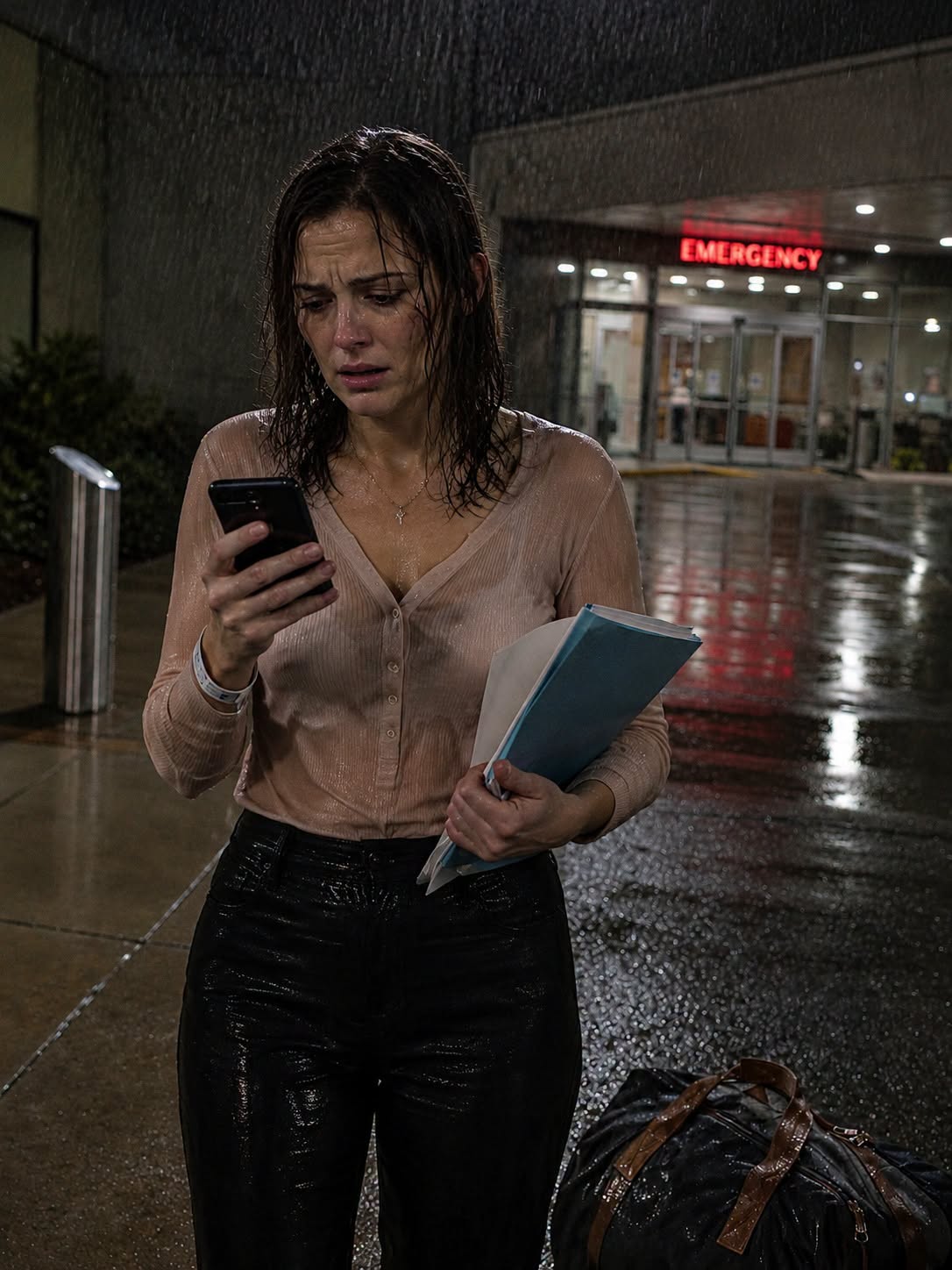
My husband promised he would pick me up after the ER discharged me.

I believed him because that was what husbands did. They showed up when their wives were sick. They waited outside hospital doors. They drove them home, helped them get comfortable, and made sure they were okay.

Instead, when I stepped into the hospital pickup lane, still weak and dizzy after seven hours in the emergency room, I found a message waiting on my phone.

He had already left.

He was on his way to his parents’ anniversary trip.

And he told me to call a ride.

At first, I tried to convince myself there had to be an explanation. Maybe something urgent happened. Maybe his parents needed him. Maybe he misunderstood what I needed.

I might have believed that.

Until his sister messaged me before I even made it home.

Kara’s message arrived while my rideshare was still pulling away from St. Vincent’s Hospital.

Thanks for being cool about Caleb coming. Mom was already upset he might miss the anniversary weekend.

I stared at the words on my screen.

Then I read them again.

And again.

Because somehow, that message hurt more than the hospital bracelet still wrapped around my wrist.

I typed back slowly.

I didn’t tell him to go.

The typing bubble appeared almost immediately.

Then disappeared.

Then appeared again.

Wait. What?

I didn’t respond right away.

The driver’s air conditioning was freezing, and every turn made my stomach twist. The ER doctor had told me the worst of the dizziness was probably caused by dehydration after a stomach virus. I needed rest, plenty of fluids, and a follow-up with my primary doctor if I didn’t improve.

Nothing dramatic.

Nothing life-threatening.

But I had still spent seven hours under harsh fluorescent lights, vomiting into a plastic basin, struggling every time I tried to stand.

Caleb knew exactly how sick I had been.

At 11:40 that morning, while I was waiting for test results, he had texted me:

Still here. I’ll get you as soon as they discharge you.

At 12:26:

Mom keeps asking when we’re leaving. Don’t worry about it.

At 1:18:

They’re really taking forever.

Then at 2:07, right after the nurse handed me my discharge papers, he sent the message that changed everything.

I’m sorry. If I don’t leave now I’ll miss dinner tonight. You’re cleared to go home, so can you grab an Uber? I already headed north.

I called him immediately.

No answer.

I called again.

A few seconds later, my phone lit up.

Driving. We’ll talk later.

That was it.

No apology.

No explanation.

No “Are you okay?”

No “I’m sorry I’m not there.”

So I sat alone on a bench outside the hospital entrance with a paper bag containing two electrolyte drinks, my discharge papers, and a blue hospital wristband I had forgotten to remove.

That was the moment I realized something I didn’t want to admit.

Caleb hadn’t been forced to choose between me and his family.

He had already chosen.

His parents’ fortieth anniversary trip was supposed to be a huge event.

His mother, Pamela, had planned it for months. She rented a cabin in northern Michigan, arranged a catered dinner, scheduled family photos, and booked a boat rental for Sunday morning if the weather was good.

All three adult children were expected to be there.

And I was supposed to be there too.

Actually, I had done everything possible to make sure it happened.

I found the cabin.

I compared catering prices.

I made the Friday dinner reservation because Pamela hated calling restaurants.

I ordered the anniversary cake.

Two days before the trip, I packed a cooler with breakfast groceries because Caleb’s older brother had forgotten food on their previous family vacation.

I wanted to go.

That part mattered.

This wasn’t a story about a wife who hated her husband’s family and was angry because he went without her.

I had been looking forward to that weekend.

Thursday night, when I was sitting on the bathroom floor fighting nausea, Caleb had crouched beside me.

“If you’re still like this tomorrow, we’ll stay home,” he said.

I looked at him and nodded.

“I hope we don’t have to.”

Friday morning, I tried walking from the bedroom to the kitchen and almost collapsed.

That was when Caleb drove me to the ER.

Before leaving, I pointed toward the two weekend bags sitting beside our bedroom door.

“If they send me home early enough, we can still go.”

He kissed my forehead.

“I’ll grab everything when I come back for you.”

I believed him.

That was our plan.

Until 2:07.

When the rideshare finally dropped me home, I immediately noticed something.

My bag was still sitting beside the bedroom door.

Caleb’s bag was gone.

The cooler was gone too.

I stood in the kitchen staring at the empty space where it had been.

He had come home.

He had walked past my packed bag.

He had taken the groceries I bought for his family.

Then he had driven north without me.

My phone buzzed.

Kara again.

I’m calling you.

For a second, I almost ignored it.

Then I answered.

“Leah?”

“Yeah.”

“You really didn’t tell him to come?”

“No.”

There was silence.

“That’s not what he told Mom.”

I sat down at the kitchen table.

“What did he tell her?”

Kara lowered her voice.

“He said you were being discharged and told him not to ruin the weekend.”

My chest tightened.

“I never said that.”

“Oh.”

For illustrative purposes only

That single word told me she believed me.

Kara wasn’t cruel. She wasn’t the type to attack people without hearing the truth.

The problem with Caleb’s family was more complicated.

Pamela had spent years making disappointment feel like a crisis.

If someone missed Thanksgiving, she wanted an explanation.

If someone couldn’t attend a birthday dinner, she wanted to know why.

If a grandchild had a Saturday activity, she questioned why it couldn’t be moved.

Caleb had spent his entire life trying to prevent his mother from being upset.

And for eleven years, I had helped him do it.

“Did she pressure him?” I asked.

Kara sighed.

“She kept saying Dad would notice if one of us wasn’t there. Caleb told her he might have to stay with you. Mom said, ‘She’s at a hospital, not stranded on the highway. They won’t send her home if she can’t manage.’”

I closed my eyes.

Kara continued.

“I’m not saying what he did was okay.”

“Did he tell her I agreed?”

“Yes.”

“When?”

“Before lunch.”

Before lunch.

That was the part I couldn’t stop thinking about.

While I was still sitting in the hospital waiting for fluids, Caleb had already decided that if I was discharged, he was leaving.

His later text wasn’t a last-minute choice.

It was simply the first time he informed me about a decision he had already made.

When I got off the phone, I carried my bag into the bedroom.

I changed into an old T-shirt, drank half of the electrolyte drink, and climbed into bed.

At 5:43 p.m., Caleb finally called.

His name appeared on my screen.

I watched it.

Then it disappeared.

Ten minutes later, he called again.

This time, I answered.

“Hey,” he said carefully. “How are you feeling?”

“Did you tell your family I told you to go?”

Silence.

Only a few seconds.

But enough.

“Leah…”

“Did you?”

He sighed.

“Yes.”

I looked toward the doorway.

My tan weekend bag was still sitting there.

“Why?”

“Because Mom was already turning it into a whole thing. I didn’t want everyone spending the weekend angry at you.”

“So you lied about me to make things easier.”

“I was trying to keep the peace.”

“With them.”

“That’s not fair.”

“Where are you?”

“About twenty minutes from the cabin.”

He had been driving for almost four hours.

Four hours where he could have turned around.

Four hours where he could have admitted what happened.

Four hours where he could have chosen differently.

Instead, he kept going.

“Go enjoy the weekend,” I said.

“Leah, don’t do that.”

“I’m tired. I need to sleep.”

“We’ll talk Sunday.”

I ended the call.

Then I noticed something sticking out of the side pocket of my weekend bag.

A folded sheet of paper.

It was the cabin schedule Pamela had emailed earlier that week.

Caleb had printed two copies.

Friday dinner.

Saturday breakfast.

Family photos.

Boat rental.

Then I saw something written beside Friday afternoon.

A note in Caleb’s handwriting.

If Leah is still sick, leave by 1:30 alone.

I stared at it.

He had written that before we ever went to the hospital.

Before anyone knew what the doctor would say.

He already had an exit plan.

And I was never part of the conversation.

The next morning, I photographed the note and sent it to him.

He called within a minute.

“I wrote that last night,” he said.

“I know.”

“I was just trying to have a backup plan.”

“A backup plan you never told me about.”

“I didn’t know what the hospital was going to say.”

“Neither did I. That was why you were supposed to wait.”

Silence.

Then he finally said the thing that explained everything.

“I knew Mom would make the whole weekend miserable if I canceled. I thought if the doctor sent you home, that meant you were okay enough to be there without me.”

There it was.

Not hatred.

Not intentional cruelty.

A decision.

He had decided that because a doctor allowed me to leave the ER, I no longer needed my husband beside me.

I told him I needed sleep and turned my phone on silent.

Saturday morning, I woke after nine and saw six messages in the family group chat.

Pamela wanted confirmation about the cake.

Caleb’s brother needed the boat rental address.

Someone had forgotten coffee filters.

Normally, I would have answered.

Normally, I would have fixed everything.

Instead, I wrote:

Everything I booked is in the shared trip folder. I’m recovering at home, so please handle the rest without me.

Pamela replied almost immediately.

Of course. We just don’t want Caleb stressed on his parents’ anniversary weekend.

I stared at that message.

Then I put my phone down.

For the first time in years, I refused to step in and make everything easier.

That evening, Caleb called again.

He sounded different.

Less defensive.

He told me dinner had been uncomfortable after Kara told him she knew the truth.

“Mom thinks this is between us,” he said.

“It is.”

“But she keeps saying you would have wanted me to come if you were thinking clearly.”

I laughed quietly.

“Caleb, listen to what you just said.”

He went silent.

I told him the hospital wasn’t the only problem.

The bigger problem was that he had replaced my answer with the answer that protected him from disappointing his mother.

“I’ve spent eleven years helping you avoid Pamela being upset,” I said.

“What does that mean?”

“It means your family plans are yours now. Reservations, gifts, groceries, schedules. All of it. I’m not the person who absorbs everyone’s disappointment anymore.”

He said, “Okay.”

But I knew he didn’t fully understand yet.

Sunday morning, he texted that they were leaving after breakfast and he would be home by two.

I looked at my discharge papers.

I looked at the weekend bag I had never unpacked.

Then I replied:

Don’t come home today. Stay with your brother tonight.

His answer came immediately.

Leah, seriously?

Yes.

I need a few days where I’m not responsible for making this easier for you too.

The typing bubble appeared.

Stopped.

Started again.

Finally:

Okay.

For illustrative purposes only

That was the first time all weekend he accepted my answer without trying to replace it with something more convenient.

Caleb stayed with his brother Sunday night.

Monday, he texted:

Can I come by after work tomorrow?

I said yes.

Tuesday evening, he arrived at 6:15 carrying the small insulated pharmacy bag containing the medication my doctor prescribed.

No flowers.

No dramatic apology.

I was grateful.

Flowers would have made it feel like the problem could disappear with one gesture.

He placed the bag on the counter.

“Can I sit down?”

I nodded.

After a moment, he said:

“I told my family the truth.”

I looked at him.

“What truth?”

“That you never told me to go. That I chose to leave and told everyone you were okay with it because I didn’t want Mom angry.”

For the first time, he wasn’t hiding behind excuses.

He admitted what happened.

That mattered.

We spent the next few months rebuilding.

Not with promises.

With actions.

Caleb started managing his own family responsibilities.

He arranged his mother’s birthday dinner.

He bought gifts without asking me what to choose.

When his brother planned another trip, Caleb answered for himself and stopped assuming I would organize everything.

I stopped reminding him.

And I learned something too.

I had spent years volunteering to make everything smooth, then becoming angry that nobody noticed the effort.

That was something I needed to change.

The biggest test came when Pamela messaged the family group.

Since Leah already knows everyone’s food preferences, can she handle Thanksgiving reservations this year?

Before I could answer, Caleb replied.

Mom, I’ll handle the reservation. Leah isn’t coordinating family events anymore.

Pamela responded:

I was only asking.

Caleb wrote:

I know. I’m answering.

And that was it.

No explosion.

No argument.

No family disaster.

The world kept turning.

Months later, Pamela finally called me herself.

Not to ask if Caleb was coming somewhere.

Not to ask me to organize something.

She simply asked:

“Would you like to have lunch with me?”

It was awkward.

She never gave the perfect apology I imagined.

But while we cleared the plates, she said:

“I should not have pushed him about that weekend.”

I looked at her.

“No. You shouldn’t have.”

She nodded.

And that was enough.

Six months after the ER visit, I had another appointment at the same medical complex.

Nothing urgent.

The night before, Caleb asked:

“Do you want me to drive you, or would you rather go alone?”

That question meant more than he probably realized.

“I want you to drive me.”

“Okay.”

The next morning, he cleared his schedule.

When we arrived, his phone buzzed.

Pamela’s name appeared.

He looked at it.

Then silenced the call and put the phone away.

“You can answer,” I said.

“I will later.”

And he stayed beside me.

After the appointment, we walked through the same glass doors where I had stood alone months earlier.

The same pickup lane.

The same hospital entrance.

The same place where I once held my discharge papers and wondered if my marriage mattered less than a weekend trip.

This time, Caleb opened the passenger door for me.

No speech.

No grand gesture.

Just a simple choice.

On the drive home, he asked:

“What do you want for dinner?”

“Soup.”

He smiled.

“Soup it is.”

And he turned toward the grocery store.

That was the difference.

Not the words.

The choice.

The day he left me at the hospital, he chose the easier path.

The day he came back, he finally understood that loving someone means choosing them even when choosing them is inconvenient.

And sometimes, the moment that breaks a marriage is also the moment that reveals exactly what needs to be rebuilt.