
Aug
Part 1 — The Silver Box
Three weeks after I delivered triplets, I had just slept for exactly forty-seven minutes when my mother-in-law rang the doorbell.
One baby was against my chest.
One had finally stopped crying in the bassinet.
The third had spit up on the only clean cardigan I could find.
There were eight bottles lined up beside the sink, twenty-six diapers in the pail, and a cup of coffee in the microwave that I had reheated three times without taking a single sip.
My body still did not feel like mine.
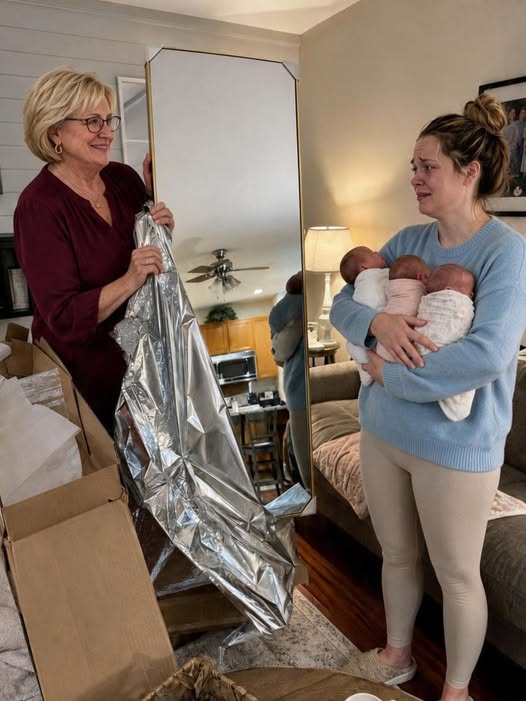
And then Patricia walked into my living room, looked me up and down, and handed me a full-length mirror so I could “get my figure back for her son.”
For one awful second, I wondered whether my husband secretly agreed with her.
Then Daniel disappeared down the hallway and returned carrying something from his mother’s own past.
The moment she saw it, every trace of satisfaction vanished from her face.
Our triplets—Nora, Miles, and Jamie—had come five weeks early. After nine days of hospital monitoring, they were home but still tiny enough that I checked their breathing whenever the house became quiet.
Daniel and I tracked every bottle, diaper, and vitamin drop in a spiral notebook because neither of us trusted our memory. At 6:17 that morning, I had fallen asleep halfway through writing Jamie’s name. Daniel lifted him from my chest, brought me water, and washed twelve burp cloths without complaint.
Still, exhaustion can make old insecurities sound like facts.
Nothing fit except maternity leggings and two oversized cardigans. I avoided my reflection even though Daniel reminded me that I had carried three babies and owed no one a quick recovery.
Patricia had postponed her first visit because of a cold. When she arrived, she carried a box nearly as tall as our kitchen table, wrapped in shiny silver paper with an enormous white bow.
“This is for you,” she announced.
For a moment, I was genuinely touched.
Everyone else had brought things for the babies, so I liked the idea that Patricia had remembered I was still a person too.
Daniel steadied the box while I untied the ribbon.
Underneath the paper was a full-length mirror with a white wooden frame.
I stared at it, confused.
“It’s…very large,” I said.
Patricia smiled as if she had selected the perfect gift.
“Put it somewhere you’ll see yourself every morning.”
“Why?”
Her eyes moved slowly from my face to my stomach.
“So you’ll be motivated to get back in shape faster for my son.”
The room went silent except for the soft hiss of the bottle warmer in the kitchen.
At first, I thought she must be joking.
Then she glanced directly at the hand I had placed over my middle.
“You have three children now, Penny, but you’re still a wife,” she said. “Daniel shouldn’t have to feel embarrassed standing next to you.”
Heat rushed into my face. Without thinking, I pulled my cardigan closed.
Patricia gave a little laugh.
“Oh, don’t be so sensitive. Sometimes women need a push.”
I could not look at Daniel. Three weeks of broken sleep made me wonder if he had complained to her and secretly shared her embarrassment.
Then I heard him laugh softly.
Patricia’s expression turned triumphant.
“See?” she said. “At least my son understands.”
My stomach dropped.
But when I finally looked at Daniel, he was not laughing at me.
He was staring straight at his mother in disbelief.
“You know what, Mom?” he said calmly. “Your timing couldn’t be better.”
Patricia frowned. “What are you talking about?”
“I actually have something for you too.”
Her eyebrows rose. “You bought me a present?”
“You could call it that.”
He disappeared down the hallway.
I stood beside that awful mirror, blinking back tears.
About a minute later, Daniel returned.
He was carrying an old avocado-green bathroom scale.
Its vinyl was cracked, and faded writing showed beneath a strip of yellowed tape.
Patricia saw the scale and took one full step backward.
“What the hell is that?” she whispered.
Daniel walked toward her and held it out.
“Since we’re apparently giving each other things we desperately need today, Mom…”
He paused.
“This one’s for you.”
Patricia did not take it.
She stared at the ugly green scale as if it had spoken her name. Her hands were shaking.
Part 2 — The Words Underneath
“Where did you get that?” Patricia asked.
Her voice no longer held a trace of amusement.
Five weeks earlier, a pipe had leaked in Patricia’s basement. Daniel had rescued six boxes, including one labeled DANIEL—BABY YEARS. Four still sat in our garage because the triplets arrived the following morning.
“I was drying the contents when I found this,” he said.
He turned the scale over and pointed to the masking tape.
The handwriting was faded, but I could still read it.
For Patricia. A little motivation after the baby. Love, Evelyn.
Beneath that was a date from thirty-four years earlier—twenty-two days after Daniel had been born.
Evelyn had been Patricia’s mother-in-law—a woman Daniel said could make a compliment feel like a parking ticket.
Patricia folded her arms.
“That is none of Penny’s business.”
“The scale isn’t,” Daniel replied. “This is.”
From his back pocket, he removed a cream-colored envelope. The paper had softened with age, and one corner bore a pale water stain.
Across the front, in Patricia’s handwriting, were seven words:
For Daniel, when he has a family.
Patricia closed her eyes as if trying to hold a door shut against a memory.
“Don’t,” she said.
“It was addressed to me,” Daniel replied. “Do you remember what you wrote?”
“I was young.”
Daniel unfolded the letter and read four lines.
“If you ever become a father, protect the mother of your child from words that make her feel small. A new mother needs food, rest, and kindness—not a scale. If I ever forget that, show me this letter. No woman should have to earn tenderness by becoming smaller.”
No one moved. The mirror and scale stood twenty feet apart, separated by thirty-four years, carrying the same message.
You are not enough as you are.
Patricia took the letter and read it silently. The color drained from her face.
For one hopeful moment, I thought she would apologize.
Instead, she folded the letter with sharp, careful movements.
“You have no idea why I gave Penny that mirror,” she said.
Daniel set the scale on the rug.
“Then explain it.”
Patricia looked at me, eyes bright and jaw tight.
“I was trying to save your marriage.”
What came next revealed a family wound Daniel had never told me about.

Part 3 — What Patricia Had Been Taught
“Your father didn’t leave all at once,” Patricia said to Daniel.
She was still holding the old letter.
“First he stopped coming home for dinner. Then he started criticizing everything—my hair, my clothes, the way I looked after a long day. Your grandmother told me I was lucky he was honest. She said a wife who let herself go should not be surprised when her husband looked elsewhere.”
Daniel’s face hardened, but Patricia kept speaking.
“So I tried. I weighed myself every morning. I skipped meals. I spent money we didn’t have on clothes I didn’t even like. And he left anyway.”
Daniel’s father had moved out when he was nine—too young for Daniel to know this part.
Patricia pressed the folded letter to her chest.
“Afterward, Evelyn told me I should have tried harder. For years, I believed her. I promised myself my son would never go through a broken home because his wife stopped making an effort.”
It was not an excuse, but it was an explanation. Patricia had been handed cruelty, taught to call it guidance, and wrapped the same cruelty in silver paper thirty-four years later.
Daniel stepped closer to her.
“Dad did not leave because you failed to lose weight.”
“You don’t know that.”
“I know he made his own choices. I know you could have lived on lettuce and run ten miles a day, and it still would not have made him loyal or kind.”
Patricia’s mouth tightened.
Daniel glanced at me before continuing.
“Penny does not exist to protect me from embarrassment. She carried our three children, spent nine days going back and forth to the hospital, and still remembers which baby needs an extra half ounce after sleeping seventy-three minutes.”
His voice broke slightly on the last sentence.
“There is nothing about her that embarrasses me.”
I had not expected to hear that he saw all the invisible work I was doing.
Patricia looked toward the mirror.
“I only meant—”
“No,” Daniel said. “You meant exactly what you said.”
Then he stopped speaking for me and looked at me.
“Penny, do you want her to stay?”
The question surprised me.
I had spent six years smoothing things over when Patricia criticized our furniture or called my library job “a sweet little hobby.”
But I looked at Nora asleep in the bassinet and imagined her growing up, watching me accept words that made me fold inward.
“No,” I said.
My voice shook, so I tried again.
“I need you to leave today, Patricia.”
She stared at me.
“Over a mirror?”
“Not over a mirror. Over what you wanted it to make me feel.”
“You hurt me in my own home when I am more exhausted and vulnerable than I have ever been. You made me wonder, even for a few seconds, whether my husband was ashamed of me. I won’t pretend that was helpful.”
Patricia looked at Daniel, apparently waiting for him to soften my words.
He did not.
“Before you see Penny or the babies again,” he said, “you need to understand three things. No comments about her body. No marriage advice we didn’t ask for. And no gifts with hidden insults.”
“You’re keeping my grandchildren from me?”
“We’re protecting the atmosphere in our home. What happens next is up to you.”
Then Patricia slipped the old letter into her handbag, walked to the door, and left without touching the scale—or the mirror.
Daniel locked the door behind her.
I stared at the white frame reflecting all six feet of the silence she had left behind.
I did not know whether we had just ended our relationship with Patricia.
Or whether, for the first time, we had finally made an honest one possible.
Part 4 — The Question I Asked at 2:13 A.M.
Daniel turned the mirror toward the garage wall, then sat beside me.
“I am so sorry,” he said.
“You didn’t give it to me.”
“I should have stopped her sooner. There were smaller comments before this.”
There had been. We both knew it.
That afternoon, three babies needed feeding, two loads of laundry needed folding, and one insurance form was due by five. At 8:40, we ate lukewarm lasagna over the sink.
At 2:13 in the morning, while the babies slept for the rare and glorious stretch of eighteen consecutive minutes, I finally asked the question that had been circling my mind.
“When you laughed, before you went down the hall…why did you laugh?”
Daniel looked wounded.
“Because I couldn’t believe she had done the exact thing she wrote that letter about.”
“Not because you agreed with her?”
He took my hand.
“Penny, look at me.”
I did.
“I don’t love you despite what your body looks like after carrying our children. I love you. There is no second half to that sentence.”
That was when I finally cried, and Daniel stayed beside me until it passed.
The next ten days were quiet.
Patricia did not call, text, or ask relatives to intervene. The silence gave me room to be angry, sad, then angry again.
Daniel sent her one message: We love you. The boundary stands. Contact us when you’re ready to take responsibility for what happened.
There was no reply.
On the eleventh morning, at 7:06, my phone lit up while I was measuring formula.
It was Patricia.
Her message contained only three sentences.
I read my letter twelve times. I understand why you asked me to leave. May I come back—not to see the babies, but to apologize to you?
I showed Daniel.
“What do you want to do?” he asked—not What should we do? or She’s my mother.
I looked at the three bassinets lined up beside our bedroom wall.
Then I typed a reply.
Tomorrow. Four o’clock. Just you, me, and Daniel.
Patricia answered immediately.
I will be there.
The following afternoon, she arrived seven minutes early carrying no silver paper, no bow, and no advice.
She carried only a photograph and a brown grocery bag.

Part 5 — The Photograph
Patricia stopped just inside the doorway.
“May I come in?” she asked.
It was the first time I remembered her asking permission to enter our space.
I nodded.
We sat at the kitchen table with the monitor between us. Patricia placed the photograph face down.
“Penny,” she began, “what I said to you was cruel. It was not concern. It was not motivation. I wanted you to feel ashamed because, somewhere along the way, I started believing shame kept women safe.”
She took a breath.
“I was wrong.”
I waited for the word but.
It did not come.
“You had been home with three newborns for twelve days,” she continued. “I walked into the place where you should feel safest and made you question your body and your marriage. Then I called you sensitive when you were hurt. I am sorry.”
Her voice trembled, but she kept her eyes on mine.
“You do not have to forgive me today. I only needed to say it without asking you to make me feel better.”
Daniel reached beneath the table and squeezed my hand.
Patricia turned over the photograph.
It showed a young Patricia in a narrow kitchen, baby Daniel against her shoulder, hair unwashed, and a bowl of cold oatmeal on the counter.
Behind her, partly hidden by a chair, was the avocado-green scale.
“Your father took this the morning after Evelyn brought the scale,” she told Daniel. “I pulled it from my album last night. Back then, I felt hideous. Now all I see is a twenty-six-year-old who had not slept in weeks.”
She touched the edge of the picture.
“I wanted someone to look at that girl and tell her she was doing well. No one did.”
Then she looked at me.
“Yesterday, I realized I had become the person I spent half my life resenting.”
Her honesty did not erase my anger, but it made space beside it for understanding.
“Why did you keep the scale?” I asked.
“At first, because I used it every day. Later, throwing it away felt like admitting its power. I wrote the letter after your father found me crying in the pantry. Then he left, and Evelyn’s voice became louder than my own.”
She slid the photograph toward me.
“That explains my behavior. It does not excuse it.”
Then she finally opened the grocery bag.
Inside were three labeled containers: chicken soup, baked oatmeal, and vegetable pasta.
“I remembered what my letter said a new mother actually needs,” she said. “Food, rest, and kindness.”
I almost smiled, but I was not ready yet.
Patricia folded her hands.
“I would like the chance to do better. I know a promise is not proof. Tell me what rebuilding trust would look like to you.”
The question put the work where it belonged—with her. Daniel gave the smallest nod.
“I have one condition,” I said.
Patricia straightened in her chair.
And it was not the condition she expected.
Part 6 — What Rebuilding Looked Like
“Don’t try to impress me,” I said. “Help us.”
Patricia blinked.
“I don’t understand.”
“No grand gestures. Show up when invited. Wash bottles. Fold towels. Hold a baby while I shower. And ask before giving advice.”
She nodded slowly.
“I can do that.”
“Also, my body is not a family discussion. Not now. Not when the babies are one. Not ever.”
“Understood.”
Daniel added, “And if it happens again, the visit ends.”
Patricia swallowed. “Understood.”
We did not hug when she left. I thanked her for the food, and she asked if she could take the mirror and scale away.
“Please,” I said.
She carried both to her car herself.
Trust did not return in one emotional afternoon. It came back in small, almost boring pieces.
The next Tuesday, Patricia arrived at 1:00 p.m. because that was the time we had agreed on. She brought no gift. She washed fourteen bottles, matched twenty-one tiny socks, and left at 3:00 without waking a sleeping baby to say goodbye.
The following week, she texted from the grocery store: Do you need milk or diapers? Advice is not on sale, so I won’t bring any.
That time, I did smile.
Some visits were awkward. Once she began a sentence with, “When Daniel was a baby, I always—” then stopped herself and asked, “Do you want a suggestion, or do you just want me to listen?”
“Just listen,” I said.
So she did.
She never asked me to reassure her or turned her apology into a performance. She kept doing the unglamorous work.
By three months, Patricia knew Nora chirped upon waking, Miles grunted, and Jamie released one dramatic sigh. Trust returned not in a dramatic rush, but through recognition and repetition.
Six months after the mirror incident, we attended Aunt Margaret’s Thanksgiving dinner. I wore dark jeans, a soft green sweater, and comfortable boots.
For once, I had left the house without changing clothes four times.
I was placing Jamie’s carrier near the dining room wall when Aunt Margaret looked me over.
“Three babies and still carrying some of that pregnancy weight, huh?” she said with a laugh. “You’d better be careful, or it may decide to stay.”
The old heat climbed into my face.
Before I could answer, Patricia set down the bowl she was holding.
“Margaret,” she said, “we do not discuss a woman’s body in this family.”
The room became quiet.
Aunt Margaret raised her eyebrows. “I was only trying to help.”
Patricia held her gaze.
“Then bring her a plate or hold a baby. Shame is not help.”
Daniel looked at his mother.
So did I.
Patricia did not look around for approval. She picked up the bowl and asked if I wanted sweet potatoes.
That was the moment I knew her change was real.
But the mirror still had one final part to play in our story.

Part 7 — What I Finally Saw
In January, Patricia called and asked if she could stop by for five minutes.
She arrived carrying the cream-colored letter Daniel had found in the basement box.
“I added something,” she said.
At the bottom of the page, beneath the words she had written at twenty-six, she had added a paragraph in fresh blue ink.
I did forget. My son reminded me, and my daughter-in-law gave me the chance to remember through my actions. If Nora, Miles, or Jamie reads this one day, let them know that love is not proved by making someone smaller. Love makes room.
She handed the letter to Daniel.
“It was written for you,” she said. “You should keep it.”
“What happened to the scale?” he asked.
“I threw it away.”
“And the mirror?”
Patricia hesitated.
“It’s in my guest room, facing the wall. I didn’t know what to do with it.”
To my own surprise, I asked her to bring it back.
Daniel looked at me carefully. “Are you sure?”
“Yes.”
Daniel anchored it securely near our closet—not so I could measure myself against old jeans.
I wanted the mirror to mean something different.
The first morning, I held Nora while Miles sat in a bouncer and Jamie kicked on a blanket. My elastic was crooked, my T-shirt stained, and my cardigan did not close.
For several seconds, the old instinct told me to look away.
I did not.
I saw arms that could hold two babies, tired eyes that knew three cries in the dark, and a body recovering on its own timetable.
Most of all, I saw a woman who had finally said, “No, you may not speak to me that way,” and discovered that setting a boundary did not destroy a family.
It gave the family a chance to become healthier.
Now the triplets are fourteen months old. Patricia still comes most Tuesdays, brings soup more often than presents, and asks before offering advice.
The letter is in a new frame on our bookshelf, beside the photograph of twenty-six-year-old Patricia holding baby Daniel.
The full-length mirror remains near our closet.
Some mornings I stop. The woman staring back is not who I was before the triplets, and that is no longer a problem to solve.
One recent Tuesday, I caught Patricia standing in front of it with Nora on her hip. She was making silly faces, and Nora was laughing so hard that both of them had tears in their eyes.
Patricia saw me in the reflection and grew quiet.
“I’m sorry for what I wanted this mirror to do to you,” she said.
I stood beside her, and for a moment the glass held three generations.
“It doesn’t do that anymore,” I replied.
And it didn’t.
The mirror Patricia had given me to make me feel smaller had become the place where I could finally see how much room love had made for all of us.