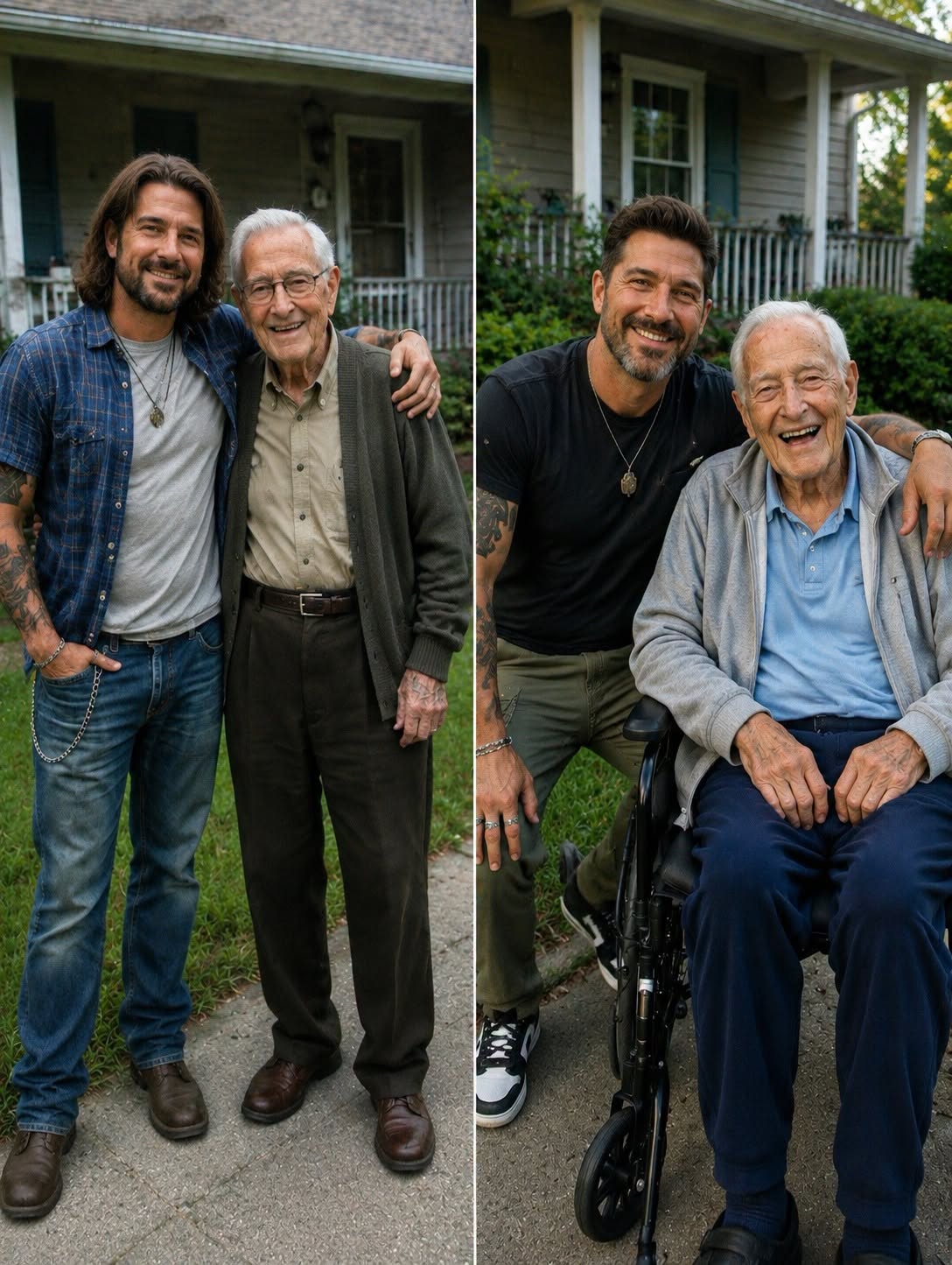

Some people change your life with grand gestures.
Others do it with a cup of coffee on an ordinary Sunday morning.
For twelve years, I believed I was simply helping an elderly neighbor who had no one else. I never expected those quiet weekly visits to become the most meaningful relationship of my adult life. And I certainly never imagined that after he was gone, he would leave me something that would shake me to my core.
Looking back now, everything began on the most forgettable Sunday imaginable.
I was twenty-eight years old, standing at the edge of my driveway with a recycling bin in one hand, watching early autumn leaves drift across our peaceful suburban street. The neighborhood was unusually quiet, the kind of silence that only exists before families wake up and begin mowing lawns or washing cars.
Nothing about that morning suggested it would become one of the most important days of my life.
My next-door neighbor, Ezra Harrison, had lived there for years.
We weren’t close.
We exchanged polite waves whenever we happened to be outside at the same time. Sometimes we’d chat about the weather or complain about property taxes before returning to our own lives. He was simply the quiet widower next door, and I was the younger man who had recently bought a starter home.
Truthfully, I barely knew him.
That morning, however, I noticed him struggling beside his car.
His trunk was open, filled with grocery bags. He tried lifting all four at once, but one slipped from his elbow and nearly crashed onto the driveway. The effort alone seemed to steal his balance.
Without thinking, I walked over.
“Let me help you with those.”
He looked embarrassed.
“Oh… you really don’t have to.”
“I know I don’t,” I smiled. “But I’m already here.”
For a second he hesitated, pride wrestling with exhaustion.
Finally, he stepped aside.
“Well… thank you.”
I carried the groceries into his house, following him through a front door that smelled faintly of old cedar, coffee, and decades of memories. Everything inside was spotless but worn. The furniture looked as though it had belonged to another era, carefully preserved rather than replaced.
As I unloaded the groceries onto his kitchen counter, Ezra slowly lowered himself into a chair.
“You’ve already done enough,” he said. “At least let me pour you a cup of coffee.”
Normally I would’ve declined.
I wasn’t someone who sat in strangers’ kitchens making conversation.
But there was something about the way he asked—as if he fully expected me to refuse—that made saying no feel cruel.
“One cup,” I replied. “Then I’ve got to clean my gutters.”
His face lit up.
It wasn’t a big smile.
It was the smile of someone who hadn’t expected company.
Over that single cup of instant coffee, an hour disappeared.
Ezra told me stories about when our subdivision had been farmland. He described children riding bicycles through dirt roads where the elementary school now stood.
“I told my wife we’d only live here for a couple of years,” he laughed.
“I said the same thing when I bought my place,” I admitted.
He grinned.
“Funny how life ignores our schedules.”
Somewhere during the conversation, he mentioned a nephew.
“Marcus calls occasionally,” he said with an odd pause.
“Close family?”
Ezra stirred his coffee for several seconds before answering.
“He usually calls when he needs money.”
The words sounded casual.
His eyes didn’t.
I could tell there was more behind them, but I respected the silence.
When I stood to leave, I jokingly knocked on the doorframe.
“Next grocery trip, call me first. Save your back.”
“I don’t like bothering people.”
“Then don’t think of it as bothering me.”
For a long moment he simply looked at me.
Then he smiled.
Slowly.
Crookedly.
I walked home convinced I’d simply helped an elderly neighbor.
I had no idea I’d just committed myself to the next twelve years.
The change happened gradually.
First, Ezra walked a little slower.
Then I noticed his hands trembling whenever he poured coffee.
Eventually he admitted driving made him nervous.
Without discussing it, our routine simply evolved.
Every Sunday morning I’d stop by the grocery store, pick up everything on his handwritten list, and deliver it before lunch.
At first he insisted on paying me for gas.
“Anthony,” he’d say while forcing folded bills into my hand, “I’m not some charity case.”
“I know you’re not.”
“Then take this.”
“I’m already driving there anyway.”
“Gas isn’t free.”
“Maybe next week.”
Neither of us believed that.
Eventually he quit offering.
Not because he stopped appreciating it.
Because he realized the argument was unwinnable.
Instead, he’d insist on coffee.
Every.
Single.
Sunday.
The groceries became an excuse.
The conversations became the real tradition.
Sometimes he’d tell stories about Margaret, his late wife.
She had loved gardening.
According to Ezra, she could grow tomatoes large enough to make neighbors jealous.
Other Sundays he asked about my work.
My parents.
My future.
He celebrated every promotion as though it belonged to both of us.
When I started dating Claire, he wanted updates every week.
“So… is she the one?”
“I think she might be.”
“I’ve lived long enough to know what that smile means.”
When Claire and I became engaged, Ezra insisted on seeing pictures before anyone else.
After our wedding, he hugged us both at the front door.
Claire immediately understood how important Sundays had become.
“You’re heading over there again?” she teased one morning.
“It’ll only be an hour.”
She raised an eyebrow.
“It always starts as one hour.”
She wasn’t wrong.
Before I left, she handed me a tin filled with homemade chocolate chip cookies.
“Take these to Ezra.”
When I delivered them, he stared at the tin as though it contained priceless treasure.
“Claire made these?”
“She did.”
“Tell her thank you.”
He reminded me again twenty minutes later.
And again before I left.
That same morning, Marcus came up once more.
“He stopped by recently.”
“Oh?”
“He wanted to know what I planned to do with the house.”
“What’d you tell him?”
Ezra smiled faintly.
“I told him I planned to keep living in it.”
We both laughed.
But once again, the laughter never reached his eyes.
I began noticing a pattern.
Marcus only existed in our conversations when he wanted something.
A car repair.
Late rent.
Another business opportunity.
Another loan.
Ezra never complained directly.
He didn’t have to.
Loneliness has a way of speaking without words.
Years slipped past almost unnoticed.
I turned thirty.
Then thirty-five.
Then thirty-eight.
Then forty.
Every Sunday remained unchanged.
Groceries.
Coffee.
Conversation.
Sometimes we barely spoke.
We simply sat together watching birds gather around Margaret’s old feeder.
Those quiet mornings became the calmest part of my week.
I never realized how much they meant until the day they stopped.
It was an October Sunday.
Bright.
Cool.
Perfect.
I stepped outside carrying my newspaper when something immediately felt wrong.
Ezra’s porch light was still on.
Most people would’ve ignored it.
Not Ezra.
He turned that light off every single sunrise.
Always.
Without exception.
I stared across the yard.
Maybe he’d forgotten.
Maybe he’d slept late.
Maybe…
I tried convincing myself everything was fine.
I went back inside.
Made coffee.
Opened the newspaper.
Read the same paragraph four times.
Around noon, an ambulance turned onto our street.
Before it even stopped, I already knew.
A neighbor quietly confirmed what my heart had accepted minutes earlier.
Ezra had died peacefully in his sleep.
He was eighty-four years old.
I stood outside his house long after the ambulance disappeared.
Someone had switched off the porch light.
That somehow hurt more than anything else.
Claire eventually found me standing there.
She didn’t speak.
She simply slipped her hand into mine.
Sometimes silence says everything.
The funeral broke my heart.
Not because of what happened.
Because of who wasn’t there.

A handful of distant acquaintances filled a few scattered pews.
The pastor spoke warmly.
But the room felt painfully empty for a man who had lived such a long life.
Across the aisle stood one man who clearly didn’t belong emotionally.
Expensive suit.
Designer watch.
Eyes glued to his phone.
Marcus.
He barely looked toward the casket.
When the service ended, he walked directly toward me.
“So you’re the grocery guy.”
“I’m Anthony.”
“Marcus.”
I offered condolences.
He barely acknowledged them.
“Twelve years of Sunday visits,” he said. “That’s quite an investment.”
“He was my friend.”
“Sure.”
His gaze shifted toward Ezra’s house visible through the cemetery gates.
“Anyway, I’ll be selling the place immediately. No sense letting it sit.”
I clenched my jaw.
He leaned closer.
“You know, people get attached to lonely old men for interesting reasons.”
“I never accepted a dollar from him.”
“That’s what everyone says.”
Before I could answer, he was already walking away while raising his phone to his ear.
I wanted to yell.
Instead, I stayed silent.
Ezra deserved peace.
Not an argument over his grave.
Just as Claire and I prepared to leave, a man in a gray suit approached.
“Anthony Collins?”
“Yes.”
“I’m Richard Whitman. Ezra’s attorney.”
He held out an old brown leather suitcase.
Its corners were worn smooth from age.
“This was left specifically for you.”
I blinked.
“For me?”
“Those were Mr. Harrison’s instructions.”
“Did he tell you what’s inside?”
“He simply said you’d understand once you opened it.”
Before I could respond, Marcus appeared again.
“What’s that?”
Mr. Whitman answered calmly.
“Your uncle instructed that this suitcase be delivered privately to Anthony.”
Marcus’s expression changed instantly.
“That belongs to the estate.”
“It does not.”
“It absolutely does.”
The lawyer never raised his voice.
“It was legally separated from the estate years ago through notarized instructions.”
Marcus stared.
“Years ago?”
“Correct.”
“He was manipulated!”
“No,” Mr. Whitman replied. “He was very organized.”
Marcus turned toward me, anger burning behind his eyes.
“Whatever’s inside… I’ll find out.”
I didn’t answer.
I simply carried the suitcase to my car.
The entire drive home, it sat beside me on the passenger seat like a mystery I’d never asked to solve.
Claire met me in the kitchen.
She looked from my face to the suitcase.
“What happened?”
I explained everything.
She gently rested a hand on my shoulder.
“Open it.”
The metal clasps clicked.
Inside…
There wasn’t gold.
There wasn’t cash.
There wasn’t jewelry.
Instead, there were two thick photo albums.
A weathered leather journal.
And hundreds of sealed envelopes tied neatly together with faded blue ribbon.
I picked up the first envelope.
The date nearly stole my breath.
It was dated the Sunday we first shared coffee.
Twelve years earlier.
I opened it.
Ezra had written about our very first conversation.
About how surprised he was that a young neighbor had stayed for coffee instead of rushing home.
About how lonely he’d been before that morning.
I grabbed another.
Then another.
There was one letter…
For every single Sunday.
Hundreds of them.
Letters he’d never mailed because they were never meant to be mailed.
They were memories.
A record of our friendship.
Claire covered her mouth.
“Oh my goodness…”
With trembling hands, I opened the journal.
Halfway through, I discovered something Ezra had never fully shared.
Years before Margaret died, they had lost their only son.
Daniel.
He’d mentioned having a son only once.
He’d quickly changed the subject.
Now I understood why.
The pain had never disappeared.
As I continued reading, tears blurred the ink.
One entry stopped me completely.
Somewhere along these Sundays, Anthony stopped feeling like the neighbor who helps me.
Without either of us noticing, he began filling the quiet place Daniel left behind.
I don’t expect him to replace my son.
No one could.
But God has a strange way of sending family when blood has forgotten you.
By then I was crying openly.
At the bottom of the suitcase rested one final envelope addressed to me.
Inside was a notarized letter from Mr. Whitman explaining everything.
Years earlier, Ezra had established a modest savings account entirely separate from his estate.
Marcus couldn’t touch it.
Last month—only weeks before his death—Ezra personally updated the suitcase, added more letters, and reaffirmed that everything inside belonged to me.
Not because I’d earned payment.
Because he’d wanted me to know what our friendship had meant.
Claire wrapped both arms around me.
Neither of us spoke for several minutes.
Three days later, someone pounded on our front door.
Marcus.
His face was red with anger.
“You manipulated him!”
“No.”
“That money should’ve been mine.”
I quietly walked back inside.
From the suitcase, I selected one letter.
Not all of them.
Just one.
I handed it to him.
He read silently.
His expression slowly changed.
The anger disappeared first.
Then the arrogance.
Finally, only sadness remained.
The letter wasn’t cruel.

It simply explained that Marcus rarely visited unless he needed another favor, another loan, or another rescue.
It ended with words that seemed to hollow him out.
I never stopped loving you.
I simply stopped believing you loved me.
Marcus read the final paragraph twice.
“He… never told me he felt this way.”
His voice barely rose above a whisper.
“I know.”
He folded the letter carefully.
Handed it back.
Without another word, he walked to his car and drove away.
I never saw him again.
Using part of the savings Ezra left behind, Claire and I created something we knew would have made him smile.
We called it the Harrison Sunday Circle.
Every Sunday, volunteers deliver groceries to elderly neighbors living alone.
But groceries aren’t really the point.
They stay.
They talk.
They drink coffee.
They listen.
Because loneliness isn’t cured by food.
It’s eased by someone choosing to show up.
Every Sunday morning before leaving the house, I read one of Ezra’s letters.
Sometimes they make me laugh.
Sometimes they make me cry.
Every one reminds me of the same simple truth.
The battered suitcase was never the real gift.
The real gift was twelve years of ordinary Sundays that became extraordinary simply because two people kept showing up for each other.
And I’ve learned something I’ll carry for the rest of my life.
Kindness is rarely dramatic while it’s happening.
Most of the time, it looks like carrying groceries, sharing coffee, or spending an hour with someone everyone else has forgotten.
But years later, those quiet moments become the memories that matter most.
I still miss my friend every Sunday.
And I hope, wherever he is now, he knows that not a single one of those Sundays was ever wasted.