
Part 1
They made my daughter and me stand up in front of the entire first-class cabin.
There was no quiet apology, no discreet conversation, and no attempt to protect our dignity. A young gate agent in a perfectly pressed uniform stood beside our seats with an electronic tablet in his hand, wearing the kind of professional smile people use when they have already made up their minds about you.
“Sir, I’m going to need you and your daughter to gather your belongings,” he said firmly. “There has been a change, and we need to relocate you to the back of the aircraft.”
My seven-year-old daughter, Nora, looked up from her wide leather seat with confusion written all over her small face. Her tiny legs barely reached the edge of the cushion, and she was still holding the light blue airline blanket the attendant had given her only minutes earlier.
“Daddy,” she whispered, tightening her grip on my hand, “do we really have to move?”
Outside the oval window beside her, the morning sky stretched over Salt Lake City International Airport. The plane was still sitting on the runway, surrounded by the distant movement of luggage carts and airport vehicles. Inside the cabin, however, every sound suddenly seemed louder.
I could feel people watching.
A businessman in an expensive suit lowered his phone and glanced over. A woman wearing a pearl necklace stopped stirring her coffee. Several passengers pretended not to stare while doing exactly that.
Everyone knew what was happening.
A man who looked like he belonged in first class was about to keep his seat.
A man who looked like he didn’t was being asked to leave.
The problem was simple.
Those seats belonged to us.
I had paid for them.
But standing there beside my daughter, watching her innocent face search mine for an explanation, I knew this was no longer just about an airline seat.
I had learned many lessons during my years in places where people fought for survival. One of the most important was that not every battle was worth fighting in front of a child.
Especially not in front of a child who trusted you completely.
So I forced a smile.
“You know what, sweetheart?” I said softly. “Maybe the back of the plane is actually better. We’ll be able to see everything from there.”
Nora looked at me carefully.
Children always know when adults are trying to hide pain behind gentle words.
She knew I wasn’t telling the truth.
But she also knew I was trying to make things easier for her.
So she nodded.
I reached down for our carry-on bag with my right hand while holding my wooden cane with my left. The bag wasn’t heavy because of clothes or souvenirs. It was heavy because of what I carried inside.
Something precious.
Something irreplaceable.
Something that represented the final promise I had ever made to my wife.
I lifted the bag slowly, carefully, and took Nora’s hand.
Then we began walking.
The walk down that aisle felt longer than any road I had ever traveled.
The wheels of our small suitcase bumped over every seam in the floor. Nora’s sneakers made quiet squeaking sounds against the carpet. The engines hummed outside, overhead compartments clicked open and closed, and strangers watched us make the walk of shame toward the back of the plane.
Every step hurt.
Not just emotionally.
Physically.
Three years earlier, I had lost most of my left leg during my final deployment overseas. My lower back was reinforced with surgical hardware that doctors still checked regularly. On good days, I could move normally with my prosthetic leg and cane.
On bad days, every step felt like a negotiation between my body and my determination.
That morning was not a good day.
But I kept my head up.
I refused to let my daughter see me break.
Nora’s little fingers wrapped tightly around mine as we moved through the cabin. She was too young to understand why adults sometimes decided someone’s worth by their clothing, their appearance, or the way their body moved.
She didn’t understand why a man with a cane could be seen as less important than someone wearing a luxury watch.
She only understood one thing.
Her father had promised her these were special seats.
And now someone was taking them away.
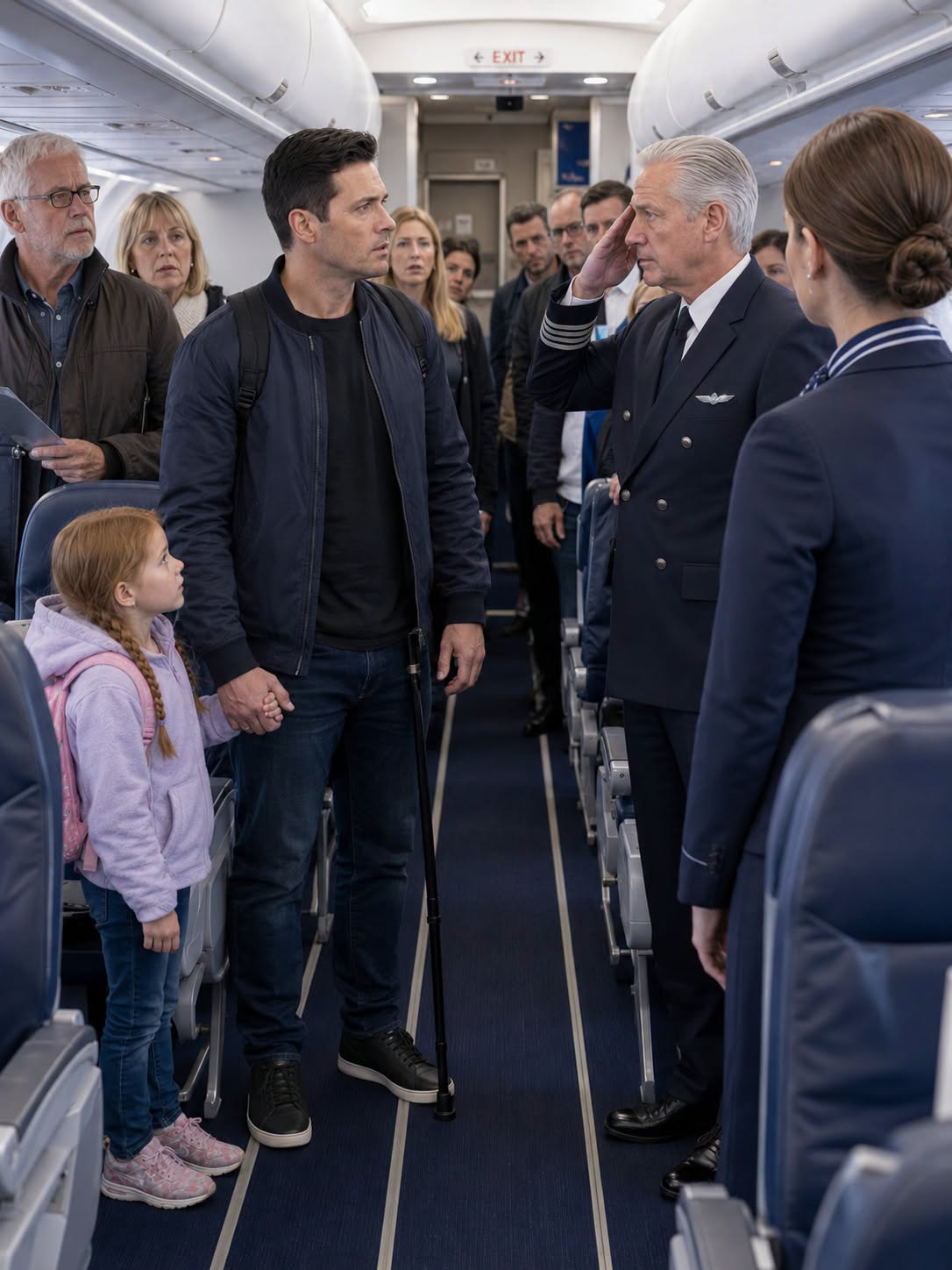
We were almost at the front galley when the cockpit door opened.
The senior captain stepped into the aisle.
He was an older man with silver hair, a calm expression, and a perfectly fitted pilot uniform. He carried himself with the quiet confidence of someone who had spent decades making decisions under pressure.
At first, nobody paid attention.
Then he looked directly at me.
Not at my clothes.
Not at my cane.
Not at my worn boots.
At me.
His eyes moved briefly toward the military insignia attached to my travel bag.
Then something changed.
The captain straightened his posture.
And in front of every passenger on that aircraft, he raised his right hand.
He saluted me.
A perfect military salute.
The entire cabin froze.
The gate agent stopped moving.
The businessman in the navy suit stared.
The flight attendants near the galley went silent.
Nobody understood what was happening.
Not even Nora.
“Daddy?” she whispered.
I couldn’t answer immediately.
Because for the last few years, I had worked very hard to disappear.
I was not someone who wanted attention.
I was simply Samuel Barrett.
A forty-one-year-old widowed father trying to raise his daughter.
A man who packed school lunches every morning.
A man who learned how to braid hair after losing his wife.
A man who quietly carried memories he never talked about.
A wounded veteran who believed the men who never returned home deserved the recognition more than he did.
Yet here I was.
Standing in the middle of a commercial airplane.
And the captain was saluting me like I mattered.
My throat tightened.
I placed the bag down carefully, straightened my back as much as my injured body allowed, and raised my left hand.
I returned his salute.
For a few seconds, the world seemed to stop.
A pilot in uniform.
A tired father wearing a faded flannel shirt.
Two veterans connected by something nobody else in that cabin could see.
Because a military salute is not simply a movement.
Between people who understand sacrifice, it says something much deeper.
I see you.
I know what you carried.
You are not invisible.
Captain Thomas Bennett lowered his hand and walked toward me.
He extended his right hand.
“Sir,” he said clearly enough for everyone to hear, “it is an incredible honor to have you aboard my aircraft today.”
He shook my hand firmly.
Then he turned toward the gate agent.
The atmosphere changed instantly.
“This man and his daughter are not moving anywhere,” Captain Bennett said. “They are sitting exactly where they belong. And I believe someone owes them a sincere apology.”
The gate agent’s expression changed.
The confidence disappeared.
The entire cabin was watching now.
But they did not know the story behind that moment.
They did not know why the captain recognized me.
They did not know why two simple seats meant more than comfort.
They did not know what was inside the bag I had carried onto that plane.
They did not know about the promise I made to a dying woman.
My name is Samuel Barrett.
And before that morning ended, everyone on that aircraft would understand why those seats were never just seats.
They were the final chapter of a promise.
A promise I spent two years fighting to keep.
My wife Clara and I had been together since we were nineteen.
She was the person who understood me before anyone else ever did.
She waited through my deployments. She knew how to sit beside me during the silent nights after I returned home. She never demanded explanations for memories I wasn’t ready to share.
She simply stayed.
When my mind pulled me back to places I hated remembering, Clara was the person who brought me back.
She saved me in ways I could never repay.
Then cancer took her away.
The diagnosis came suddenly.
Eleven months later, she was gone.
I had faced enemy fire.
I had carried injured soldiers through impossible situations.
I had survived things many people never should have experienced.
But losing Clara was the hardest battle of my life.
Because against everything else, I had training.
Against losing her, I had nothing.
Near the end, when she was lying in that hospital bed, she asked me for one final thing.
“Samuel,” she whispered, “when Nora is old enough to remember it forever, take her to the ocean.”
I held her hand.
“The ocean?”
She smiled weakly.
“The place where we started.”
Clara grew up near the coast of North Carolina. She always said the sound of waves made her feel peaceful. Years earlier, before we had money or stability, we had driven there in my old pickup truck for our honeymoon.
We couldn’t afford a hotel.
So we slept in the truck.
We sat on the beach wrapped in a blanket, drinking cheap coffee and watching the waves.
Clara rested her head against my shoulder and told me that one day we would return with our children.
Life gave us only one child.
And it took her before we could complete that dream.
Before she passed away, she looked at me and whispered:
“Please bring our daughter home to the ocean someday.”
That became my mission.
The reason I saved.
The reason I sacrificed.
The reason I bought those first-class tickets.
For two years, I saved every extra dollar I could find.
Every week, I placed money into an old metal coffee can sitting on top of our refrigerator.
Sometimes I added twenty dollars.
Sometimes only two.
Nora called it our ocean fund.
Sometimes she would quietly add coins from her piggy bank because she wanted to help bring Mommy home.
Every time she did it, my heart broke.
A child should never have to save coins to say goodbye to her mother.
But I never stopped her.
Because that little can represented hope.
I worked extra shifts whenever my body allowed it. I repaired old boots instead of replacing them. I skipped lunches. I wore the same shirts until they were almost impossible to fix.
Slowly, painfully, dollar by dollar, the money grew.
Then one afternoon, I counted everything.
We had enough.
Enough for two first-class tickets.
Not because I wanted luxury.
Not because I wanted to impress anyone.
Because I needed to be able to walk my wife’s ashes to the shoreline.
Because I wanted Nora to feel special on the journey where she would say goodbye to her mother.
Those seats represented two years of sacrifice.
They represented love.
They represented a promise.
And that was why, when the gate agent walked onto the plane and decided we did not belong there, the pain went deeper than he could ever understand.
He saw a man in a faded shirt.
A wooden cane.
A little girl.
He made his decision before he ever knew my name.
“Sir,” he said, “we have a priority passenger who needs this cabin.”
He looked at my tickets.
Then at me.
Then he decided.
We were the easiest people to move.
The businessman waiting nearby was important.
His company spent millions with the airline.
So instead of asking him to adjust his plans, they looked at us.
A wounded veteran.
A widowed father.
A seven-year-old girl.
They assumed we wouldn’t fight.
And maybe I wouldn’t have.
Not for myself.
But watching Nora’s face fall hurt more than anything else.
“Daddy,” she whispered, “I thought these were our special seats.”
That question broke something inside me.
Because how do you explain unfairness to a child?
How do you tell your daughter that sometimes people judge what they see before they understand what they don’t?
So I smiled.
I lied gently.
And I told her we would be fine.
What I didn’t know was that someone else had been watching.
Someone who noticed the things the gate agent ignored.
A senior flight attendant standing near the galley had seen my cane.
She had seen the way I carefully shifted my weight.
She noticed the military insignia on my bag.
And when I pulled out my wallet, she caught sight of my veteran identification card.
She didn’t know my whole story.
But she knew enough.
She knew something was wrong.
While I reached down to lift our bag, she quietly walked toward the cockpit.
She knocked on the door.
And seconds later, Captain Thomas Bennett stepped into the aisle.
That was the moment everything changed.

Part 2
Captain Thomas Bennett did not step into the aisle to create a scene.
He did not raise his voice.
He did not demand attention.
He simply walked forward with the calm confidence of someone who had spent his entire life facing difficult situations, looked directly at me, and recognized something familiar.
He did not know my name yet.
But he recognized the signs.
The military insignia.
The cane.
The careful way I stood.
The quiet strength of someone who had learned how to carry pain without announcing it to the world.
That was why he saluted.
And that simple gesture meant more to me than any ceremony I had ever attended.
I had received medals before.
I had stood in formal military rooms while commanders spoke about sacrifice and courage. I had accepted awards while holding a folded flag and listening to words that were meant to honor people like me.
I appreciated those moments.
But none of them reached my heart the way that salute did.
Because this time, it happened in front of the people who had just watched me being pushed aside.
It happened while my daughter held my hand.
It happened when I needed someone to remind her that her father was not someone who could simply be dismissed.
When I returned Captain Bennett’s salute, my eyes filled with tears.
I focused on the small American flag patch attached to his uniform because I knew if I looked down at Nora, I would lose my composure.
Captain Bennett lowered his hand and shook mine.
“Sir,” he said firmly, “it is a genuine honor to have you aboard my aircraft today.”
Then he turned toward the gate agent.
The young man immediately looked uncomfortable.
“This gentleman and his daughter are staying in their assigned seats,” Captain Bennett said. “They purchased those seats, and I expect an apology.”
The gate agent swallowed.
“Captain, I was only following company procedures,” he explained quickly. “We had a priority customer situation, and I was attempting to resolve the seating conflict—”
Captain Bennett listened silently until he finished.
Then he responded.
“Your procedure was to remove a wounded combat veteran and his young daughter from seats they paid for because another passenger arrived late and wanted special treatment?”
His voice remained calm.
That made it even more powerful.
“That is not a seating solution. That is a failure to recognize basic human dignity.”
The cabin remained silent.
The phrase “wounded combat veteran” seemed to change the entire atmosphere.
Passengers who had previously looked away now looked down.
The businessman in the navy suit, who had been standing nearby, suddenly looked embarrassed.
He cleared his throat.
“There is no need for this,” he said quietly. “I’ll take another seat.”
His confidence had disappeared.
He picked up his briefcase and walked toward the back of the aircraft.
For the first time that morning, nobody was looking at me like I didn’t belong.
The gate agent stepped aside.
The senior flight attendant who had alerted Captain Bennett walked toward Nora and smiled.
“Miss Nora,” she said gently, “I think your seat is waiting for you.”
Nora looked at me.
She was still uncertain.
Still wondering if someone would take it away again.
I smiled and nodded.
“It’s okay, sweetheart.”
Slowly, she climbed back into the leather seat.
The flight attendant adjusted her blanket, brought her a fresh drink, and then reached into her pocket.
“I have something for you.”
She pulled out a small pair of silver pilot wings.
“I think every special passenger needs these.”
She carefully pinned them onto Nora’s shirt.
“There,” she said. “Now you’re part of the crew today.”
For the first time since the gate agent approached us, my daughter smiled.
Not a forced smile.
Not the careful smile children give when they know their parents are hurting.
A real smile.
The kind that makes a parent feel like they can finally breathe again.
And that was all I wanted.
I didn’t care about proving someone wrong.
I didn’t care about embarrassing the gate agent.
I only wanted my daughter to remember this trip as the day she brought her mother home.
Not the day a stranger made her feel unwanted.
The entire cabin changed after that.
The passengers who had watched us being removed from first class now looked at us differently.
A woman across the aisle wiped tears from her eyes.
An older man sitting behind us leaned forward and extended his hand.
He didn’t say anything.
He simply shook my hand.
I understood.
Some people don’t need words.
Especially veterans.
Sometimes respect is communicated through silence.
I sat beside Nora and looked out the window as the aircraft prepared for takeoff.
The runway stretched ahead.
The sky was clear.
And for the first time that morning, I felt peace.
I thought about Clara.
I thought about how close I had come to letting one painful moment become the memory Nora carried forever.
But someone had stepped in.
Someone had seen us.
Someone had reminded my daughter that her father mattered.
What I didn’t know yet was that Captain Bennett had a reason far deeper than simple kindness.
About an hour after takeoff, Nora fell asleep beside the window.
Her small hand rested on mine.
The silver pilot wings on her shirt reflected the sunlight coming through the glass.
The flight attendant returned quietly.
“Mr. Barrett,” she whispered, “Captain Bennett would like to speak with you in the galley when you have a moment.”
I looked at my sleeping daughter.
“I don’t want to leave her alone.”
The flight attendant smiled.
“I’ll stay right here with her.”
I trusted her.
So I picked up my cane and carefully stood.
Walking toward the front of the plane felt different this time.
The aisle was the same.
The distance was the same.
My injured body still hurt.
But the weight I had carried earlier was gone.
When I reached the galley, Captain Bennett was waiting.
The professional expression he had worn earlier was gone.
Now he looked emotional.
Almost overwhelmed.
“Sergeant Barrett,” he said quietly.
I froze.
I had not told him my rank.
He took a deep breath.
“I need to tell you something.”
I held my cane tighter.
“What is it, Captain?”
He looked down for a moment, searching for the right words.
“Three years ago, there was a military convoy attack in the eastern province.”
The memories returned instantly.
The smoke.
The fire.
The screams.
The impossible choices.
Captain Bennett continued.
“One soldier went back into enemy fire repeatedly to pull men out of a burning vehicle.”
My chest tightened.
“That soldier was you.”
For a moment, I couldn’t speak.
Because I knew exactly what day he was talking about.
That was the day I lost my leg.
That was the day I earned the Distinguished Service Cross sitting inside a drawer at home.
A medal I rarely looked at.
People who have never been in combat often think medals represent pride.
Sometimes they do.
But sometimes they represent something much heavier.
They represent a day you wish never happened.
They represent faces.
Names.
Memories.
They represent the people you saved.
And the people you couldn’t.
I never went back to that burning vehicle because I wanted to be called a hero.
I went back because my brothers were trapped.
Because they were alive.
Because they needed someone.
That was all.
Captain Bennett’s eyes filled with emotion.
“My son was inside that vehicle.”
The words hit me harder than I expected.
“My son was one of the soldiers you pulled out.”
I stood completely still.
He continued.
“He survived because you refused to leave him behind.”
His voice broke.
“For three years, I have known there was a soldier who saved my boy’s life. I knew there was someone who gave my family another chance. But I never knew your name.”
He looked directly at me.
“Then this morning, my flight attendant told me about a disabled veteran being moved from first class. I checked the passenger manifest.”
He paused.
“And I saw Samuel Barrett.”
The cabin suddenly felt impossibly small.
Out of every possible flight.
Every airline.
Every route.
Every pilot.
The plane carrying my daughter and me to fulfill Clara’s final wish was being flown by the father of the soldier I had saved.
The same soldier whose rescue had cost me my leg.
The same soldier whose survival had allowed another family to remain whole.
For years, I had believed that day only represented loss.
The loss of my body.
The loss of my ability to live the way I once did.
The loss of the men who never came home.
But standing there with Captain Bennett, I saw something else.
I saw the other side of that terrible day.
A father who still had his son.
A family that still celebrated birthdays.
Children who still had a grandfather.
A life that continued because of one impossible decision made on a battlefield.
Captain Bennett grabbed both of my hands.
“My son is alive today,” he said. “He’s married. He has children. Two beautiful lives exist because you chose to go back.”
I struggled to answer.
There were no words big enough.
A simple “thank you” felt too small.
An apology felt wrong.
So I squeezed his hand and nodded.
Sometimes silence says everything.
“I’m going to make sure you and Nora reach that ocean,” he said. “I want you to know something, Sergeant Barrett. Flying you there is the greatest honor of my career.”
When I returned to my seat, Nora was still asleep.
Her blanket was tucked around her shoulders.
Her little silver wings were still shining.
I sat beside her and looked out at the clouds below.
For a long time, I thought about Clara.
I wondered if she had somehow guided us here.
Maybe some things are too perfectly timed to be explained.
Maybe some promises are protected by something greater than ourselves.
Because the little girl beside me was finally going to see the ocean.
And her father had just discovered that the worst day of his life had also given another family the greatest gift imaginable.
The rest of the flight passed peacefully.
But the story was far from over.
Because when we landed in North Carolina, I learned that the most important part of that journey was still waiting for us.

Part 3
Captain Bennett kept every promise he made to us.
The rest of the flight passed peacefully.
For the first time in a long time, I was not fighting against memories, pain, or the feeling that I had to carry everything alone. I simply sat beside my daughter while she slept peacefully against the window, her small hand still holding mine.
The little silver pilot wings attached to her shirt caught the sunlight every time the plane moved.
I watched her sleep and thought about Clara.
I thought about the promise I made.
I thought about all the nights I wondered if I would ever be able to give my daughter this moment.
And somehow, against all odds, we were almost there.
When the aircraft finally touched down in North Carolina, Captain Bennett personally walked us off the plane.
The afternoon sunlight filled the terminal. Families reunited near baggage claim. Travelers rushed toward their next destinations. Airport announcements echoed through the building.
But for me, everything felt strangely quiet.
Because after two years of saving, grieving, and waiting, we had finally arrived.
Nora held my hand tightly.
I carried Clara’s ashes carefully.
As we reached the terminal exit, Captain Bennett stopped.
Then he lowered himself onto one knee.
He smiled at Nora.
“You take very good care of your father, okay?”
Nora looked at him with complete seriousness.
“I always do.”
Captain Bennett laughed softly.
Then he stood and turned back toward me.
He shook my hand.
But this time, he didn’t let go quickly.
“Thank you, Sergeant,” he whispered.
His voice carried years of gratitude.
“Thank you for giving me my son back.”
I looked at him for a moment.
Then I glanced at my daughter.
“Thank you, Captain,” I replied. “Thank you for reminding my daughter who her father really is.”
Neither of us needed to say anything else.
Some moments are too meaningful for many words.
We rented a simple car and drove toward the coast.
The road stretched through quiet marshlands, old oak trees covered in moss, and small bridges crossing peaceful waterways. The windows were slightly open, allowing the salty ocean air to fill the vehicle.
Nora sat in the back seat, looking everywhere.
“Daddy,” she asked excitedly, “do you think I’ll see the ocean soon?”
I smiled.
“Yes, sweetheart.”
Her mother’s ocean.
The place where our story began.
The place where we would finally say goodbye.
When we reached the beach, the sky had turned a soft gray.
It was almost exactly as I remembered it.
The same shoreline.
The same waves.
The same endless horizon.
Years earlier, Clara and I had sat on that sand as two young people with almost nothing.
We had no money.
No fancy hotel.
No expensive vacation.
Just an old truck, a blanket, two cups of cheap coffee, and each other.
Back then, we never imagined that one day I would return there alone with our daughter carrying her ashes.
Life rarely follows the plans we make.
But sometimes, love finds a way to complete unfinished promises.
I helped Nora roll up her pants.
Then I carried Clara toward the water.
For a moment, I stood there with my daughter beside me and felt the weight of everything that brought us there.
The years of marriage.
The years of war.
The years of grief.
The years of trying to be both a mother and father to a little girl who missed her mother every single day.
The ocean waves moved gently toward us.
And finally, Clara was home.
I won’t share every private word spoken on that beach.
Some conversations belong only to the people who have lost someone they love.
Some prayers are meant only for the wind and the waves.
But I will say this.
The ocean received her exactly the way she wanted.
With peace.
With love.
With the sound she had always carried in her heart.
Nora cried at first.
Then suddenly, a small wave rushed over her feet.
She jumped back in surprise.
Then she laughed.
A real laugh.
The kind I had not heard from her enough since Clara passed away.
And standing there, watching my daughter laugh beside the ocean, I felt something inside me finally loosen.
The grief did not disappear.
It never truly does.
But the weight became lighter.
Because I had done what Clara asked me to do.
I had brought our daughter home.
Nora stood beside me, her hair moving in the ocean breeze.
Then she looked toward the horizon.
“Daddy?”
“Yes, sweetheart?”
“Do you think Mommy can see us right now?”
I looked out at the endless water.
And I answered with the truth I believed.
“Yes.”
My voice became soft.
“I know she can see us.”
Nora was quiet.
“She has been watching over us the whole way here. And I know she is proud of you.”
My daughter stared at the ocean for a long moment.
The sunlight touched her face.
And for one second, she looked exactly like Clara.
It took my breath away.
Then Nora whispered:
“Goodbye, Mommy.”
She paused.
“We brought you back home.”
Those words broke me.
Because that was the entire reason we had started this journey.
Every saved dollar.
Every repaired pair of boots.
Every painful step.
Every lonely night.
Every moment when I wondered if I could keep going.
It had all led to this.
My daughter had helped me fulfill the final promise I made to the woman we both loved.
Standing there on that beach, I realized something.
There are rare moments in life when you understand exactly why you were given the strength to survive everything before that moment.
For me, that was one of them.
I would never trade that memory.
Not for medals.
Not for recognition.
Not for comfortable seats on airplanes.
Nothing.
That evening, Nora fell asleep in our small coastal hotel room with the curtains slightly open so she could hear the ocean waves.
I sat beside her bed for hours.
I watched her breathe.
I watched the little girl who had lost her mother but somehow still carried so much love inside her.
Late that night, she opened her eyes.
“Daddy?”
“I’m right here.”
She looked at me sleepily.
“Was the airplane captain right about you?”
I smiled slightly.
“Right about what?”
She blinked.
“Are you really a hero?”
I sat quietly for a moment.
Because children deserve honesty.
But children should not have to carry the weight of adult pain.
“No, sweetheart,” I said softly. “I’m just your daddy.”
She watched me carefully.
“A long time ago, I was in a very difficult situation. Some people needed help, and I tried my best to make the right choice.”
I brushed her hair away from her face.
“Because of that choice, some people got to return home to their families.”
Nora thought about that.
Then she whispered:
“I’m going to make the right choices on my worst days too.”
A few seconds later, she fell asleep again.
I sat alone in the dark room listening to the ocean outside.
And I thought about Clara.
That was the legacy we wanted to give our daughter.
Not money.
Not status.
Not a perfect life without struggles.
Because nobody can protect their children from every hardship.
What we could give her was something much more valuable.
A strong heart.
A sense of dignity.
The courage to do what is right even when nobody is watching.
Years have passed since that flight.
Nora is much older now.
And every year on the anniversary of that journey, we return to Clara’s beach.
We still fly in the front cabin.
Not because I care about luxury.
Not because I need comfortable seats.
I keep those lifetime travel privileges because they remind me of something far more important.
Human kindness.
The people who choose to see others.
Before every trip, I check the flight crew whenever possible.
And sometimes, we are lucky.
Sometimes Captain Thomas Bennett is still the pilot.
He talks about retirement more often now, but whenever our paths cross, it feels like no time has passed.
On some flights, his grandchildren are waiting at the gate after landing.
Those children exist because their father survived.
Because years ago, one soldier refused to leave him behind.
Last spring, Captain Bennett’s son came to meet us at the airport.
The same soldier I remembered from that burning vehicle.
Except now he was older.
A grown man.
A father.
Healthy.
Alive.
He had a few gray hairs, just like his own father.
When he saw me, he didn’t say much.
He didn’t need to.
He walked forward and hugged me.
A long, powerful hug.
Over his shoulder, I watched his children playing with Nora near the gate.
They laughed.
They ran.
They had no idea that their lives were connected by one terrible day years earlier.
A day filled with smoke, fear, and loss.
A day that had once been only a painful memory.
But there they were.
Alive.
Happy.
Together.

For years, I carried the memories of the people I couldn’t save.
That day at the airport, I finally saw the other side of the story.
The families that continued.
The children who were born.
The birthdays celebrated.
The bedtime stories told.
The lives that continued because one terrible moment did not get the final word.
I am still just Samuel Barrett.
A man with a cane.
A man who wears old flannel shirts.
A man who lives a simple life.
Most strangers still do not know my story.
And that is okay.
Because I learned something important on that airplane.
People are judged in seconds.
A worn shirt.
A tired face.
A quiet voice.
A disability.
A child with a simple backpack.
People look once and believe they understand everything.
The gate agent looked at me and saw someone easy to move.
Captain Bennett looked at me and saw someone worthy of respect.
The difference was never my clothing.
It was never my seat.
It was never even my military record.
The difference was compassion.
One person judged what he saw.
Another person cared enough to look deeper.
And for the rest of my life, I want to be the second kind of person.
When someone moves slowly in front of me at a store, I wait patiently.
When someone looks exhausted, I remember they may be fighting battles nobody can see.
When I see a parent struggling to stay strong in front of their child, I remind myself that many people are carrying invisible burdens.
Whenever Nora asks about her mother, I tell her the ocean remembers Clara.
I tell her promises matter.
I tell her dignity can survive even the most humiliating moments.
And most importantly, I tell her something Clara taught me.
A hero is not always someone wearing a uniform.
A hero is not always someone receiving applause.
Sometimes a hero is simply an ordinary person having the hardest day of their life and still choosing to do the right thing.
That was Captain Bennett stepping out of the cockpit.
That was the flight attendant refusing to ignore what she saw.
That was Clara smiling at me from her hospital bed because she knew I was pretending everything was okay.
And maybe, on one impossible day, that was me too.
The person I am most proud of will always be Nora.
Because she watched the world try to teach her a cruel lesson.
She watched someone decide her father did not belong.
But instead of learning that kindness was rare, she learned something much more powerful.
She learned that people are not defined by their clothes.
Not by their seats.
Not by other people’s assumptions.
She learned that quiet people often carry the greatest stories.
She learned that being overlooked does not mean being worthless.
She learned that even when life becomes unfair, we still get to choose who we become.
That is the lesson I carried home from that flight.
Not that every wrong will be corrected.
Not that every good deed will be recognized.
But that sometimes, in the middle of an ordinary place, when people have already decided what you are worth…
A door opens.
Someone steps forward.
Someone sees you.
And suddenly, everything changes.