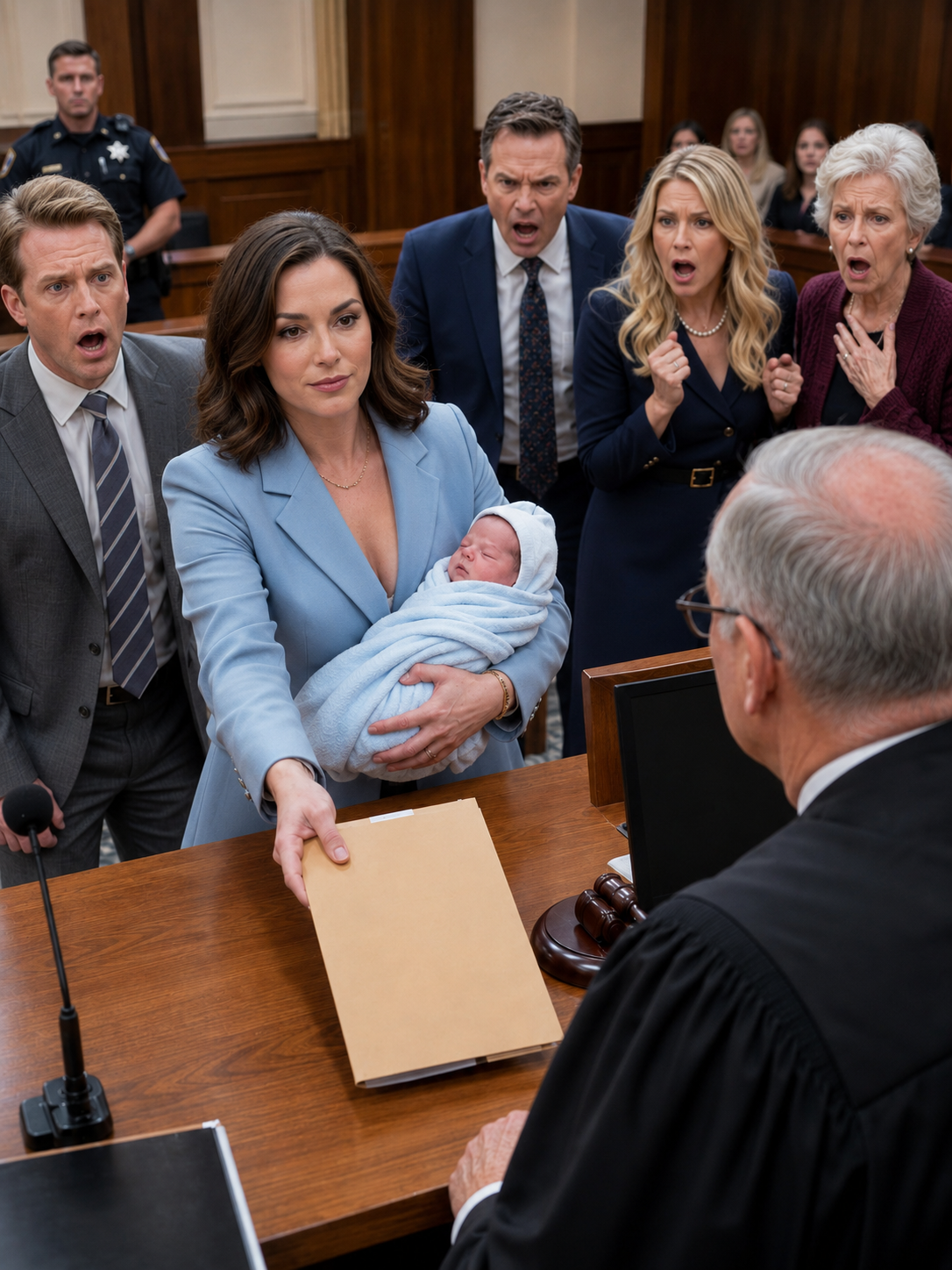

Six days after giving birth to my son, I walked into a family courtroom in Richmond, Virginia, with a newborn sleeping against my chest and a thick burgundy binder tucked beneath my arm.
I was still sore from delivery.
I had barely slept more than two hours at a time since leaving the hospital.
My body did not feel like mine yet, and every protective instinct I possessed was focused on the tiny boy breathing softly against my shoulder.
Across the courtroom, my husband, Preston Calloway, looked rested.
Prepared.
Confident.
He sat beside his attorney, Graham Pike, wearing the charcoal suit I had bought him for our anniversary two years earlier.
Directly behind him sat his mother, Marjorie, dressed in cream silk and pearls as if she were attending a charity luncheon rather than a hearing that could determine where her six-day-old grandson would spend the first months of his life.
Beside Marjorie sat Celeste Harrow.
The woman Preston had repeatedly described as “a family friend.”
The woman who had somehow started appearing at nearly every Calloway family dinner during the final months of my pregnancy.
The woman currently wearing a delicate pearl bracelet that looked almost identical to one Preston had once given me.
Preston noticed the burgundy binder.
His eyes rested on it for perhaps two seconds.
Then he smiled.
It was not a loving smile.
It was the expression of a man who believed he had already written the ending and was waiting for everyone else to read it.
His emergency petition claimed that I had become emotionally unreliable after childbirth.
That I had taken our newborn son away without explanation.
That I had hidden Owen from him.
That he feared I was no longer capable of making safe decisions for our baby.
None of it was true.
And inside the binder were months of records proving that his story had begun long before Owen was born.
When Judge Evelyn Mercer entered, everyone rose.
I tightened my arm around my sleeping son and reminded myself of one thing.
For months, Preston had been telling everyone what kind of woman I was.
Today, I was finally going to show the court what kind of husband he had been.
Judge Mercer reviewed Preston’s petition first.
His attorney stood.
“Your Honor, Mr. Calloway is simply asking for immediate access to his newborn son. Mrs. Calloway left the marital residence shortly after delivery and has demonstrated concerning behavior during a very vulnerable period.”
My stomach tightened.
The language was deliberate.
Concerning behavior.
Vulnerable period.
Carefully polished phrases that sounded reasonable until someone asked what they actually meant.
Judge Mercer turned toward me.
“Mrs. Calloway, do you have counsel today?”
“Not yet, Your Honor.”
“And what are you carrying?”
I looked down at the binder.
“Records I believe the court should see before making any temporary custody decision.”
Graham rose almost immediately.
“Your Honor, we have not had an opportunity to review whatever Mrs. Calloway has assembled. Given that she delivered less than a week ago, we also have concerns about how accurately she may be interpreting ordinary family disagreements.”
Ordinary family disagreements.
Another elegant phrase designed to erase months of pressure, threats, financial control, and quiet preparation.
Judge Mercer lifted one hand.
“You will have time to respond, Mr. Pike.”
Then she looked at me.
“Bring the binder forward.”
My legs felt unsteady as I approached the clerk.
Owen slept through everything, his tiny cheek pressed against my shoulder.
I set the binder down.
The first page read:
Documented Timeline of Financial Restriction, Custody Preparation, Medical Concerns, and Communication Prior to Delivery.
Judge Mercer read the title.
Then she read it again.
Across the room, Preston’s smile disappeared.
The first section contained records from my prenatal appointments.
Nothing sensational.
No dramatic accusations.
Just small observations recorded by medical professionals who Preston had apparently forgotten were paying attention.
One nurse noted that I became noticeably quiet whenever Preston entered the examination room.
Another wrote that he repeatedly answered questions on my behalf even when those questions were addressed directly to me.
Then came notes from Dr. Serena Caldwell, my obstetrician.
Three weeks before Owen was born, I had asked to speak with her alone.
By then, Preston had begun making comments that I could no longer convince myself were harmless.
“A responsible mother knows when she needs someone else making decisions.”
And:
“If you become difficult after the baby arrives, I’ll have no choice but to protect him from the confusion.”
For weeks, I had told myself he was nervous about becoming a father.
Maybe controlling because he was afraid.
Maybe overprotective.
Maybe I was the one being too sensitive.
Dr. Caldwell never told me what conclusion to reach.
She simply documented what I said and quietly gave me information for a patient advocate.
Those notes were now in front of Judge Mercer.
She turned toward Preston.
“Were you aware your wife had expressed concerns about custody before the child was born?”
Preston shifted.
“She was anxious throughout the pregnancy.”
“That was not my question.”
His attorney leaned toward him, but Preston answered.
“No. I wasn’t aware she had said those things to her doctor.”
I nearly laughed.
Of course he had not known.
Preston had always behaved as though private conversations existed only when he controlled them.
The next section concerned the address I had supposedly hidden from him.
According to his petition, I had taken Owen from the hospital and disappeared.
Judge Mercer looked directly at me.
“Mrs. Calloway, where did you go after being discharged?”
“To my friend April Bennett’s house.”
“Did your husband know the address?”
“Yes, Your Honor.”
Preston’s head snapped toward me.
I reached into the diaper bag beside my chair and handed the clerk a printed page.
“The messages are under Section Four.”
Judge Mercer found them.
The conversation had taken place the morning I left the hospital.
My text read:
“I’m being discharged this afternoon. Since you said you would not come unless I signed the temporary custody documents, I’m going to April’s house with Owen. The address is 46 Hawthorne Ridge. Please communicate with me by text and arrange any visit in advance.”
Preston had replied:
“You’re making this much worse than necessary.”
I answered:
“Owen is healthy and being cared for. You know exactly where we are.”
Then Preston wrote:
“If you make me handle this through court, I won’t make it easy for you.”
The courtroom became so quiet that I could hear Owen breathing.
Judge Mercer lifted her eyes.
“Mr. Pike, the petition states Mrs. Calloway’s location was unknown.”
Graham’s jaw tightened.
“My client’s position was that he did not have meaningful access.”
“That is different from not knowing the location.”
No one answered.
I looked at Preston.
For the first time that morning, there was uncertainty in his face.
The financial records came next.
There was no secret offshore fortune.
No missing millions.
The truth was much more ordinary.
And because it was ordinary, it had been frighteningly easy for Preston to disguise.
Before pregnancy, I worked as a children’s librarian.
I loved my job.
I loved helping nervous children find their first chapter books and watching parents bring toddlers to story hour.
Preston gradually convinced me to leave.
We could comfortably live on his income, he said.
Pregnancy was exhausting.
Why should I work when he could provide for us?
“You deserve a peaceful pregnancy, Kendall.”
I believed him.
Three months after I stopped working, money began disappearing from our shared checking account.
Preston transferred funds into an account I could not access.
Then one afternoon my credit card was declined.
When I confronted him, he said we needed to “simplify the household finances.”
When I complained to Marjorie, she sent me a message.
“You will have access to household funds when you begin making responsible choices for this family.”
Judge Mercer read that message slowly.
Then she reached the next document.
A payment from Preston to Graham Pike’s law firm.
The amount mattered less than the date.
Six weeks before Owen was born.
Judge Mercer looked up.

“Mr. Pike, when did your office begin representing Mr. Calloway regarding potential custody matters?”
For the first time, Graham hesitated.
Preston looked at him sharply.
That hesitation revealed something Preston had probably never considered.
His attorney had not been given the entire story either.
“Approximately six weeks before the delivery,” Graham finally admitted.
A quiet murmur moved through the courtroom.
Preston’s filing had suggested that his custody concerns began because I left the hospital with Owen.
Yet he had retained a custody attorney more than a month before our son even existed outside my body.
Judge Mercer turned to me.
“Had your husband discussed separation with you at that time?”
“No, Your Honor.”
“Had he informed you that he was preparing for a custody dispute?”
“No.”
“What was he telling you?”
I looked at Preston.
“That we were preparing for our son together.”
Then came the section involving Celeste.
It was the one I had almost removed from the binder because even now I sometimes wondered whether I had overreacted.
Four days before Owen was born, I went to Marjorie’s home unexpectedly.
Upstairs, I found Celeste standing inside a bedroom.
Curtain samples covered the bed.
A crib had already been ordered.
So had a changing table.
I asked Preston why Celeste was designing a nursery for my baby.
He barely looked embarrassed.
“Because somebody needs to plan for what comes next.”
“What does that mean?”
“You have not been yourself lately, Kendall.”
My name is Kendall.
Once, Preston had said it softly.
That day, he said it like a diagnosis.
“Are you planning to take Owen from me?”
Preston lowered his voice.
“I intend to make sure my son grows up in a stable environment.”
“And I’m not stable?”
“You are becoming difficult.”
I remember staring at him, my hands resting protectively over my stomach.
“Why is Celeste involved?”
He glanced toward the doorway where she had disappeared.
“Celeste understands what this family requires.”
By then, the patient advocate had taught me to document important interactions whenever it was lawful and safe.
So I had recorded the conversation.
Judge Mercer listened through headphones.
No one in the room spoke.
I watched her expression change almost imperceptibly.
When she finally removed the headphones, she did not look at me.
She looked at Preston.
The hearing continued for almost another hour.
Graham argued that isolated text messages lacked context.
He suggested that exhaustion after childbirth might be distorting my perception.
He questioned whether staying temporarily with April offered enough stability for a newborn.
But every time he raised a concern, the binder answered it.
April had provided a signed statement confirming that Owen and I had a private bedroom, a safe bassinet, transportation, food, and everything necessary for a newborn.
My pediatrician confirmed Owen had attended his first follow-up appointment.
My hospital discharge paperwork contained no concern regarding my ability to care for him.
The text messages proved Preston knew exactly where we were.
And the payment record proved his legal preparations had begun long before the emergency he claimed I had created.
Eventually, Judge Mercer closed the binder.
“The emergency request presented by Mr. Calloway is denied.”
For a second, I thought exhaustion had made me misunderstand her.
Then she continued.
“Temporary primary physical custody will remain with Mrs. Calloway pending a full hearing. Mr. Calloway will receive scheduled supervised visitation through an approved family center.”
Behind me, April began crying quietly.
I could only stare at the judge.
“Communication regarding the child will take place only through the approved parenting application. Neither party is to use relatives or acquaintances to pressure the other.”
Her eyes moved directly toward Marjorie.
Marjorie looked offended.
Judge Mercer did not seem particularly concerned.
“Mrs. Calloway will also receive temporary protection from unwanted personal contact while the court reviews the material presented today.”
Preston whispered something urgently to Graham.
Judge Mercer looked straight at him.
“Mr. Calloway, the court takes accuracy in emergency filings seriously. Do not make this situation worse.”
The hearing ended.
For the first time in months, I felt like I could breathe without asking anyone’s permission.
April and I were almost at the elevators when someone called my name.
“Kendall.”
I turned.
Celeste stood several feet behind us.
Without Marjorie beside her, she looked different.
Less polished.
Less certain.
April immediately stepped between us.
“You probably shouldn’t be talking to her.”
Celeste nodded.
“I know.”
Then she reached toward her wrist and unclasped the pearl bracelet.
“I didn’t know this belonged to you when Preston gave it to me.”
My stomach tightened.
“When did he give it to you?”
She looked down.
“About four months ago.”
Four months.
While Preston was still sleeping beside me.
While we were putting together Owen’s crib.
While he was telling friends how excited he was to become a father.
Celeste held the bracelet toward me.
I did not take it.
Then she said the words that changed everything.
“There is a storage unit near Laurel Lake.”
April and I exchanged a glance.
Laurel Lake was a private community north of Richmond where the Calloway family had owned a summer property for decades.
“What storage unit?”
“Marjorie’s name is connected to it, but Preston uses it. I saw boxes containing paperwork with your name.”
“What kind of paperwork?”
“Medical forms. Copies of signatures. Evaluations.”
Cold spread through my chest.
“Why are you telling me this now?”
Celeste hesitated.
“Because after listening to what happened in court, I’m starting to wonder what I was actually helping him prepare.”
Before she could continue, the elevator doors opened.
Preston stepped out.
The second Celeste saw him, her shoulders stiffened.
He noticed.
Then he saw me.
“Celeste,” he said pleasantly, “we’re leaving.”
His eyes moved to my burgundy binder.
He did not look furious.
He looked worried.
That frightened me more.
That evening, April drove me back to her townhouse.
Owen slept in his car seat while rain streaked across the windshield.
Halfway home, my phone buzzed.
Unknown number.
Do not trust Celeste completely.
Another message arrived.
And do not visit Laurel Lake by yourself.
April immediately pulled into a pharmacy parking lot.
“Screenshot everything.”
I did.
Then a photograph appeared.
It was old.
Preston looked about twenty-four.
Marjorie stood beside him on a wooden dock.
Between them was a dark-haired teenage girl.
On the back, someone had written:
Before Kendall, there was Rachel.
Neither April nor I spoke.
I had never heard the name Rachel.
Not once.
April’s brother, Miles, was a high school teacher with a talent for public-record research.
Without contacting anyone, he searched old archives.
The girl was Rachel Devereaux.
At seventeen, she had received a Calloway Family Arts Scholarship.
Her father had worked as caretaker for several Laurel Lake properties.
An old article showed Rachel standing beside Preston and Marjorie.
A year later, another article reported that the scholarship program had quietly ended.
Rachel could not be reached for comment.
Then she disappeared from local news completely.

Eventually, Miles found an obituary for Rachel’s father.
It listed his surviving daughter as Rachel Whitmore.
She had moved to Charlottesville.
She might still be alive.
That should have comforted me.
Instead, I kept asking the same question.
Why had someone sent me her photograph?
The answer began arriving the following evening.
A courier left a padded envelope outside April’s townhouse.
No return address.
My name was printed across the front.
Inside was a small silver key.
Its tag read:
Laurel Lake Storage — Unit 27.
Beneath it was a handwritten note.
He keeps records of every woman.
Not only you.
My hands began shaking.
April reached into the envelope.
“There’s something else.”
Three photographs.
Rachel, standing on the Laurel Lake dock years earlier.
On her wrist was a pearl bracelet.
Celeste, photographed on the same dock much later.
She was wearing a pearl bracelet too.
And then me, at Marjorie’s birthday party the previous summer.
Pregnant.
Smiling.
Completely unaware.
Wearing the bracelet Preston had given me before our wedding.
Underneath the pictures were five words.
It was never just jewelry.
My phone buzzed.
Another message from the unknown number.
This time it contained an address in Charlottesville.
Rachel Whitmore.
Then one final sentence:
Ask her what happened before Preston learned how to make every woman doubt herself.
I looked across the room at Owen sleeping peacefully in the bassinet April had placed beside the couch.
Until that moment, I had believed I was uncovering the truth about my marriage.
Now I understood that my marriage might only be one chapter in a story that had begun long before Preston met me.
He had spent months telling me I was confused.
Overly emotional.
Difficult.
Unstable.
The burgundy binder had proved something much simpler.
I had been paying attention.
Documenting what happened had not made me vindictive. It had given my memories support when someone tried to rewrite them.
I had also learned that control did not always arrive as shouting or obvious cruelty. Sometimes it arrived disguised as help. It looked like a husband telling you to leave a job you loved because he wanted to “take care of you,” then deciding when you could access money. It sounded like relatives calling obedience responsibility. It felt like someone repeatedly telling you that your fear, anger, or confusion proved you could not trust yourself.
Financial independence, I now understood, was not only about earning a paycheck. It was also access to accounts, documents, transportation, information, and people you trusted enough to call when something felt wrong.
Real support did not demand obedience in exchange for kindness.
The people who truly cared about me gave me space to recover, think, ask questions, and make decisions without insisting that I repay their help by surrendering control.
And Owen was not a prize either Preston or I could win.
Parenthood was not ownership.
A child needed adults willing to choose patience, safety, stability, and love over victory.
For years, the Calloways had cultivated an image of respectability so polished that I had mistaken reputation for character.
Court reminded me that reputation was not evidence.
A charming husband at a dinner party could still behave very differently when the doors closed.
Asking for help had not made me weak.
Dr. Caldwell had helped.
The patient advocate had helped.
April had helped.
Even a judge who had never met me before that morning had been willing to look at facts instead of accepting Preston’s version automatically.
Healing did not begin with some dramatic declaration.
It began in April’s quiet townhouse.
With a warm meal left beside me while I fed Owen.
With clean baby clothes folded on the sofa.
With someone taking the diaper bag without demanding an explanation.
With silence that did not feel threatening.
With kindness that wanted nothing back.
Learning that Preston had deceived me made me question almost every memory of our marriage.
But I did not want revenge to become the rest of my life.
I wanted enough truth to protect my son and myself.
Whatever happened at Laurel Lake, whatever Rachel knew, whatever was hidden inside Unit 27, I would face it differently now.
Not as the woman Preston had convinced to doubt her own memory.
But as the woman who had carried six days of exhaustion, a newborn baby, and a burgundy binder into court—and watched his carefully constructed story begin to collapse.
And somewhere inside that storage unit were records Preston had been terrified I would discover.
Records of every woman.
Not only me.
The court hearing had saved me from losing Owen that morning.
But the silver key in my hand told me the real story was only beginning.