
Part 1
I thought bringing my son Noah back to the beach would help him feel close to his father again.
I thought the sound of the waves, the smell of the salt air, and the simple act of building a sandcastle in the same place where he had once laughed with his dad would give him something to hold onto.
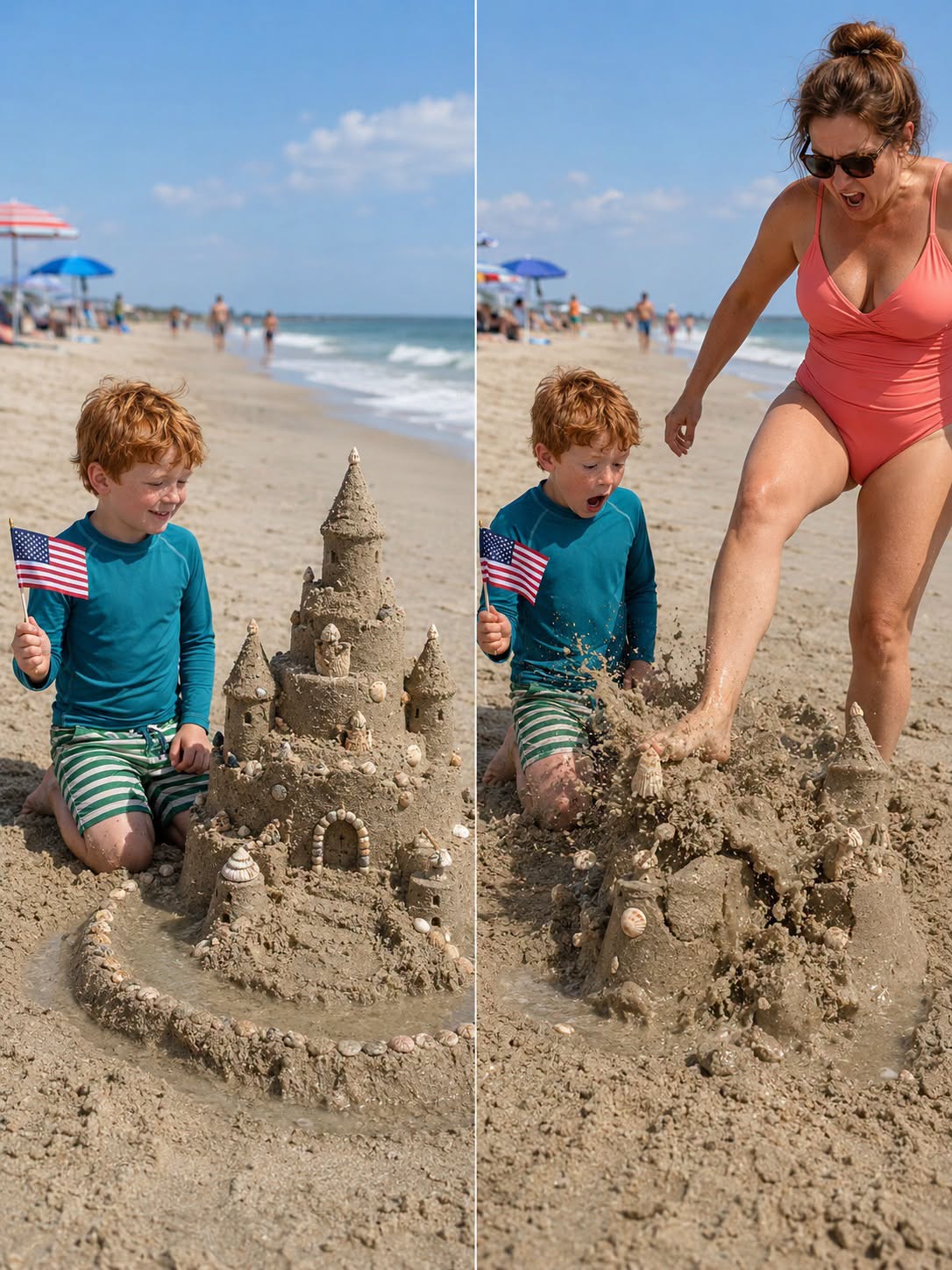
I never imagined that a stranger would walk up, look at the little kingdom my nine-year-old son had spent hours creating for his late father, and destroy it because she believed it was blocking her view.
And I never imagined that twenty minutes later, a lifeguard carrying a golden box would walk straight toward that same woman and reveal something that made everyone on the beach understand what she had truly destroyed that day.
Noah carried the tiny American flag in his pocket all morning.
Not inside his backpack.
Not tucked away in our beach bag.
His pocket.
Every few minutes, his small hand would slip down and touch it, checking that it was still there. It reminded me of the way adults check for their keys or wallet before leaving the house.
Except Noah wasn’t checking for something valuable.
He was checking for a memory.
“You okay, Bug?” I asked softly as we walked across the sand.
He nodded, but he didn’t look at me.
His eyes were already fixed on the shoreline ahead.
The beach stretched out beneath the bright Fourth of July sun. Families filled every corner. Children chased each other through the waves. Colorful umbrellas dotted the sand. Music played from portable speakers, and somewhere nearby, someone was laughing so loudly that even the people several yards away could hear them.
For a moment, it felt like any other summer day.
But for Noah and me, it wasn’t.
This beach carried a piece of our past.
Noah stopped near the edge of the water.
He stood there quietly, staring at the damp sand where the waves had recently pulled away.
Then he whispered, “This is where Dad built the dragon wall.”
I followed his gaze.
That exact stretch of beach had once belonged to Noah and his father.
Last summer, before everything changed, Simon had spent hours there with him.
While other fathers relaxed under umbrellas, played on their phones, or tossed footballs with their children, Simon built entire worlds out of sand.
He never rushed.
He never told Noah it was too messy or that they were wasting time.
He packed wet sand into buckets, carved tiny windows with popsicle sticks, and let Noah decide every detail.
The castles needed towers.
They needed secret tunnels.
They needed a moat.
And according to Noah, every proper kingdom needed a bakery.
“Every kingdom needs bread,” Noah had told his father one afternoon.
Simon had looked at him with complete seriousness and nodded.
“Then we build the bakery first.”
That was the kind of father Simon was.
He treated every idea Noah had like it mattered.
He made him feel like his imagination was something worth protecting.
Then, last October, everything changed.
A beam collapsed at a construction site.
That was the sentence everyone used because it was easier than saying the truth.
Easier than saying my husband left for work that morning carrying a travel mug of coffee, kissed our son goodbye, and never came home.
Easier than saying one phone call had divided our lives into before and after.
After Simon died, Noah became quieter.
Not angry.
Not rebellious.
Just quiet.
The kind of quiet that frightened me more than tears ever could.
He stopped asking questions about the future.
He stopped talking about things he wanted to do.
Sometimes I would find him sitting in Simon’s old chair, holding one of his father’s tools or looking through old pictures on my phone.
He missed him in ways a nine-year-old child shouldn’t have to miss anyone.
Then, one evening in June, Noah found something inside his father’s old tackle box.
It was a tiny American flag.
The fabric was faded. One corner was frayed. The wooden stick was scratched from years of being carried around.
He held it carefully between his fingers.
“Mom,” he asked.
I looked up from the kitchen counter.
“Yeah, buddy?”
He stared at the flag for a long time before speaking.
“Do you think Dad can still see the sandcastles I build for him?”
My heart broke in that moment.
Not because I didn’t know the answer.
Because I knew exactly what answer he needed.
I turned away for a second so he wouldn’t see my eyes filling with tears.
Then I looked back at him.
“Yes, baby,” I said.
“I think he sees them.”
That was why we came back to the beach.
Not because I thought sandcastles could bring Simon back.
Not because I believed one afternoon could fix grief.
But because sometimes people need a place where they can feel close to someone they lost.
Noah picked the perfect spot.
The sand was damp enough to hold its shape but far enough from the waves that the castle would survive for a while.
For a while.
That mattered to me.
It never mattered to Simon.
He had always understood something I didn’t.
Some things were beautiful precisely because they didn’t last forever.
Noah worked for three hours.
He started with the foundation, just like his dad taught him.
He packed the wet sand tightly and pressed down carefully with Simon’s old blue shovel.
Then came the towers.
Four around the edges.
One in the middle.
He decorated the walls with shells he collected himself.
He dug a trench around the castle using both heels.
Every few minutes, he stepped back and studied his work with the same serious expression Simon used whenever he was designing something.
Watching him was both painful and comforting.
Because for small moments, I could see his father in him.
The way he tilted his head.
The way he focused.
The way he refused to give up when something didn’t look right.
When Noah finally finished the entrance, he found a broken shell and placed it above the gate.
“Dad would say the front needs guards,” he said.
I smiled gently.
“What kind?”
He looked completely serious.
“Crab guards.”
I laughed softly.
“Terrifying.”
For the first time that day, Noah almost smiled.
Not a full smile.
Not the carefree laugh he used to have.
But something close.
And I treasured it.
When the castle was finally complete, Noah ran into the shallow water to wash his hands.
Then he came back slowly.
Very slowly.
Almost like he was afraid a sudden movement might somehow damage what he had built.
The little flag remained in his pocket.
He pulled it out carefully.
The cloth moved slightly in the ocean breeze.
“This is going on the highest tower,” he announced proudly.
He looked like a tiny soldier guarding his kingdom.
“It’s for Dad.”
He had just started reaching toward the tallest tower when I saw her.
At first, I noticed the phone.
A woman was walking along the shoreline holding it in front of her, recording herself.
She had a wide sun hat, oversized black sunglasses, and an expensive-looking white cover-up that moved dramatically in the wind.
She walked like the entire beach belonged to her.
Then she stopped.
Right in front of Noah’s sandcastle.
Not beside it.
Not around it.
Directly in front of it.
She stared down at the castle.
For a second, I thought maybe she was impressed.
I was wrong.
“Seriously?” she said.
Noah froze.
His hand was still holding the flag.
The woman lowered her phone slightly and looked toward a beach blanket several yards away.
Then she scoffed.
“Gross. This thing ruins the view from my spot.”
I stood up immediately.
“We’ll be done soon,” I said calmly.
I tried to keep my voice polite.
“He’s just putting the flag on top.”
The woman looked at me like I had said something ridiculous.
“It’s in the way.”
I glanced at Noah.
His face had already changed.
That small moment of happiness was disappearing.
And I knew that feeling.
I knew what it was like to have something precious taken away without warning.
Before I could step forward, the woman lifted her leg.
And kicked the tallest tower.
The sound was small.
Just sand collapsing.
But the expression on Noah’s face made it feel like something much bigger had broken.
Sand flew everywhere.
The tower crumbled.
The woman didn’t stop.
She kicked again.
The corner wall collapsed.
The shells Noah had carefully placed scattered across the beach.
The little gate he had built for his “crab guards” disappeared beneath her foot.
The next wave rolled forward and carried pieces of his castle toward the ocean.
“STOP!” I shouted.
But she only stepped back and brushed sand from her ankle.
“It’s pathetic.”
Noah stood completely still.
The flag shook in his hand.
Then he whispered the words that broke my heart.
“But…”
His voice trembled.
“I built it for my dad.”
The woman rolled her eyes.
“It’s just sand.”
Then she turned away.
“Build another one.”
But to her, it was only sand.
To Noah, it was three hours with his father.
It was a memory.
It was love.
It was the closest thing he had to a conversation with the man he missed every day.
I rushed to Noah.
Not to yell at her.
Not to argue.
Not in that moment.
Because my son needed me more.
I wrapped my arms around him, and he buried his face against my shoulder.
At first, he didn’t cry.
His body just shook.
The kind of crying that happens when someone is trying so hard not to fall apart.
Around us, the entire beach seemed to become silent.
A teenager holding a boogie board stared at the woman.
A father nearby pulled his little daughter closer.
Someone behind me whispered, “Are you serious?”
The woman looked around, almost annoyed that people were reacting.
Then she picked up her phone again.
But this time, she wasn’t recording.
She walked back to her blanket, shook out her towel, and sat down as if nothing important had happened.
As if she hadn’t just destroyed something a grieving child had built for his father.
Noah never let go of the tiny flag.
And neither of us knew that twenty minutes later, everything was about to change.

Part 2
For the next several minutes, I stayed exactly where I was.
Holding Noah.
Listening to the waves.
Trying to convince myself that I had done the right thing by not screaming at that woman.
Every part of me wanted to walk over there and ask her what kind of person looked at a grieving child and saw an inconvenience.
I wanted to ask her if she had any idea what she had destroyed.
But then I looked down at Noah.
His small fingers were still wrapped around the little wooden flag.
His face was pressed against my shoulder.
And I realized something.
That woman had already taken enough from him.
I wasn’t going to let her take his mother’s attention too.
So I stayed.
I rubbed his back gently and whispered the same words Simon used to tell him whenever he got frustrated.
“It’s okay, buddy.”
But even as I said it, I wondered if I was saying it for him or for myself.
Because it didn’t feel okay.
It didn’t feel okay that a stranger could walk onto a beach, destroy a child’s creation, and then sit back down like she had simply moved a chair.
It didn’t feel okay that Noah had spent months trying to find pieces of his father in small things, only to have one of those pieces crushed in seconds.
After a while, Noah finally lifted his head.
His cheeks were wet.
“Mom?”
“Yeah?”
“Did Dad see it before she broke it?”
The question hit harder than anything else that day.
I swallowed.
I looked toward the ocean where the last pieces of the castle disappeared beneath the waves.
“Yes,” I said softly.
“I think he did.”
Noah looked at the water.
“She didn’t know.”
I shook my head.
“No, buddy. She didn’t.”
He held the flag tighter.
“She didn’t know it was for Dad.”
“No.”
“She didn’t know Dad made castles here.”
“No.”
He was quiet for a long time.
Then he whispered something that made my chest ache.
“I wish she knew.”
Because that was Noah.
Even after someone hurt him, his first thought wasn’t revenge.
It was understanding.
He didn’t want her punished.
He wanted her to know.
He wanted her to understand why that little pile of sand mattered.
Before I could answer, a whistle cut through the sound of the beach.
Sharp.
Clear.
Everyone turned.
A lifeguard stood at the top of the tower.
For a moment, I thought someone was in trouble in the water.
Another whistle followed.
The crowd looked around.
Then I saw him.
An older lifeguard was walking down from the tower carrying something in his hands.
A golden box.
It was small, but impossible to miss.
It was tied with a dark navy ribbon, and the sunlight reflected off the surface as he carried it across the sand.
The man was older than the other lifeguards.
Maybe in his sixties.
He had silver hair tucked beneath a red cap and sun-weathered skin from years spent outdoors.
His shirt had a name stitched across the front.
Captain Reyes.
The moment I saw him, something in my memory shifted.
I had seen him before.
Not today.
Years ago.
Then it came back.
Simon waving toward that exact lifeguard tower.
Noah running across the beach with a bucket full of wet sand.
Captain Reyes watching them build one of their ridiculous castles that stretched farther than anyone expected.
Back then, I never paid much attention.
I was usually carrying bags, applying sunscreen, or trying to stop Noah from eating sand.
I never realized those ordinary moments would become memories I would hold onto forever.
Captain Reyes didn’t look at me first.
He didn’t look at the woman sitting on her blanket.
He looked at Noah.
More specifically, he looked at the tiny American flag in Noah’s hand.
Then he started walking.
Straight toward the woman.
The woman noticed him approaching.
At first, she looked annoyed.
Then she saw the golden box.
Her expression changed.
She sat up straighter.
The people around her started watching.
She noticed that too.
And suddenly, the same woman who had acted like everyone else was beneath her seemed very interested in being noticed.
Captain Reyes stopped beside her blanket.
He smiled politely.
“Excuse me, ma’am.”
She pushed her sunglasses slightly up.
“Yes?”
“Congratulations,” he said.
Her eyebrows lifted.
“Congratulations?”
He nodded.
“You’ve been selected for today’s special beach presentation.”
A few people nearby exchanged confused looks.
The woman looked around.
She saw the attention.
And she smiled.
“Oh.”
She laughed lightly.
“Well, that’s nice.”
Captain Reyes extended the golden box toward her.
She accepted it with both hands.
For a second, she looked proud.
Like she expected a reward.
Like she expected everyone watching to admire her.
The navy ribbon slipped loose.
The lid opened.
And her smile disappeared.
Inside the box was not jewelry.
Not money.
Not some expensive gift.
Resting on dark velvet was a small brass compass.
She stared at it.
Then looked up.
“What the hell is this?”
The beach became quiet.
Captain Reyes didn’t answer immediately.
He simply watched her.
She looked back into the box, confused and irritated.
Then she noticed a card beside the compass.
Captain Reyes reached over and picked it up.
His voice carried across the sand.
“‘For people who help others find their way.’”
Nobody spoke.
The woman’s expression changed slightly.
Not guilt.
Not yet.
Just confusion.
Then Captain Reyes continued.
“‘Today, a little boy almost forgot why he came to this beach.’”
The silence afterward was heavier than shouting.
No one laughed.
No one clapped.
No one congratulated her.
Because everyone understood.
This wasn’t a celebration.
It was a lesson.
The woman slowly looked around.
And for the first time, she seemed to realize something.
People weren’t looking at her because they admired her.
They were looking past her.
At Noah.
At the flag in his hand.
At the empty space where his castle had been.
At the waves that had carried away something he had built with love.
Her confidence began to disappear.
She closed the box.
Then she pushed it back toward Captain Reyes.
“I don’t want this.”
Her voice was sharper now.
Captain Reyes calmly took it back.
She grabbed her bag.
The movement was rushed.
Her hat slipped sideways, and she quickly caught it before it fell.
She looked around one more time.
Maybe she expected someone to defend her.
Maybe she expected people to say it wasn’t a big deal.
But nobody did.
Nobody followed.
Nobody cared.
She walked away across the sand toward the boardwalk stairs.
Captain Reyes watched her leave.
Then he turned around.
And walked toward us.
The golden box was still in his hands.
But this time, he wasn’t carrying it toward someone who wanted attention.
He was carrying it toward someone who needed kindness.
He stopped in front of Noah.
Then slowly lowered himself onto one knee.
“Mind if I sit here, buddy?”
Noah wiped his face with the back of his wrist.
“My castle is broken.”
Captain Reyes looked toward the water.
“I saw.”
Noah’s voice became smaller.
“She did it on purpose.”
Captain Reyes nodded.
“She did.”
There was no pretending.
No forced smile.
No saying, “It’s okay, she didn’t mean it.”
Because she did.
And Noah deserved the truth.
Captain Reyes placed the golden box between them.
Then he looked at my son.
“Can I show you something your dad left behind without knowing it?”
I froze.
Noah looked up.
“My dad?”
Captain Reyes opened the box again.
But this time, he didn’t focus on the compass.
He lifted the velvet lining underneath it.
Hidden beneath the fabric was a laminated photograph.
The edges were faded.
The picture looked like it had spent years sitting in a drawer, waiting for the right moment to be found.
Captain Reyes handed it to me.
And the second I saw it, the entire world seemed to stop.
Because standing in that photograph was Simon.
My Simon.
Younger.
Barefoot.
Laughing.
Covered in wet sand up to his elbows.
He was standing beside a massive sandcastle I had never seen before.
Not a small one.
Not the kind Noah built in an hour.
This castle was enormous.
It had towers.
Walls.
A bridge.
And Simon was laughing so hard his eyes were almost closed.
I stared at the photograph.
I couldn’t breathe.
Because I had spent months thinking I knew every important thing about my husband.
But I had never seen this.
I had never known this part of him.
And Captain Reyes was about to tell us a story about Simon that would change the way Noah and I looked at those disappearing sandcastles forever.

Part 3
I couldn’t take my eyes off the photograph.
For several seconds, I forgot about the crowded beach around us.
I forgot about the waves.
I forgot about the woman who had walked away.
All I could see was Simon.
My husband.
The man I thought I knew completely.
The man who had spent his life building things meant to last.
Buildings.
Bridges.
Structures carefully designed with measurements, calculations, and foundations strong enough to survive years of storms.
But there he was in that picture.
Barefoot.
Covered in sand.
Standing beside a giant sandcastle with the biggest smile I had seen on his face in years.
Noah leaned against my arm, staring at the photograph.
“Dad?”
His voice was barely a whisper.
Captain Reyes nodded.
“That’s your dad.”
Noah touched the edge of the picture carefully, as if even touching it too hard might damage the memory.
“Where was this?”
Captain Reyes looked toward the shoreline.
“Right here.”
He pointed toward the same stretch of beach where Noah had built his castle earlier.
“Before you were born, your father used to come here early in the morning.”
I looked at him.
“Early?”
Captain Reyes smiled.
“Sometimes before sunrise.”
That surprised me.
Simon had never told me.
Not once.
“He would come with a shovel, a bucket, and more ideas than anyone could fit into one day,” Captain Reyes continued.
“He built castles when the beach was almost empty. Big ones. Strange ones. Beautiful ones.”
He chuckled softly.
“One time, he built a wall shaped like a whale. Another time, he made a whole village with tiny houses and roads.”
Noah smiled slightly.
“That sounds like Dad.”
It did.
It sounded exactly like him.
Captain Reyes looked down at the photograph.
“Your father always stayed until the tide came in.”
I frowned.
“He knew they would disappear?”
The lifeguard nodded.
“Of course.”
“Then why spend so much time building them?”
Captain Reyes looked at Noah.
“Because your dad understood something most people forget.”
He paused.
“Something important.”
The wind moved gently through the beach grass.
Then he said:
“Your father used to tell me, ‘If my kid only learns how to build things that last, he’ll miss half the beautiful things in life.’”
The words hit me harder than I expected.
Because suddenly, so many memories returned.
Simon carving pumpkins with Noah even though they would rot within days.
Building blanket forts in the living room even though they would be destroyed before bedtime.
Flying kites even though he knew the wind might tear them apart.
Planting flowers every spring even though winter would eventually take them.
At the time, I thought those moments were just moments.
Little pieces of happiness.
But maybe they were lessons.
Maybe Simon had been teaching Noah something without either of us realizing it.
Not everything beautiful was meant to stay forever.
Some things mattered because they happened.
Some things were precious because they were temporary.
Noah looked down at the broken sand near the water.
“Was Dad sad when the ocean took the castles?”
Captain Reyes smiled.
“Never.”
Noah looked confused.
“Why?”
The lifeguard glanced at the waves.
“Because your dad used to say the ocean wasn’t destroying them.”
He pointed toward the water.
“He said the ocean was just taking its turn to admire them.”
For the first time since the woman kicked the castle, Noah looked at the ocean without sadness.
He just watched.
The waves rolled forward and back.
Coming.
Leaving.
Coming again.
“Can I keep the picture?” Noah asked.
Captain Reyes didn’t hesitate.
“It’s yours, buddy.”
Noah held it carefully.
Then he handed it to me so he could stand.
And instead of walking away from the shoreline, he walked toward it.
I watched him carefully.
A part of me was afraid.
Afraid that the sight of the water would bring everything back.
Afraid that he would remember the castle disappearing.
Afraid that the hurt would return.
But Noah didn’t cry.
He didn’t look angry.
He simply knelt down.
And picked up a handful of wet sand.
Then another.
And another.
He started building again.
Not the same castle.
Not the huge kingdom he had spent three hours creating.
Something smaller.
Something simpler.
A tiny tower.
Crooked.
Uneven.
Barely taller than his knee.
People around us noticed.
The same people who had watched the woman destroy his first castle now stood quietly watching him rebuild.
Nobody interrupted.
Nobody laughed.
Nobody told him it was pointless.
Noah pressed the little American flag into the top of the tower.
The red, white, and blue fabric moved gently in the wind.
For a moment, everything felt still.
Then the next wave came.
It rushed toward the sand.
It circled the tiny tower.
The water touched the base.
The sand softened.
The tower began to lean.
I held my breath.
Because I knew what Noah had lost already.
I knew how much that little flag meant.
The wave pulled back.
The tower collapsed.
The flag tipped sideways.
And for one second, I thought my son was going to break again.
But instead…
Noah laughed.
A real laugh.
The kind I hadn’t heard in months.
He ran forward, grabbed the flag before the water could carry it away, and lifted it high above his head.
“I got it!”
His voice echoed across the beach.
And everyone around us smiled.
Not because the castle survived.
It didn’t.
But because Noah did.
Captain Reyes stood beside me, watching my son.
I looked down at the photograph in my hands.
“Thank you,” I said.
He nodded.
Then he looked at Noah.
“Your husband built good castles.”
I smiled through the tears in my eyes.
“He built something better.”
Captain Reyes didn’t answer.
He didn’t need to.
Because we both knew.
Simon had built memories.
He had built love.
He had built a son who could lose something and still choose to create again.
The next day, Noah asked if we could return to the beach.
But something had changed.
He didn’t ask if Dad could see the castle.
He didn’t ask if it would survive.
He only asked one question.
“Can we bring Dad’s blue shovel?”
So we went back.
By noon, something incredible happened.
Five children had joined Noah near the tide line.
A little boy helped dig tunnels.
Two girls collected shells for windows.
Another child built a tiny bakery beside the castle because Noah insisted every kingdom needed bread.
And soon, the beach was filled with laughter.
The same place where Noah had cried the day before was now filled with children creating something together.
A little girl watched the waves slowly moving closer.
She looked worried.
“The tide is just going to knock it down,” she said.
Noah kept pressing sand into place.
Then he looked up and smiled.
“That’s okay.”
He reached into his pocket.
The same pocket where he had carried the little American flag.
This time, he pulled out a tiny red paper flag he had made himself.
He placed it carefully on the highest tower.
Then he said:
“We’ll just build another one.”
And with that, he ran toward the waves with the other children.
I stayed behind for a moment.
Watching the little red flag stand alone in the sea breeze.
Waiting for the tide.
And I finally understood something Simon had known all along.
Life was never about building something that could never be broken.
Because everything changes.
Everything fades.
Everything eventually returns to the ocean.
The real gift was learning to build anyway.
To love anyway.
To create something beautiful even when you know you might have to let it go.
That woman thought she destroyed a pile of sand that day.
She thought she had removed an inconvenience from her perfect view.
But she was wrong.
She didn’t destroy Noah’s castle.
She only reminded him of the lesson his father had been trying to teach him all along.
Some things are not meant to last forever.
Some things are meant to be remembered.