
Part 1
Four months after my mother died, I still felt like I was living in the shadow of a loss I couldn’t escape.
People kept telling me that grief would become easier with time.
They said the pain would soften.
They said one day I would wake up and think about my mother without feeling like someone had reached inside my chest and squeezed my heart.
I wanted to believe them.
But they didn’t understand that losing my mother wasn’t just losing a person.
It was losing the one person who had always been there when everyone else walked away.
My mother, Margaret, had spent her entire life making sure I never felt alone.
And then, after two years of fighting a disease that slowly stole pieces of her from us, she was gone.
The doctors had done everything they could.
Or at least that was what they told us.
There were treatments, medications, hospital stays, specialist appointments, and endless bills that arrived faster than we could open them.
I watched my mother go from the strongest woman I knew into someone who needed help walking from her bed to the bathroom.
And I hated every second of it.
Not because I regretted caring for her.
Never that.
I would have done anything for one more day with her.
One more conversation.
One more laugh.
One more morning hearing her call my name from the kitchen.
The money didn’t matter.
The exhaustion didn’t matter.
The sleepless nights didn’t matter.
I would have traded everything I owned just to have one more year with my mom.
Instead, after she passed away, she left me $38,000 from her insurance and savings.
Everyone heard that number and assumed I had received some kind of miracle.
They imagined a daughter suddenly becoming wealthy because her mother had died.
But they didn’t see what came before.
They didn’t see the credit cards I had maxed out.
They didn’t see the loans I had taken.
They didn’t see the nights I sat at my kitchen table calculating which bills could wait and which ones couldn’t.
For nearly two years, I had fought beside my mother.
When insurance refused to cover certain treatments, I found another way.
When doctors suggested another procedure, I found another way.
When the hospital needed payment, I found another way.
The money my mother left behind didn’t feel like an inheritance.
It felt like a small piece of what I had already spent trying to keep her alive.
A few relatives called it “a blessing.”
I called it a reminder of everything I lost.
But there was one thing I missed more than anything else.
A small gold locket.
My mother had worn it almost every day for years.
I was the one who gave it to her.
It wasn’t expensive when I bought it. I was younger, and I didn’t have much money. But to my mother, it was priceless because inside the locket was a tiny photograph of me.
A picture of me when I was still a child.
She kept it pressed against her heart.
“I never take this off,” she once told me while lying in her hospital bed.
I smiled and teased her.
“Not even when the nurses tell you it’s time?”
She shook her head.
“Not even for the nurses.”
I laughed.
“Not even for God himself?”
My mother smiled softly.
“Not even then.”
At the time, I thought she was joking.
I didn’t realize how much that little piece of jewelry meant to her.
During her final hospital stay, the locket disappeared.
I noticed it immediately.
My mother was weak, but she always reached for it.
Her fingers would touch the gold surface whenever she was scared.
Whenever she needed comfort.
The day I realized it was gone, my stomach dropped.
I asked the nurses.
I asked the doctors.
I asked the cleaning staff.
Everyone.
A nurse held my hand and gave me a sad look.
“I’m so sorry,” she said. “Things sometimes disappear in hospitals. We’ll keep looking.”
But they never found it.
And somehow, that loss hurt more than I expected.
People might think losing a necklace is nothing compared to losing a mother.
Maybe they’re right.
But that locket was the last thing connecting me to a version of my mother who still felt untouchable.
The woman who laughed loudly.
The woman who cooked too much food because she was afraid someone would leave hungry.
The woman who told me everything would work out, even when she was the one running out of time.
When the locket disappeared, it felt like losing another piece of her.
I thought it was gone forever.
I had no idea I would see it again.
And I had no idea that the person who found it would eventually bring me one final message from my mother.
A message that would change the way I saw those painful years forever.
Four months after my mother’s funeral, my sister-in-law Christina invited me to her birthday dinner.
My first instinct was to say no.
I didn’t want to go anywhere.
I didn’t want to sit at a table pretending everything was normal while everyone talked about ordinary things.
I was still surrounded by boxes of my mother’s belongings at home.
Boxes I couldn’t bring myself to open.
Every object inside carried a memory I wasn’t ready to face.
But Christina didn’t accept my refusal.
“You have to come,” she insisted over the phone.
“It won’t be the same without family.”
I stayed quiet.
Because the truth was, I wasn’t sure I felt like family anymore.
Not after watching how quickly people moved on after my mother died.
Not after realizing how easy it was for everyone else to return to normal while I was still trying to figure out how to breathe.
Christina continued.
“You’ve been locked in that house for months. You need to get out.”
I looked around my living room.
At the photographs.
At the boxes.
At the empty chair where my mother used to sit when she visited.
“I don’t really feel like celebrating,” I admitted.
“It’s not about celebrating,” she replied. “It’s about being around people who love you.”
The words sounded comforting.
At that moment, I wanted to believe them.
When I told my husband about the invitation, he agreed with Christina.
“She’s right,” he said gently.
He sat beside me on the edge of our bed.
“One dinner won’t hurt. You need to breathe again.”
I looked at him.
“Then don’t make it some huge thing. I’ll go, eat something, talk for a little while, and come home.”
He nodded.
“That’s all anyone is asking.”
I thought about it for a long moment.
Then I finally agreed.
“Fine,” I said. “One dinner.”
I had no idea that decision would lead to one of the most humiliating nights of my life.
If I had known what Christina was planning, I would have stayed home.
The restaurant she chose was far more expensive than I expected.
The kind of place where the napkins were folded into perfect shapes and the glasses sparkled under soft lighting.
The kind of place where you looked at the menu prices and immediately wondered if you belonged there.
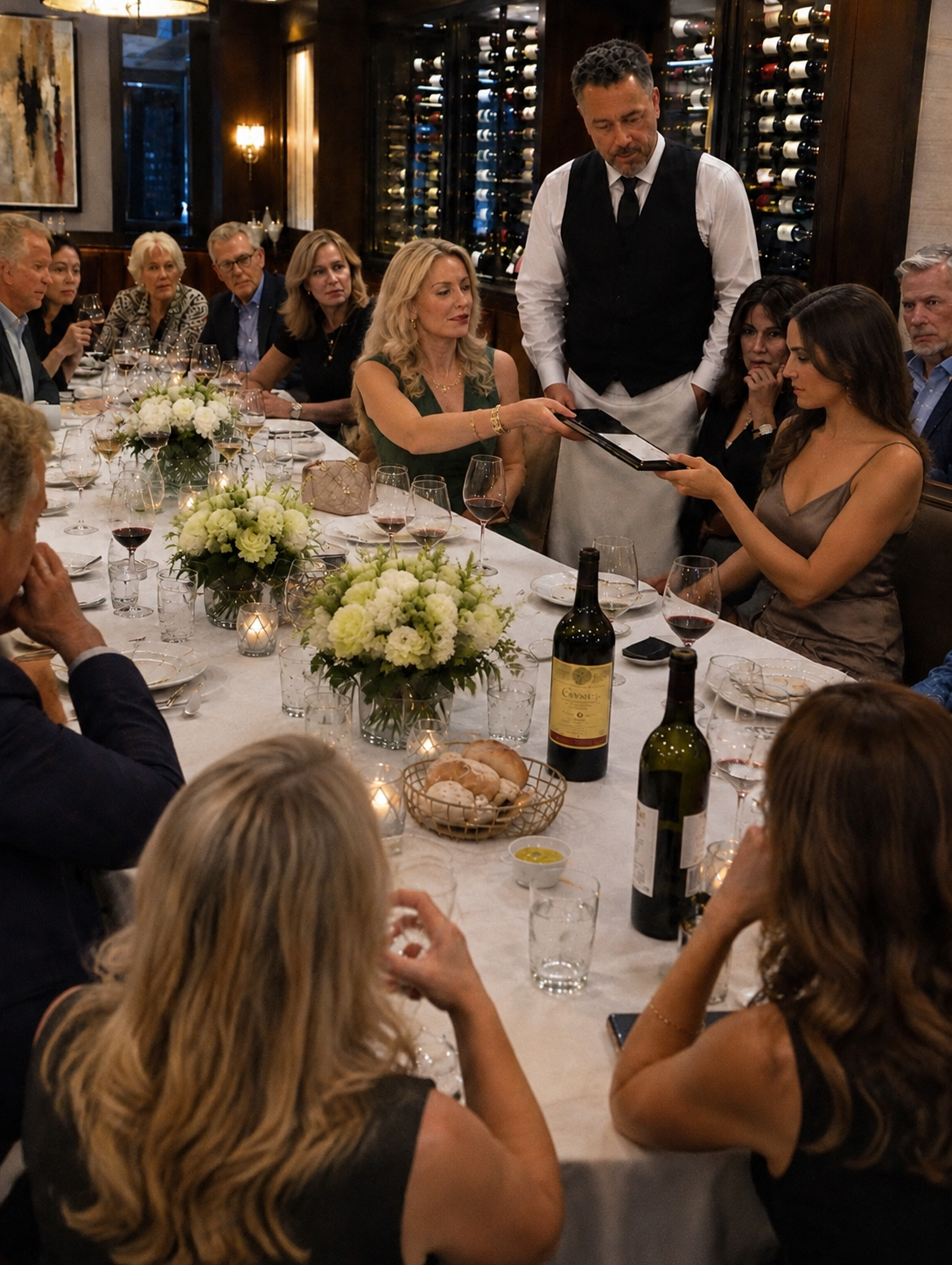
I arrived and found twelve relatives already seated around a long table.
Christina spotted me immediately.
“There she is!”
She waved her perfectly manicured hand.
“The birthday girl’s favorite sister-in-law.”
I forced a smile.
“Happy birthday, Christina.”
She stood and hugged me.
“Sit right here. Next to me. Tonight is going to be amazing.”
I sat beside her, even though something about the way she said it made me uneasy.
For the first few minutes, everything seemed normal.
People laughed.
They shared stories.
Someone asked about work.
Someone else talked about vacation plans.
For a brief moment, I almost forgot how heavy my heart felt.
Maybe my husband had been right.
Maybe I did need to get out.
Maybe being around family would help.
Then Christina leaned closer.
“You look tired, honey.”
Her eyes studied my face.
“But you’re holding up well.”
I nodded.
“I’m getting through it. One day at a time.”
“Of course you are,” she said. “And honestly, a night like this is exactly what you need.”
She raised her hand and called over the waiter.
He was young, polite, and carried himself with a calm professionalism.
“We’ll start with appetizers,” Christina announced.
“All of them.”
The waiter looked surprised for half a second but quickly smiled.
“Of course.”
“Don’t be shy,” she added. “It’s my birthday.”
I lowered my voice.
“Christina, that’s a lot of food for twelve people.”
She laughed.
“It’s one night. Live a little.”
The waiter wrote everything down.
Then, for just a moment, his eyes moved toward me.
Not in a rude way.
Not in a curious way.
Almost like he was trying to remember where he had seen me before.
I noticed it.
But I ignored it.
At the time, I had no idea that small moment would matter later.
I only wanted the night to pass quietly.
I wanted to go home.
I wanted to sit beside my mother’s boxes and somehow find the courage to open them.
But Christina had no intention of letting the evening stay simple.
And she was about to turn my grief into a weapon.

Part 2
The appetizers arrived one after another.
A dozen different plates filled the table.
Things I had never even heard of.
Fancy cheeses.
Seafood dishes.
Expensive-looking desserts.
Everyone reached across the table, laughing and sharing bites, but I noticed something strange.
Nobody asked how much anything cost.
Nobody looked at the menu again.
Nobody seemed concerned.
Except me.
I wasn’t there to judge anyone for enjoying themselves. It was Christina’s birthday, and I understood that people wanted to celebrate.
But after spending two years watching every dollar disappear into hospital bills, watching food arrive without anyone thinking about the price made me uncomfortable.
I quietly sipped my water.
Then Christina lifted her wine glass.
“To family,” she announced.
Everyone raised their glasses.
“To Christina!”
The table filled with laughter.
I smiled politely and took another sip of water.
I hadn’t wanted alcohol that night.
Not because I was trying to be difficult.
I just didn’t feel like celebrating.
My mind was still somewhere else.
With my mother.
With the hospital room.
With all the moments I wished I could go back and change.
Christina noticed.
“You’re not drinking?”
I looked up.
“I’m okay with water.”
She laughed.
“Come on. It’s a party. Loosen up.”
“I’m fine,” I said softly.
She shrugged, but there was something in her expression that bothered me.
A few minutes later, another bottle of wine arrived.
Then another.
I watched as the waiter carefully poured glass after glass.
Everyone seemed happy.
Everyone seemed relaxed.
Christina looked happier than anyone at the table.
At the time, I assumed she was simply enjoying her birthday.
I didn’t realize she already knew exactly how the night would end.
The waiter continued moving around the table, making sure everyone had what they needed.
He was attentive.
Quiet.
Professional.
But every now and then, I caught him looking at me.
Not at my clothes.
Not at my empty glass.
At me.
It was strange.
Almost like he was trying to place a memory.
I wondered if maybe I reminded him of someone.
But I was too exhausted to think about it.
After dinner, everyone continued talking.
The conversation moved from vacations to family gossip.
Then eventually, the waiter returned with the bill.
The leather folder landed in the center of the table.
My heart immediately sank.
I knew it would be expensive.
But I never expected what happened next.
Christina picked up the folder.
She barely looked inside.
Then she smiled.
And instead of opening it, she pushed it across the table toward me.
At first, I thought she was joking.
I laughed lightly.
“Happy birthday,” I said, pushing it back toward her.
But Christina didn’t laugh.
“No, seriously.”
She pushed it back.
“You should take care of it.”
I stared at her.
“What?”
She leaned back in her chair.
“You just inherited thousands from your mom.”
The words hit me harder than I expected.
Not because I hadn’t heard people mention the inheritance before.
But because of the way she said it.
Like my mother’s death had been a financial opportunity.
Like losing the woman who raised me had somehow become a reason I owed everyone else something.
I looked around the table.
A few relatives suddenly became very interested in their plates.
“I don’t think that’s appropriate,” I said quietly.
Christina tilted her head.
“Why?”
“Because that money isn’t for this.”
She gave a small laugh.
“Come on.”
I lowered my voice.
“Most of that money is going toward the debt from my mom’s treatment.”
Her smile faded slightly.
“I paid for years of hospital bills. I maxed out credit cards. I borrowed money from people because I wanted to give her every chance possible.”
I expected at least a little understanding.
Maybe an apology.
Maybe embarrassment.
Instead, Christina rolled her eyes.
“You’re being dramatic.”
I felt my chest tighten.
“Excuse me?”
She picked up her wine glass and swirled it slowly.
“I’m just saying, you got money. We’re family. What’s wrong with helping out?”
I looked at the bill.
Then back at her.
“This isn’t helping out. This is a birthday dinner you chose.”
Her expression changed.
A little colder.
A little sharper.
Then she said the one thing I never expected to hear from another person.
“Honestly, all that expensive treatment didn’t save her, did it?”
The table went silent.
Completely silent.
I felt like the air had been knocked out of my lungs.
For a moment, I couldn’t even process the sentence.
My mother’s face appeared in my mind.
Her hospital bed.
Her tired smile.
Her hand holding mine.
All those nights when she apologized for being sick.
As if her illness was something she had done to me.
Christina continued.
“Why are you still paying for it?”
Nobody moved.
Nobody spoke.
Twelve people sat around that table.
Twelve people who had attended my mother’s funeral.
Twelve people who had told me how sorry they were.
But now, when I needed someone to say something, they all looked away.
My brother, Christina’s husband, stared down at the tablecloth.
An aunt adjusted her napkin.
Someone cleared their throat.
Nobody defended my mother.
Nobody defended me.
And somehow, that hurt more than Christina’s words.
Because strangers can be cruel.
But when your own family stays silent, it feels like betrayal.
I finally found my voice.
“You don’t get to talk about her like that.”
My words came out quietly.
But they were shaking.
Christina raised her eyebrows.
“Why? Because it’s true?”
“No.”
I looked directly at her.
“Because you barely visited her.”
Her expression hardened.
“I was busy.”
She lifted her chin.
“Some of us have lives.”
I felt tears burning behind my eyes.
“You have no idea what those two years cost me.”
She interrupted.
“No, I think I do.”
She tapped the bill folder.
“You spent everything trying to save someone who was already dying.”
My stomach turned.
“It wasn’t like that.”
“Wasn’t it?”
She looked around the table.
“She’s gone. The money’s gone. And now you’re sitting here acting like a victim because someone asked you to pay for dinner.”
I couldn’t believe what I was hearing.
The woman sitting across from me wasn’t just asking me for money.
She was rewriting my entire relationship with my mother.
She was taking the hardest years of my life and reducing them to a bill.
Then she pushed the folder closer.
“Just pay it.”
Her voice became softer.
Almost fake.
“You’ll feel better.”
I looked around the table again.
I waited.
I waited for my husband to speak.
For my brother to say something.
For anyone to tell Christina she had gone too far.
But nobody did.
That was the moment something inside me broke.
I realized I wasn’t fighting one person.
I was fighting a room full of people who had decided staying comfortable mattered more than standing up for me.
Christina leaned closer.
“You know what your problem has always been?”
I didn’t answer.
“You’ve always been the favorite.”
She smiled slightly.
“Mom’s little girl.”
My hands tightened under the table.
“And now you have the money to prove it.”
She glanced at the bill.
“The least you can do is spread it around.”
I swallowed hard.
“You have no idea what those two years cost me.”
My voice cracked.
“Not just the money. The time. The fear. Watching her suffer. Sitting beside her when she couldn’t even recognize the room anymore.”
Christina looked away.
Then came the words that hurt even more.
“Margaret would be ashamed.”
For one second, my heart stopped.
Because I thought she was finally defending my mother.
I thought maybe someone had finally understood.
Then my aunt spoke.
And I realized I had misunderstood.
“She would be ashamed,” my aunt said quietly.
But she wasn’t looking at Christina.
She was looking at me.
My stomach dropped.
Christina immediately nodded.
“Exactly.”
She smiled.
“Ashamed of how selfish you’re being.”
That was it.
That was the moment I stopped hoping they would understand.
I stopped waiting for someone to save me.
I reached into my purse.
Maybe I would just pay.
Maybe I would take the humiliation and leave.
I didn’t have the strength to fight twelve people at once.
I didn’t want another argument.
I just wanted the night to end.
My fingers touched my wallet.
But before I could take it out, someone else moved.
A hand reached across the table.
And slowly lifted the bill folder away from me.
I looked up.
It was the waiter.
The young man who had been watching quietly all night.
The man who had heard every cruel word.
And for the first time that evening, someone finally decided to stop letting me carry the weight alone.

Part 3
The waiter stood beside the table holding the leather bill folder against his chest.
For a moment, nobody understood what was happening.
Christina looked up at him, annoyed.
“What are you doing?”
Her voice carried the same confidence she had used all evening.
The confidence of someone who believed everyone would always take her side.
The waiter didn’t answer her immediately.
Instead, he looked at me.
There was something in his expression that I couldn’t explain.
Not pity.
Not curiosity.
Something deeper.
Something that felt almost like recognition.
Then he asked quietly,
“Your mother’s name wasn’t Margaret, was it?”
The entire table froze.
I felt my heart stop.
The room seemed to become smaller.
The sounds of other diners talking around us faded away.
All I could hear was his question.
“My mother?”
My voice barely came out.
“Yes,” he said gently. “Was her name Margaret?”
I stared at him.
“Yes.”
His expression changed.
The uncertainty disappeared.
And in its place was a sadness mixed with warmth.
A feeling I had seen many times on people’s faces when they remembered my mother.
“Why?” I whispered.
Instead of answering, he reached into the pocket of his apron.
Slowly, carefully, he pulled something out.
Something small.
Something gold.
My breath caught before my mind could even understand what my eyes were seeing.
He placed it on the white tablecloth in front of me.
For a few seconds, I couldn’t move.
Because I knew that shape.
I knew that shine.
I knew the tiny scratches on the surface.
The locket.
My mother’s locket.
The one I had searched for.
The one I had cried over.
The one I believed was gone forever.
My hands covered my mouth.
“No…”
The word escaped before I could stop it.
The waiter looked at me softly.
“Open it.”
My fingers shook as I reached forward.
I was afraid.
Afraid that somehow I was wrong.
Afraid that I would open it and find another photograph.
Another person.
Another reminder that my mother was truly gone.
But the moment I touched the clasp, I knew.
It was hers.
I opened it.
And there she was.
The little photograph of me from years ago.
The same picture my mother carried close to her heart every day.
The same picture she had refused to remove, even when nurses told her to take off jewelry before procedures.
Tears immediately filled my eyes.
“How?”
My voice broke.
“Where did you get this?”
The waiter pulled out a chair slightly and lowered his voice.
“I work here at night to pay for school.”
The entire table remained silent.
“During the day, I’m a CNA trainee.”
He looked at the locket.
“I did part of my training at the hospital where your mother was treated.”
My fingers closed around the gold.
“I spent a lot of time in your mother’s room.”
He paused.
“One night, she noticed I was upset.”
I looked at him.
“Why?”
He smiled sadly.
“I was worried about tuition. I was trying to figure out how I could afford another semester. I was thinking about dropping out.”
My eyes never left his face.
“And then your mother did something I’ll never forget.”
He swallowed.
“She took this locket off her neck.”
My heart ached.
Because I knew what that meant.
My mother had told me she would never take it off.
Not for anyone.
Not for anything.
“She told me it was real gold,” he continued. “She said I could pawn it. That it might help pay for my classes.”
The table became completely still.
“She said something that night that stayed with me.”
He looked down at the locket.
“She said, ‘If something I can’t take with me can help someone who is still trying to get somewhere, then it’s worth giving away.’”
My eyes filled with tears.
For months, I had believed someone had stolen the most precious thing my mother owned.
But the truth was completely different.
She had given it away.
Because that was who she was.
Even while fighting for her own life, she was still thinking about someone else.
“But why do you still have it?” I asked.
The waiter smiled faintly.
“Because I couldn’t sell it.”
He looked at the photograph inside.
“I opened it and saw you.”
I froze.
“She had told me about you.”
My throat tightened.
“She talked about her daughter constantly.”
He smiled.
“She told me about how you stayed with her. The hospital visits. The bills. The nights you barely slept. The things you gave up to take care of her.”
I looked down.
My tears fell onto the tablecloth.
“She was proud of you.”
Those four words broke something inside me.
Because for months, I had wondered if I had done enough.
If I had made the right choices.
If I had spent too much.
If I should have tried harder.
But my mother had never seen me as a burden.
She had seen me as her daughter.
The waiter continued.
“I know it sounds strange, but keeping the locket helped me.”
He touched his chest.
“Whenever I wanted to quit, I looked at it and remembered her.”
His voice became softer.
“It reminded me that someone believed I could make it.”
I wiped my tears.
“Mom used to say the locket helped her feel brave.”
The waiter nodded.
“I think she gave that feeling to me.”
For the first time all night, nobody at the table knew what to say.
Nobody had a comment.
Nobody had a judgment.
Nobody had an excuse.
Then Christina finally spoke.
Her voice was impatient.
“This is very touching.”
She crossed her arms.
“But it doesn’t change anything.”
Everyone looked at her.
She continued.
“The treatment was still a waste of money. She died anyway.”
The warmth disappeared from the waiter’s face.
Slowly, he turned toward her.
And I realized something.
The locket was not the only reason he had stopped the argument.
My mother had left him something else.
Her words.
Her wisdom.
Her truth.
The waiter spoke calmly.
“May I tell you what Margaret believed about that?”
Christina didn’t answer.
But she didn’t stop him.
So he continued.
“She knew the treatment might not save her.”
My breath caught.
“She told me, ‘Sometimes treatment doesn’t buy a cure.’”
He looked around the table.
“‘Sometimes it buys time. And time still counts.’”
I covered my mouth.
Because suddenly, everything changed.

For four months, I had looked at those medical bills and only seen what we lost.
Money.
Energy.
Hope.
But my mother had looked at those same bills differently.
She had seen every extra morning she woke up.
Every extra meal we shared.
Every extra conversation.
Every extra moment where she got to be my mother.
The waiter looked directly at me.
“She told me every extra month, every extra dinner, every extra conversation with the daughter she loved was worth more than anything.”
His voice softened.
“She said it was the best money she had ever spent.”
The tears came harder.
Because I finally understood.
My mother hadn’t fought because she was afraid of dying.
She fought because she wanted more time with me.
Christina shifted in her seat.
“That’s easy to say when someone else is paying the bills.”
The waiter didn’t react.
He simply looked at her.
“Ma’am, your mother-in-law was thinking about helping a struggling student she barely knew while she was sick.”
His voice became firmer.
“And tonight, you used that same woman’s death as a reason to hand her grieving daughter a four-hundred-dollar bill.”
The table became uncomfortable.
A few relatives looked down.
Others avoided Christina’s eyes.
She opened her mouth.
“I didn’t mean—”
“You said the treatment didn’t save her.”
The waiter interrupted calmly.
“So let me ask you something.”
He placed the bill folder back on the table.
“Do you think Margaret would want her daughter paying for your birthday wine?”
Nobody answered.
Not Christina.
Not anyone.
Her face slowly lost its confidence.
The waiter picked up the locket and held it out to me.
“This belongs to you now.”
My hands trembled as I took it.
“I’ve carried it for months.”
He smiled.
“It helped me through the hardest time in my life.”
He looked at the locket.
“But I think it needs to be with you now.”
I closed my fingers around it.
The small gold weight felt warm.
Like a piece of my mother had somehow found its way back home.
“She’d be proud of you,” I whispered.
The waiter smiled.
“You finished your training?”
“Almost.”
He nodded.
“Because of people like her.”
For a moment, I forgot about Christina.
I forgot about the bill.
I forgot about the relatives who had sat silently while I was hurt.
All I felt was my mother.
Not in the hospital.
Not in pain.
But in kindness.
In the stranger sitting across from me.
In the locket resting in my palm.
My mother had reached me again.
Through someone she helped when she thought nobody was watching.
“Thank you,” I whispered.
The waiter nodded.
Then he placed the bill folder back in the center of the table.
“I’ll give you all a few more minutes to decide who will be paying for this.”
Then he walked away.
Nobody spoke.
Christina’s smile was gone.
The confidence she had carried all night had disappeared.
For the first time, she looked uncomfortable.
“I didn’t know,” she said quietly.
“I didn’t mean it like that.”
Nobody responded.
Then my brother slowly reached across the table.
He picked up the leather folder.
Everyone watched him.
He turned toward Christina.
“Your birthday.”
He placed the bill in front of her.
“Your wine.”
A pause.
“Your bill.”
Christina stared at him.
“But we’re family.”
My brother looked at her.
“Then act like it.”
And for once, nobody defended her.
I walked out of that restaurant feeling lighter than I had in two years.
Not because of the bill.
Not because Christina had been embarrassed.
But because I finally had something back that I thought I had lost forever.
The locket rested in my hand as I walked home.
And somehow, my mother didn’t feel as far away anymore.
That night, I sat beside the boxes of her belongings I had avoided opening for months.
For the first time, I didn’t feel afraid.
I placed the locket around my neck.
Then I opened the first box.
Inside were her old photographs.
Her favorite scarf.
Small things that belonged to the woman I missed more than words could explain.
And as I sorted through them, I finally allowed myself to cry.
Not the painful tears I had cried for months.
Different tears.
The kind that came when you realized love didn’t disappear just because someone was gone.
Maybe the locket had made me brave enough to face the final part of letting go.
Or maybe I had simply been waiting for my mother to remind me that she was never truly gone.
She had left pieces of herself everywhere.
In memories.
In kindness.
In strangers.
And now, finally, I was ready to find them.