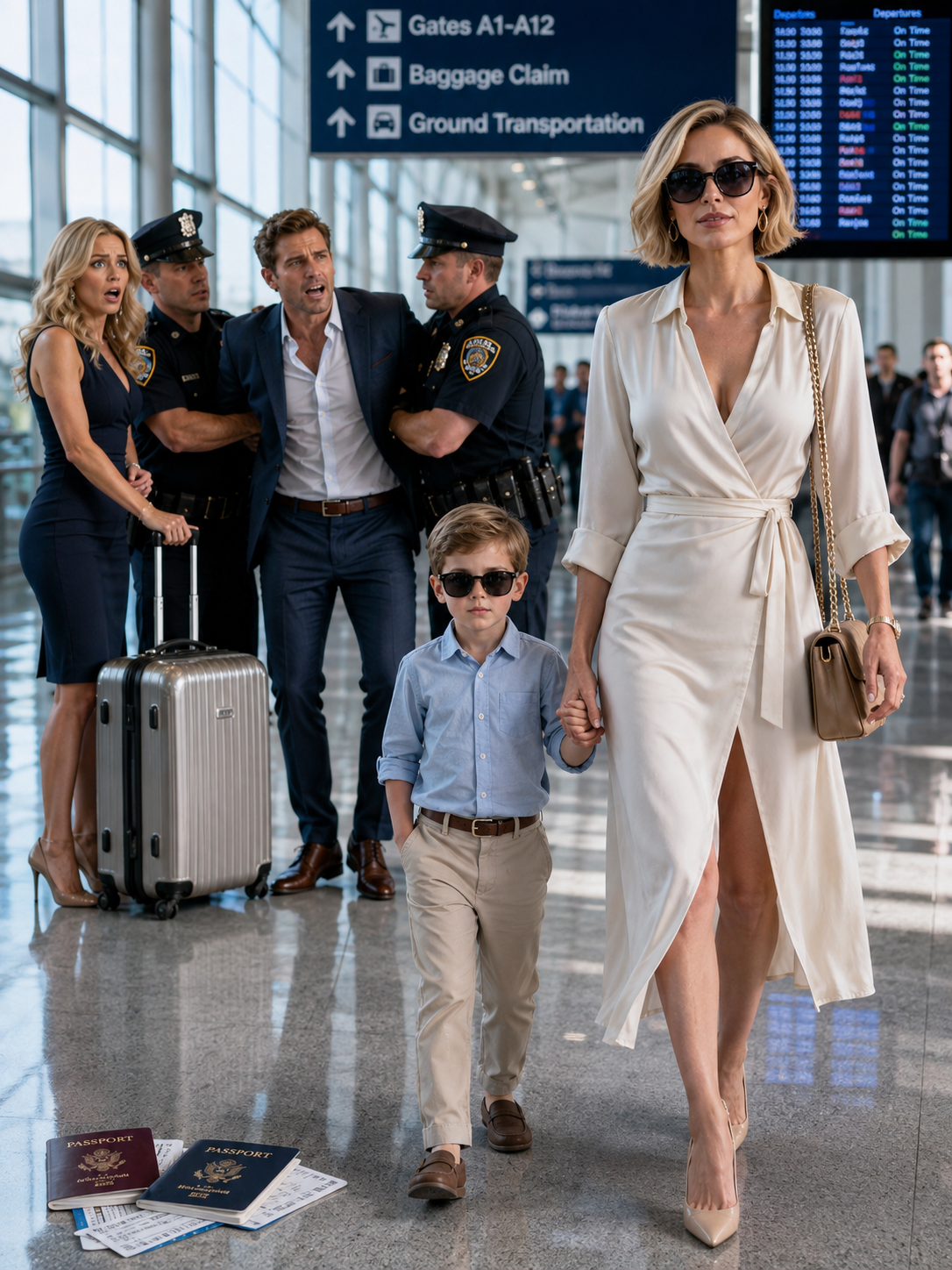

Part 1: The Goodbye at JFK
The strangest thing about being abandoned is not the moment someone walks away.
It is the moment before.
The final seconds when you realize the person standing in front of you—the person you shared decades of your life with, the person who once promised to love you through every season—has already left emotionally long before they ever leave physically.
That was what happened to me at JFK International Airport.
My husband, Richard Ashford, did not look like a man ending a twenty-seven-year marriage.
He looked like a man celebrating a promotion.
He stood beneath the bright airport lights in the international departure hall, one hand resting casually on the handle of his expensive suitcase, the other wrapped around the arm of a woman seventeen years younger than him.
A woman who was not his wife.
A woman who looked at me with the quiet confidence of someone who believed she had already won.
Her name was Bianca Vale.
She was elegant, polished, and perfectly dressed in a cream designer coat that probably cost more than my first car. Her blonde hair was carefully styled, her makeup flawless, and her expression carried the kind of satisfaction only someone certain of their future could wear.
Richard glanced at his watch, then looked back at me.
“I’m moving to Dubai with Bianca,” he said.
His voice was calm.
Too calm.
Like he was announcing a business decision instead of destroying a family.
“You can stay here and grow old in that house you never knew how to enjoy.”
For a moment, the noise of the airport seemed to disappear.
The announcements over the speakers.
The rolling suitcases.
The footsteps of strangers rushing toward their gates.
Everything faded except those words.
Grow old alone.
That was what he wanted me to hear.
That was the final wound he wanted to leave behind.
My name is Eleanor Ashford.
I was fifty-four years old when my husband decided he was done with me.
I had silver strands beginning to appear near my temples. My hands showed years of cooking, cleaning, caring, and working. I was not the young woman Richard had married anymore.
But I was also not the helpless woman he imagined.
For years, Richard had confused my silence with weakness.
He believed because I did not scream, I did not notice.
Because I did not fight, I did not understand.
Because I stayed, I had nowhere else to go.
He was wrong.
Very wrong.
I stood there holding the suitcase he had asked me to carry from the car, looking at the man I had spent almost three decades beside.
Then I simply said:
“All right.”
Richard blinked.
“All right?”
I nodded.
“Have a safe trip.”
For the first time that morning, his confident expression changed.
Only slightly.
But I noticed.
Richard had prepared for tears.
He had prepared for anger.
He had prepared for me to grab his arm, beg him to reconsider, or make some desperate scene in front of hundreds of strangers.
He wanted proof that he still had power over me.
Instead, I gave him nothing.
His jaw tightened.
“That’s all?”
“Yes.”
“You’re not going to fight for your marriage?”
I looked at him.
“No.”
Bianca let out a small laugh beside him.
Not a loud laugh.
A cruel one.
The kind people use when they believe they are standing above someone else.
“Richard needs someone who understands ambition,” she said. “Not someone whose life revolves around medicine bottles, grocery lists, and reheated dinners.”
Her words were carefully chosen.
She wanted them to hurt.
And years earlier, they probably would have.
But pain changes when you have already survived the worst parts.
I had spent nearly six years caring for Richard’s mother, Margaret Ashford.
When Margaret became too sick to live alone, Richard told everyone he was doing everything possible.
He told relatives he was overwhelmed.
He told his colleagues he was balancing family responsibilities.
He told people he was a devoted son.
The truth was much simpler.
He was rarely there.
While Richard attended expensive dinners in Manhattan with Bianca disguised as “business meetings,” I was sitting beside Margaret’s bed at three in the morning, helping her breathe through panic attacks.
I prepared her meals.
I organized her medications.
I drove her to doctor appointments.
I cleaned the house.
I listened when she was afraid.
There were nights when Margaret forgot what year it was and cried because she thought she was a burden.
I was the one who held her hand and told her she mattered.
Richard never saw those moments.
Or maybe he simply never cared enough to look.
Seven months before the airport goodbye, Margaret passed away.
At her memorial service, Richard stood in front of family members, business partners, and old friends wearing a perfectly tailored black suit.
He spoke about his mother with tears in his eyes.
He called himself a devoted son.
People praised him.
They told him Margaret was lucky to have such a loving child.
I stood quietly in the back of the room.
No one knew I was the person who had been there when Margaret could no longer recognize her own reflection.
No one knew I was the person who whispered comfort to her when she was scared.
No one knew I was the person who held her hand during her final moments.
Richard accepted the sympathy.
He accepted the praise.
He accepted the image of a good son.
And that was the moment something inside me changed.
I stopped waiting for him to become the man he pretended to be.
Back at JFK, Richard adjusted the expensive watch on his wrist.
A watch I had bought him years earlier for our twentieth anniversary.
“I’ve already arranged to sell the house,” he said.
The house.
The place where we raised our children.
The place where Margaret spent her final years.
The place where I had built a life.
“You’ll receive instructions about moving out,” he continued. “Maybe one of your sisters can help you find a smaller apartment.”
Bianca smiled.
She looked around the airport as if she could already see herself living in my place.
She had no idea.
Neither of them did.
The house could not be sold.
Not without my approval.
Richard did not know that.
He also did not know that the eighteen million dollars he believed he had moved overseas had never actually left the United States.
He thought he had hidden everything perfectly.
He thought he had erased every trace.
But people like Richard always made the same mistake.
They believed the people they ignored were incapable of discovering the truth.
He had spent years underestimating me.
And that was exactly why I had the advantage.
“Goodbye, Richard,” I said.
His eyes narrowed.
Something about my calmness bothered him.
Maybe deep down, he sensed something was wrong.
Maybe he realized this was not the reaction of a woman who had just lost everything.
But his arrogance won.
It always did.
He picked up his luggage.
Bianca placed her hand through his arm.
Together, they walked toward security.
They did not look back.
Richard believed he was walking toward freedom.
He believed Dubai represented a new beginning.
A younger woman.
A new country.
A life without responsibilities.
He had no idea those suitcases carried the beginning of his downfall.
Inside them were expensive watches purchased through company funds.
Corporate documents.
Undeclared assets.
Evidence of transactions he believed nobody would ever find.
And enough information to confirm what investigators had already begun uncovering.
I watched him approach the security checkpoint.
The man who had once promised to stand beside me forever.
The man who believed he could replace twenty-seven years of marriage with a new romance.
The man who told me I would grow old alone.
He placed his passport against the scanner.
For one second, everything looked normal.
Then the machine beeped.
A sharp warning sound cut through the airport noise.
Richard froze.
The officer looked at the screen.
“Sir, please step to the side.”
Richard frowned.
“There must be some mistake.”
The officer did not answer.
And for the first time that morning, Richard looked uncertain.
Not angry.
Not confident.
Uncertain.
I stood several feet away, still holding the suitcase he had handed me.
And I watched the first crack appear in the life he thought he had built.
Because Richard Ashford believed he was leaving me behind.
He had no idea the truth was waiting for him at the gate.

Part 2: The Door That Would Not Open
The warning sound from the passport scanner was not loud.
Most travelers probably barely noticed it.
But Richard did.
He had spent his entire life believing every door would open for him if he walked toward it confidently enough.
Banks approved his loans.
Executives trusted his promises.
People believed his stories.
His employees followed his orders.
And for twenty-seven years, I had quietly protected the image of a man who was far less impressive than he wanted the world to believe.
But that morning at JFK, a small electronic beep stopped him.
The officer looked at the screen again.
“Sir, I need you to step aside.”
Richard forced a laugh.
“This is ridiculous. I’m a Global Entry member. I travel internationally several times a year.”
The officer remained professional.
“I understand, sir. Please step aside while we complete a review.”
Bianca’s confident smile began to disappear.
“We’re going to miss our flight,” she said.
The officer did not even look at her.
“Ma’am, please allow us to handle this.”
Richard’s face tightened.
He hated being ignored.
He especially hated being ignored in public.
For years, he had perfected the image of a powerful businessman who controlled every room he entered. He knew exactly how to speak, how to dress, and how to make people feel as if they were lucky to have his attention.
But airports were different.
Security officers did not care about his reputation.
They did not care about his company.
They did not care about the stories he told.
They cared about what appeared on their screen.
I watched from behind the security line, still holding the suitcase he had pushed into my hands earlier.
A strange feeling settled over me.
Not happiness.
Not revenge.
Something quieter.
Relief.
Because for the first time in years, Richard was standing in a place where charm could not protect him.
A second officer arrived.
Then a third.
Richard noticed.
His confidence began to crack.
“What exactly is this about?” he demanded.
No one answered immediately.
That frightened him more than an accusation would have.
Then a man wearing a dark suit approached.
He was not dressed like airport security.
He moved differently.
Calm.
Focused.
The kind of person who did not need to raise his voice to make people listen.
He spoke quietly with the officers before turning toward Richard.
“Mr. Ashford?”
Richard looked at him.
“Yes?”
The man showed his identification.
“I’m Special Agent Marcus Wren with the Federal Bureau of Investigation.”
For the first time that day, Richard had no immediate response.
The color drained slightly from his face.
“That’s impossible.”
Agent Wren remained expressionless.
“Mr. Ashford, you need to come with us.”
Richard gave a short laugh.
“This is some kind of misunderstanding.”
“Do not make this harder than it needs to be.”
People around them had started watching.
Travelers slowed down.
A few whispered.
Bianca immediately stepped forward.
“Excuse me, but there must be some mistake. Richard is traveling for business.”
Agent Wren looked at her.
“Ms. Vale?”
Her expression changed.
Only for a moment.
But I saw it.
The confidence disappeared.
“How do you know my name?” she asked.
“We’ll discuss that shortly. You’ll need to come with us as well.”
Richard turned toward her.
“What?”
Bianca looked at him.
Not with fear.
Not with loyalty.
With calculation.
It was a small change.
A slight movement of her eyes.
But Richard noticed.
And suddenly, for the first time, he realized the woman he had chosen over his wife might not be standing beside him.
“What did you do?” he whispered.
Bianca’s eyebrows lifted.
“What did I do?”
“This is your company too.”
Her voice became sharper.
“Your company, Richard. Your decisions.”
That was the moment he understood.
He was alone.
The same way he had planned for me to be alone.
The same way he had confidently told me I would grow old without him.
The irony was almost impossible to miss.
Richard Ashford, the man who believed he was escaping his old life, was now watching his new life begin to collapse.
As they escorted him away, he suddenly looked back at me.
Not lovingly.
Not apologetically.
Desperately.
“Eleanor.”
It was the first time in months he had said my name like I was a person instead of a responsibility.
I did not move.
I did not answer.
Because I remembered how this began.
Three months after Margaret’s death, I found the first clue.
It happened on an ordinary evening.
Richard had left his laptop open on the kitchen counter.
Normally, I would have ignored it.
That was the kind of wife I had been.
Respectful.
Trusting.
The kind of person who believed privacy mattered even inside marriage.
But that night, his phone lit up beside the computer.
A message appeared.
I did not search for it.
I did not invade anything.
It simply appeared.
And what I saw changed everything.
The message said:
“Dubai structure finalized. Wife still unaware? Transfer window closes Friday.”
Wife.
Not Eleanor.
Not my name.
Just wife.
A box to check.
An obstacle to remove.
The sender was listed as B. Vale.
Bianca.
My hands went cold.
For several minutes, I simply stared at the screen.
I wanted to believe there was an explanation.
A business mistake.
A misunderstanding.
Anything.
Because accepting the truth meant accepting that twenty-seven years of marriage had been built on something I no longer recognized.
The next morning, Richard kissed my forehead before leaving.
The same way he had done thousands of times.
“I’ll be late tonight. Board dinner.”
I smiled.
“Of course.”
Then I packed his blood pressure medication into his briefcase.
That was the moment I understood something about myself.
I was not going to scream.
I was not going to confront him.
I was not going to give him the satisfaction of seeing me broken.
Instead, I called my sister Helen.
Helen had spent thirty years working as a forensic accountant for the U.S. Attorney’s Office.
When she heard what I found, she did not immediately react.
She simply asked:
“Eleanor, do you want the truth?”
I looked around the house.
At the photographs.
The furniture.
The memories.
The life I thought I had.
“Yes.”
She paused.
“Are you sure?”
I knew what she meant.
The truth would not just hurt me.
It would destroy the version of Richard I had carried in my mind for decades.
“Yes,” I repeated.
“I want the truth.”
Helen spent weeks quietly investigating.
No accusations.
No dramatic confrontations.
Just facts.
Numbers.
Documents.
Patterns.
She found what Richard believed was invisible.
Hidden accounts.
Fake consulting payments.
Shell companies.
Luxury purchases disguised as business expenses.
Money transferred through companies that existed only on paper.
The eighteen million dollars Richard thought he had hidden away was not missing.
It was stolen.
Piece by piece.
Carefully.
Deliberately.
He had not built a secret future.
He had built evidence.
Helen looked at me after reviewing everything.
“Men like Richard hide crimes in places they assume women won’t look.”
She tapped the folder in front of us.
“They hide them behind complicated words. Investment structures. Corporate language. Legal documents.”
She looked directly at me.
“But greed always leaves fingerprints.”
And Richard had left thousands.
One of the most important discoveries came from Lydia Rowe.
A seventy-three-year-old early investor whose late husband had been one of Richard’s mentors.
Richard always treated Lydia like an old woman who was too sentimental to understand business.
He called her family.
But behind closed doors, he underestimated her.
A few weeks after Margaret’s funeral, Lydia called me.
“Eleanor,” she said quietly, “did Richard tell you I requested a full redemption of my account?”
“No.”
There was silence.
Then she said:
“He told me you were ill and asked me not to trouble your household.”
My grip tightened around the phone.
“I’m not ill.”
“I know.”
Her voice became colder.
“That’s why I became suspicious.”
Lydia had discovered that her investment funds were not where they were supposed to be.
And once she started asking questions, she found missing documents.
False reports.
Unauthorized movements.
The same pattern Helen had uncovered.
That was when everything changed.
The investigation became bigger.
Attorneys became involved.
Records were requested.
Meetings were held behind closed doors.
And while all of that happened, Richard continued living in our house believing I was still the same quiet woman who would never challenge him.
He complained about small things.
Dinner not being ready early enough.
The house not being organized exactly how he liked.
My “lack of excitement.”
He never noticed that I had stopped listening.
He never noticed that I had stopped hoping.
And most importantly, he never noticed that I already knew everything.
Until JFK.
Until the moment he tried to walk away.
Agent Wren turned back toward me.
“Mrs. Ashford.”
Richard stopped.
His eyes moved between us.
“You know her?”
I looked at him.
After twenty-seven years, after all the lies, after all the secrets, I finally saw him clearly.
A man who thought he had abandoned me.
A man who had no idea he was the one being trapped.
“I told the truth,” I said.
Richard stared at me.
The realization slowly reached his face.
The calm goodbye.
The suitcase.
The investigators.
The timing.
The money.
The documents.
He finally understood.
He had not left me behind.
He had walked directly into the consequences waiting for him.
The officers led him and Bianca away.
This time, she did not hold his arm.
She did not look like the woman who had won.
She looked like someone searching for a way out.
After they disappeared, I released my grip on the suitcase.
It fell onto its side with a heavy thud.
Inside were the things Richard never expected anyone to find.
Luxury watches bought with company money.
Unsigned corporate documents.
Encrypted drives.
Printed copies of files Bianca had tried to erase.
Richard had told me that morning:
“You might as well be useful one last time.”
So I was.
I had carried his suitcase.
I had delivered his secrets.
And I had watched the door close behind him.

Part 3: The House He Could Not Sell
By the time the officers finished questioning me at JFK, the sun had already begun moving lower over the airport.
The morning that Richard planned to begin his new life had become the day his carefully constructed world started falling apart.
I sat inside a private conference room with Agent Marcus Wren and two investigators.
They did not treat me like a victim.
They treated me like someone who had survived something.
And strangely, that meant more.
For years, people had looked at me and seen a quiet wife.
A caregiver.
A woman who stayed behind while her husband built an empire.
They never saw the person who remembered every detail.
Every conversation.
Every unexplained expense.
Every moment Richard thought was too insignificant for me to notice.
Agent Wren placed a document on the table.
“Mrs. Ashford, we need you to confirm something.”
I looked down.
It was a spousal consent form.
My name appeared at the bottom.
A signature that looked almost identical to mine.
Almost.
“Did you sign this?” he asked.
I stared at the paper.
“No.”
The room became silent.
“Do you recognize the signature?”
I looked closer.
Then I saw the notary information.
My stomach tightened.
“Bianca Vale.”
Agent Wren nodded.
“She notarized it.”
The document had been created on the same day Margaret suffered a seizure upstairs.
I remembered that day clearly.
I remembered Richard standing in the doorway while I held Margaret’s hand and waited for the ambulance.
I remembered calling him seven times.
Seven.
He never answered.
Later, he told me he had been in an important board meeting.
Apparently, that meeting was more important than his dying mother.
Apparently, so was everything else.
Agent Wren continued.
“She was attempting to authorize liquidation of jointly held assets.”
“Meaning?”
“Meaning Richard intended to sell properties, move funds, and make it appear you had approved.”
I closed my eyes for a moment.
For years, I had wondered how someone I loved could become so cold.
Now I understood.
Richard did not suddenly become a different person.
He simply stopped pretending.
By late afternoon, the investigators allowed me to leave.
Lydia’s attorney offered to arrange transportation.
I refused.
I drove home in Richard’s black sedan.
The same car he had driven to meet Bianca.
The same car where he had probably answered her calls while pretending he was stuck in traffic.
The inside smelled like his cologne.
For years, that smell meant one thing.
Richard was home.
That afternoon, it meant nothing.
When I opened the front door, the house felt strangely unfamiliar.
Not because anything had changed.
Because I had.
His coffee cup was still sitting in the sink.
His jacket hung over the chair.
His closet door was open.
He had taken his expensive suits, his watches, his passport, and the framed photograph of himself standing beside a former senator.
But he had not taken a single picture of us.
Not one.
That hurt more than I expected.
Not because I wanted him back.
But because it confirmed something I had spent years refusing to see.
Richard had already removed me from his life long before he physically walked away.
I went upstairs.
Bianca’s perfume still lingered near the dresser.
I stopped.
Evidence was one kind of pain.
A scent was another.
A scent carried memories.
It reminded me that another woman had stood inside the home I had protected.
A home where I had cared for Margaret.
A home where I had spent years believing I was building something permanent.
I opened every window.
Cold air moved through the room.
Then I began packing the rest of Richard’s belongings.
Not angrily.
Not dramatically.
Just carefully.
The way I had done everything for twenty-seven years.
At the back of his closet, behind several garment bags, I found a locked case.
I almost ignored it.
The old Eleanor would have.
The woman who trusted him.
The woman who believed marriage meant never questioning.
But that woman was gone.
I searched his nightstand.
The key was taped beneath the bottom drawer.
Richard always believed he was smarter than everyone around him.
He was not.
He was simply surrounded by people who trusted him.
Inside the case were passports.
Three of them.
The first was a second American passport.
The second contained Richard’s photograph under another name.
My hands froze when I opened the third.
It belonged to Bianca.
But not under the name Bianca Vale.
The name inside was:
Clara Whitman.
Beside the passports were property documents from Portugal.
Bank information from Singapore.
Private phone numbers.
And a photograph.
A little girl standing beside Richard on a beach.
She looked around eight years old.
She had blonde hair.
Bianca’s hair.
And Richard’s eyes.
I turned the photograph over.
Three words were written on the back in Richard’s handwriting.
“For my daughter.”
I sat on the edge of the bed.
For months, I thought I understood the betrayal.
The affair.
The money.
The escape.
The humiliation.
But there was more.
Richard had another child.
I thought about all those years.
The fertility treatments.
The miscarriages.
The nursery I had painted pale yellow.
The room I eventually turned into Margaret’s recovery space.
I remembered Richard saying he was too busy to continue trying.
Too busy for appointments.
Too busy for hope.
Now I wondered what else he had been hiding.
My phone rang.
Helen.
I answered immediately.
“Are you home?”
“Yes.”
Her voice changed.
“Lock the doors.”
I stood.
“What happened?”
“Richard made a call.”
My heart tightened.
“Who did he call?”
Helen hesitated.
“Bianca’s emergency contact.”
“Who?”
“Adrian Vale.”
The name meant nothing to me.
But it meant something to Helen.
“He’s connected to Vale International Logistics,” she said. “A company that was investigated years ago for moving undeclared assets through international free ports.”
I looked toward the dark window.
Outside, headlights slowed near the house.
A car passed.
Then another vehicle stopped.
My reflection stared back at me.
Silver hair.
Tired hands.
Calm eyes.
The woman Richard thought he had abandoned.
My phone buzzed.
An unknown number.
A message appeared.
It contained a photograph.
Richard and Bianca were sitting in a room I did not recognize.
Richard looked terrified.
Bianca stood behind him.
Smiling.
The message underneath said:
“You found the wrong secret, Eleanor.”
Then I heard it.
A sound from downstairs.
Not the doorbell.
The lock turning.
Someone had a key.
Part 4: The Woman He Forgot
The person standing outside my door was not Richard.
It was Elena Voss.
Richard’s first wife.
I knew her name before I knew her face.
For years, Richard had described her as unstable.
Difficult.
A woman who could never let go.
He always told the story the same way.
He was the victim.
She was the problem.
But Margaret once whispered something to me during one of her final weeks.
“He did it before.”
At the time, I assumed she meant cheating.
I never imagined she meant destruction.
Elena stood on my porch wearing a dark coat, holding a small folder.
She looked older than the photographs I had seen.
But she also looked free.
“I’m sorry,” she said.
Two words.
Simple words.
But they carried years of pain.
She handed the folder to me.
Inside were documents.
Original documents.
Proof that Richard had been doing this long before I met him.
Elena explained that Richard had stolen money from her family trust after their divorce.
He forged signatures.
Manipulated accounts.
Destroyed her father’s retirement savings.
And when she tried to expose him, Richard convinced everyone she was bitter.
Crazy.
Angry.
“She knew,” Elena said.
“Who?”
“Margaret.”
I froze.
“She knew what he was?”
Elena nodded.
“Not at first. But eventually.”
She looked toward the house.
“She tried to warn people.”
My chest tightened.
Margaret had tried.
She had seen the monster hiding behind the successful businessman.
And she had spent years carrying that knowledge alone.
Then Elena handed Agent Wren a hard drive.
“Everything is here.”
The investigation expanded overnight.
Richard was not just a man hiding money.
He was part of a system built long before him.
His father had created secret accounts.
Hidden assets.
Private networks.
Richard inherited it.
Then improved it.
But he made one mistake.
He became arrogant.
He believed everyone around him was less intelligent.
Especially women.
Especially me.
That was why he lost.
Because he never considered the possibility that I was paying attention.
Part 5: The Fall of Richard Ashford
Bianca was arrested trying to retrieve documents from the luxury apartment Richard purchased under another person’s name.
Inside were encrypted drives.
Hidden accounts.
Fake contracts.
And Margaret’s missing sapphire brooch.
The same one Richard claimed had disappeared.
The same one he quietly blamed others for losing.
Bianca eventually cooperated.
Not because she suddenly became honest.
Because she realized Richard was willing to sacrifice her.
The man who promised her a future had prepared an escape plan without her.
When investigators questioned her, she admitted Richard planned to disappear after reaching Dubai.
New identity.
New accounts.
New country.
He never intended to build a life with her.
She was simply another part of the plan.
Another person he believed he could use.
The investigation eventually found the truth behind the eighteen million dollars.
Richard had not moved it overseas successfully.
He had moved pieces.
Slowly.
Carefully.

Through companies connected to his father’s old network.
But Margaret had discovered the truth before she died.
And she had prepared for it.
Inside a sealed envelope was a letter addressed to me.
Her handwriting shook.
But her message was clear.
She apologized for not telling me sooner.
She wrote that Richard had learned from his father that people were tools.
Useful until they became inconvenient.
She wrote that she had watched him hurt Elena.
Lie to me.
And destroy anyone who stood between him and money.
Then came the part I never expected.
Margaret had protected the family shares.
A controlling portion of Ashford Meridian.
She transferred them into a trust.
The beneficiary?
Me.
The woman who cared for her when there was nothing to gain.
The woman Richard considered insignificant.
I read the letter again and again.
Elena smiled sadly.
“He tried to destroy a company he no longer controlled.”
The irony was almost unbelievable.
Richard thought he was escaping with everything.
He was leaving behind the very empire he believed belonged to him.
Part 6: The Man Who Begged Too Late
When Richard asked to see me, I almost refused.
But I went.
Not because I missed him.
Because I wanted closure.
He sat across from me behind a glass wall.
For the first time in twenty-seven years, Richard Ashford looked small.
Not powerful.
Not untouchable.
Just human.
“Eleanor,” he said.
I said nothing.
“Call my attorney.”
I looked at him.
“For which problem?”
He swallowed.
The old Richard would have become angry.
The new Richard was afraid.
He blamed Bianca.
He blamed circumstances.
He blamed stress.
He blamed everything except himself.
Then he said something that surprised me.
“I did love you once.”
I believed him.
That was the saddest part.
Because love had existed.
It just had not been enough.
“I loved you too,” I said.
His eyes filled.
“Then why are you doing this?”
I looked at him.
“Because you stopped loving me long before I stopped loving you.”
Silence.
“You didn’t leave me at the airport, Richard.”
He looked confused.
“You left me every time you chose someone else over me.”
Every ignored phone call.
Every lonely night.
Every lie.
Every betrayal.
The airport was simply the first time he said it out loud.
He lowered his eyes.
“What do you want from me?”
For the first time, he asked an honest question.
“Tell the truth.”
He looked away.
“Then what?”
“Then live with it.”
That was the one thing Richard had never done.
Live with consequences.
Part 7: A Life He Could Not Steal
Richard was eventually sentenced.
Bianca received a reduced sentence for cooperation.
The company was rebuilt.
The stolen funds were recovered.
The people Richard harmed finally received justice.
But the greatest thing he lost was not money.
It was control.
The house he tried to sell became something different.
Not a monument to Richard Ashford.
A place of healing.
With Margaret’s support, I opened Margaret’s Garden School on the land beside the house.
A place for children who needed patience.
Quiet.
Safety.
A place where people were valued.
Later, another property Margaret had protected became The Margaret House on the Maine coast.
A retreat for women rebuilding their lives.
Women leaving painful marriages.
Women starting over.
Women who thought their best years were behind them.
They came carrying boxes.
Court papers.
Broken dreams.
And they left carrying something else.
Hope.
On my sixtieth birthday, I stood on the porch overlooking the ocean.
The women staying there sang badly.
Laughed loudly.
And for the first time in years, I laughed without feeling guilty.
Richard sent one final message through his attorney.
He wanted to know if I would visit.
I replied with one sentence.
“Tell Mr. Ashford I have a school recital on Friday, new guests arriving in Maine, and no unfinished business with him.”
Then I burned the letter.
Not out of anger.
Out of peace.
The woman Richard abandoned at JFK was gone.
She had been replaced by someone stronger.
Someone wiser.
Someone who finally understood that being underestimated was not a weakness.
It was freedom.
Richard thought he was leaving me behind.
But the truth was simpler.
He was the one who got left behind.
And while he spent his life trying to build something everyone would admire, I built something far more valuable.
A life that was finally mine.