
Part 1
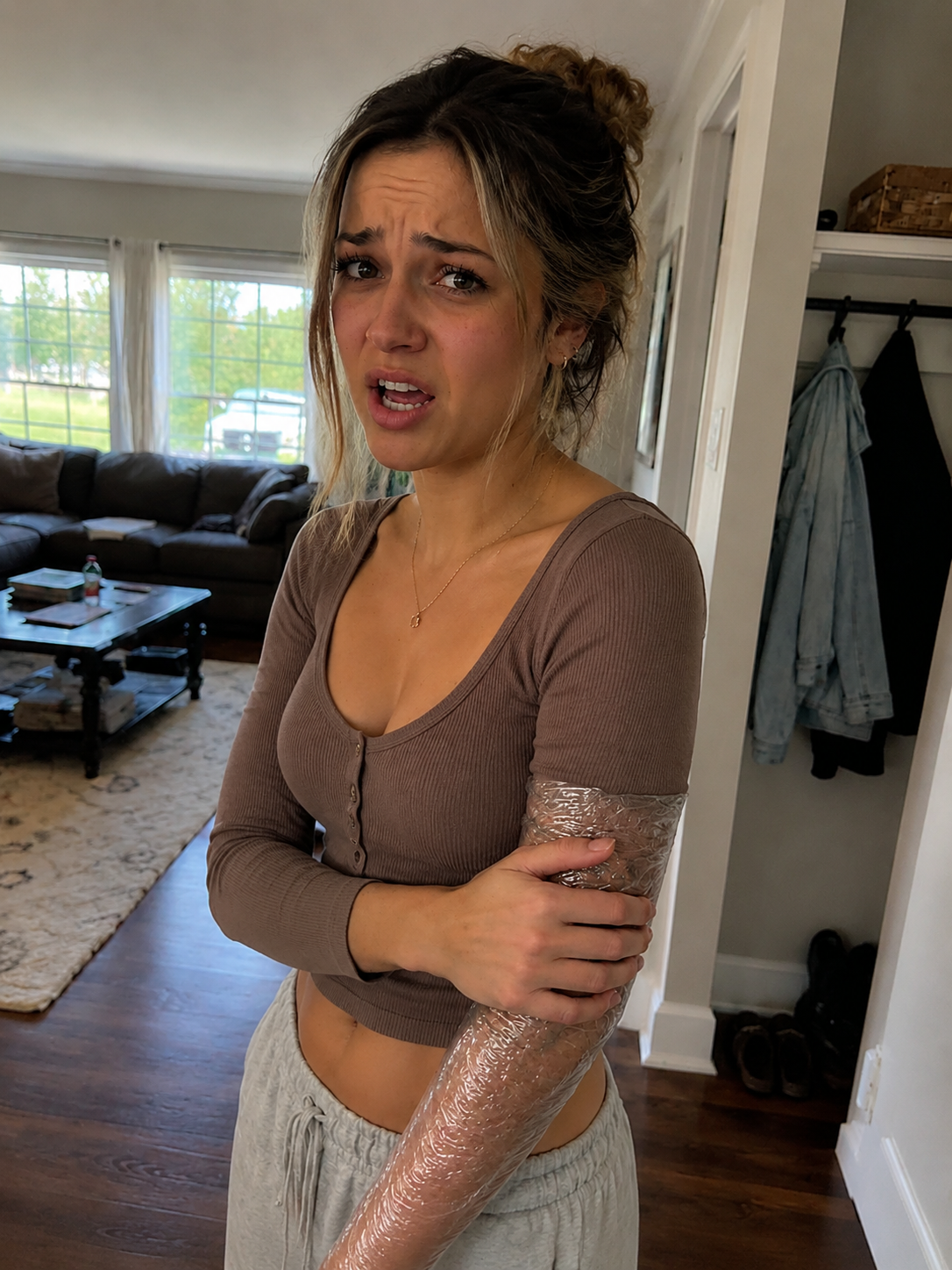
My 16-year-old daughter came through the kitchen door at 9:40 p.m. on a Tuesday night with her jacket still on, her eyes avoiding mine, and her left arm wrapped from her elbow all the way down to her wrist.
Before I even had time to ask what happened, she stopped in the middle of the kitchen and said something that immediately made my stomach tighten.
“Promise me you won’t get mad until you see the result.”
I froze.
That wasn’t a normal sentence a teenager said after walking into the house late at night.
At the kitchen table, my husband Tom looked up from his laptop.
“Result of what?”
Riley didn’t answer right away.
She slowly removed her jacket.
That was when I saw the white gauze, the plastic covering, and the careful way she was holding her arm close to her body as if she was protecting it from us.
I stood up so quickly my chair scraped against the floor.
“Riley… what did you do?”
She swallowed.
“You have to wait three days.”
Tom immediately pushed his chair back.
“Wait three days for what?”
His eyes narrowed at the bandage.
“Is that a tattoo?”
Riley pulled her arm toward her chest.
“The artist said I have to keep the covering on until Friday.”
The artist.
That word landed harder than anything else.
“What artist?” Tom asked.
Riley’s face changed for half a second.
A tiny flash of regret crossed her expression.
She knew she had said too much.
“Riley,” I said slowly. “What artist?”
She looked away.
“You’re sixteen years old.”
“I know how old I am.”
“Then you know you can’t just go get something permanent done without telling us.”
“Where did you get it?”
Silence.
Tom wanted the name of the shop.
He wanted a receipt.
He wanted the phone number of whoever had done this.
“Give me the tattoo shop information,” he demanded.
Riley didn’t move.
“Riley.”
“I promised.”
That caught me off guard.
Promised who?
But before I could ask, I tried another question.
“How much did this cost?”
For the first time, Riley hesitated.
“$340.”
I actually laughed.
Not because it was funny.
Because I couldn’t believe what I was hearing.
“You spent $340?”
“It was my money.”
“All of it?”
She looked down.
“Pretty much.”
Every dollar she had saved since she was fourteen.
And suddenly, I felt something inside me break.
Not because of the tattoo.
Because of everything happening around us.
My mother’s funeral had been eleven days earlier.
The funeral home invoice was still stuck to our refrigerator under a small lemon-shaped magnet.
Unpaid.
$2,180.
Tom’s work hours had been reduced back in January.
I had been surviving on four hours of sleep every night, spending those quiet hours after everyone went to bed adding up bills in my head.
Groceries.
Mortgage.
Funeral expenses.
Medical costs.
Everything.
And now my daughter had spent hundreds of dollars on something she wouldn’t even show us.
“Go upstairs,” Tom said.
Riley looked at him.
Then she slowly walked away.
She didn’t argue.
She didn’t slam the door.
And somehow, that made me even angrier.
I almost wished she would scream.
I almost wished she would act like a rebellious teenager so I could understand what I was dealing with.
But Riley didn’t do that.
She just disappeared upstairs quietly.
The next morning, Tom was already angry.
“I’m calling every tattoo shop in town.”
I looked at him.
“You don’t even know where she went.”
“Exactly.”
“You can’t call every place.”
“I can try.”
“You can’t tattoo a sixteen-year-old without parental consent.”
“I know.”
“So somebody broke the law.”
“We don’t know that yet.”
“Exactly.”
Riley walked into the kitchen while we were talking.
Tom immediately pointed toward her wrapped arm.
“Shop name.”
She opened the refrigerator.
“No.”
“Riley.”
“I promised.”
I turned toward her.
“Who did you promise?”
She grabbed an apple.
“Someone.”
“Someone who?”
She didn’t answer.
Then she walked out.
At breakfast, Max watched her leave.
Max was four years old and still believed every problem in the world could be solved with a Band-Aid.
He stared at Riley’s arm.
“Why does Riley have a giant Band-Aid?”
Tom looked down.
“Because she made a bad decision.”
Riley stopped in the doorway.
She turned around.
For a moment, I thought she might finally explain.
Instead, she looked at Max.
“Because I made a promise.”
Then she left.
That was it.
By Wednesday night, I was furious.
By Thursday, Tom had stopped talking to her.
And Riley acted like none of it mattered.
That was Riley.
Or at least, that was the Riley I thought I knew.
She had always been difficult to read.
She didn’t cry easily.
She didn’t hug unless someone hugged her first.
She wasn’t the kind of child who ran into my arms when I picked her up from school.
At my mother’s funeral, I watched relatives break down completely.
My aunts cried.
My cousins cried.
Even Tom had tears in his eyes.
But Riley stood beside the coffin with a completely calm expression.
No tears.
No shaking.
Nothing.
Afterward, Tom squeezed my shoulder.
“That’s just Riley being Riley.”
And I believed him.
I told myself she was strong.
I told myself she processed emotions differently.
I told myself she didn’t need comfort the way other people did.
I never considered that maybe she had already cried somewhere I couldn’t see.
Thursday evening, I found the funeral invoice sitting on the kitchen counter.
$2,180.
I whispered the number under my breath.
Riley was behind me filling a glass of water.
“Still?”
I turned around.
“What?”
“That’s what we still owe?”
I stared at her.
“Why are you asking?”
She shrugged.
“I was just wondering.”
Something inside me snapped.
“Maybe because some of us have to think about money before spending hundreds of dollars on ourselves.”
Riley slowly placed the glass down.
“I saved that money.”
“Do you have any idea what this family is going through right now?”
She didn’t answer.
“Your grandmother just died. Your father’s hours were cut. I’m taking care of Max. There are bills everywhere. And now this.”
I pointed toward her covered arm.
“Do you ever think about anyone besides yourself?”
The second the words left my mouth, I knew they were cruel.
But I was angry.
Exhausted.
Grieving.
And sometimes exhaustion makes people say the things they would never say if they had enough strength left to think.
Riley’s mouth opened slightly.
For a second, I thought she was going to fight back.
Instead, she simply closed it.
“Okay.”
Then she walked upstairs.
She didn’t cry.
Of course she didn’t.
That was what I told myself.
Friday night came.
The third night.
The night she had promised us she would finally remove the covering.
At a little after seven, Riley came downstairs and sat on the arm of the couch.
Tom muted the television.
“Three days,” he said.
Riley nodded.
“That’s what you told us.”
She looked at me.
“Please.”
Her voice was softer now.
“Look at it before you say anything.”
I folded my arms.
Riley reached for the edge of the covering.
Slowly, she started peeling it away.
My stomach twisted as more of her forearm appeared.
Then I saw the ink.
Black letters.
Not a skull.
Not a boyfriend’s name.
Not something reckless.
Words.
Thin cursive writing ran along the inside of her forearm.
And before I even finished reading it, I knew exactly whose words they were.
“WHEN IT GETS TOO HEAVY, GIVE ME SOME.”
I stopped breathing.
Because those words weren’t Riley’s.
They belonged to my mother.
My mom had said that sentence to me hundreds of times throughout my life.
Bad exam?
Give me some.
A broken heart?
Give me some.
A terrible day?
Give me some.
When my father died when I was twenty-eight, I spent the first week pretending I was fine.
I organized the funeral.
Answered every phone call.
Comforted everyone else.
Until my mother took the condolence cards out of my hands and looked directly at me.
“When it gets too heavy, Claire,” she said, “give me some.”
And now those exact words were permanently written on my daughter’s arm.
“Where did you get that?”
Riley didn’t answer.
She just looked at the tattoo.
Then Max suddenly jumped up from the rug.
“Hey!”
Everyone turned.
He pointed at Riley’s arm.
“That’s mine!”
I looked at him.
“What?”
“That’s my sun!”
And underneath my mother’s words was a tiny crooked drawing.
A little sun.
Seven uneven rays.
Two huge eyes.
A sideways smile.
My four-year-old son’s drawing.
Riley smiled for the first time in three days.
“You did draw it.”
Max looked proud.
“Why is my sun on Grandma’s writing?” he asked.
Riley touched the little drawing.
“Because Grandma loved it.”
And then she finally told us the truth.
The truth I had never seen coming.

Part 2
The truth I thought I knew about my daughter had completely fallen apart.
For three days, I had looked at Riley’s covered arm and only saw a mistake.
A reckless decision.
A teenager who thought she was old enough to do whatever she wanted.
But sitting there on the couch, staring at those words written in my mother’s handwriting, I realized I had been looking at the wrong thing.
I had been focused on the tattoo.
I had never stopped to ask why she needed it.
“Where did you get that phrase?” I whispered.
Riley looked down at her arm.
She didn’t answer immediately.
Then Max climbed onto the couch beside her.
“Grandma wrote it,” he said proudly.
I turned toward him.
“What?”
Riley gently smiled.
“Grandma wrote it for me.”
The room became silent.
Tom leaned forward.
“When?”
Riley took a deep breath.
“The night she told me she wasn’t getting better.”
My heart stopped.
“What do you mean?”
Riley looked at me.
And for the first time in days, I saw something different in her eyes.
Not anger.
Not defiance.
Pain.
Real pain.
“She knew.”
I felt my throat tighten.
“She knew what?”
“That she didn’t have much time left.”
I shook my head.
“No.”
The word came out automatically.
Because I wasn’t ready to hear it.
Because I had spent weeks trying to convince myself my mother was only tired.
Only weaker.
Only having a difficult time.
I wasn’t ready to accept that she had known.
“She never told me that,” I said.
Riley nodded slowly.
“I know.”
“Why?”
“Because she didn’t want you to worry.”
That sentence hurt because it sounded exactly like something my mother would say.
She had spent her entire life protecting everyone else.
Especially me.
Riley looked back at the tattoo.
“She asked me to promise her something.”
“What?”
“She told me that when she was gone, you were going to try to carry everything.”
I looked away.
Because she was right.
That was exactly what I had done.
I handled the funeral.
I answered the calls.
I took care of the paperwork.
I made sure everyone else was okay.
I never let myself stop.
“She said you always think being strong means doing everything alone.”
My eyes filled with tears.
Riley continued.
“She told me, ‘Your mom has been taking care of everyone since she was a little girl. She forgets that she’s allowed to need people too.’”
I covered my mouth.
Because suddenly, I could hear my mother’s voice.
Not the voice from the hospital.
Not the voice from the funeral.
The voice from years ago.
The voice that used to tell me to rest.
The voice that used to know when I was pretending.
“She gave me that sentence,” Riley said. “She told me if I ever saw you trying to carry everything again, I should remind you.”
I looked at her.
“And you got a tattoo?”
Riley nodded.
“I didn’t know how else to make sure I wouldn’t forget.”
The anger I had carried for three days started disappearing.
Not all at once.
Because I was still a mother.
I was still upset that she had lied.
But underneath that anger was something else.
Regret.
A lot of regret.
“Why didn’t you tell me any of this?”
Riley looked down.
“Because Grandma asked me not to.”
“She asked you to keep this from me?”
“No.”
Riley shook her head.
“She asked me not to tell you while you were still trying to hold everything together.”
That broke something inside me.
Because my mother had known me better than I knew myself.
And my daughter had understood something about me that I had never understood about myself.
I always thought I was protecting my family by pretending I was okay.
But maybe I was only teaching them that I didn’t need help.
“Mom,” Riley whispered.
I looked at her.
“I’m sorry I did it without telling you.”
Her voice was different now.
Softer.
Not the confident teenager who walked into the house three nights earlier.
Just my daughter.
“I know I shouldn’t have signed your name.”
I stared at her.
“What?”
Tom looked up.
“You signed her name?”
Riley immediately looked guilty.
“The shop needed a parent signature.”
My eyes widened.
“Riley.”
“I know.”
“You forged my signature?”
“I know.”
For the first time all week, she sounded sixteen.
Not mature.
Not calm.
Just sixteen.
“I was scared you would say no.”
I sighed.
“And you decided lying was better?”
“No.”
She shook her head.
“I knew it was wrong.”
“Then why?”
Riley looked at the tattoo.
“Because I was afraid I would lose the courage to do it.”
I frowned.
“What does that mean?”
She rubbed her thumb gently beside the words.
“After Grandma died, everyone kept asking me if I was okay.”
I swallowed.
“Were you?”
She laughed quietly.
A sad laugh.
“No.”
That one word hurt more than anything.
“I just didn’t know how to say it.”
I thought about the funeral.
The way she stood silently.
The way everyone assumed she wasn’t affected.
“I thought you didn’t care.”
Riley looked at me.
“I cared too much.”
The room went completely quiet.
“I couldn’t cry there,” she continued.
“Why?”
“Because if I started, I didn’t think I could stop.”
My eyes filled.
Riley looked down.
“I cried with Grandma before she left.”
And suddenly I remembered something.
The night before my mother died, Riley had been the only person missing from the house.
I had assumed she was avoiding the situation.
I had assumed she was hiding.
But she wasn’t.
She was saying goodbye.
“What happened that night?” I asked.
Riley took a deep breath.
“She was in bed. She looked tired.”
Her voice became quieter.
“She asked me if I was scared.”
“Of what?”
“Losing her.”
I felt tears running down my face.
“What did you say?”
“I said yes.”
Riley wiped her eyes.
“Then she said she was scared too.”
I looked at her.
“My mom was scared?”
Riley nodded.
“She wasn’t scared of dying.”
A pause.
“She was scared of leaving you.”
That sentence destroyed me.
Because I realized my mother had spent her final days worrying about me.
Not herself.
Me.
“She told me something else.”
“What?”
Riley reached into the blue cookie tin again.
She pulled out a folded piece of paper.
The paper looked old.
Carefully handled.
Like someone had opened it many times.
“I kept this because I wasn’t ready to show you.”
My hands shook as I took it.
I recognized the handwriting immediately.
My mother’s handwriting.
The kind I had seen on birthday cards.
Grocery lists.
Notes left on the kitchen counter.
At the top of the page were the words Riley had tattooed on her arm.
“When it gets too heavy, give me some.”
Underneath was another sentence.
“Your mother will try to carry all of us when I’m gone. Don’t let her.”
I couldn’t breathe.
“She wrote that about me?”
Riley nodded.
“Mostly.”
I laughed through tears.
Because even at the end, my mother was still my mother.
Still worrying.
Still trying to take care of me.
“I’m sorry,” I whispered.
Riley looked confused.
“For what?”
“For thinking you didn’t care.”
Her eyes became wet.
“For saying you only thought about yourself.”
Silence.
Then she quietly said:
“That one hurt.”
I closed my eyes.
Because she deserved to say that.
I had hurt her.
And understanding why she got the tattoo didn’t erase the fact that she had lied.
So I didn’t ask her to forgive me immediately.
I didn’t make excuses.
I simply told her the truth.
“I was wrong.”
Riley nodded.
“I know.”
That was all.
No dramatic hug.
No instant forgiveness.
Just two people sitting together and finally admitting that they had both been carrying things they never said out loud.
The next morning, we called the tattoo shop.
They had accepted a forged consent form without ever speaking to me.
Tom filed a complaint.
Riley still faced consequences.
She lost her phone for a month.
She had to rebuild the savings she spent.
And she complained about both.
Which, strangely, made me feel relieved.
Because she was still grieving.
But she was also still sixteen.
She wasn’t suddenly an adult because she experienced loss.
She was still my daughter.
And I was still her mother.
But something between us had changed.
I stopped seeing her silence as indifference.
And she stopped pretending she was always okay.
A few weeks later, I learned the hardest lesson of all.
It happened on an ordinary afternoon.
No funeral.
No argument.
No life-changing revelation.
Just a broken jar of pasta sauce.
I was making dinner when it slipped from my hands.
Glass shattered across the floor.
Max screamed.
Tom called from upstairs asking what happened.
The phone started ringing.
And suddenly, standing there surrounded by broken glass and red sauce, I felt everything I had been holding back finally collapse.
I started crying.
Not quietly.
Not the controlled tears I had allowed myself before.
Real crying.
The kind I had avoided since my mother died.
“I’m fine,” I said automatically.
Because that was what I always said.
Then Riley appeared in the doorway.
She looked at me.
Then she looked at her arm.
The tattoo had healed completely by then.
She touched the words gently.
“Too heavy?”
I almost said no.
The old me would have.
The old me would have wiped my face, cleaned the floor, and told everyone I was okay.
But then I remembered my mother.
I remembered her words.
So I looked at my daughter.
And finally admitted the truth.
“Yeah.”
Riley pulled out a chair.
“Then give me some.”
And for the first time in a long time…
I did.

Part 3
I sat down.
That was all I did.
I didn’t fix anything.
I didn’t apologize for crying.
I didn’t tell Riley that I was okay when I wasn’t.
I just sat there.
And somehow, that felt harder than anything I had done in weeks.
For most of my life, I believed love meant carrying the heavy things for the people you cared about.
That was how my mother loved me.
She carried my worries.
My fears.
My heartbreaks.
She carried them so quietly that I never realized how much weight she had been holding.
And without even knowing it, I had learned the same habit.
When my father died, I became the person who answered every phone call.
When bills became difficult, I became the person who stayed awake at night figuring things out.
When my mother got sick, I became the person who told everyone, “I’ve got it.”
I thought being strong meant nobody ever had to worry about me.
But Riley’s tattoo made me realize something I had missed.
Sometimes, refusing help doesn’t make you stronger.
Sometimes, it only keeps the people who love you standing outside the door, unable to reach you.
That night, after the kitchen was cleaned and Max was asleep, Riley and I sat together at the table.
The house was quiet.
For the first time in months, there was no emergency.
No funeral paperwork.
No medical appointment.
No crisis to solve.
Just me and my daughter.
“I’m sorry,” I said.
Riley looked up.
“For what?”
“For making you feel like your grief didn’t matter.”
She looked away.
“You didn’t know.”
“I should have asked.”
A small silence passed between us.
Then I continued.
“I should have asked why you weren’t crying instead of assuming you didn’t care.”
Riley played with the edge of her sleeve.
“I didn’t know how to explain it.”
“I know.”
“No, Mom.”
She looked at me.
“I really didn’t.”
Her eyes filled slightly.
“Everyone kept saying Grandma was gone. Everyone kept talking about how much they missed her.”
She swallowed.
“But I didn’t miss her the same way they did.”
“Why?”
“Because I still felt like I had pieces of her everywhere.”
I listened.
“She was in my room. In that box. In those notes. In the things she taught me.”
Riley touched her arm.
“And now she’s here too.”
I looked at the tattoo.
For days, I had seen it as a symbol of everything that scared me.
A secret.
A mistake.
A decision made without us.
Now I saw something else.
A sixteen-year-old girl trying to hold onto someone she wasn’t ready to lose.
“I still don’t like that you did it without telling us,” I said.
Riley nodded.
“I know.”
“And signing my name was not okay.”
“I know.”
“You understand there are consequences, right?”
“Yes.”
She sighed.
“Phone for a month.”
“And rebuilding your savings.”
She made a face.
“That one hurts more.”
I laughed.
Actually laughed.
The first real laugh I had had since my mother died.
And Riley smiled.
That moment was small.
But I think that was when I realized my daughter was still there.
The same Riley who made jokes with Max.
The same Riley who stole fries from my plate.
The same Riley who needed boundaries and rules.
Grief had not made her older.
Pain had not made her an adult.
She was still sixteen.
She still needed her mother.
And I still needed to be her mother.
Not her judge.
Not someone waiting for her to make another mistake.
Her mother.
The weeks after that were not magically perfect.
I wish I could say everything changed overnight.
It didn’t.
Riley was still stubborn.
I was still worried.
We still argued about normal teenage things.
Laundry left on the floor.
Homework.
Phone use.
Curfew.
She still rolled her eyes when I asked her questions.
I still reminded her that communication was not optional.
But something important had changed.
We talked.
Really talked.
Not just about schedules.
Not just about grades.
Not just about what needed to get done.
We talked about how we felt.
And sometimes, that meant uncomfortable conversations.
One night, Riley came into my room and sat on the edge of my bed.
“Can I ask you something?”
“Of course.”
“Do you think Grandma would be mad about the tattoo?”
I smiled sadly.
Because I knew my mother.
I knew exactly what she would say.
“She would probably tell you that making permanent decisions while emotional is something to think carefully about.”
Riley laughed.
“Yeah. That sounds like her.”
“But…”
Riley looked at me.
“I think she would also understand why you did it.”
She nodded.
“She always understood things before anyone else.”
“Yes.”
I looked toward the framed picture of my mother on the dresser.
“She understood me before I understood myself.”
Riley was quiet.
Then she said:
“She did that for me too.”
And that was when I realized something.
My mother’s love had not disappeared.
It had simply moved.
From her hands…
to mine.
From her voice…
to Riley’s.
From one generation…
to the next.
A few months later, we visited my mother’s grave.
It was the first time Riley had wanted to come with me.
Before that, I had avoided asking.
I thought maybe it was too painful.
But she surprised me.
She stood beside me holding flowers.
The same kind my mother used to buy every spring.
“I think she would like these,” Riley said.
I smiled.
“She would.”
We stood there quietly.
Then Riley touched her tattoo.
“You know what’s funny?”
“What?”
“I thought getting this would make me feel closer to her.”
“And did it?”
She looked at the words.
“Yes.”
A pause.
“But I think talking about her with you did more.”
I looked at my daughter.
The daughter I had misunderstood.
The daughter I thought was too distant.
The daughter who had been carrying grief in a way I never recognized.
“I’m proud of you,” I said.
She looked surprised.
“Even after everything?”
“Especially after everything.”
She smiled.
“But I’m still grounded, right?”
I laughed.
“Yes.”
“Worth asking.”
That was Riley.
And I was grateful.
Because after losing my mother, I was afraid I had lost another important relationship too.
But instead, I found something I didn’t know I needed.
A chance to know my daughter again.
A chance to stop assuming I understood everything.
A chance to listen.
I still don’t approve of how Riley got the tattoo.
I still wish she had trusted us enough to tell us first.
I still wish she hadn’t felt like she had to carry that promise alone.
But every time I see those words on her arm, I no longer see a mistake.
I see my mother.
I see Riley.
I see the love between them.
And I remember the lesson both of them tried to teach me.
Love is not about carrying every burden until you break.
Love is trusting someone enough to say:
“This is heavy.”
And letting them answer:
“Then give me some.”
Because sometimes the greatest gift we can give the people we love…
is not protecting them from our pain.
It is allowing them to stand beside us while we carry it together.