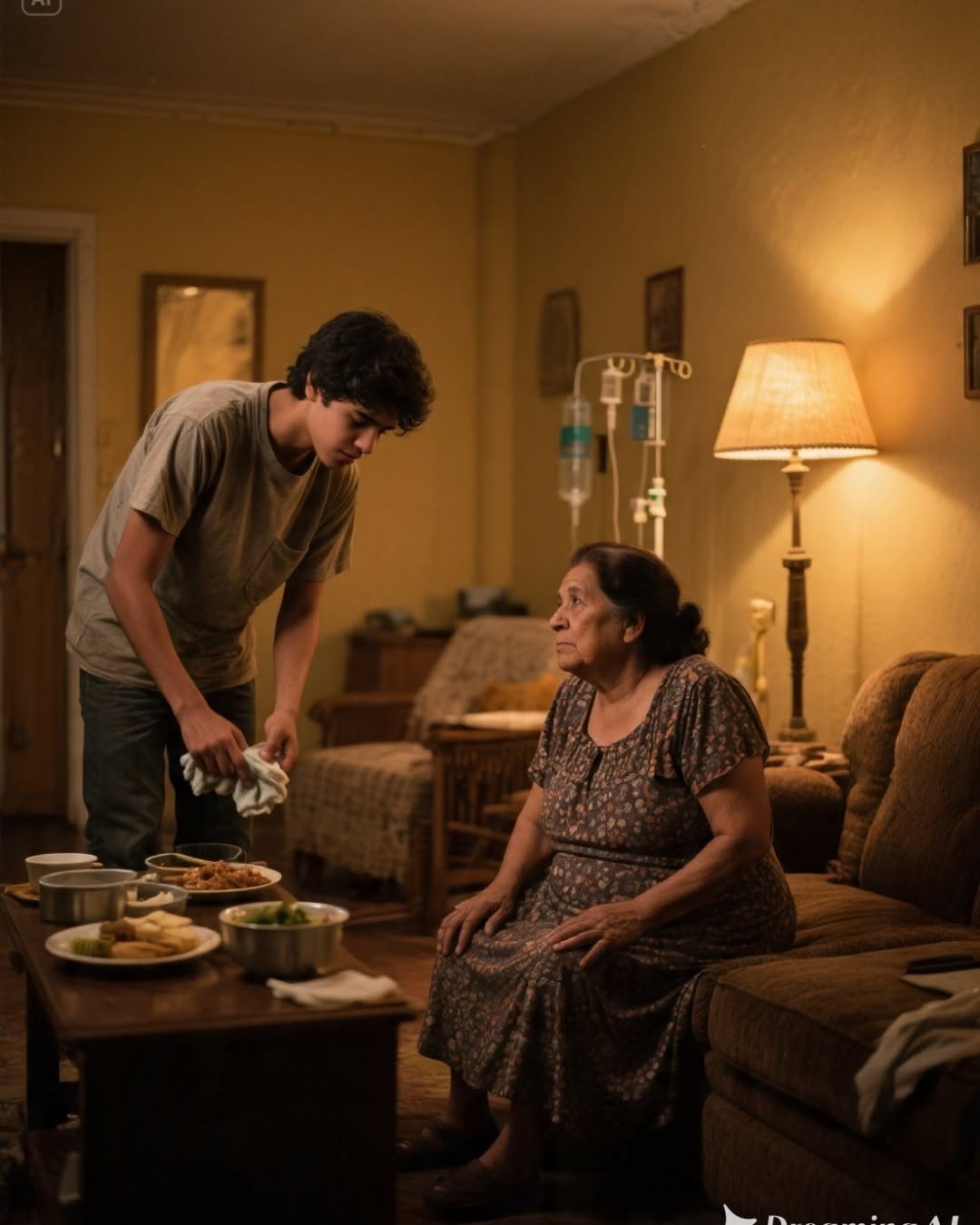
My name is Diego. I’m twenty-one and a third-year college student in Guadalajara. Like many students struggling to make ends meet, I took whatever part-time work I could find.
Tutoring. Working behind a coffee counter. Moving boxes. Running errands. If it paid something, I was willing to do it.
Then one afternoon, while scrolling through a Facebook job group, I came across an advertisement for someone to clean the home of an elderly woman who lived alone in a narrow alley not far from downtown.

The pay wasn’t much, but to me, every peso counted.
Her name was Carmen.
I still remember the first time I knocked on her door.
I wasn’t prepared for the woman who opened it.
She was incredibly frail, with a tiny body, snow-white hair, and trembling hands wrapped tightly around a cane. Her little house was dark, cramped, and visibly worn by years of neglect. Inside, everything seemed trapped in another time. An old broken radio sat untouched on a shelf. Faded family photographs hung crookedly along the walls. Even the wooden bed groaned whenever she moved.
Carmen explained that she suffered from severe arthritis and high blood pressure. Walking more than a few steps had become painful, so she needed someone to come once a week and help around the house.
The work itself seemed easy.
Sweep the floors. Dust the furniture. Wash the dishes.
She promised to pay me 200 pesos every time I came.
For someone like me, that money mattered. It could cover transportation, a few meals, and help me get through another couple of days.
So I accepted.
But after only a few visits, I began noticing things that bothered me.
Her refrigerator was practically empty.
There might be two eggs, a few wilted vegetables, some rice, and a little sauce. Sometimes there was even less.
One day, I finally asked her why she barely had any food.
She gave me a tired smile.
“My children live far away. I don’t want to become a burden to them.”
I couldn’t stop thinking about that answer.
From then on, after finishing the cleaning, I started staying longer.
Whenever I could afford it, I’d stop by the market, buy some meat, fish, or fresh vegetables, and cook her a proper meal.
Carmen loved those meals.
Whenever I placed a steaming bowl of soup or stew in front of her, her entire face seemed to brighten. For a few moments, the lonely little house didn’t feel quite so lonely.
There were also days when her arthritis became so painful that she couldn’t stand properly.
On those days, I took her to the public hospital myself.
I sat beside her for hours, helped her through the paperwork, waited for her medicine, and made sure she got home safely.
One afternoon, as we were leaving the hospital, Carmen gently reached for my hand.
She held it for a moment before whispering,
“You remind me so much of my youngest son. He was a good boy too.”
I didn’t know how to respond.
There was so much sadness hidden behind those words.
I understood loneliness.
And Carmen had clearly been living with hers for years.
So I kept coming.
One week became another.
Then another month.
Then several more.
And somewhere along the way, something changed.
Carmen stopped feeling like a client.
She became someone I cared about.
The strange part was that she never actually paid me.
Not once.
There was always another excuse.
“Next week.”
“After I fix the money situation.”
“When my money comes.”
“Soon, Diego. I promise.”
I could have walked away.

Maybe I should have.
But somehow, I never did.
Perhaps I felt sorry for her.
Perhaps I believed she truly intended to pay me.
Or perhaps I had finally realized that I wasn’t simply cleaning her house anymore.
I was keeping an elderly woman company during what might be the final chapter of her life.
Then, one morning, Carmen died.
Just like that, she was gone.
I thought that was where our story ended.
I assumed all those unpaid hours, all the meals, hospital visits, and conversations would simply disappear with her.
But after her funeral, someone approached me.
They handed me a sealed envelope.
My name was written across the front in Carmen’s handwriting.
I stared at it for several seconds before opening it.
I expected an apology.
I was completely unprepared for what I found inside.
I unfolded the letter with trembling hands.
The first line was simple.
“Dear Diego, if you are reading this, then I am no longer here to thank you in person.”
I stopped.
For some reason, I couldn’t continue.
I had spent months listening to Carmen talk about her children, her memories, and the life she had once lived.
But seeing her handwriting suddenly made her absence feel real.
I wiped my eyes and kept reading.
“I know I owe you money. Much more than the 200 pesos I promised you every week.”
A bitter smile escaped me.
At least she knew.
Then I read the next sentence.
“But the truth is, I stopped asking you to come because I needed someone to clean my house.”
My smile disappeared.
I read it again.
And again.
Then I continued.
“I asked you to come because I was lonely.”
My throat tightened.
Carmen explained that her children had not always lived far away.
Years earlier, they had moved abroad after a bitter family argument. She had been too proud to ask them to return, and they had eventually stopped calling.
She had spent years convincing herself that she preferred being alone.
But she admitted something in the letter that broke my heart.
“The day you first cooked soup for me, I cried after you left.”
I covered my mouth.
She had never told me.
The letter continued.
“Not because the soup was special. Because someone had remembered that I needed to eat.”
I had to put the letter down.
For several minutes, I simply sat there.
Then I noticed another envelope inside the first one.
This one was much thicker.
On the front were four words:
“Please give this to Diego.”
I opened it.
Inside was a bank document.
My name was on it.
I stared at the page in confusion.
It was an education fund.
And the amount nearly made me drop it.
Carmen had deposited money into the account over the previous several months.
Money that, according to the attached documents, had come from the sale of a small property she owned outside the city.
I immediately thought of the unpaid cleaning visits.
Then I found another note.
“You probably think I didn’t pay you because I was unable to.”
I held my breath.
“That isn’t true.”
My heart began pounding.
“I could have paid you from the beginning. But every time I tried to hand you money, you refused to leave when I was still alone. You stayed. You cooked. You took me to the hospital. You listened to stories you had probably heard ten times before.”
My eyes filled with tears.
“So I stopped thinking of you as the young man I hired.”
“You became the family I thought I had lost.”
I couldn’t stop crying.
Then I reached the final paragraph.
“I don’t want you to use this money to feel like you owe me anything. I want you to finish college.”
“You once told me you were afraid you would have to quit school because you couldn’t afford another semester.”
I remembered saying that.
I had completely forgotten.
Carmen hadn’t.
“My youngest son wanted to become a teacher. He never got the chance.”
“Maybe you can.”
The final line was written shakily.
“And Diego, when you become successful, please don’t forget what it feels like when someone has nothing but still deserves kindness.”
I pressed the letter against my chest and cried.
Not because Carmen had left me money.
Because she had remembered everything.
The following Monday, I went to the bank and confirmed the account was real.
It was enough to cover my remaining tuition, books, transportation, and living expenses until graduation.
But there was something else.
Carmen had left instructions for the little house.
She didn’t want it sold.
She wanted it turned into a small community kitchen for elderly people who lived alone.
The property was to be managed by a local nonprofit, with one condition:
Every week, elderly residents living alone would be offered a free hot meal and someone to sit with them.
I knew immediately why.
Carmen didn’t want another old person eating dinner alone in a silent house.
Two years later, I graduated.
I kept the letter Carmen had written to me inside the same worn backpack I carried throughout college.
And every Saturday, I returned to the little house in the narrow alley.
The old radio had been repaired.
The crooked photographs had been straightened.
The kitchen was filled with the smell of soup, rice, and fresh bread.
There were always people there.
Elderly men playing cards.
Grandmothers talking over coffee.
Volunteers carrying groceries.
And students who came to help, just as I once had.
One afternoon, a young college student walked through the door looking nervous.
“I saw the volunteer advertisement,” he said. “I don’t have much experience, but I’ll do anything.”
I smiled.
“You don’t need much experience.”
I handed him an apron.
“Just be willing to stay a little longer.”
He looked confused.
“Longer?”
I glanced toward the old wooden chair where Carmen used to sit.
“Sometimes people don’t need you to fix their lives.”
I smiled softly.
“Sometimes they just need someone to sit beside them so they don’t feel forgotten.”
That evening, after everyone had gone home, I stood alone in Carmen’s old kitchen.
The sunset poured through the window.
For a moment, I could almost hear her voice.
“You remind me of my youngest son.”

I smiled through my tears.
“I finished college, Carmen.”
Then I looked around the warm, crowded house she had left behind.
“And I think you finally got your family back.”
I never became rich.
I never expected to.
But Carmen taught me something money could never have taught me.
Sometimes the smallest kindness you give someone becomes the greatest thing they leave behind.
And sometimes, the person you think you’re helping…
is actually the person who changes your life forever.