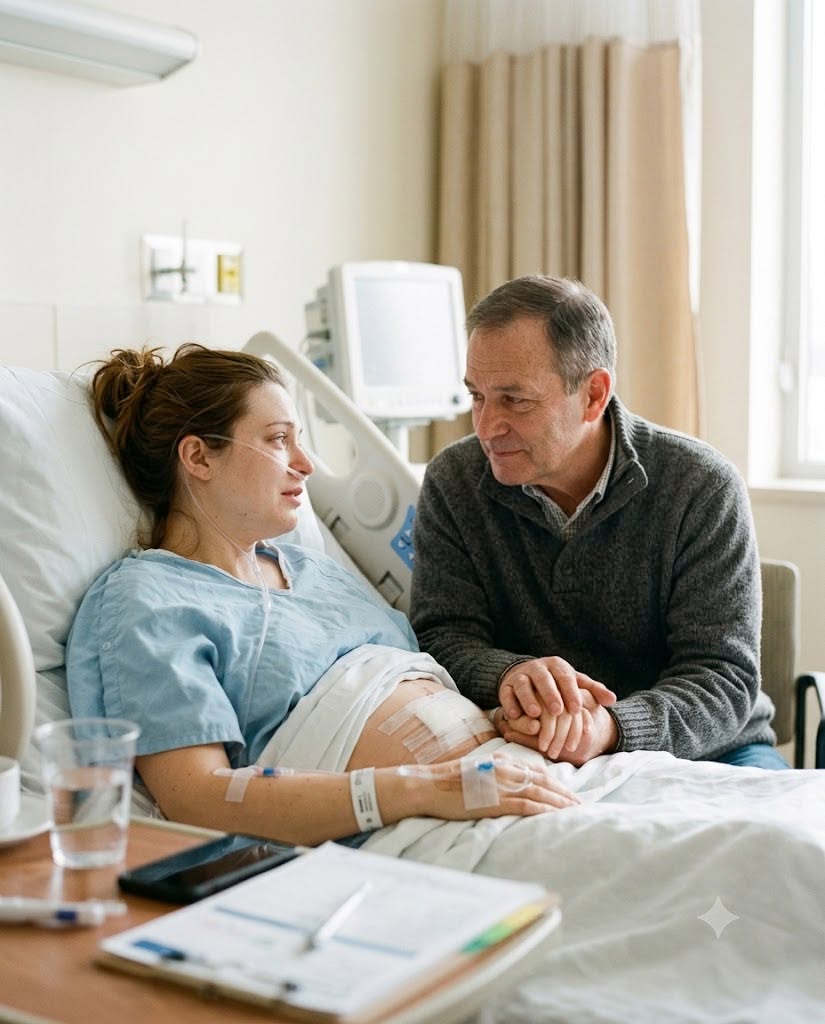
At 1:38 in the morning, the pain stopped feeling like a stomachache.
Until that moment, I had spent most of my life doing what I had been trained to do whenever something went wrong:
Make it smaller.
Make it manageable.
Make sure nobody else had to be inconvenienced because of me.

I was twenty-six years old, lying on the kitchen floor of my one-bedroom apartment with my back pressed against the cabinet beneath the sink. One hand was clamped over the right side of my abdomen. The other was wrapped tightly around my phone.
The refrigerator clicked on and off.
The old radiator hissed against the wall.
Outside, February rain tapped nervously against the window.
The tile beneath my cheek was freezing, but somehow, that cold felt comforting.
My name is Natalie Caldwell.
I was old enough to pay my own rent, schedule my own appointments, and pretend I didn’t still need my mother when the world became too much.
But at 1:38 a.m., sweating through my T-shirt and barely able to breathe without shaking, I needed her more than I had needed anyone in years.
The pain had started earlier that evening while I was tying pale yellow ribbons around party favors for my sister Lauren’s baby shower.
Mom had stopped by after work carrying three grocery bags filled with tiny glass honey jars, little tags, and rolls of ribbon.
She set everything down on my kitchen table like she was dropping off another assignment.
“You’re so good at neat things like this, Nat,” she said. “Lauren can’t be stressed.”
Lauren was eight months pregnant.
She was glowing, adored, and somehow treated as though even the smallest inconvenience was a family emergency.
In our family, Lauren’s discomfort mattered.
Mine was usually something I was expected to push through.
I told Mom that my stomach hurt.
She sighed.
Not with concern.
With irritation.
“Take something for it. You probably skipped dinner again.”
So I kept tying ribbons.
One hundred and sixteen of them.
My fingers smelled like twine, honey, and lavender dish soap. By midnight, the dull ache had sharpened into something vicious.
By 1 a.m., I had crawled from the bathroom into the kitchen because the tile was cooler than the carpet, and every attempt to stand made black spots swim across my vision.
At 1:12 a.m., I called Mom.
It rang until her cheerful voicemail answered.
At 1:14, I called Dad.
Straight to voicemail.
I tried Mom again.
Then Dad.
Then Mom.
Then Dad.
Each call felt like throwing a stone into a bottomless well and waiting for a splash that never came.
By the ninth call, I was crying so hard I could barely hear the ringing.
By the twelfth, I was lying flat on the floor, my cheek pressed against the cold tile.
By the fifteenth, something inside me finally understood what my mind was still refusing to accept.
This wasn’t pain asking for patience.
Something was seriously wrong.
My phone slipped from my hand and clattered beneath the edge of the breakfast table.
I dragged myself toward it on my elbows, every breath scraping painfully through my chest.
At 2:03 a.m., I called my mother for the seventeenth time.
When her voicemail answered, I stopped pretending I was okay.
“Mom,” I whispered.
The word broke in my throat.
“Please. I think I’m dying. Please answer. Please come.”
I ended the call and stared at the screen until the numbers blurred behind my tears.
Seventeen outgoing calls.
Not one answer.
Not one text.
Not even a frantic missed-call message from the people who had once taught me to look both ways before crossing the street.
Then my phone buzzed.
For one foolish, desperate second, I thought Mom was finally calling me back.
It was a text.
Mom: Your sister’s baby shower is tomorrow. We can’t leave now. Don’t make this dramatic.
I stared at those words.
Across the room, the honey jars sat in perfect rows on my table, each one tied with a pale yellow bow I had made with trembling fingers.
Not Are you okay?
Not Do you need an ambulance?
Not even Call 911.
Just Lauren’s baby shower.
Just don’t make this dramatic.
Then something inside my abdomen seemed to tear open.
A wave of blinding pain ripped through me so violently that my entire body seized.
Heat flooded my stomach.
My vision turned gray.
Then black.
I couldn’t think.
I couldn’t scream.

My only remaining instinct was to hit the emergency slider on my phone.
When the 911 operator answered, I couldn’t form a single word.
Only a ragged gasp escaped my throat.
Then the phone slipped from my sweaty fingers and landed on the kitchen floor.
I don’t remember the paramedics breaking down my door.
I don’t remember the stretcher.
I don’t remember the ambulance ride.
What I remember comes in fragments.
Fluorescent lights rushing across a hospital ceiling.
Voices shouting around me.
Machines screaming.
Someone yelling, “Peritonitis! Her blood pressure is crashing. She’s in septic shock. Get her to OR-3 now!”
Then—
Nothing.
A flat, endless tone.
The sound of my heart stopping.
When I finally opened my eyes, everything felt heavy and distant.
The room smelled sharply of antiseptic and fresh flowers.
A monitor beside my bed pulsed with a steady rhythm.
Beep.
Beep.
Beep.
Tubes ran into my arm, and a wide surgical dressing stretched tightly across my abdomen.
At the foot of the bed stood a tall, silver-haired surgeon in green scrubs.
He was studying my chart with a deeply furrowed brow.
Near the window sat an older man in a navy wool coat, quietly holding a battered leather notebook.
The surgeon looked up.
His expression softened.
“Welcome back, Natalie. I’m Dr. Mercer.”
He stepped closer and checked my monitors.
“You gave us a terrifying fight.”
My throat was too dry to speak.
Dr. Mercer continued.
“Your appendix had completely ruptured. The infection spread, and you developed systemic sepsis. Your heart stopped during surgery.”
I stared at him.
“You… you brought me back?”
He nodded.
“We lost your pulse for nearly two minutes before we got it back. You’re extremely lucky to be alive.”
My eyes filled with tears.
The first thought that came to me wasn’t about the surgery.
It wasn’t about the pain.
It was my mother.
“My… my mom?”
The seventeen unanswered calls suddenly felt like a weight inside my chest.
“Did she… come?”
Dr. Mercer’s expression changed.
His jaw tightened.
“A woman claiming to be your mother came here around ten this morning, shortly after you were moved to recovery.”
I swallowed.
“She didn’t ask how the surgery went,” he said.
“She demanded that we discharge you immediately.”
My heart sank.
“She said you had family responsibilities to attend to. She insisted you were exaggerating what was nothing more than a stomach flu.”
I couldn’t move.
“We refused, of course,” Dr. Mercer continued. “She then saw the preliminary billing breakdown for the emergency surgery, resuscitation, and ICU care.”
He paused.
“She told the front desk that you were an adult and that your medical bills were not her responsibility.”
My eyes burned.
“She left?”
“She stormed out.”
He glanced toward the older man sitting by the window.
“And she left you with nothing.”
Then his voice softened.
“But someone else stepped in.”
The older man slowly stood.
As he walked into the light, I recognized him.
My breath caught.
“Arthur?”

Arthur Vance.
My former high school art teacher.
He was also the owner of the local framing studio where I had worked part-time for three years during college.
Five years earlier, after his wife died, I had been the only person who consistently checked on him.
I brought groceries.
I sat with him on his porch.
I made sure he didn’t spend every evening alone.
He had never forgotten that.
And years ago, when I needed an emergency contact for my apartment lease, I had listed Arthur.
Because somewhere along the way, I had learned that my parents might not answer their phones.
Arthur did.
Dr. Mercer smiled gently.
“He paid your entire bill.”
I stared at Arthur.
The surgeon continued.
“When the woman claiming to be your mother tried to leave you without support, Mr. Vance told us—”
Arthur stepped closer.
Dr. Mercer looked at me.
“He said, ‘This girl spent half her life being treated like a background character in her own family. Put every single cent on my card. Assign her private nursing care. And if anyone from that address shows up again, call building security.’”
The tears came before I could stop them.
Arthur reached my bedside and took my hand.
His grip was warm.
Steady.
The kind of touch that made me feel safe without asking me to explain why.
“You’re safe now, Natalie,” he said quietly.
“The apartment is locked. Your landlord knows what’s happening. Your job is waiting for you whenever you’re ready.”
He squeezed my hand.
“You don’t owe anyone your life anymore.”
For the first time in twenty-six years, I believed someone when they said it.
Two hours later, my phone vibrated on the bedside table.
Mom.
There were photographs attached.
Lauren was smiling beside a mountain of wrapped gifts and yellow ribbon.
Then came the message.
Mom: You missed the entire shower. Everyone was asking where you were. You really ruined Lauren’s special day with this stunt. Hope you’re happy.
I stared at the screen for a long time.
Something inside me had changed.
Maybe it was because I had crossed a line that night.
Maybe it was because I had come within seconds of dying.
Or maybe the little girl who had spent her entire life making herself smaller had finally realized she didn’t have to anymore.
The girl who had tied 116 honey jars while barely able to stand was gone.
She had died on that operating table.
And when I came back, I wasn’t going to live the same way.
I typed one message.
I died for two minutes on the operating table last night. The hospital bill is paid, my locks are being changed, and you will never see me again. Have a nice life.
Then I pressed Block.
I shut off my phone.
And handed it to Arthur.
For the first time in my life, I closed my eyes and took a breath—
without apologizing for needing it.