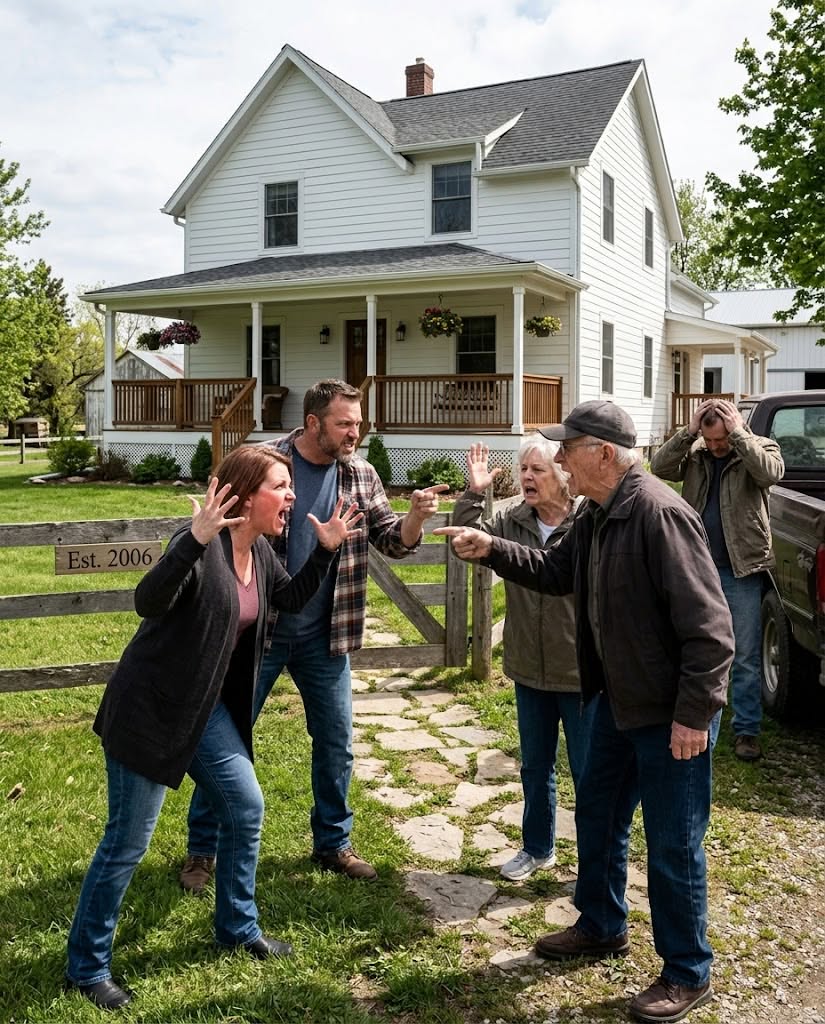
My parents sold me their old farmhouse for $1 when I got married. Twenty years later, after my husband and I had poured $60,000 and countless hours into restoring it, they asked me to give it back so my divorced brother would have a place to live.
I thanked them.
Then I moved my brother and his three children into the upstairs rooms.

My mother came to my house on a Tuesday evening in March. She never even took off her coat. Dad sat beside her, turning his old seed cap over and over in his hands.
“Jeff needs a place to live, Tammy,” Mom began. “Those kids can’t keep sleeping on air mattresses in our basement.”
She paused before delivering the real reason for their visit.
“We’d like you to sell us the house back for a dollar.”
The same dollar I had handed Dad at the closing table in 2006.
I was twenty-six then, newly married and eager to build a life with my husband, Dale. My parents had moved into town and wanted me to stay close. They offered us the old farmhouse, a place that had been standing since 1912.
Calling it a fixer-upper would have been generous.
The roof leaked. The furnace barely worked. The wiring was so old it belonged in a museum. That first winter, Dale and I wore stocking caps to bed because the house was so cold.
But we didn’t give up.
We replaced the roof for $14,000. We installed a propane furnace for another $7,800. We ripped out every foot of the dangerous knob-and-tube wiring and spent years repairing, painting, and rebuilding nearly everything else.
Little by little, the neglected farmhouse became our home.
Over twenty years, we invested $60,340 in improvements. I kept every receipt in a spiral notebook tucked inside the hutch drawer.
The house wasn’t just a property anymore. It was where Dale and I had built our marriage, raised our daughter, Hannah, and worked through every hard season life had thrown at us.
And now my parents wanted it back for the same dollar they’d sold it to me for.
Dale sat at the end of the kitchen table in his barn socks. Beneath the table, his hand found my knee and squeezed once.
It was his quiet way of telling me that this was my family and my decision, but he would stand beside me no matter what.
I looked at my mother.
Dad still hadn’t lifted his eyes from his cap.
“Thank you for asking me to my face,” I said.
Mom blinked in surprise.
She had clearly prepared herself for an argument. Maybe she expected me to cry, or to give in out of guilt.
She hadn’t prepared for gratitude.
“I’ll give you an answer on Saturday,” I told them.
They left without another word.
That night, Dale and I lay awake long after the lights were out.
“It’s my house too, Tam,” he finally said. “But whatever you decide, I’m with you.”
I stared at the ceiling until nearly two in the morning.
Here’s the thing my parents didn’t understand.
I wasn’t going to let my brother’s three children spend another night sleeping beside a chest freezer in a crowded basement.
But I wasn’t going to surrender the home Dale and I had spent twenty years rebuilding with our own hands, either.
I had no intention of choosing between those two things.
Around three in the morning, I finally found my answer.
And by Saturday, I was ready to put it into action.
The morning came bright and bitterly cold.
Dale and I began clearing out the upstairs rooms. We’d kept two bedrooms closed for years to save on propane, and they were full of dust, old boxes, and furniture we no longer used.
Hannah, our sixteen-year-old daughter, grabbed the vacuum and started cleaning dead flies from the windowsills.
“Who’s moving in?” she asked.
“Your uncle Jeff and the kids.”
She stopped vacuuming.
“All three of them?”
“All three.”
She nodded, set the vacuum aside, and went back to work without asking another question.
By noon, the rooms were clean, the beds were made, and fresh towels sat folded on the dresser.
At twelve-thirty, Jeff’s pickup rattled up the gravel driveway. A mattress was strapped into the truck bed.
I was carrying a box up the porch steps when he climbed out.
He was forty-three, recently divorced, and looked like a man who hadn’t slept properly in weeks. He carried a duffel bag in one hand and a pillow in the other.
He wouldn’t quite meet my eyes.
His children followed him up the steps.

Brody, twelve, carried a backpack over one shoulder. Kenzie, nine, held hers against her chest. Little Cole, six, carefully carried a goldfish bowl with both hands.
“This is Pickles,” he announced solemnly.
I smiled.
“Well, then, we’d better find Pickles a safe spot.”
For the first time that afternoon, Jeff looked directly at me.
“Tammy, I don’t know what to say.”
“You don’t have to say anything right now. Just get your kids settled.”
He swallowed hard and nodded.
At four o’clock, my phone rang.
It was Mom.
“Tammy, what on earth are you doing?”
I could hear the disbelief in her voice.
“Giving my brother a place to live,” I replied.
“But we talked about the house! We asked you to sell it back!”
“And I told you I’d have an answer on Saturday.”
“That’s not what we meant!”
“I know what you meant, Mom. But Jeff and the kids needed a place to stay. So I opened my upstairs rooms.”
There was a long silence.
Then I added, “Come over for Sunday dinner. You and Dad can see for yourselves.”
She hung up without saying goodbye.
In all my life, my mother had never ended a phone call like that.
Sunday dinner was the loudest our kitchen had been in years.
Brody and Cole argued over who got the last dinner roll. Jeff kept apologizing for the mess. Dale refilled everyone’s glasses, and Hannah sat beside Kenzie, helping her cut her chicken.
Halfway through the meal, Hannah reached over and began braiding her cousin’s hair.
Kenzie went completely still.
Then she whispered, so quietly I almost missed it, “Daddy tries. He’s just not very good at it.”
My throat tightened.
I made an excuse to get more napkins from the pantry because I didn’t want anyone to see my face.
These children had already lost the life they knew. Their parents’ marriage had fallen apart, their home was gone, and now they were living in someone else’s house, trying not to take up too much space.
They didn’t need another family argument.
They needed to feel safe.
By ten that night, the children were asleep upstairs. The kitchen had finally gone quiet, and Dale had gone to bed.
I sat alone at the table with my spiral notebook open in front of me.
$60,340.
Twenty years of repairs, written down in ink.
I wasn’t going to pretend those years hadn’t happened. I wasn’t going to erase the work Dale and I had done just because my parents had suddenly decided they wanted the house back.
But I also couldn’t stop thinking about the three children sleeping upstairs.
I’d made the right decision. I knew that.
Then I heard footsteps on the stairs.
Jeff came down slowly, one hand gripping the railing. He was holding something flat against his chest.
He looked different now. Not like the exhausted man who had arrived with a mattress in the back of his truck, but like the boy I remembered from our childhood—the boy who used to follow me around the farmhouse when we were little.
He stopped beside the table.
“Tam,” he said quietly. “Did you know this was still up there?”
He placed the object in front of me.
It was an old envelope, yellowed at the edges. My name was written across the front in Dad’s unmistakable handwriting.
I looked up at Jeff.
“Where did you find this?”
“In the upstairs closet. Behind the old trunk.”
My fingers trembled as I opened it.
Inside was a folded document dated 2006, along with a letter from my father.
I began to read.
The document confirmed what I already knew: the farmhouse had been sold to me for one dollar. But the letter explained something I had never been told.
Dad had written it when we first bought the house.
He said he’d always intended the farmhouse to be mine because I was the one who had stayed, the one who had cared for it, and the one who had spent years bringing it back to life. He wanted me to have a home that no one could take away from me.
Then came a sentence that made my stomach drop.

“If anyone ever asks you to give up this house because they think someone else deserves it more, remember that you earned your place there long before they asked.”
I read it twice.
“Does Mom know about this?” I asked.
Jeff shook his head.
“I don’t think so. I found it while we were moving the old boxes. I thought you should have it.”
For a long moment, neither of us spoke.
Then Jeff pulled out a chair and sat down.
“Mom told me you agreed to give the house back,” he admitted. “She said you were going to sign it over so I could live here.”
I stared at him.
“I never agreed to that.”
His face drained of color.
“She said you understood. She said it was only fair because I needed the house more than you did.”
I felt a cold anger settle in my chest. My parents hadn’t simply asked me to return the farmhouse. They had made my brother believe the decision was already settled.
Jeff rubbed both hands over his face.
“I should have asked you myself. I just… I was desperate. The kids needed somewhere to go, and I didn’t have much left.”
“I know,” I said softly. “That’s why you’re here.”
He looked at the letter, then at the notebook full of receipts.
“I never wanted you to lose your home because of me.”
“You’re not taking my home, Jeff. You’re living in it. There’s a difference.”
His eyes filled with tears.
For the first time since his divorce, my brother let himself cry.
I reached across the table and squeezed his hand.
“We’ll figure this out. But nobody is signing this house away.”
The following Sunday, my parents came for dinner.
Mom walked into the kitchen with the same determined expression she’d worn during her first visit. Dad followed quietly, his seed cap in his hands.
I placed the old letter on the table.
Mom read it first. Her expression shifted as she reached the final paragraph.
Dad looked at the letter for a long time.
“You kept that,” he said.
“I found it upstairs,” Jeff replied. “And I found out you told me Tammy had agreed to give the house back when she hadn’t.”
Mom opened her mouth, then closed it again.
Finally, she turned to me.
“We were only trying to help Jeff and the children.”
“So was I,” I said. “That’s why they’re living here. But helping my brother doesn’t mean I have to give up everything Dale and I built.”
Dad lowered his head.
“I never meant for it to come to this.”
“Then let’s make sure it doesn’t happen again,” I replied.
I told them Jeff and the children could stay as long as they needed while he got back on his feet. We would work out household expenses together, and Jeff would contribute when he found steady work. No one would be asked to leave before we had a realistic plan.
But the farmhouse would remain mine.
Mom looked as though she wanted to argue. Then she glanced toward the stairs, where the children’s laughter drifted down from Hannah’s room.
Her shoulders finally sagged.
“All right,” she whispered.
It wasn’t a perfect apology. It didn’t undo the pressure she’d put on me or the assumptions she’d made about what I owed my family.
But it was a beginning.
Over the next few months, Jeff found steady work. The children settled into school, and the house slowly filled with the ordinary sounds of family life. Brody helped Dale with small repairs. Kenzie learned to braid her own hair, though Hannah still did it for her on special occasions. Cole insisted that Pickles belonged at the center of every family photograph.
And the old farmhouse remained standing—not because someone had handed it back, but because the people who lived in it chose to care for one another.
One evening, I found Dad standing on the porch, looking out over the fields.
“I was wrong to ask you to give it back,” he said at last.
I stood beside him.
“Yes,” I answered. “You were.”
He nodded, accepting the truth without trying to defend himself.
Then he looked through the kitchen window at Jeff and the children gathered around the table.
“You found a better solution than I did.”
I smiled faintly.
“No, Dad. I just remembered what a home is supposed to be.”
That night, I put the letter back in its envelope and returned it to the hutch drawer, beside the spiral notebook containing twenty years of receipts.
One held the proof of what we’d spent.
The other held the reason we had fought so hard to keep it.
My parents had sold me the farmhouse for one dollar. They’d thought that meant it could always be taken back for the same price.
But they had forgotten something important.
The dollar bought the house. The twenty years of love, labor, and sacrifice made it our home. And I could open that home to my brother without surrendering the life my husband and I had built.