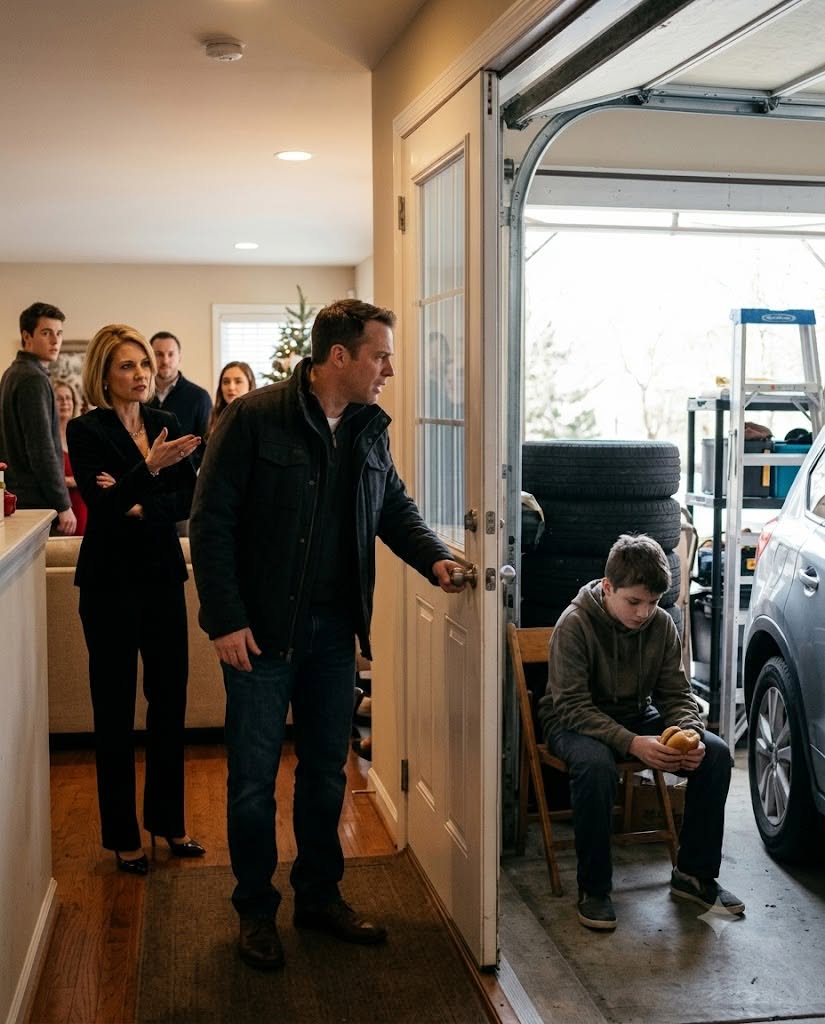
Instead, I found my thirteen-year-old son, Ethan, sitting alone in the garage, eating a wrapped sandwich on an overturned storage bin.
He looked up when I opened the door. For a moment, he seemed relieved to see me. Then he quickly lowered his eyes, as if he had done something wrong.
“Dad, you’re early,” he said quietly.
I stared at the sandwich in his hands.
“Why are you eating out here?”

Ethan hesitated. “Aunt Victoria said I should stay here until dinner is over.”
I felt my stomach tighten.
“Why?”
He glanced toward the house before answering.
“Because I smell like the restaurant.”
That was when I noticed the way he had pulled his sleeves over his hands. His jacket was folded beside him, and his hair was still slightly damp from the shower he had taken after work.
I knew exactly what had happened.
Earlier that afternoon, two employees at my restaurant in Manhattan had called out unexpectedly. We were overwhelmed with orders, especially desserts and holiday takeout boxes. Ethan had insisted on helping me package everything for three hours.
He was proud to help. He had carefully tied ribbons around boxes, checked labels, and made sure every order was correct.
Before we left, I told him how grateful I was.
Then we drove to Daniel’s house for Christmas dinner.
Ethan had changed into a clean shirt, but the faint smell of butter, garlic, and smoke from the restaurant still clung to his jacket.
Apparently, that was enough to make him unwelcome at his own family’s Christmas celebration.
“Did Aunt Victoria tell you to eat your sandwich here?” I asked.
He nodded.
“She said the dining room had to stay nice because there were so many guests. She said I could come inside after everyone finished eating.”
He tried to smile as he added, “It’s okay, Dad. I’m not that hungry anyway.”
That sentence hurt more than anything else.
My son was thirteen years old. He should have been excited about Christmas dinner, arguing with his cousins over dessert, and sneaking extra pieces of candy when the adults weren’t looking.
Instead, he was sitting in a cold garage, pretending he didn’t mind being excluded.
I crouched beside him.
“Ethan, look at me.”
He lifted his head.
“You did nothing wrong. You worked hard today, and you have every right to sit at that table.”
“But Aunt Victoria said—”
“I don’t care what she said.”
I took his sandwich, wrapped it back up, and held out my hand.
“Come on. We’re going inside.”
“Dad, please don’t make a scene,” he whispered. “It’s Christmas.”
I looked at my son, who was already worried about protecting the adults who had hurt him.
That was when I realized this wasn’t just about dinner anymore.
Someone had taught him that keeping the peace mattered more than standing up for himself.
And I wasn’t going to let that lesson stand.
The house looked like something out of a Christmas magazine.
A towering tree stood beside the fireplace. Golden lights glittered across the windows, and a long dining table had been set with polished silverware, crystal glasses, and white linen napkins.
Thirty-five relatives and family friends filled the living room and dining area.
Daniel had spared no expense. A prime rib roast rested on the kitchen counter, and a champagne display stood near the entrance to the dining room.
Victoria was moving between guests, smiling and making sure everything looked perfect.
When she saw me walking in with Ethan, her smile faltered.
“Mark,” she said, lowering her voice. “You’re early. Is something wrong?”
I didn’t answer immediately.
Instead, I looked around the room at the people chatting, laughing, and preparing to sit down for dinner.
Then I spoke loudly enough for everyone to hear.
“My thirteen-year-old son is sitting alone in the garage eating a sandwich while the rest of the family has Christmas dinner because somebody decided his jacket smelled too much like my restaurant.”
The room went silent.
A woman holding a wineglass slowly lowered her hand. One of my cousins turned toward Victoria. Daniel emerged from the kitchen, looking confused.
Victoria’s face flushed.
“Mark, don’t be ridiculous,” she said. “I was simply trying to keep the dining room pleasant for our guests.”
“You sent a child outside to eat alone.”
“He could have changed his clothes.”
“He did change.”
“Well, the smell was still there.”

I stared at her.
“So you decided that the smell of honest work made him unworthy of sitting with his own family?”
“That is not what I said!”
“No? Then explain it to me. Explain why thirty-five people are welcome at your table, but the boy who helped his father work through an understaffed shift has to eat in the garage.”
Victoria opened her mouth, then closed it again.
Daniel stepped between us.
“Can we not do this right now? It’s Christmas Eve. We have guests.”
I turned toward my brother.
“Exactly. It’s Christmas Eve. And while everyone was enjoying the holiday, your thirteen-year-old nephew was sitting outside with a sandwich because your wife decided he didn’t look presentable enough.”
Daniel rubbed his forehead.
“You’re making this bigger than it needs to be.”
“Am I?”
I pointed toward the garage door.
“Then tell me, Daniel. If your son had been sitting out there, would you still be telling me to calm down?”
He didn’t answer.
That silence said more than any excuse could have.
I thought Victoria’s decision was the worst part of the evening.
Then I looked at my mother.
She was standing near the fireplace, twisting a napkin between her fingers. She wouldn’t meet my eyes.
“Mom,” I said quietly. “Did you know Ethan was out there?”
Her shoulders stiffened.
“Mark, please.”
“Did you know?”
After several seconds, she nodded.
“I knew he was in the garage.”
The room seemed to grow even colder.
“And you let him stay there?”
“I didn’t want an argument,” she whispered. “Victoria had worked so hard on dinner. There were so many people coming. I thought it would be better not to make a fuss.”
I stared at her, struggling to understand how she could say those words while my son was standing beside me.
“You saw your grandson being excluded from Christmas dinner, and you decided the most important thing was avoiding an argument?”
“I didn’t think it would hurt him that much.”
I looked at Ethan.
He was standing very still, staring at the floor.
“That’s the problem,” I said. “Nobody thought about how much it would hurt him. You thought about the decorations, the food, the guests, and keeping everyone comfortable. But nobody thought about the thirteen-year-old boy who was sitting alone in a garage wondering what was wrong with him.”
My mother began to cry.
“I never wanted him to feel unwanted.”
“Then why didn’t you bring him inside?”
She had no answer.
Victoria crossed her arms.
“This is completely unfair. I did not tell him he wasn’t good enough for our family.”
I looked directly at her.
“You didn’t have to.”
Her lips tightened.
I continued, “You didn’t need to say those exact words. You showed him where you thought he belonged. You made him sit outside while everyone else ate inside. And every adult who knew about it showed him that nobody was willing to stand up for him.”
For the first time, no one tried to interrupt me.
Then Ethan tugged gently at my sleeve.
“Dad,” he whispered, “can we just go home?”
I turned to him.
“Do you want to leave?”
He nodded.
I didn’t hesitate.
“Okay. We’re leaving.”
But before we could reach the door, Daniel finally spoke.
“Mark, wait. You’re not seriously going to leave over a sandwich, are you?”
I stopped.
“A sandwich?”
He seemed to realize too late how that sounded.
“This is a family gathering. We can talk about it later.”
“No, Daniel. The sandwich isn’t the problem. The problem is that my son was treated like an embarrassment, and now you’re more worried about the guests than the reason he’s leaving.”
I glanced around the room.
“Everyone here came to celebrate Christmas. But if we can’t treat a child with basic kindness, then all these decorations and expensive food mean absolutely nothing.”
I took Ethan’s hand and walked out.
Behind us, nobody said another word.

The drive home was quiet.
Ethan sat in the passenger seat, watching the Christmas lights pass by the window. I wanted to tell him that everything would be fine, but I knew a few comforting words wouldn’t erase what had happened.
Finally, he spoke.
“Dad, was it embarrassing that I helped you at work?”
I glanced at him.
“No. Not even a little.”
“Then why did Aunt Victoria act like it was?”
I tightened my grip on the steering wheel.
“Sometimes, people care too much about appearances. They worry about what other people might think, and they forget what actually matters.”
He was quiet for a moment.
“Grandma knew, too.”
“I know.”
“She used to tell me family always comes first.”
That sentence broke my heart.
I pulled into a quiet parking lot and turned toward him.
“Listen to me, Ethan. Family should be the people who make you feel safe, loved, and respected. But being related to someone doesn’t give them permission to treat you badly. And you never have to accept cruelty just to keep other people happy.”
His eyes filled with tears.
“I just wanted to have dinner with everyone.”
I reached over and hugged him.
“I know, buddy. I’m sorry they made you feel like you didn’t belong.”
He held on to me for a long time.
That night, instead of eating prime rib beneath Daniel’s expensive chandelier, we went home and made grilled cheese sandwiches. Ethan chose a Christmas movie, and I let him cover the sofa with blankets.
We laughed at the ridiculous jokes, burned one side of our sandwiches, and ate cookies straight from the baking tray.
It wasn’t the Christmas Eve I’d planned.
But it was the first time that evening I felt certain we were exactly where we belonged.
I thought the incident would end there.
I was wrong.
The next morning, my phone began buzzing before eight o’clock.
First, Daniel called. Then my mother. Then several relatives who had been at dinner.
Some wanted to apologize. Others wanted me to apologize for embarrassing Victoria in front of everyone.
One aunt told me I should have handled the situation privately.
I asked her a simple question.
“If I hadn’t arrived early and found Ethan in the garage, would anyone have told me what happened?”
She paused.
Then she admitted she probably wouldn’t have.
That answer confirmed everything I needed to know.
Later that afternoon, Daniel arrived at my house alone.
He looked exhausted.
“Victoria is furious with you,” he said.
“I imagine she is.”
“She says you humiliated her in front of the entire family.”
I folded my arms.
“And what does she think she did to Ethan?”
Daniel looked down.
For a while, he said nothing. Then he admitted that he had seen Ethan’s empty chair earlier and assumed he was helping in the kitchen. He hadn’t bothered to check.
“I should have asked,” he said.
“Yes, you should have.”
He rubbed his face.
“I kept thinking it wasn’t worth ruining Christmas over.”
“Daniel, Christmas wasn’t ruined when I spoke up. It was already ruined when a child was sent away and the adults who knew about it decided to do nothing.”
My brother nodded slowly.
“I know.”
For the first time, he seemed to understand that this wasn’t about winning an argument with his wife. It was about a boy who had been made to feel ashamed of helping his father.
Before he left, Daniel asked if Ethan would be willing to speak with him.
I told him that was Ethan’s decision, not mine.
“You’ll have to earn back his trust,” I said. “And that starts with understanding why he was hurt, not demanding that he get over it.”
Daniel accepted that without arguing.
It was a small step, but at least it was a step.
A week later, my mother came to visit.
She brought Ethan a Christmas gift she had bought before the dinner, but she didn’t immediately hand it to him.
Instead, she sat beside him and apologized.
She told him she should have brought him inside. She should have spoken up, even if it meant upsetting Victoria. And she should never have allowed him to believe that keeping adults happy was more important than his feelings.
Ethan listened quietly.
Then he said, “I was more upset that you knew and didn’t come get me.”
My mother began to cry again.
“I know, sweetheart. And I’m so sorry.”
Ethan didn’t rush to hug her or pretend everything was fine.
He simply thanked her for apologizing.
I was proud of him.

He was learning that forgiveness didn’t mean pretending nothing had happened. It meant allowing people the opportunity to make things right while still respecting his own feelings.
As for Victoria, she never offered a genuine apology that evening or in the days that followed. She insisted that I had exaggerated the situation and that her only concern had been protecting the atmosphere of the party.
I eventually stopped arguing with her.
Some people will always defend their intentions rather than acknowledge the consequences of their actions.
I couldn’t force Victoria to understand what she had done.
But I could make sure Ethan understood that her judgment didn’t define his worth.
Months later, our restaurant hosted a community Christmas charity event. Ethan volunteered to help again, carefully arranging dessert boxes and carrying trays to the serving tables.
When one of the organizers thanked him for his hard work, he smiled proudly.
That smile reminded me of the boy who had sat in the garage trying to convince me he wasn’t hungry.
He was still the same thoughtful, hardworking kid.
The difference was that he no longer seemed embarrassed about it.
A few weeks after the event, Daniel invited us to dinner at his house. This time, he called ahead to ask what Ethan wanted to eat. When we arrived, Daniel met us at the door and welcomed his nephew warmly.
Victoria was polite, though distant.
I didn’t pretend everything was suddenly perfect. Trust takes time, and some wounds don’t disappear because someone finally realizes they were wrong.
But Ethan sat at the table that night.
He laughed with his cousins, helped himself to dessert, and talked about school without once looking toward the door as if he expected someone to send him away.
On the drive home, I asked him how he felt about the evening.
“Better,” he said. “Uncle Daniel actually talked to me.”
“That’s good.”
He looked out the window for a moment before adding, “Dad, I think I understand something now.”
“What is that?”
“Helping you at the restaurant isn’t something I should be ashamed of. I worked hard. I didn’t do anything wrong.”
I smiled.
“That’s exactly right.”
He leaned back in his seat, satisfied.
And I realized that the most important thing I had done that Christmas wasn’t exposing Victoria in front of thirty-five guests.
It was showing my son that he never had to shrink himself to fit into someone else’s idea of who deserved a place at the table.
Christmas is supposed to be about generosity, love, and making room for the people who matter.
That night, my family had a beautiful house, expensive food, sparkling champagne, and a table set for thirty-five.
But they had forgotten the most important thing.
A family table means nothing if the people sitting around it are willing to make a child feel he doesn’t belong.
And if standing up for my son meant making a room full of adults uncomfortable, I would do it every single time.