
Part 1: The Photograph Beneath the Toolbox
For twenty years, my husband insisted the woman tattooed over his heart did not exist.
At first, I believed him because I was young, newly married, and hopelessly in love. Later, I believed him because doubting him would have meant questioning every year we had built together.
But the truth has a way of waiting.
It can hide beneath ordinary things—behind old receipts, under layers of dust, inside a toolbox no one has opened in years.
And when it finally reveals itself, it does not always arrive loudly.
Sometimes, it simply slips onto the floor.
The photograph fell from beneath a loose wooden panel inside Richard’s toolbox and landed face-up beside my shoe.
I had been searching for a small screwdriver.
That was all.
The kitchen cabinet hinge had come loose that morning, and Richard was at work, so I had gone into the garage to find the tool myself. His workbench was cluttered with half-empty paint cans, bent nails, old gardening gloves, and coffee mugs he had promised to throw away years ago.
I pulled open the top drawer of the toolbox, moved aside a tray of screws, and noticed that the bottom panel shifted beneath my fingers.
When I lifted it, the photograph slid free.
At first, I only saw its yellowed edges.
Then I saw her face.
My breath stopped.
The woman in the photograph was younger than the one tattooed across Richard’s chest, but there was no mistaking her.
The same dark, expressive eyes.
The same thick hair falling over one shoulder.
The same delicate rose behind her left ear, no bigger than a thumbnail.
She was standing inside what appeared to be a hospital neonatal unit. Fluorescent lights glowed above her, and rows of medical equipment blurred into the background.
In her arms was a premature baby.
The child was wrapped in a cream-colored blanket and looked impossibly small, almost weightless. Thin monitoring wires disappeared beneath the fabric. One tiny hand rested near the woman’s collar.
But the woman was not looking at the camera.
She was gazing down at the baby with such complete tenderness that something tightened painfully inside my chest.
I knew that expression.
I had worn it myself while rocking Claire through fevers, nightmares, and sleepless nights.
I turned the photograph over.
Richard’s handwriting covered the back.
Six words.
Only six.
Forgive me, Rose. She can’t know.
I read the sentence once.
Then again.
By the third time, the words no longer looked real.
The garage seemed to tilt around me.
For twenty years, Richard had told me the woman was imaginary.
A face created from an artist’s sketch.
A symbol of compassion.
Someone who had never truly existed.
Yet there she was.
Real.
Holding a baby.
And Richard had written her name on the back.
Rose.
My mind dragged me back to our honeymoon.
We had been married for three days when I first saw the tattoo properly.
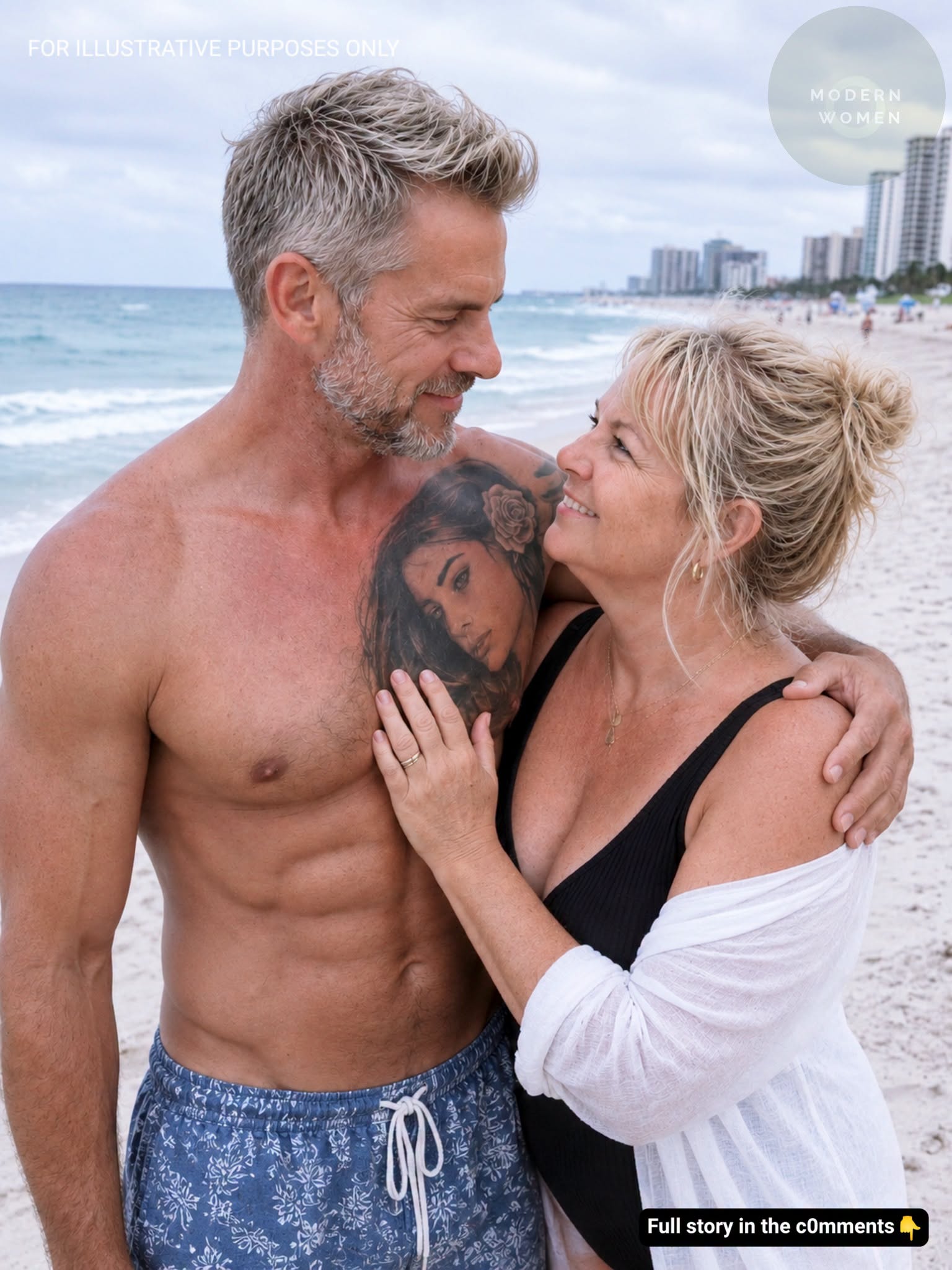
Richard stepped out of the hotel bathroom with a towel wrapped around his waist, his hair still wet from the shower. Sunlight from the balcony crossed his bare chest, revealing the portrait directly over his heart.
A beautiful young woman stared out from his skin.
Her eyes were calm but sad. Dark hair framed her face, and behind her left ear was a tiny rose.
I had seen part of the tattoo before, but never clearly enough to understand what it was.
I remember laughing at first.
“Who is she?” I asked.
Richard glanced down as though he had forgotten the portrait was there.
“Nobody.”
I thought he was joking.
“Who is she, Richie?”
He walked toward the bed and reached for his shirt.
“Just an old tattoo.”
“Nobody gets a woman tattooed over his heart for no reason.”
He smiled, pulled me into his arms, and kissed my forehead.
“She’s nobody you know.”
“That wasn’t my question.”
“I had it done years ago. Before you.”
“Was she an ex?”
“No.”
“Someone you loved?”
His smile faded for only a second.
Then it returned.
“She wasn’t real.”
I stared at him.
“What does that mean?”
“It means the artist designed her. She’s just a face.”
I wanted to ask more.
I should have asked more.
But we were newlyweds, standing in a beautiful hotel room with the ocean outside our balcony, and I did not want to begin our marriage by interrogating him about a woman he claimed had never existed.
So I let it go.
And over the years, I learned not to look too closely at the face over his heart.
I trusted Richard during our first fertility treatment.
I trusted him during the second.
Then the third.
By the fifth, our marriage had become a collection of appointments, injections, blood tests, careful optimism, and quiet grief.
Each failed attempt left me feeling as though my body had betrayed us.
Richard never blamed me.
He held my hand in clinic waiting rooms.
He brought me soup after procedures.
He sat beside me the afternoon the doctor gently suggested that we stop trying.
“You’ve both been through enough,” she said.
I remember staring at the floor because I could not look at Richard.
On the drive home, neither of us spoke.
That night, he found me sitting on the bathroom floor with my back against the tub.
He knelt beside me.
“We can still be a family,” he whispered.
At the time, I believed those words saved me.
Months later, when we began the adoption process, Richard handled most of the paperwork. He spoke to the agency, answered the calls, and reassured me every time I became afraid that something would go wrong.
Then, one cold morning, we brought home a premature baby girl with dark eyes, a stubborn cry, and a cream-colored blanket tucked tightly around her legs.
Claire.
I loved her before we reached the parking lot.
She was so small that I was afraid to breathe too close to her. Richard carried the infant carrier while I walked beside him, touching the blanket every few steps to make sure she was still there.
I remembered a nurse saying Claire liked humming.
Another person warned us that she always worked one foot free from the blanket when she became warm.
At the time, I was too overwhelmed to remember anyone’s face.
All I saw was my daughter.
For years, that morning had remained one of the happiest memories of my life.
Now, standing in the garage with Rose’s photograph in my hand, the memory felt altered.
Not ruined.
But changed.
Like a familiar room after someone turns on a light and reveals a door you never noticed.
I searched the toolbox again.
This time, I emptied every drawer.
Screws scattered across the workbench. Old batteries rolled onto the floor. I found expired warranties, rusted keys, and receipts from stores that no longer existed.
Then, beneath the tray in the bottom drawer, I found a black address book with a cracked spine.
Most of the pages were covered with names I recognized—former coworkers, neighbors, relatives who had passed away.
Several phone numbers had been crossed out.
One had not.
Rose.
My thumb hovered over the number.
For one desperate second, I considered putting everything back exactly as I had found it.
I could have closed the toolbox.
Returned to the kitchen.
Tightened the cabinet hinge.
Pretended the photograph had never fallen.
But I already knew pretending would not make the truth disappear.
I carried the address book into the house and used the landline.
I did not want Richard to see the call on my mobile phone.
The number rang once.
Twice.
Three times.
By the fifth ring, I nearly hung up.
Then a woman answered.
“Hello?”
Her voice was older than I had imagined.
Soft.
Cautious.
I gripped the receiver so tightly that the plastic creaked in my hand.
For several seconds, I could not speak.
“Hello?” she repeated.
Then her breathing changed.
“Richard?” she whispered. “Is that really you?”
My heart hammered against my ribs.
She recognized our number.
“This isn’t Richard,” I said.
Silence.
“It’s his wife.”
Something touched a hard surface on her end of the line, perhaps a cup or a spoon.
Then I heard a small, broken sound.
She was crying.
“You finally found me,” she whispered.
The words sent coldness through my entire body.
“What does that mean?”
Rose did not answer.
“Who are you?”
Her breathing slowed, as though she were forcing herself to remain calm.
“I can’t tell you over the phone.”
“You can tell me right now.”
“No.”
Her tone was not defensive.
It was almost gentle.
And somehow, that made me angrier.
“You are tattooed over my husband’s heart,” I said. “I found a photograph of you holding a baby. On the back, he wrote, ‘Forgive me, Rose. She can’t know.’ So please don’t tell me you can’t explain.”
Another silence followed.
When Rose finally spoke, her voice trembled.
“Some truths should not arrive without a face attached to them.”
I closed my eyes.
“Where are you?”
She gave me the address of a diner in the next town.
“I’ll be there in forty minutes,” she said.
I hung up without saying goodbye.
Then I took the photograph, the address book, and my coat.
I left before Richard came home.
My hands shook so badly on the drive that I missed the turn twice.
By the time I pulled into the diner parking lot, rain had begun tapping against the windshield.
Rose was already inside.
She sat in the last booth beside the window, holding a coffee cup between both hands.
Her hair had turned silver.
Lines framed her eyes.
But I recognized her immediately.
The woman on my husband’s chest was real.
And she had been waiting twenty years for me to find her.

Part 2: The Woman Behind the Tattoo
The bell above the diner door chimed softly as I stepped inside.
Warm air wrapped around me, carrying the familiar scent of fresh coffee and buttered toast, but none of it reached me. My eyes found the last booth immediately.
Rose sat exactly where she had promised she would.
She looked up the moment I entered.
For a brief second, neither of us moved.
Twenty years of questions seemed to fill the silence between us.
I walked toward her, each step heavier than the last, until I reached the booth.
“You’re Evelyn,” she said quietly.
Her voice held no surprise.
Only sadness.
“And you’re the woman on my husband’s chest.”
Her fingers tightened around the coffee cup.
“I suppose I am.”
I slipped the old photograph from my purse and placed it carefully on the table between us.
“What is this?”
Rose lowered her eyes to the faded picture.
The moment she saw it, something inside her seemed to soften.
She traced the edge of the photograph without touching it.
“I wondered if he had kept it.”
“You knew he had it?”
She nodded almost imperceptibly.
“I gave it to him many years ago.”
My stomach twisted.
“So you did know him.”
“Yes.”
“How?”
She lifted her eyes to mine.
“I was hoping we could talk before answering that.”
“I’m afraid that opportunity disappeared the moment I found this hidden in my husband’s garage.”
She accepted the sharpness in my voice without arguing.
“I understand.”
“You understand?”
“I do.”
“You understand what it feels like to spend twenty years believing your husband has another woman tattooed across his heart?”
“No,” she admitted. “But I understand what secrets cost.”
Before I could reply, the bell above the entrance rang again.
I glanced toward the door.
Richard walked in.
For one impossible moment, I wondered whether I was dreaming.
He froze after taking only two steps.
His eyes found me first.
Then Rose.
Every trace of color drained from his face.
He didn’t look like a man who had been caught cheating.
He looked like someone who had finally reached the day he had spent two decades dreading.
Rose inhaled slowly.
“I called him,” she said.
I looked at her.
“You what?”
“I knew he deserved to hear this from me before he walked into whatever happened next.”
Richard remained standing near the entrance.
Rainwater dripped from his coat onto the floor.
He seemed unable to move.
Finally, Rose spoke again.
“Did you keep it?”
Richard closed his eyes for a moment before answering.
“Every day.”
He removed his coat but still didn’t sit down.
Instead, he reached into his wallet and carefully unfolded a small square of yellowed paper.
The creases had nearly worn through.
He placed it beside the photograph.
Rose looked at it but made no effort to touch it.
“You still carry it,” she whispered.
“I always said I would.”
Curiosity overcame my anger.
I picked up the note.
The handwriting was unfamiliar.
Only one sentence had been written.
Promise me she’ll always grow up believing she was wanted. Never let her feel like someone gave her away.
I read it twice.
Then a third time.
Finally I looked at Richard.
“Who is she?”
Neither of them answered.
The silence stretched until even the waitress approaching with a coffee pot hesitated.
She looked at our faces, quietly turned around, and walked away without interrupting.
“Richard.”
He stared at the note.
Not at me.
Not at Rose.
Only at those faded words.
“Claire,” he finally whispered.
The name struck me like cold water.
“Our Claire?”
“Yes.”
I blinked.
Nothing made sense anymore.
I looked at Rose.
Then back at Richard.
“Is Claire your daughter?”
“No.”
The answer came immediately.
“So she’s Rose’s daughter?”
Again—
“No.”
I pushed my chair back.
“Then someone tell me what is happening.”
Richard rubbed one thumb across the folded paper before speaking.
“When I was nineteen, I volunteered at St. Matthew’s Hospital after classes.”
I frowned.
“You’ve never mentioned that.”
“I know.”
“I volunteered in the children’s wing.”
He paused.
“There was one nurse everyone admired.”
His eyes drifted toward Rose.
“She never rushed past the babies whose parents couldn’t visit.”
“She spoke to them.”
“She read stories to them.”
“She sang quietly while changing feeding tubes.”
“She celebrated every tiny victory as though each ounce of weight gained was a miracle.”
Rose lowered her eyes.
“I was only doing my job.”
“No,” Richard said softly.
“You were doing much more than that.”
I crossed my arms.
“What does this have to do with Claire?”
Richard took a slow breath.
“Years later, after we lost hope of having children naturally, we were matched with a premature baby girl.”
“I know that part.”
“When we arrived at the hospital to bring her home…”
His voice faltered.
“The nurse waiting for us was Rose.”
I stared at him.
“You’re telling me you recognized her?”
“Yes.”
“And she recognized you.”
Rose nodded.
“I remembered him immediately.”
A strange pressure settled in my chest.
“You already knew each other.”
“Yes.”
“But not the way you’re imagining.”
I wanted to believe her.
I truly did.
But twenty years of unanswered questions refused to disappear so easily.
“Then explain.”
Rose folded her hands together.
“Claire was born more than ten weeks early.”
“I know.”
“What the adoption agency told you wasn’t false.”
She chose every word carefully.
“But it wasn’t complete.”
I felt my pulse quicken.
“What wasn’t complete?”
“She stayed in the neonatal intensive care unit for nearly four months.”
“I know she was premature.”
“But no one ever came.”
The words barely rose above a whisper.
“No parents.”
“No grandparents.”
“No relatives.”
“No visitors.”
“She spent nearly four months fighting to live without anyone sitting beside her crib.”
The image struck me harder than I expected.
Claire.
Alone.
So impossibly tiny.
“So you…”
“I was assigned to her.”
Rose smiled faintly.
“She hated being swaddled too tightly.”
“She always managed to wiggle one foot out of the blanket.”
My breath caught.
Richard looked at me.
“You remember someone telling us that.”
I did.
The memory surfaced unexpectedly.
A pale green discharge room.
Claire asleep inside her carrier.
Someone laughing gently.
“She always frees one foot.”
At the time, I hadn’t looked up from my daughter long enough to notice who had spoken.
Now that forgotten voice suddenly had a face.
Rose continued quietly.
“She only slept when someone hummed.”
“The other nurses called her stubborn.”
“What did you call her?” I asked before I realized I was speaking.
Rose smiled through tears.
“Determined.”
The word echoed inside me.
Determined.
It sounded exactly like Claire.
I looked again at the photograph.
Rose wasn’t posing.
She wasn’t smiling for the camera.
She was simply looking at a fragile little baby with complete devotion.
“Why were you holding her?”
Rose answered without hesitation.
“Because babies need to be held.”
The simplicity of the answer stole some of the anger from my heart.
Not all of it.
But enough that I listened instead of interrupting.
“She was so small,” Rose continued.
“She could barely wrap two fingers around mine.”
“She hated the monitoring leads.”
“She frowned whenever the alarms beeped.”
“And every single ounce she gained felt like a celebration.”
Richard smiled sadly.
“She used to tell the volunteers every morning how much Claire weighed.”
Rose laughed quietly.
“I probably talked about her too much.”
“You did.”
“You remember?”
“I remember everything.”
Their conversation wasn’t romantic.
It wasn’t nostalgic.
It sounded like two people remembering a child they had both hoped would survive.
Still, one question remained.
“When Claire became eligible for adoption…”
Rose nodded before I finished.
“I applied.”
My heart skipped.
“You wanted to adopt her?”
“Yes.”
“And?”
“I wasn’t approved.”
“Why?”
She didn’t answer immediately.
Instead, she looked toward the rain sliding down the diner window.
“My mother was dying.”
“I worked night shifts.”
“I spent every day caring for her.”
“My apartment had one bedroom.”
“My savings disappeared into medication and rent.”
She smiled sadly.
“The social worker told me that love wasn’t enough.”
The words lingered between us.
“I thought loving her might be enough,” Rose admitted.
“It wasn’t.”
I swallowed.
“So you let her go?”
She slowly shook her head.
“No.”
“I was forced aside by circumstances.”
“Choosing to step back came afterward.”
I felt something inside me shift.
Not completely.
But enough to realize that perhaps the story I had imagined for twenty years had never existed at all.
Yet one mystery still remained.
If Rose had simply been the nurse who loved my daughter before I ever met her…
Why had Richard carried her face over his heart for twenty years?
And why had he hidden the truth from me for our entire marriage?
Neither question had been answered.
Both waited silently between the three of us, heavier than the rain beating against the diner windows.

Part 3: The Truth Beneath His Heart
The question lingered between us.
If Rose had simply been the nurse who cared for Claire before we became her parents, why had Richard carried her portrait over his heart for twenty years?
And why had he spent our entire marriage insisting she had never been real?
I looked directly at him.
“You still haven’t answered the most important question.”
Richard didn’t pretend not to understand.
“I know.”
“The tattoo.”
His hand instinctively moved to his chest, stopping over the place where Rose’s face had rested beneath every shirt he had worn since before I met him.
“Tell me the truth.”
He released a long, unsteady breath.
“When I was nineteen, volunteering at the hospital changed my life.”
Rose looked down into her untouched coffee.
“I had never seen babies fighting so hard just to survive,” Richard continued. “Most visitors walked through the neonatal unit quietly, but I always noticed one nurse.”
He smiled faintly.
“Rose.”
“She spoke to every baby.”
“She learned their personalities.”
“She celebrated every tiny improvement.”
“When parents couldn’t be there, she made sure those babies still heard someone’s voice.”
Rose looked embarrassed.
“There were dozens of nurses.”
“There was only one like you,” Richard answered gently.
He continued before either of us spoke.
“One afternoon another volunteer sketched Rose while she was sitting beside an incubator.”
His expression softened with the memory.
“She didn’t know anyone was drawing her.”
“I asked if I could keep the sketch.”
Rose blinked.
“I never knew that.”
“I carried it in my wallet for months.”
I stared at him.
“You were in love with her?”
He shook his head.
“No.”
“You admired her.”
“I admired what she represented.”
He looked at me with complete honesty.
“I grew up believing kindness was ordinary.”
“Watching Rose taught me that compassion could become someone’s entire life.”
“I’d never seen anything like it.”
Years before I met Evelyn.”
“Years before I even knew what I wanted my future family to look like.”
He rested his hand against his chest.
“I was young.”
“I thought getting the tattoo would remind me to become the kind of person who deserved a family someday.”
I searched his face.
“You tattooed a stranger over your heart?”
“A woman who inspired me.”
He nodded.
“I know how strange it sounds.”
“It probably was.”
“But I never saw the tattoo as belonging to a woman.”
“I saw it as belonging to the lesson she gave me.”
I wanted to dismiss the explanation.
To call it ridiculous.
Yet there wasn’t a trace of hesitation in his voice.
He believed every word.
“And then,” he continued quietly, “twenty years ago, we walked into the hospital to bring Claire home.”
“I looked up.”
“And there she was.”
Rose smiled sadly.
“I recognized him almost immediately.”
“I recognized the tattoo first.”
I frowned.
“You saw it?”
Richard laughed softly.
“I had rolled up my sleeves while carrying Claire’s car seat.”
“The edge of the tattoo showed.”
“I couldn’t believe she remembered.”
Rose nodded.
“I remembered the volunteer who asked endless questions about the babies.”
“He always wanted to know whether they had gained weight.”
Richard smiled.
“I usually asked about one baby.”
“Claire.”
The realization settled over me.
Not because he had known Rose.
Not because he admired her.
But because fate had somehow brought them together again on the single day our daughter became ours.
“What happened after that?” I asked.
Rose reached into the canvas bag beside her.
“I gave him something.”
She unfolded the same note Richard had carried for two decades.
“I knew Claire would never remember me.”
“I didn’t expect her to.”
“But I couldn’t bear the thought of her growing up believing she had been unwanted.”
Her voice trembled.
“So I asked Richard for one promise.”
She pointed to the faded words.
“‘Promise me she’ll always grow up believing she was wanted. Never let her feel like someone gave her away.’”
Richard looked at me.
“I promised.”
“And then I broke another promise.”
“My promise to be completely honest with you.”
I met his eyes.
“Why?”
His shoulders slumped.
“At first I told myself Claire was too young.”
“Then I convinced myself it would only confuse her.”
“Eventually…”
He swallowed hard.
“I became ashamed.”
“Ashamed of the tattoo.”
“Ashamed that I’d lied about it.”
“And every year that passed made the truth harder to explain.”
Rose turned toward him.
“You should have told Evelyn.”
“I know.”
“You should have trusted her.”
“I know.”
He didn’t defend himself.
He didn’t search for excuses.
For the first time since we had sat down, he accepted the full weight of his mistake.
That silence carried more honesty than every explanation he had given me over the last twenty years.
Rose reached into her bag once more.
This time she carefully unfolded a familiar cream-colored blanket.
I stared.
Claire’s baby blanket.
The faded satin border.
The tiny stain near one corner.
The loose thread Claire used to rub between her fingers whenever she was nervous, even as a teenager.
I had washed that blanket hundreds of times.
Packed it for family vacations.
Wrapped it around Claire during fevers.
Folded it beside her on the day she left for college.
“Why do you have it?” I whispered.
Richard answered.
“I brought it to her last week.”
“You what?”
“I remembered she was the one who stitched it.”
Rose smiled softly.
“One corner kept fraying while Claire was still in the hospital.”
“I repaired it during a break.”
She pointed near the hem.
“There.”
I leaned closer.
For the first time in twenty years, I noticed a tiny embroidered rose hidden in one corner.
So small I had never questioned it.
“I wanted to leave something behind,” Rose said quietly.
“Not something that would make anyone wonder.”
“Just something that would stay with her.”
My fingertips brushed the tiny flower.
Suddenly every bedtime.
Every road trip.
Every fever.
Every lullaby.
Every moment Claire had clutched that blanket—
Rose had unknowingly been part of all of them.
The bell above the diner door rang.
We all turned.
Claire stood just inside the entrance.
She spotted us immediately.
Then she noticed the blanket in my hands.
Her smile faded.
Richard stood.
“I texted her.”
I looked at him.
“You called Claire?”
“I thought she deserved to hear the truth from all of us.”
Claire approached cautiously.
“Mom?”
“Dad?”
She slid into the booth beside me.
Her eyes moved from my face to Richard’s.
Then to Rose.
Finally they settled on the blanket.
“Why do you have my baby blanket?”
I gently placed the photograph beside it.
Claire picked it up.
Her eyebrows lifted.
“That’s my blanket.”
“Yes.”
She studied the woman holding the tiny baby.
Then looked toward Rose.
“I know you.”
Rose smiled.
“I don’t think you do.”
“I’ve seen your face before.”
Richard slowly unbuttoned the top of his shirt.
Just enough for the upper edge of the tattoo to become visible.
Claire’s eyes widened.
“The woman on your tattoo.”
She looked back at Rose.
“It’s you.”
Rose nodded.
“I was one of the nurses who looked after you when you were born.”
Claire didn’t speak.
Rose continued gently.
“You always kicked one foot out of your blanket.”
Claire laughed through confused tears.
“I still do.”
“You slept whenever someone hummed.”
“I still fall asleep to music.”
“The other nurses called you stubborn.”
Claire smiled.
“My mom still calls me stubborn.”
Rose’s eyes sparkled.
“I always called you determined.”
Claire looked down at the embroidered flower.
“You made this?”
“Yes.”
“Why?”
The diner seemed to fall completely silent.
Rose waited before answering.
Then she spoke the words that would remain with me forever.
“Because I had the privilege of loving you first.”
She looked at Richard.
Then at me.
“But your parents were blessed to love you forever.”
Claire’s eyes filled with tears.
Without saying another word, she moved around the table and wrapped both arms around Rose.
For half a second, Rose froze.
As though twenty years of teaching herself to let go had become instinct.
Then she hugged Claire back.
Not as a mother reclaiming a child.
Not as someone asking for a place she had never been promised.
Simply as a woman finally allowed to say goodbye to the little girl she had prayed would survive.
When Claire returned to her seat, she reached for my hand with one hand and Richard’s with the other.
Then she looked at him.
“The tattoo never bothered me.”
He smiled sadly.
“I know.”
“The lie did.”
His eyes closed briefly.
“I know.”
She squeezed his hand.
“You should have trusted Mom.”
“I should have.”
“And me.”
“I should have trusted both of you.”
Nobody spoke for several moments.
Finally Claire looked toward Rose again.
“I’d like to know you.”
Rose blinked.
“You don’t owe me that.”
“I know.”
Claire smiled.
“But I’d like to anyway.”
Tears rolled silently down Rose’s cheeks.

“So would I.”
That evening, after Claire drove home and Rose promised to join us for dinner the following weekend, Richard and I returned to our quiet house.
The baby blanket rested across the dining room table.
I folded it carefully, running my fingers over the tiny embroidered rose.
Richard stood silently in the doorway.
“I don’t expect forgiveness tonight,” he said.
“I know.”
“I was wrong.”
“You were.”
“I thought I was protecting everyone.”
“You protected the secret.”
He nodded.
“And hurt the people who loved you most.”
“Yes.”
For a long moment neither of us spoke.
Then I looked at the blanket one last time.
For twenty years, I had believed another woman’s face over my husband’s heart represented betrayal.
Instead, it represented the kindness that had quietly touched our daughter before we ever held her in our arms.
The lie had wounded us.
But the truth revealed something stronger than suspicion.
It revealed that our family had begun not with deception, but with an act of extraordinary compassion from a nurse who asked for nothing in return except one promise—that a tiny premature baby would always know she had been deeply, completely wanted.
I carefully folded the blanket, placed it inside Claire’s keepsake box, and closed the lid.
This time, there were no more hidden photographs.
No more unanswered questions.
Only gratitude—for the woman who loved our daughter first, for the family we had built together, and for the truth that, however late it arrived, finally found its way home.