
Jul
The Homecoming They Had Planned
During the four months I spent at an emergency aviation leadership program in Idaho, I survived on two things: video calls with my daughter and the belief that home was waiting for me.
Every evening, no matter how exhausted I was after flight simulations, command drills, and wildfire-response exercises, I opened the same folder on my phone. It was filled with photographs of Sophie asleep in her crib, Sophie smearing applesauce across her cheeks, Sophie standing unsteadily beside the living-room sofa while her father held out both hands.
My husband, Grant Holloway, had complained about the distance, but he always ended our calls by saying, “Just finish the program, Elena. We’ll be here when you get back.”
I believed him.
On the morning I returned to Virginia, Grant texted me twice. The first message reminded me to arrive by six. The second said his mother had arranged a surprise.
For the entire drive from Richmond, I imagined balloons taped to the porch, a crooked welcome-home banner, maybe Sophie wearing the little blue dress I had mailed for her first birthday. I pictured Grant stepping outside before I had even turned off the engine. I pictured him taking our daughter from my arms, kissing me, and saying that four months had been too long.
Instead, when I entered the house, no one moved toward me.
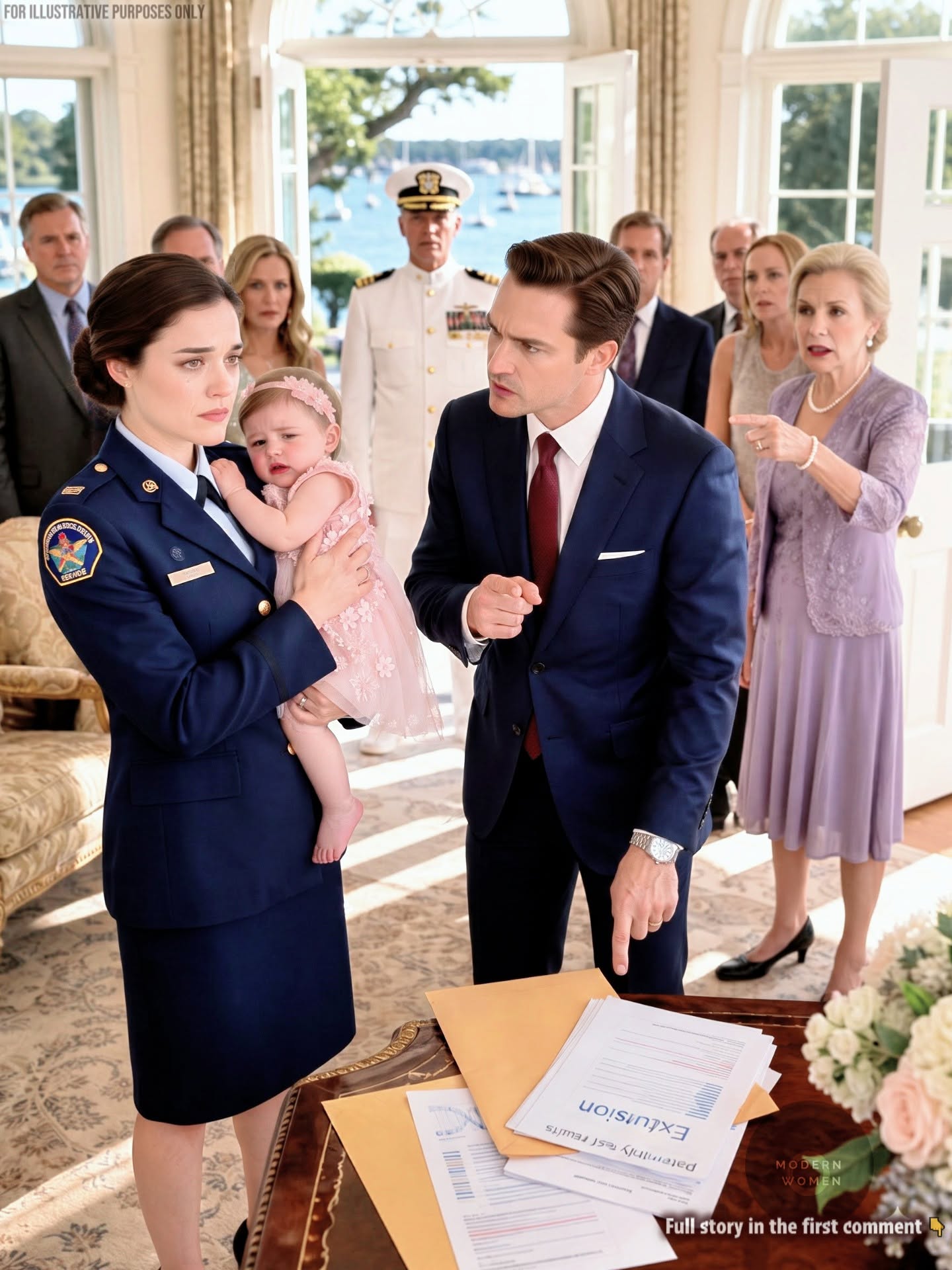
I was still wearing my dark navy dress uniform from the state wildfire aviation unit. My cap was tucked beneath one arm, and Sophie was asleep against my shoulder, her warm cheek pressed to the brass buttons of my jacket. Rainwater shone on the hardwood floor behind me.
The living room was crowded.
Grant stood near the fireplace. His mother, Diane, remained beside the front door. His sister Claire sat stiffly on the sofa, while two uncles, an aunt, and several cousins watched me with the uneasy silence of people who had been invited to witness something but had not been told what it would cost.
There was no dinner. No banner. No welcome.
Only a white envelope in Grant’s hand.
He crossed the room and dropped several pages onto the coffee table.
“The test says Sophie isn’t mine.”
For a moment, I thought I had misunderstood him. The words seemed too absurd to belong in the room where we had assembled Sophie’s crib, celebrated Christmas, and argued cheerfully over which photographs to frame.
“What test?” I asked.
“A DNA test.” His voice was flat, practiced. “I had it done while you were away.”
I stared at the report. My name was printed across the top, along with Grant’s and Sophie’s. Beneath them was a conclusion presented in bold type.
“Without telling me?”
Diane gave a dry laugh. “Why would he tell you? You would have found a way to interfere.”
Sophie shifted in my arms. One small hand opened against my collar, then curled again.
I looked at Grant. “You watched her take her first steps. You sat beside her when she had a fever. You called her your little star. And now you’re standing there saying she isn’t yours because of a report I’ve never seen before?”
His jaw tightened. “The science is clear.”
“No,” I said quietly. “A piece of paper is clear. The truth is something else.”
Diane stepped forward. “Do not turn this into a performance. My son has been humiliated enough.”
The room tilted around me. Four months of sleepless nights, missed birthdays, guilt, and longing rushed back all at once. I had accepted the training because it could lead to a promotion and better stability for our family. Grant had encouraged me to go. He had told everyone how proud he was.
Now, in front of those same people, he pointed toward the hallway.
“Pack whatever you need and leave. Take your daughter with you.”
Your daughter.
Not our daughter.
Those two words hurt more than the accusation. They erased every bedtime story, every bottle he had warmed at two in the morning, every photograph of Sophie asleep on his chest. They reduced an entire year of fatherhood to something he could abandon when it became inconvenient.
Sophie woke and began to whimper. Instinctively, I moved toward Grant, expecting him to reach for her.
He stepped back.
That was the moment something inside me changed. Not shattered—changed. The part of me that had entered the house hoping for comfort disappeared, and in its place came the calm I used during emergencies: breathe, observe, protect, remember.
Before I could speak, the front door opened behind me.
Samuel Pierce, the regional director who had supervised my leadership program, entered carrying a sealed folder. His gray hair was damp from the rain, and water darkened the shoulders of his coat.
“Commander Brooks,” he began, then stopped when he saw the room. “I appear to have arrived at an unfortunate time.”
Grant straightened immediately. “This is private, sir.”
Director Pierce’s gaze moved from Grant to me, then to the report on the table.
“I came to deliver Elena’s promotion recommendation in person,” he said. “But since a child is crying and half the family looks afraid to breathe, perhaps someone should explain what is happening.”
Diane answered before I could. “My son discovered that the baby is not his.”
Director Pierce looked at the report. “May I?”
Grant hesitated, then handed it over.
Pierce read the heading, the laboratory name, and the conclusion. “Who collected the samples?”
“I did,” Grant said.
“Was the collection witnessed by an independent professional?”
“No.”
“Were identities verified? Was the chain of custody documented?”
Grant’s expression hardened. “It was a private test.”
“Then it may answer a private question for the person who submitted it, but it does not establish what happened, who supplied the samples, or whether this document is genuine.” Director Pierce placed the pages back on the table. “If you want a result that can carry legal weight, use an accredited facility with witnessed collection. Until then, you have suspicion—not proof.”
Diane folded her arms. “My son knows when he has been betrayed.”
Pierce met her stare. “A crowded living room is not a courtroom, and humiliation is not evidence.”
No one replied.
He helped me carry Sophie’s bag to my car. By then my hands were shaking so badly that I could not fasten the straps on her car seat.
“Slow down,” he said. “You do not have to solve everything tonight.”
“I don’t understand what just happened.”
“You don’t need to understand the whole plan yet. Protect your daughter. Preserve every message. Do not argue where facts can speak for you later.”
I looked back at the house. Diane stood behind the glass panel beside the door, watching to make sure I left.
I did leave.
But not in surrender.

The Message On His Laptop
My closest friend, Nora Collins, opened her door before I finished explaining.
She took one look at my uniform, my swollen eyes, and the sleeping child in my arms and said, “The guest room is ready. You and Sophie are staying here.”
Grant called nineteen times that night.
His first messages accused me of fleeing because I had been exposed. By ten o’clock, he said I was keeping his family from him. Near midnight, his tone changed completely.
We were both emotional.
You misunderstood what I meant.
Come back so we can discuss this calmly.
The sudden softness frightened me more than the anger. Grant had not become reasonable. He had realized the scene had not ended the way he expected.
The next morning, I returned to the house while he was at work. I needed Sophie’s medication, clothes, diapers, and the stuffed rabbit she refused to sleep without.
I entered through the garage using my own key. The house felt strangely staged, as though the furniture had witnessed something shameful and was waiting for me to notice.
Upstairs, I packed quickly. I found Sophie’s medicine in the bathroom cabinet and folded her pajamas into a canvas bag. On my way out, I passed Grant’s office.
His laptop was open on the desk.
I would have kept walking if a message had not appeared in the lower corner of the screen.
“Everything worked. Once she’s gone, she can’t interfere with the house.”
The sender’s name was Vanessa Blake.
I knew Vanessa only vaguely. Grant had described her as a consultant helping him explore investment opportunities. I had seen her twice at company events, always standing a little too close to him while pretending not to notice me.
My pulse slowed into the heavy rhythm that came before a difficult decision.
I stepped into the office.
The message thread was already open. I did not need to guess a password or search through files. Their conversation was displayed in front of me like an invitation left by arrogance.
There were weeks of messages.
Diane says the family will come if she tells them it’s important.
Make sure Elena brings the baby. It looks worse if she leaves alone.
The report is ready. She won’t question it with everyone watching.
Once she walks out, we document that she abandoned the house.
I felt cold from the inside out.
The accusation had not been an explosion of jealousy. It had been rehearsed.
I scrolled farther.
There were references to a Monday deadline, a buyer, and signed authorization. Then I found bank confirmations showing transfers from the savings account Grant and I had built together. Small withdrawals had been made for months, then larger ones while I was in Idaho.
The total was just under sixty thousand dollars.
My fingers went numb.
That money included the inheritance my father had left me, the emergency fund I believed would protect Sophie, and years of careful saving. Grant had not merely planned to end our marriage. He had been dismantling our financial life while encouraging me to focus on training.
A car turned into the driveway.
I photographed every message I could see, along with the bank transfers and the file names on the screen. Then I returned the cursor to its original position, left the laptop exactly as I had found it, and picked up Sophie’s bag.
Diane entered through the front door as I reached the foyer.
Her expression sharpened. “I told you not to come back.”
“This is still my home,” I said. “And I came for my daughter’s belongings.”
“You have already done enough damage.”
I tightened my grip on the bag. “I am not the person who brought deception into this house.”
For the first time, uncertainty flickered across her face.
I walked past her without another word.
At that point, I still did not know exactly what was supposed to happen on Monday.
I only knew they needed me gone before then.
The Sale Set For Monday
Director Pierce connected me with Rebecca Sloan, a family attorney who had represented several emergency-service employees during complicated separations.
Rebecca did not interrupt while I told the story. She reviewed the photographs from Grant’s laptop, the bank activity, the DNA report, and the messages he had sent after I left.
When I finished, she leaned back in her chair.
“This was not about paternity,” she said. “The accusation was a tool.”
“A tool for what?”
“To control the story before you had time to understand the facts. If Grant could persuade relatives that you were unfaithful and that you left voluntarily, he could present himself as the betrayed spouse and the more stable parent.”
The phrase more stable parent made my stomach tighten.
Rebecca’s investigation moved quickly. By the following afternoon, she had located a separate account Grant had opened eight months earlier. He had been transferring money in amounts small enough to avoid my attention. She also confirmed that he had consulted a divorce attorney before I left Idaho.
Then she opened a property file.
Our house was under contract to be sold on Monday.
The buyer was a newly formed investment company managed by Vanessa Blake.
The price was far below market value.
I stared at the screen. “He can’t sell it without me. Both our names are on the deed.”
“Normally, no.” Rebecca clicked on another document. “But this file contains a power of attorney authorizing Grant to sign for you.”
My signature appeared at the bottom.
It looked almost right. The curve of the E, the narrow loop in my last name, even the habit I had of lifting the final stroke too sharply. Someone had studied how I signed.
“I never signed that.”
“I believe you,” Rebecca said. “And if this document is fraudulent, the transaction may be stopped before closing.”
She filed for an emergency order that afternoon. She also arranged a legally witnessed DNA test at an accredited laboratory.
Grant arrived at the testing center with Diane beside him. He did not speak to me. Sophie sat on my lap, twisting the strap of my handbag while a technician verified our identification, collected the samples, labeled each container, and sealed everything in front of us.
The difference between the real process and Grant’s mysterious report was impossible to miss.
Three days later, the result arrived.
Grant was Sophie’s biological father with a probability greater than 99.99 percent.
I had never doubted it. Still, when I held the report, my knees weakened.
For days, Grant had made me defend a truth so intimate that defending it felt degrading. Now the truth existed in a form he could not bend with tone, witnesses, or accusation.
Rebecca sent the result to his attorney.
Grant replied within minutes.
The laboratory must have made a mistake.
That evening, his sister Claire called me.
Her voice trembled. “Elena, I need to tell you something. After everyone left that night, I saw Grant burn an envelope in the fireplace. He thought I had gone upstairs. I only saw part of the label, but it looked like it came from a laboratory.”
A second test.
A real result, perhaps, obtained before the staged gathering.
Grant had not believed Sophie was someone else’s child. He had known she was his.
The false report had not been created from fear. It had been created from strategy.
Bank and phone records deepened the picture. Hotel charges, weekend trips, restaurant bills, and repeated payments tied Grant to Vanessa. Faced with those records—and apparently frightened by how quickly Grant began blaming her—Vanessa asked to meet Rebecca and me.
She arrived pale and defensive, but she brought a folder.
“Grant told me your marriage had been over for years,” she said. “He said you stayed in the same house because selling it would be complicated. He said Sophie wasn’t his.”
“You helped him produce the false report,” I said.
Vanessa lowered her eyes. “I connected him with someone who could create a document that looked convincing. I told myself it was only to force a conversation. I know how that sounds.”
“It sounds like you helped humiliate a mother and a child.”
“I did.” Her voice cracked. “But I did not forge your signature.”
Rebecca leaned forward. “Who did?”
Vanessa hesitated.
“Diane found examples of Elena’s signature in the mortgage records. Grant said he had someone who could imitate it. He planned to sell the house, move the proceeds into the company, and then file for temporary custody. He said Elena’s work schedule would make her look absent.”
I could barely breathe.
My career—the work I had built to provide for my family—had been turned into evidence they intended to use against me.
“Why are you telling us this now?” Rebecca asked.
Vanessa opened the folder. Inside were printed messages and a small digital recorder.
“Because last night Grant said that if the deal was discovered, he would claim Elena created the documents to frame him. Then he said he could make it look like I acted alone.”
One recording captured Grant’s voice clearly.
“By the time Elena gets back from Idaho, everything will be in place. If she leaves quietly, good. If she resists, we make sure everyone believes she can’t be trusted.”
The emergency order stopped the sale hours before the closing deadline.
But one question remained.
Who had signed my name?

The Woman Who Borrowed My Identity
The closing attorney eventually located security footage from the day the power-of-attorney document had been notarized.
Rebecca played it in her office.
Diane entered first, carrying a folder and a photocopy of my employee identification card. Another woman followed her. The camera angle was poor, but when she turned toward the desk, I recognized the way she tucked her hair behind her ear.
My cousin Natalie Foster.
For several seconds, I could not speak.
Natalie and I had grown up in the same small town outside Roanoke. We had shared bedrooms during family visits, whispered secrets after midnight, and promised that no matter what happened in adulthood, we would never become strangers.
After my father died, Natalie helped me sort through his papers. She had handled deeds, insurance forms, and bank records. She knew exactly how I signed my name.
Financial records showed that Grant had paid her nine thousand dollars in three installments.
When Rebecca informed her that video evidence existed, Natalie agreed to meet.
She entered the office looking older than she had a month earlier. She clutched her handbag with both hands and avoided my eyes.
“I didn’t know they were going to try to take Sophie,” she said.
“But you knew you were signing my name.”
Tears filled her eyes. “Diane said it was temporary. She said Grant needed authorization because you were away and the buyer had a deadline. She promised the paperwork would be corrected when you came home.”
“And the money?”
Natalie’s face folded. Her husband’s landscaping business had failed, and creditors were calling daily. Diane had learned about the debt through a relative and offered enough money to delay foreclosure.
“I was ashamed,” Natalie whispered.
I looked at the woman who had once sat beside me at my father’s funeral and held my hand until the service ended.
“You were more ashamed to ask me for help than you were to become me on paper?”
She began to cry.
I wanted to feel compassion. Instead, I felt the exhausted grief that comes when someone familiar suddenly becomes unrecognizable.
Natalie confirmed the rest of the plan. Diane knew the paternity report was false. The relatives had been invited so they could later testify that I left after being confronted. Grant intended to describe my departure as voluntary abandonment. If I tried to return, he would claim I was unstable and disruptive.
They needed me out before Monday because I might see the sale documents.
Every detail of that night rearranged itself in my memory.
Diane standing near the front door.
Grant refusing to hold Sophie.
The relatives positioned around the room.
The envelope placed where everyone could see it.
The accusation had not been meant to discover truth. It had been designed to manufacture witnesses.
Rebecca filed complaints concerning the forged authorization, concealed assets, attempted transfer of marital property, and misuse of my identification. A judge froze the connected accounts and prohibited any sale of the house. Grant was barred from removing Sophie from daycare or approaching me outside the communication arrangements established through counsel.
Only then did his tone change.
We should settle this privately, he wrote. We’re adults. We can repair our family.
I read the message twice.
For years, I had mistaken Grant’s confidence for strength. Now I saw it differently. He was gentle when gentleness benefited him, angry when anger created fear, and apologetic only when consequences became unavoidable.
I did not respond.
That evening, Director Pierce called.
“I heard the matter has become more serious,” he said. “How are you managing?”
I looked toward the borrowed crib beside Nora’s guest-room window. Sophie was asleep with her stuffed rabbit beneath one arm.
“I’m exhausted,” I admitted. “But I’m not confused anymore.”
“That matters.”
“I keep thinking I should have noticed something sooner.”
“Do not punish yourself for trusting the person who asked for your trust.” His voice softened. “Discipline is not the same as enduring everything someone chooses to do to you. Sometimes discipline means moving carefully enough to protect what matters without losing yourself.”
I carried those words into every meeting that followed.
What The Court Finally Heard
The divorce hearing took place in Richmond in early autumn.
I wore a navy suit instead of my aviation uniform. My professional role had helped me remain calm, but I did not want anyone to mistake my rank for the reason I deserved to be heard.
I was there as Sophie’s mother.
Rebecca presented the accredited paternity report, the hidden transfers, Grant’s early consultation with a divorce lawyer, the attempted sale, the false authorization, the security footage, and the messages between Grant and Vanessa.
Grant’s attorney argued that he had been acting under genuine emotional distress.
The judge reviewed several documents in silence. Then he read one of Grant’s messages aloud.
“She’ll never discover that the first test wasn’t real.”
The room became still.
The judge looked directly at Grant. “That sentence does not describe a frightened husband seeking clarity. It describes a person preparing deception.”
Grant lowered his eyes.
The hearing then turned to custody.
Rebecca submitted Sophie’s medical records, daycare notes, my duty schedule, and statements from Nora, neighbors, colleagues, and Director Pierce. They described a mother who called during every break, arranged backup care in advance, kept records of every appointment, and accepted temporary hardship to build a more stable future for her child.
Grant’s attorney tried to portray my work as unpredictable.
Rebecca answered, “Her work requires planning, responsibility, and composure under pressure. The evidence before the court shows that Mr. Holloway exploited her temporary absence while she was serving the public and advancing her qualifications.”
The court granted me primary custody. Grant’s visitation would be supervised until he completed counseling and a parenting program. The missing money had to be restored to the marital estate. The house would remain protected until it could be sold through lawful channels, and Grant was ordered to cover a significant portion of my legal expenses. The separate investigation into the forged documents would continue.
Outside the courtroom, Grant caught up with me near the elevators. Sophie slept in her stroller beneath a yellow blanket.
“Do you really think you won?” he asked.
I studied his face. There had been a time when one disappointed look from him could make me question myself for days. Now I saw only a man searching for the sentence that would hurt me most.
“This was never about defeating you,” I said. “It was about preventing your decisions from controlling her future.”
“You could leave me with nothing.”
“You placed everything at risk.”
The elevator doors opened, and I walked away.
I expected triumph. What I felt was quieter.
Relief.
Justice did not feel like applause. It felt like a door that finally locked, a bank account that could no longer be emptied, and a child who could fall asleep without being used as a weapon in someone else’s plan.
In the months that followed, Sophie and I moved into a modest apartment near the aviation center. Nora helped when my shifts ran late. I returned to work slowly, still startled by unfamiliar sounds in the hallway and still checking my phone whenever it lit up after dark.
Healing was not dramatic. It happened through small ordinary moments: buying groceries without wondering whether our account had been drained, hanging Sophie’s drawings on a wall that belonged to us, and waking on Saturday mornings without feeling that danger had arrived before breakfast.
Grant attended counseling because it was required if he wanted expanded visits. At first, he came resentful and distracted. Sophie often hid behind my legs when she saw him.
Over time, he began bringing picture books instead of expensive gifts. He learned the names of her teachers, remembered which foods she refused to eat, and asked about her appointments without turning every conversation into an argument.
I did not forgive him quickly. I also did not stand between him and the possibility of becoming a better father.
One afternoon after a supervised visit, he stopped beside the entrance to the family center.
“I don’t understand how I convinced myself that you were the problem,” he said.
“Because blaming me was easier than facing what you were doing.”
“I lost my family.”
“You endangered your family,” I replied. “What remains depends on whether you can build something honest from here.”
He had no answer.

The Inheritance I Chose For Sophie
Six months after the hearing, Diane came to my apartment.
She stood in the hallway carrying a cloth bag. Without the confidence of Grant’s house and the support of gathered relatives, she seemed smaller than I remembered.
“I don’t expect you to forgive me,” she said.
“Then why are you here?”
“Because I remember that night every day.” Her voice shook. “I watched my son accuse you, and I accepted every word because he was my son. I never demanded proof. I never considered what we were doing to an innocent child. I helped a grown man escape responsibility by turning a baby into evidence.”
“Sophie was your family too.”
“I know.”
She opened the bag and removed a cream-colored blanket, carefully folded. “My mother made this when Grant was born. I would like Sophie to have it.”
I accepted the blanket but did not invite her inside.
“A blanket cannot erase what happened.”
“I didn’t bring it to buy forgiveness.” Diane swallowed. “I came to ask whether I might know my granddaughter again—slowly, under your rules, and only if you believe it is safe.”
For months, she had called Sophie the child or Elena’s daughter. Hearing her say my granddaughter did not restore trust.
But it offered a place to begin.
Her first visits lasted twenty minutes. She read picture books, brought sliced fruit, and left when the time ended. She did not criticize my apartment, defend Grant, or ask for more than I offered.
Weeks became months.
One afternoon, I entered the living room and found Diane sitting on the floor with Sophie. They had wrapped a doll in the old cream blanket.
“Look, Mommy,” Sophie said. “Grandma made the baby cozy.”
Diane looked up, tears shining in her eyes.
I smiled—not to comfort Diane, but because my daughter was happy and safe.
Natalie faced legal consequences for impersonating me and signing the authorization. She returned the money she had received and completed community service. Her cooperation helped clarify the case, but our relationship never returned to what it had been.
Some apologies can be sincere and still arrive too late to rebuild the home that trust once occupied.
Vanessa also provided evidence and ended her relationship with Grant. We never became friends. I did not need us to. Telling the truth did not erase her responsibility, but it prevented the lie from spreading farther.
A year after the night I was ordered out of my own house, I was promoted to regional air-operations chief.
The ceremony was small. Sophie wore a red dress and clapped whenever anyone else clapped, even before she understood what we were celebrating. Director Pierce pinned the new insignia to my jacket.
“I’m proud of the leader you have become,” he said quietly. “And even prouder of the mother you chose to remain.”
My life did not become perfect.
Grant and I spoke only about Sophie. Diane continued repairing what she could, one respectful visit at a time. Natalie no longer had access to my private decisions. The Virginia house was eventually sold through proper legal channels, and my share went into a protected education fund for Sophie.
But something inside me had changed permanently.
For years, I had confused strength with endurance. I believed a devoted wife should remain patient, absorb disappointment, offer understanding, and forgive before she had received a truthful explanation.
The night Grant placed a false DNA report on our coffee table taught me a different definition.
Strength can be quiet.
It can gather screenshots instead of shouting.
It can call an attorney instead of begging to be believed.
It can set boundaries without hatred and leave a room without surrendering dignity.
My greatest victory was not disproving the report. It was not recovering the money or stopping the house sale. It was not hearing a judge describe Grant’s actions for what they were.
My greatest victory was refusing to make bitterness Sophie’s inheritance.
Forgiveness did not mean pretending nothing happened. It meant deciding that the damage would not travel any farther through our family.
Even now, when I hear someone condemn another person because of a single accusation, I remember that crowded living room. I remember the white pages on the table, Diane guarding the door, and Sophie clutching the collar of my uniform while the adults around her treated a lie as though it were already a verdict.
Truth does not always arrive with perfect timing.
Sometimes it must be collected from one photograph, one bank record, one security camera, and one frightened confession at a time.
But when truth is protected with patience and courage, it eventually enters the room carrying something no carefully rehearsed lie can imitate:
The quiet authority of facts.
Disclaimer: This fictional story is inspired by situations from everyday life. Names, characters, businesses, and locations are created for storytelling purposes, and any resemblance to actual people or events is coincidental.