
Aug
The Coins on the Counter
The first coin rolled in a slow circle before stopping against the cash register.
No one in Rosewood Bakery spoke.
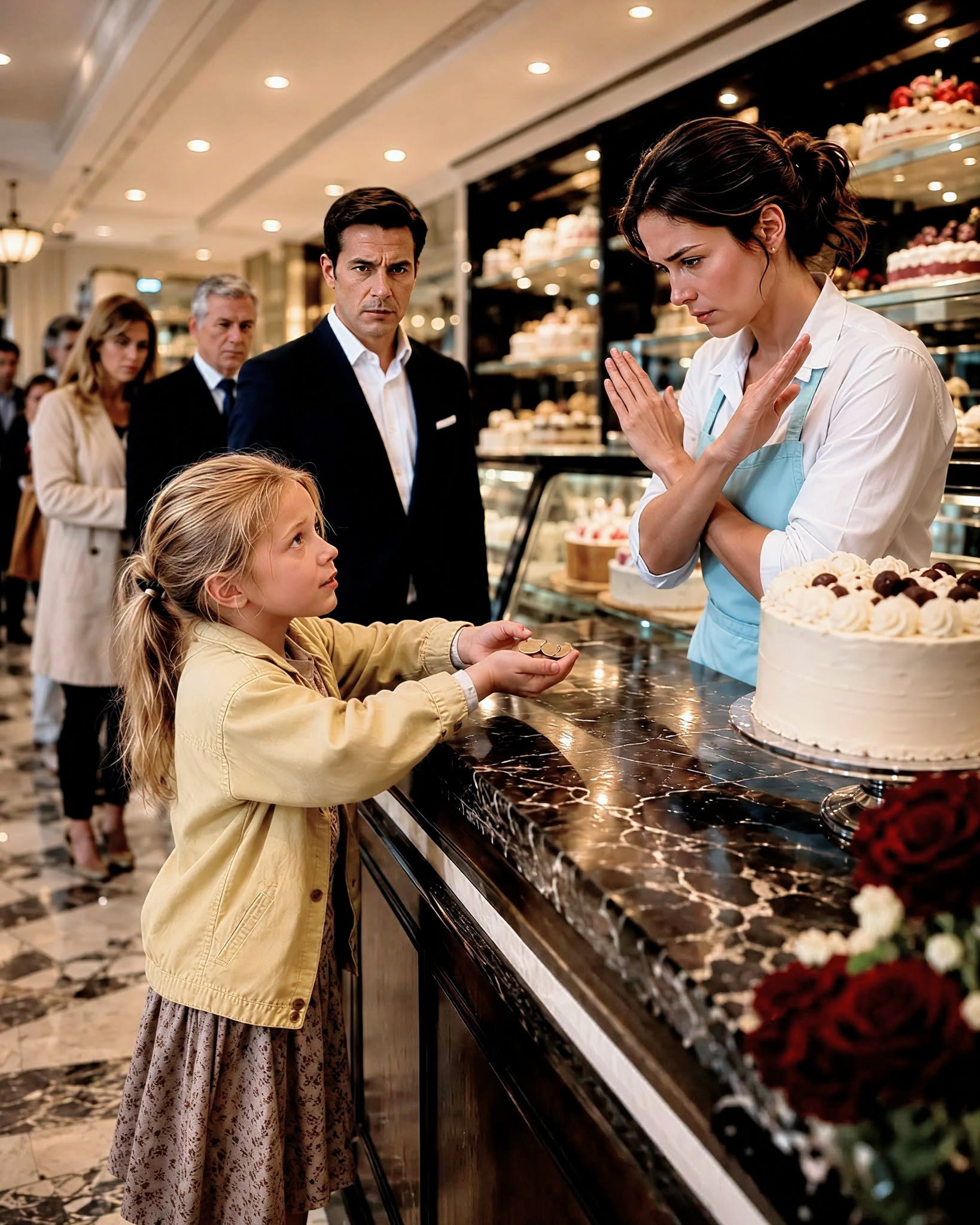
A little girl stood on tiptoe in front of the counter, carefully opening her small fist. One by one, she placed four quarters, three dimes, and four pennies on the glass.
“Is that enough for a birthday cake?” she asked.
She was six years old, wearing a faded yellow coat that was too large for her and sneakers with frayed laces. Her brown hair was tied into two uneven ponytails, and a pink hospital wristband hung loosely around her tiny wrist.
Mrs. Rosa Alvarez, the owner of the bakery, looked from the coins to the child’s hopeful face.
“Sweetheart,” she said gently, “what kind of cake are you looking for?”
“A vanilla one,” the girl answered. “A small one is okay. My mommy likes vanilla.”
Rosa glanced at the display case. The smallest birthday cake cost $24.50.
The girl seemed to understand the answer before Rosa said anything.
“I don’t need writing on it,” she quickly added. “And it doesn’t have to be fancy. Maybe just frosting and one candle.”
Behind her, customers stopped choosing pastries. A young mother holding a toddler lowered her phone. An elderly man near the window took off his glasses.
The little girl pushed the coins a little closer.
“I only have $1.34,” she whispered. “But I can come back tomorrow with more.”
Rosa’s heart tightened.
“What’s your name?” she asked.
“Emma.”
“And whose birthday is it?”
“My mom’s.”
Emma smiled, but there was something fragile about it. The kind of smile children wore when they were trying very hard to make an adult feel better.
Rosa looked again at the hospital bracelet around Emma’s wrist.
The name printed on it had nearly faded away, but Rosa could still read two words:
Hannah Bennett.
She Wouldn’t Take a Free Cake
Rosa crouched behind the counter so she was eye level with Emma.
“Emma, I can give you a cupcake,” she said. “It has vanilla frosting, and I can put a candle in it. You can take it home for your mom.”
Emma immediately shook her head.
“No, thank you.”
“It’s okay,” Rosa assured her. “You don’t have to pay for it.”
Emma pulled her coins back toward herself.
“My mommy says people work hard for things.”
Rosa swallowed.
“I’m sure she does.”
“She says we can accept help when we really need it,” Emma continued, “but we shouldn’t pretend we bought something if we didn’t.”
The young mother behind Emma quietly turned away. The elderly man near the window looked down at his coffee.
Rosa reached beneath the counter and brought out a small lemon cake. It wasn’t a birthday cake, exactly, but it had white frosting and a few sugar flowers on top.
“This one is left over from a canceled order,” she explained. “I can sell it for $1.34.”
Emma studied the cake carefully.
“Really?”
“Really.”
“Will it feed two people?”
Rosa smiled through the tears gathering in her eyes.
“It will feed two people if you cut the slices carefully.”
Emma nodded. “Then I’ll take it.”
She counted the coins twice before placing them on the counter.
“Please don’t give me change,” she said. “I need to pay all of it.”
Rosa placed the cake in a white box and tied it with a blue ribbon. She added one candle, then hesitated.
“Would you like six candles?” she asked.
Emma’s face brightened.
“Six.”
“That’s a lot of candles for a small cake.”
“Six candles are for the six years Mommy has been my mommy.”
The bakery became so quiet that Rosa could hear the refrigerator humming behind her.
Emma carefully accepted the cake with both hands.
Then she turned toward the door.
That was when a man in a dark gray coat stepped inside.

The Man Who Was Supposed to Be Somewhere Else
Adrian Cole had been on his way to a business meeting when the rain began.
He was the CEO of ColeWay Logistics, a company with warehouses in four states and thousands of employees. He was accustomed to people standing when he entered a room, to assistants reminding him of appointments, and to problems being summarized in neat bullet points.
But he had stopped at Rosewood Bakery because his driver had called to say traffic was completely backed up.
Adrian had planned to buy coffee and wait ten minutes.
Instead, he saw a little girl carrying a birthday cake that had cost her every coin.
He noticed the faces around the bakery. Some people looked embarrassed. Others looked sympathetic. One man had already reached for his wallet.
Adrian watched Emma pull the cake close to her chest.
He had seen that posture before.
Not in a boardroom.
In his childhood.
“Excuse me,” he said softly.
Emma turned.
Adrian pointed toward the cake. “Is that for your mom?”
Emma nodded.
“Would it be all right if I bought something too?”
She looked suspicious.
“What?”
“Another cake.”
“I already bought this one.”
“I know. I’m not asking you to give it back.”
“Then why do you need another one?”
Adrian almost smiled.
“Because I would like to buy the rest of the cake you chose.”
Emma frowned. “I paid for it.”
“You paid for part of it.”
“I paid all the money I had.”
“I can see that.”
“Mommy says we don’t take things from strangers.”
“She’s right.”
Emma looked at Rosa, then back at Adrian.
“Are you a stranger?”
“For now.”
The answer seemed to satisfy her more than a promise would have.
Adrian turned to Rosa.
“How much was the cake before the discount?”
“Twenty-four dollars and fifty cents.”
He took out his wallet, but Emma quickly raised her hand.
“No.”
Adrian stopped.
“I said I want to pay for it.”
“And you are going to,” he replied.
“I don’t have enough.”
“You have enough to be part of it.”
Emma stared at him.
Adrian placed twenty-three dollars and sixteen cents on the counter beside her coins.
“Your $1.34 pays for the cake,” he said. “My money pays for the part you were missing.”
“That sounds like charity.”
“It’s not.”
“What is it?”
Adrian thought for a moment.
“A purchase,” he said. “I’m buying a birthday cake for a woman I haven’t met yet.”
Emma considered this carefully.
“Are you going to eat it?”
“I hope someone offers me a slice.”
She looked toward the cake box.
“You can have a small slice.”
“Then we have a deal.”
Emma slowly nodded.
Rosa placed both amounts into the register. Adrian did not hand Emma the money directly. He did not make a show of it. He simply let her remain the customer.
As Emma reached for the cake, the sleeve of her coat slipped down.
The hospital bracelet became fully visible.
Adrian’s eyes moved to it.
The name on the band was Hannah Bennett.
Then a folded piece of pink paper slipped from the inside pocket of Emma’s coat and landed near her shoe.
Emma quickly picked it up.
But not before Adrian saw the bold red letters at the top.
FINAL NOTICE.
The Bracelet and the Paper
Adrian did not reach for the notice.
He had learned long ago that some things became more frightening when adults grabbed them too quickly.
Instead, he looked at Emma.
“Are you okay?” he asked.
Emma hugged the cake tighter.
“Yes.”
“Is your mother okay?”
Emma’s answer came too quickly.
“Yes.”
Adrian glanced at the hospital wristband.
“Is that hers?”
Emma looked down at it.
“Mommy gave it to me.”
“Why?”
“Because she came home.”
Adrian waited.
Emma touched the faded band with one finger.
“She had to stay at the hospital for a long time. When they let her come home, she cut this off. I asked if I could keep it.”
“Does it make you feel better?”
Emma nodded.
“It reminds me that she came back.”
Adrian felt something tighten in his chest.
“And the paper?”
Emma’s eyes dropped to the floor.
“That’s just something Mommy needs to take care of.”
“Do you know what it says?”
“She says it’s not my problem.”
“That sounds like something a mother would say.”
Emma looked toward the bakery window. Rain streaked the glass.
“But it is my problem a little,” she whispered.
Adrian said nothing.
Emma’s voice became even quieter.
“It says we have to leave our apartment.”
Rosa’s hand stopped halfway to the sink.
“Emma,” she said gently, “does your mother know you brought that paper with you?”
Emma shook her head.
“She was sleeping.”
“Why did you leave?”
“I wanted to get the cake before she woke up.”
“Did you leave a note?”
“Yes.”
“What did it say?”
Emma looked embarrassed.
“I wrote, ‘Don’t worry, Mommy. I know how to get your birthday cake.’”
Adrian looked away for a moment.
He had walked into the bakery thinking about a conference call. Now he was standing beside a child who had quietly taken responsibility for an entire household.
He knew that feeling.
He had once been the child who listened through thin apartment walls while his mother calculated bills at the kitchen table.
He had once believed that if he became successful enough, no child would ever have to worry about rent.
But business had taught him to focus on large numbers. Millions of dollars. Quarterly losses. Expansion plans.
He had forgotten that a family could be destroyed by a number as small as $1.34.
The bakery door opened again.
A woman entered, breathing hard.
She was pale and thin, with dark hair pulled into a loose bun. She wore a blue sweater, black pants, and slippers inside worn-out shoes.
“Emma!”
The little girl turned.
“Mommy!”
She hurried across the bakery.
Hannah Bennett dropped to her knees and wrapped both arms around her daughter. For a few seconds, she simply held Emma and closed her eyes.
Then she noticed the cake.
Her expression changed.
“Where did you get that?”
“I bought it.”
Hannah looked at Rosa.
Rosa gently explained what had happened.
Hannah rose slowly to her feet. She looked exhausted, embarrassed, and frightened all at once.
“I’m sorry,” she said. “She shouldn’t have bothered you.”
“She didn’t bother me,” Rosa replied.
Hannah’s eyes moved to Adrian.
“And you?”
“I helped complete the purchase.”
“We can’t afford it.”
“Your daughter paid what she could.”
“I’ll pay you back.”
Adrian shook his head.
“You don’t owe me anything for the cake.”
Hannah’s face hardened slightly.
“I don’t accept money from strangers.”
“I understand.”
“Then please let me return it.”
Adrian glanced at Emma.
“Would you like to return the cake?”
Emma shook her head so quickly that her ponytail bounced.
“No. I paid for it.”
Hannah closed her eyes.
Adrian spoke gently.
“I’m not trying to embarrass you. I saw your daughter carefully count every coin. She wanted to make sure her mother had a birthday. I simply paid the part she couldn’t.”
Hannah stared at him.
“You don’t know us.”
“No,” Adrian said. “But I know what it means to want to give someone you love one good day.”
For the first time, Hannah’s expression softened.
What Hannah Had Been Hiding
Rosa brought Hannah a chair and a glass of water.
Hannah sat down, keeping one hand on Emma’s shoulder.
“I’m sorry,” she said again. “I didn’t expect any of this.”
“You don’t have to apologize,” Rosa replied.
Hannah looked at the cake box.
“Emma has been saving those coins for three weeks.”
Emma looked down.
“I had more, but I bought milk.”
Hannah’s eyes filled with tears.
“You bought milk?”
“It was on sale.”
Adrian sat at a nearby table, leaving enough distance to make it clear that Hannah could leave whenever she wanted.
Rosa knew Hannah. She had worked at a nearby home-care agency and used to stop at the bakery after late shifts.
For years, Hannah had bought day-old bread and small pastries for Emma. She had always paid in cash, always thanked Rosa, and never asked for anything free.
“She was working two jobs,” Rosa explained quietly. “Home-care during the day and overnight cleaning at a medical office.”
Hannah looked uncomfortable.
“I was managing.”
“Until you ended up in the hospital,” Rosa added.
Adrian looked at Hannah, but did not interrupt.
Hannah folded her hands in her lap.
“About a month ago, I collapsed at work,” she said. “I thought I was tired. I had been tired for weeks. The doctors found an infection and some complications that required surgery. I spent twelve days at County Medical Center.”
She glanced at the bracelet around Emma’s wrist.
“Emma visited every afternoon. She was so brave.”
“I wasn’t brave,” Emma said. “I was scared.”
“You were scared and you still came.”
Hannah reached for her daughter’s hand.
“After I was discharged, I couldn’t return to work immediately. My employer held my position, but I didn’t have paid medical leave. I used what little savings we had for rent, food, and prescriptions.”
“What about assistance?” Adrian asked.
“I applied.”
“What happened?”
“I missed one appointment because I was at the hospital for a follow-up. Then they said they needed another form. I filled it out, but I sent it to the wrong office. By the time I realized it, the rent was already two months behind.”
She pulled the pink notice from Emma’s coat and placed it on the table.
“The landlord gave me until Friday.”
Adrian looked at the date.
Friday was the next day.
Hannah’s voice grew smaller.
“I planned to ask for more time, but I didn’t want Emma to know. She already thinks every envelope is bad news.”
Emma leaned against her mother.
“I don’t think every envelope is bad news.”
“Which ones do you think are good?”
“Birthday cards.”
Hannah smiled weakly.
“That’s true.”
Adrian looked at the little girl.
“Why did you want to buy the cake yourself?”
Emma hesitated.
“Because Mommy has been sad.”
Hannah lowered her head.
“She isn’t supposed to know that.”
“I know,” Emma said. “But I can tell.”
The room became quiet again.
Emma continued, “Mommy says birthdays are for celebrating people who are still here. She came home from the hospital, so I wanted her to have a real birthday.”
Hannah covered her mouth.
Adrian looked toward the rain-covered window.
The child had not come to the bakery because she wanted sweets.
She had come because she was afraid her mother was disappearing beneath hospital bills, eviction notices, and exhaustion.
She had brought $1.34 because it was the only way she knew to fight back.

Adrian Remembered His Mother
Adrian’s mother had raised him alone.
Her name was Rose, and she had worked as a waitress, a cleaner, and sometimes both in the same week. She had never been ashamed of being poor, but she had been fiercely protective of Adrian’s dignity.
When he was eight years old, he had asked for a birthday cake.
Rose had checked her purse and counted three dollars and seven cents.
They went to a bakery much like Rosa’s. Adrian still remembered standing beside her while she asked the owner what she could afford.
The owner offered them a free cake.
Rose thanked her but declined.
Instead, she asked if she could work for it.
She spent two hours washing trays and folding boxes while Adrian sat at a small table near the window. At the end of the afternoon, they walked home with a simple yellow cake.
Rose had paid for every part of it—with money, effort, and pride.
Years later, when Adrian became successful, he sent her expensive gifts. He paid her bills. He bought her a house.
But whenever he tried to give her money without asking, she would say, “Let me contribute something.”
He had once thought she was being stubborn.
Now he understood.
She wasn’t refusing kindness.
She was asking to remain part of her own life.
Adrian looked at Hannah.
“My mother was like you,” he said. “She never wanted anyone to feel sorry for her.”
Hannah gave a tired laugh.
“That sounds familiar.”
“But she eventually taught me something,” he continued. “There’s a difference between being rescued and being supported.”
Hannah watched him carefully.
“I don’t need rescuing.”
“I believe you.”
“I’m serious.”
“So am I.”
Adrian picked up the eviction notice only after Hannah nodded permission.
He read it quickly and placed it back on the table.
“I know a housing advocate who may be able to help you request an emergency extension,” he said. “There may also be medical assistance available through the hospital. I can connect you with both.”
Hannah shook her head.
“I can’t ask you to do all that.”
“You’re not asking. I’m offering.”
“That still feels like charity.”
“Then don’t accept anything tonight,” Adrian replied. “Let me give you information. You can decide what to do with it tomorrow.”
Hannah studied him.
He was not pressuring her. He was not asking for her story, a photograph, or a public thank-you.
He was simply giving her room to choose.
Finally, she nodded.
“All right.”
Help That Preserved Her Dignity
Adrian called his assistant, but he did not give instructions to write a check.
Instead, he asked her to contact Bridgeway Family Services, a nonprofit that helped families facing medical emergencies and housing problems.
He had supported the organization for years, mostly through annual donations. He knew the director, but Hannah did not need a favor from him. She needed a fair application and someone who understood the process.
Within an hour, a housing advocate named Tasha Nguyen called Hannah.
Tasha explained that Bridgeway could help her file for emergency rental assistance. They could also speak with the landlord and request a temporary hold on the eviction while the application was reviewed.
Then Adrian called the hospital’s financial assistance office.
A caseworker discovered that Hannah’s application had been delayed because one medical form had been sent to the wrong department. The caseworker promised to correct the error and review Hannah’s hospital bill for financial relief.
None of it happened instantly.
There was no magical envelope filled with cash. No dramatic landlord suddenly tearing up the notice.
There were forms, phone calls, waiting periods, and difficult conversations.
But for the first time in weeks, Hannah was not trying to solve everything alone.
The following morning, Tasha met her at the housing office. The landlord agreed to give Hannah thirty days while the emergency assistance application was processed.
Bridgeway approved a grant that covered the overdue rent directly. Hannah never had to take money from Adrian’s hand, and Adrian never asked her to repay him.
When Hannah tried to thank him, he stopped her.
“You don’t owe me gratitude,” he said.
“I do.”
“No. If you want to thank me, accept help before the situation becomes impossible next time.”
She gave him a small smile.
“I’ll try.”
“And when you are strong enough,” Adrian continued, “help someone else in whatever way makes sense for you.”
“That I can promise.”
Two weeks later, Hannah was medically cleared to work part-time.
Adrian mentioned that ColeWay Logistics was hiring a scheduling coordinator. He did not offer her the job.
He offered her an interview.
“You should know,” Hannah said, “I won’t take it if you’re hiring me because of Emma.”
“I wouldn’t want you to.”
She went through the same interview process as every other applicant. She described her years coordinating home-care visits, organizing appointments, and managing emergencies when clients needed last-minute support.
The operations manager hired her because she was qualified.
The position allowed her to work four hours a day at first, with health insurance and a flexible schedule while she continued recovering.
Adrian never sat on the interview panel.
He didn’t need to.
Hannah earned the job herself.
Six Candles
That evening, Hannah, Emma, Rosa, and Adrian gathered in the small Bennett apartment.
The place was modest. The kitchen table had one uneven leg, and the living room sofa had been repaired with a strip of blue fabric.
But Hannah had placed a clean white cloth over the table.
Emma carried the cake to the center.
Rosa had added six candles.
Adrian stood near the doorway, unsure whether he should stay.
Hannah noticed.
“You bought the missing part,” she said. “You should at least have a slice.”
Adrian smiled.
“I was hoping you might say that.”
Emma lit the candles one at a time.
The flames reflected in her eyes.
“Make a wish, Mommy.”
Hannah looked at her daughter.
“I already have one.”
“You have to close your eyes.”
Hannah did.
For a moment, nobody spoke.
Then Emma began singing “Happy Birthday,” slightly off-key and far too loudly. Rosa joined in. Adrian followed a second later.
Hannah laughed.
It was the first real laugh anyone had heard from her in weeks.
When the song ended, she blew out the candles.
Emma clapped.
“Now you have to make a wish.”
“I did.”
“What was it?”
“If I tell you, it won’t come true.”
Emma thought about this.
“Then I hope it was about me.”
“It was.”
They cut the cake into six uneven slices.
Emma carefully gave the biggest piece to her mother.
Adrian received the smallest.
“This is not a small slice,” he protested.
“It is the guest slice,” Emma explained. “Guests get small slices so there’s enough for everyone.”
Adrian nodded solemnly.
“That is an excellent rule.”
After the cake, Hannah walked him to the door.
“I still don’t know how to repay you,” she said.
Adrian glanced toward the kitchen, where Emma was licking frosting from her finger.
“You already did.”
“I did what?”
“You reminded me to pay attention.”
Hannah frowned slightly.
“To what?”
“To the small numbers.”

The Change That Followed
Months passed.
Hannah regained her strength. She continued working part-time, then gradually increased her hours. She became one of the most reliable people in the scheduling department.
She never told her coworkers the entire story, but she quietly helped other employees find community resources when they faced emergencies.
Adrian changed, too.
At ColeWay Logistics, he asked managers to create an emergency assistance program for employees dealing with medical bills, rent crises, or family emergencies.
The program was confidential. Employees did not have to perform gratitude or explain their hardship in front of a room full of people.
Adrian also asked Rosa if Rosewood Bakery wanted to participate in a community birthday project.
Rosa agreed.
Families referred by schools, hospitals, and local shelters could receive a birthday cake. They could contribute whatever they could afford—even if it was only a dollar, a handwritten note, or a promise to help someone else later.
Rosa named it the “One More Candle” program.
Emma helped decorate the sign.
She drew a yellow cake with six candles and wrote beneath it:
Everyone deserves one good day.
The faded hospital bracelet eventually came off her wrist.
Hannah placed it inside a small memory box along with Emma’s first drawing and the note that had once said, “Don’t worry, Mommy. I know how to get your birthday cake.”
Emma still remembered that day, but she no longer checked the mail with fear.
She knew that grown-ups were responsible for grown-up problems.
She was allowed to be six.
One Year Later
The following year, Emma walked into Rosewood Bakery holding her mother’s hand.
Hannah looked healthier. Her cheeks had color again, and she wore a bright blue dress.
Rosa saw Emma approach the counter.
The little girl opened her palm.
This time, she had more than $1.34.
She had saved seven dollars and eighty-two cents.
Rosa smiled.
“What are you buying today?”
Emma placed the money on the counter.
“A cake for the family staying at Bridgeway.”
Rosa glanced at the sign for the One More Candle program.
“Are you sure?”
Emma nodded.
“I want to pay for part of it.”
Adrian entered the bakery just as Emma was choosing the frosting.
He had come for coffee, but the moment he saw her, he stopped.
Emma turned toward him.
“Mr. Cole!”
“Hello, Emma.”
“I have enough for the candles this time.”
Adrian walked to the counter.
“Then I’ll buy the cake.”
Emma thought about it.
“Only if I can pay for the candles.”
“Deal.”
She carefully counted out the money.
Rosa placed the order in the register.
No one in the bakery grew silent this time.
Instead, the customers smiled. One woman added five dollars. The elderly man near the window added two. A teenager placed a dollar beside Emma’s contribution.
Soon, the cake was fully paid for.
Emma looked surprised.
“Why did everyone do that?”
Rosa leaned over the counter.
“Because sometimes one person starts something.”
Emma looked at Adrian.
“Like you did?”
Adrian shook his head.
“Like you did.”
Emma frowned. “But I only had $1.34.”
Adrian smiled.
“That was enough to begin.”
The Lesson Behind the Cake
Emma had walked into the bakery with almost nothing.
But she had brought courage, love, and the determination to give her mother one ordinary birthday.
Adrian could have handed her a free cake and walked away. It would have been kind, but it might not have changed anything.
Instead, he listened.
He respected her wish to contribute. He helped her mother find practical support. He opened doors without taking away Hannah’s ability to walk through them herself.
And Hannah accepted help without surrendering her dignity.
That was the real gift.
The cake was eaten. The candles burned out. The eviction notice was eventually replaced with a paid receipt.
But the moment stayed with everyone who had witnessed it.
Because the little girl had asked whether $1.34 was enough for a birthday cake.
The answer, in dollars, was no.
But in love, courage, and hope?
It was more than enough.
Sometimes a person doesn’t need someone to take over their life.
Sometimes they only need someone to see how hard they are trying and say:
“You don’t have to carry this alone.”