
Aug
PART 1
The clock struck 6:00 a.m. when the guards opened the heavy iron cell door.
The metallic echo traveled through the corridor of the cellblock.
Inside sat Ramira Fuentes.
She had waited five years for this morning.
Five years of repeating the same sentence to gray walls that never answered:
“I didn’t do it.”
In a few hours, the state would carry out its final order.
Ramira sat on the edge of the narrow bunk, her hands folded tightly in her lap. Her prison uniform hung loosely over her thin frame. She had lost nearly twenty pounds during those five years, but the greatest change was in her face.
At thirty-six, she looked much older.
When the guards entered, she slowly raised her head.
“I want to see my daughter,” she said. Her voice was dry from years of silence and confinement. “That’s all I’m asking. Please let me see Salomé before it’s over.”
The younger guard looked away.
The older guard gave a short, bitter laugh.
“The condemned have no rights.”
Ramira pressed her lips together.
“She’s eight years old,” she whispered. “I haven’t seen her in three years.”
No one answered.
But her request did not stay inside that cell.
A few hours later, it reached the desk of Colonel Miguel Méndez, director of San Rafael Correctional Center.
Méndez was sixty years old. He had spent thirty years watching the guilty, the dishonest, the desperate, and the broken pass through prison doors.
He had learned to recognize fear.
He had learned to recognize anger.
Most of all, he believed he had learned to recognize guilt.
Ramira Fuentes’s file seemed simple.
The evidence against her appeared impossible to challenge.
Her fingerprints had been found on the brass letter opener recovered from the study.
Dark stains had been found on her blouse.
A neighbor claimed she had seen Ramira leaving the house that night.
The prosecution had also presented a motive. Ramira had argued with her employer over $320 in unpaid wages.
The verdict had been reached in less than four hours.
Guilty.
But every time Méndez remembered Ramira sitting in the courtroom, he felt an uneasiness he could never explain.
He had watched her face when the sentence was read.
She had not looked furious.
She had not looked defeated.
She had looked confused, as if the world had suddenly begun speaking a language she did not understand.
That morning, Méndez closed the file slowly.
“Bring me the girl,” he ordered.
PART 2
At 9:15 a.m., a white county van stopped in front of the prison.
Salomé Fuentes stepped out holding the hand of a social worker named Dana Price.
She was eight years old, with pale blonde hair tied in two loose braids and large, serious eyes. A blue backpack hung from one shoulder. One of its zippers had been repaired with red thread.
She was not crying.
She was not asking questions.
She simply walked beside Dana down the long corridor as if she had already used every tear she had.
The prisoners became silent as the little girl passed.
Something about her made even the loudest men lower their voices.
When Salomé entered the visiting room, Ramira was already waiting at the table.
Her wrists were handcuffed.
For a moment, neither of them moved.
Then Ramira’s face broke.
“My child,” she breathed. “My little Salomé.”
Tears ran down her cheeks as she stood.
Salomé let go of Dana’s hand and walked toward her mother.
She did not run.
She took one step, then another, as if every footstep carried five years of distance.
Ramira extended her handcuffed arms.
Salomé leaned forward and wrapped both arms around her mother’s waist.
Ramira lowered her face into the girl’s hair.
For one full minute, they said nothing.
The guards watched in silence.
Dana looked down at her phone, pretending to be distracted.
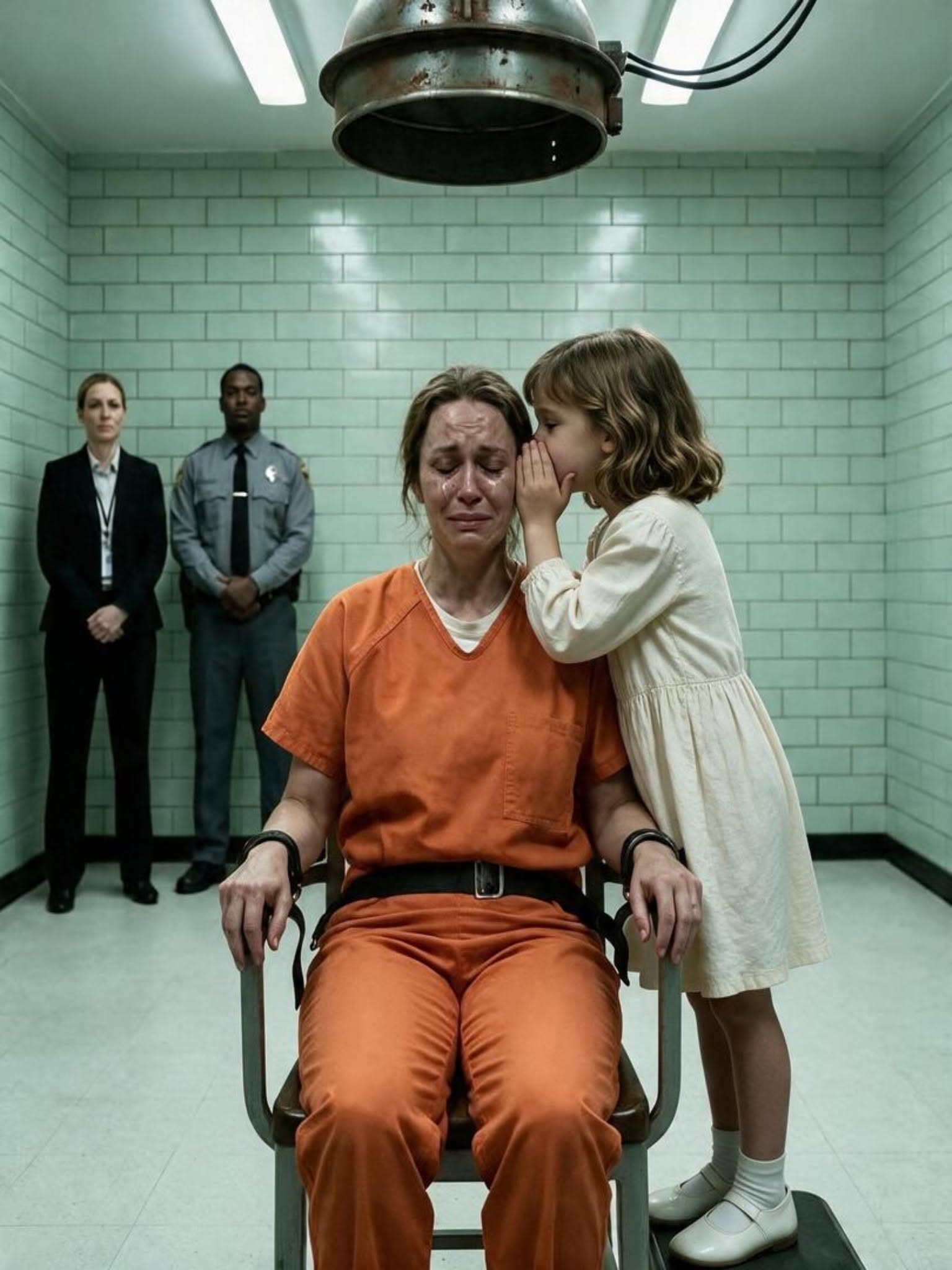
Then Salomé slowly lifted her face.
“Mommy,” she whispered.
Ramira bent down.
“What is it?”
The girl glanced toward the observation window.
Then she leaned closer to her mother’s ear.
“The little black recorder is in my blue backpack,” she whispered. “It has the man’s voice.”
Ramira’s breathing stopped.
Salomé continued in an even smaller voice.
“He said, ‘By sunrise, the housekeeper will take the blame.’ You weren’t in the study yet.”
Ramira closed her eyes.

PART 3
For five years, she had told everyone the same thing.
A man had been in the house that night.
A man wearing a gray coat.
A man with a silver star on his ring.
But nobody had listened.
She looked toward the door.
“Colonel Méndez,” she called.
The director had been standing behind the observation glass. He entered the room immediately.
Ramira’s hands trembled.
“She has something,” she said. “Something from the night they arrested me.”
Méndez looked at Salomé.
“What kind of recorder?”
The girl carefully removed her blue backpack and placed it on the table.
Dana stepped forward.
“Salomé mentioned a little black box several times during counseling,” she said. “We thought it was an old toy. She had difficulty explaining what it was.”
Salomé opened the backpack.
Inside were two library books, a pink sweater, three colored pencils, a small stuffed rabbit, and a yellow scarf folded into a square.
She lifted the scarf.
A small black digital recorder fell onto the table.
It was scratched along one side. A red button sat beneath a cracked screen.
Méndez stared at it.
“Where did you get this?”
Salomé looked at Ramira.
“The night they took you, it was under the blue chair.”
“What blue chair?” Méndez asked.
“The chair in Mr. Calder’s study.”
Ramira’s face had gone pale.
Elias Calder.
That was the name of the man whose death had destroyed their lives.
PART 4
Five years earlier, Ramira had worked in his home.
Elias Calder was seventy-one years old. He had once served as a county judge, but people remembered him more for the literacy center he had built after retiring.
Every afternoon, children from struggling families came to Calder House to read, study, and receive free tutoring.
Ramira worked there three evenings a week.
She cooked Elias’s dinner, cleaned the first floor, organized his mail, and helped him keep track of the children’s scholarship applications.
She was not wealthy.
She had never owned a car.
She rented a small apartment above a pharmacy and raised Salomé by herself.
But she was dependable. She arrived early, stayed late, and kept every promise she made.
On October 14, 2021, Ramira arrived at Calder House at 8:31 p.m.
Her regular babysitter had called twenty minutes earlier and said she could no longer watch Salomé. Elias had told Ramira to bring the child with her.
“Let her use the sunroom,” he had said. “There are books in the cabinet.”
Salomé had spent the first fifteen minutes drawing pictures beside a blue armchair.
Ramira prepared soup in the kitchen.
Elias was in his study reviewing financial records.
At 8:43 p.m., a man named Victor Sloane arrived.
Victor was Elias’s nephew and the treasurer of the literacy foundation. He was forty-two years old, polished, educated, and well-liked in town.
He wore an expensive gray wool coat and a silver star-shaped ring on his right hand.
Elias allowed him inside.
Ramira heard the front door close but continued preparing the meal.
A few minutes later, Salomé heard raised voices from the study.
The door was partially open.
She could see Elias standing beside his desk.
Victor stood across from him.
At five years old, Salomé did not understand what they were arguing about. She only knew that Elias sounded frightened, and Victor sounded angry.
The little black recorder sat on the desk.
Elias often used it to dictate notes because his eyesight had begun to weaken. That evening, he had apparently turned it on before Victor arrived.
The recorder captured everything.
Elias’s voice came first.
“The auditor receives the transfer list at nine o’clock. Twenty-seven false invoices. One hundred eighty-four thousand, six hundred twenty dollars.”
Victor answered, “You were supposed to sign the authorization.”
“I will not sign anything.”
“You don’t understand what happens if those records become public.”
“I understand exactly what happens. The children lose their money, and you explain where it went.”
There was a pause.
Then Elias said, “I will not put Ramira in the middle of this.”
Victor laughed softly.
“Ramira is already in the middle.”
“She has nothing to do with your accounts.”
“She has fingerprints all over this house. She handles your mail. She cleans your office. When people ask who had access, they will choose her.”
Elias’s voice became sharper.
“Get out of my home.”
Victor replied, “By sunrise, the housekeeper will take the blame.”

PART 5
In the sunroom, Salomé stopped coloring.
She saw Victor reach across the desk.
There was a scraping sound.
The recorder fell to the floor and slid beneath the blue chair.
Salomé moved before she could think. She crawled under the chair, picked it up, and hid it inside her blue backpack.
She did not know why.
Perhaps she thought the red button was important.
Perhaps she knew, even at five, that adults sometimes ignored small things.
A few minutes later, Ramira heard a loud sound from the study.
She ran inside.
Elias was on the floor beside his desk. The brass letter opener was nearby.
Ramira immediately called emergency services.
The 911 call was placed at 8:59 p.m.
She knelt beside Elias and pressed a folded towel against his injured side while waiting for help.
That was how the police found her.
Her blouse was stained.
Her fingerprints were on the letter opener because she had used it many times while opening Elias’s mail.
A neighbor across the street had seen a figure in a tan coat leaving the house shortly before Ramira called for help.
The neighbor had not seen the person’s face.
But the prosecution insisted the figure was Ramira.
Victor Sloane told investigators that he had left Calder House at 8:10 p.m.
He claimed he had spent the rest of the evening at his office.
Nobody questioned him for long.
He was respected.
Ramira was not.
At the police station, she repeatedly told investigators about the man in the gray coat.
She described the silver star on his ring.
They said she was confused.
She said Elias had been investigating Victor’s financial records.
They said she was trying to redirect blame.
She said Salomé had seen him.
But Salomé had stopped speaking.
The little girl sat in the corner of the interview room holding her blue backpack. She stared at the floor and refused to answer questions.
No child specialist was present.
No one asked her to draw what she remembered.
No one noticed that she kept sketching the same image on a sheet of paper: a gray coat, a silver star, and a blue chair.
At trial, the prosecutor described Ramira as desperate and resentful.
The $320 wage dispute was presented as proof of anger.
The stains on her blouse were presented as proof that she had been close to Elias when the fatal injuries occurred.
The fingerprints were presented as proof that she had used the letter opener.
The neighbor’s uncertain statement was presented as an identification.
The black recorder was never mentioned.
Because it had been in Salomé’s backpack.
Because the child had been taken into temporary care.
Because one officer had written “miscellaneous toy” on a property list and nobody had checked what the object actually was.
Ramira was convicted.
Salomé was placed with a foster family.
For the first two years, Ramira received drawings and short letters.
Then the county moved Salomé to another home.
Visits became difficult.
Letters were delayed.
Ramira saw her daughter once when Salomé was five, once when she was six, and not at all during the following three years.
Still, Ramira waited.
She kept every drawing beneath her mattress.
She could identify Salomé’s handwriting even when it was only three words.
I miss you, Mommy.
Now, inside the visiting room, Colonel Méndez picked up the recorder.
“Where has this been?” he asked.
Dana explained that Salomé’s belongings had been moved between three foster homes. The backpack had been placed in a county storage box. When Salomé recently asked to visit Ramira, Dana had collected her personal items.
“She heard something when she pressed the red button,” Dana said. “She became frightened and turned it off. She only told me that a man had said Ramira’s name.”
Méndez studied the recorder.
“Did you listen to it?”
“No,” Dana said. “I didn’t know it was connected to the case.”
Méndez looked at Ramira.
“Did you know Elias used a recorder?”
“Yes,” she whispered. “He kept one in his desk.”
“Could this be it?”
Ramira nodded.
Méndez placed the device inside an evidence bag.
Then he looked at Salomé.
“You did the right thing by bringing it here.”
The girl’s lower lip trembled.
“Will they take it away?”
“They may need to examine it,” he said carefully. “But it will remain protected. Nobody will punish you for keeping it.”
Salomé glanced at her mother.
Ramira leaned forward as far as the handcuffs allowed.
“You kept the truth safe,” she told her daughter. “I’m proud of you.”
At 10:05 a.m., the recorder was taken to the state forensic laboratory.
At 10:22, the technician managed to recover a damaged audio file.
The timestamp read 8:47:12 p.m.
At 10:31, Colonel Méndez listened to the recording through headphones.
Elias’s voice filled the small office.
“The auditor receives the transfer list at nine o’clock. Twenty-seven false invoices. One hundred eighty-four thousand, six hundred twenty dollars.”
Méndez froze.
He listened again.
Then came Victor’s voice.
“You were supposed to sign the authorization.”
The director wrote down every word.
PART 6
When the recording reached the final sentence, Méndez removed the headphones.
“By sunrise, the housekeeper will take the blame.”
For the first time in five years, Ramira’s file no longer looked complete.
It looked broken.
Méndez ordered the original case records brought to his office.
He reviewed the evidence log.
The letter opener was listed.
The stained blouse was listed.
The witness statement was listed.
The recorder was not.
A photograph taken inside the study showed the blue chair near the desk. Beneath it was a small dark shape.
The original investigator had written: “Possible child’s toy. Not collected.”
Méndez stared at the note for nearly a minute.
The evidence had not been invisible.
It had simply been ignored.
He called the district attorney’s office.
Then he called the state attorney general.
Finally, he contacted Judge Helen Ward, who had authority to issue an emergency stay.
“If the recording is authentic,” Méndez said, “the conviction cannot proceed.”
The attorney general’s investigator arrived at 10:58.
The audio specialist confirmed that the file had not been edited. The voice matched Victor Sloane’s voice in fourteen separate speech patterns.
The timestamp placed the conversation before Ramira called emergency services.
The original 911 recording confirmed that Ramira had requested help immediately.
The neighbor, Margaret Bell, was located at her home.
When investigators showed her the old statement, she began to cry.
“I never said I saw Ramira’s face,” she told them. “It was raining. I saw someone in a tan coat. I told the officer that.”
“Why did you identify Ramira at trial?”
“Because the coat belonged to her. And because everyone kept asking me the same question until I thought I was supposed to know.”
At 11:17, investigators searched Victor Sloane’s office.
They found copies of the twenty-seven false invoices.
They found a folder containing financial transfers totaling $184,620.
They also found a photograph of Victor wearing the same silver star ring Salomé had drawn dozens of times.
At 11:42, Judge Ward signed the emergency order.
The state’s final sentence was suspended.
Ramira sat in the visiting room with Salomé when Colonel Méndez entered.
The director’s face looked different.
For the first time, he seemed uncertain.
“Ramira,” he said, “the order has been suspended.”
She stared at him.
“What does that mean?”
“It means the state will not carry out the sentence today.”
Her hands began to shake.
“Today?”
“And tomorrow,” he said. “And the day after that. Your case is being reopened.”
Ramira looked toward the door.
“Is my daughter still here?”
“She is waiting outside.”
Ramira covered her face with both hands.
She did not cheer.
She did not smile.
She simply bent forward and began to cry.
Not the silent tears she had shed for five years.
These were deep, exhausted sobs that seemed to come from somewhere beneath her ribs.
Méndez stepped out and allowed Salomé to return.
The little girl climbed into her mother’s arms.
“Are you coming home?” she asked.
Ramira held her tightly.
“I’m going to try with everything I have.”
Salomé pressed her cheek against her mother’s shoulder.
“I knew you didn’t do it.”
Ramira closed her eyes.
“Why didn’t you tell anyone?”
“I tried,” the girl whispered. “But grown-ups kept saying I was confused.”
That sentence followed Méndez long after he left the room.
The next ninety-seven days were filled with hearings, interviews, and evidence reviews.
Salomé was interviewed by a child specialist in a quiet room with a blue chair.
No uniforms were present.
No one told her what to say.
She described the gray coat.
The silver star ring.
The black recorder.
The words she had heard.
She explained that her mother was in the kitchen when Victor spoke to Elias. She explained that Ramira entered the study only after the recorder had fallen and Victor had left.
Her story remained consistent.
The audio expert confirmed the recording.
The financial investigation confirmed Elias had discovered Victor’s theft.
The original medical timeline showed that Elias had suffered his fatal injuries before Ramira placed the emergency call.
Victor’s gray coat was found in storage at his office.
A tailor’s receipt dated October 15, 2021, showed that a silver star-shaped button had been replaced after it went missing.
The evidence had been waiting in different places for five years.
It only needed someone to connect it.
When investigators confronted Victor with the recording, he denied everything.
Then he said the recording had been misunderstood.

PART 7
Finally, after the financial records were presented, he admitted that he had confronted Elias about the audit.
He admitted that he had taken the foundation’s money.
He admitted that he had left Elias in serious distress and created a false story to protect himself.
He had believed Ramira would be easy to blame.
He had been right for five years.
But not forever.
On March 4, the court vacated Ramira Fuentes’s conviction.
The judge read the decision aloud.
“This court finds that Ramira Fuentes was wrongfully convicted because material evidence was overlooked, witness testimony was misunderstood, and the investigation failed to consider other reasonable explanations.”
Ramira stood silently.
She had waited five years, two months, and three days to hear those words.
When she walked out of the prison, the sky was pale blue.
Salomé stood beside Dana near the gate.
For several seconds, Ramira simply looked at her daughter.
Then she took three steps forward.
Salomé ran the rest of the way.
They held each other beneath the prison’s watchtower while a cold wind moved through the trees.
Ramira had imagined that moment hundreds of times.
In some versions, there were reporters.
In others, there were cameras and cheering crowds.
In reality, there were only two guards, one social worker, a dented county van, and Salomé’s blue backpack.
It was more than enough.
Life outside did not become perfect overnight.
Ramira had to learn how to use a smartphone.
She had never seen most of the buildings in the town because they had been built while she was in prison.
She had to learn which foods Salomé liked now.
She had missed her first day of kindergarten, her first loose tooth, her first school concert, and three birthdays.
But she did not miss the next one.
She rented a small yellow house with a porch and a maple tree in the front yard.
The state provided compensation for the years she had lost.
Ramira used part of it to create a quiet reading room inside the local library.
She called it the Blue Chair Project.
It was a place where children involved in difficult family or legal situations could speak with trained advocates in a calm environment.
On the wall, she placed a simple sign:
“Small voices deserve careful listeners.”
Colonel Méndez attended the opening ceremony.
He did not make a speech.
He stood near the back of the room while children selected books from the shelves.
Before leaving, he handed Ramira a folded piece of paper.
Inside was Salomé’s old drawing.
The gray coat.
The silver star.
The blue chair.
“I kept it in my office,” he said.
Ramira looked at the picture.
“Why?”
“Because it reminds me that a file can be complete and still be wrong.”
She folded the drawing carefully.
“You listened when it mattered,” she said.
Méndez shook his head.
“Your daughter made me listen.”
A year later, Salomé sat beside her mother at the kitchen table, doing her homework.
The black recorder rested inside a small glass box on the bookshelf.
They no longer listened to it.
They did not need to.
It had already said everything it needed to say.
“Mommy,” Salomé asked, “do you think people can change their destiny?”
Ramira looked across the table.
“Yes,” she said. “Sometimes it happens with a brave decision.”
“Like when you went to the library?”
“Yes.”
“Sometimes with a piece of evidence?”
“Yes.”
Salomé thought for a moment.
“Sometimes with a whisper?”
Ramira smiled.
“Especially then.”
Outside, the maple tree moved gently in the evening wind.
For five years, the world had believed Ramira Fuentes was guilty.
For five years, her daughter had carried a broken recorder inside a blue backpack.
Adults had called it a toy.
The court had called it irrelevant.
But the little girl had known it was important.
And on the morning everyone had already decided Ramira’s fate, Salomé’s whisper changed everything.
Not because it was loud.