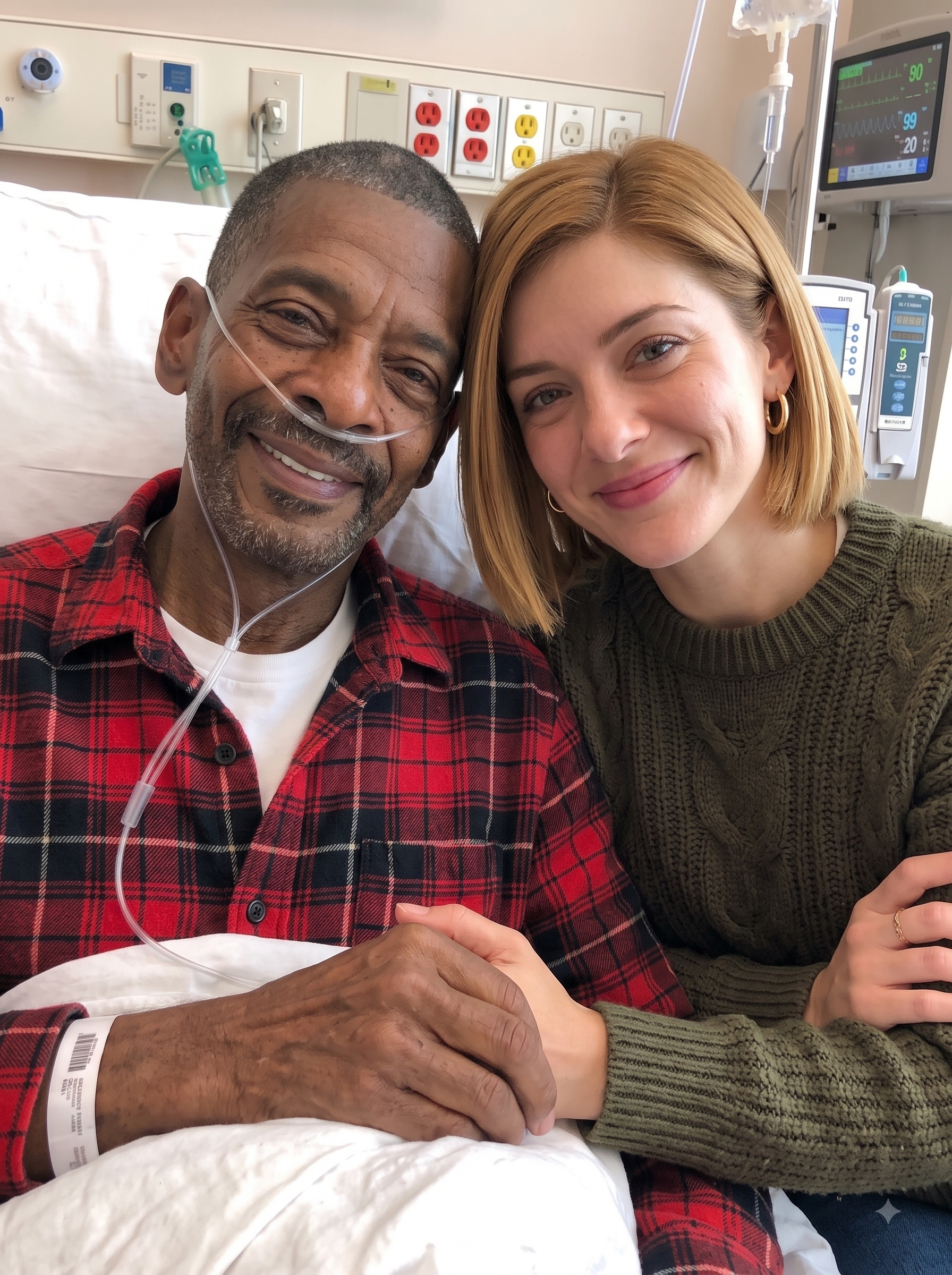

I was four years old when Julian Vance married my mother, Eleanor.
For most people, four is too young to remember much clearly. Childhood becomes a collection of flashes—sunlight through curtains, the smell of shampoo, a favorite toy, a voice calling from another room.
But I remembered Julian.
I remembered the first time he knelt in front of me and tied my shoelaces because I kept getting the loops wrong.
I remembered him carrying me upstairs after I fell asleep on the couch.
And I remembered the apple pancakes.
He used to cut them into crooked little stars, dust them with powdered sugar, then pretend to be offended when I told him they looked more like clouds.
My mother died not long after their marriage.
At least, that was what I had believed for the next twenty-four years.
After Eleanor was gone, Julian stayed.
He became everything.
He packed my lunches, attended parent-teacher conferences, sat through terrible elementary-school concerts, taught me how to drive, and waited awake on the couch whenever I came home late as a teenager.
He never remarried.
Whenever anyone asked why, Julian would smile faintly and say, “One family was enough for me.”
To everyone else, he was technically my stepfather.
To me, he was my DAD.
Years later, when I got married, Julian was the man who walked me down the aisle.
Before the church doors opened, I remember squeezing his arm and whispering, “Don’t cry.”
He looked offended.
“I’m not crying.”
“You are absolutely crying.”
“It’s allergies.”
“In December?”
He gave me that crooked smile I had known since childhood.
Then he kissed my forehead and walked me toward the man I was going to marry.
When my daughter was born, Julian became the grandfather who showed up with too many stuffed animals and insisted that newborn babies could tell when someone was singing off-key.
He stood beside me at her christening.
And even after I had grown up, built my own family, and stopped needing him to check the oil in my car, I would sometimes visit his house and find him standing in the kitchen making apple pancakes.
“For old times’ sake,” he would say.
I never imagined there could be anything false about the life we had shared.
Then Julian got sick.
It happened quickly.
One month he was complaining that the stairs made his knees ache.
A few weeks later, he was in the hospital.
By the time the doctors finally admitted how serious his condition was, his body seemed to have aged ten years in a matter of days.
I hardly left his bedside.
I slept in an uncomfortable chair with my coat folded beneath my head. I brought him coffee he could barely drink and read him newspaper articles he pretended to care about.
Sometimes he woke in the middle of the night and stared at me strangely.
Not with fear.
With guilt.
I noticed it, but I told myself he was simply afraid of dying.
Then, late one evening, the doctor quietly pulled me into the hallway.
His expression told me the truth before he spoke.
“We’re probably talking about hours now. Not days.”
I thanked him, although I don’t remember how I managed to say the words.
When I returned to Julian’s room, everything suddenly seemed unbearably small.
The humming machines.
The thin hospital blanket.
The half-empty cup of water.
The man who had filled my entire childhood reduced to a fragile body beneath fluorescent lights.
I sat beside him and took his hand.
“Dad?”
His eyes opened.
For several seconds, he simply stared at me.
Then his hand suddenly closed around my wrist.
Hard.
Much harder than I thought he still could.
“Promise you’ll hear me out before you hate me.”
My stomach tightened.
“I could never hate you.”
His icy fingers tightened against my skin.
His voice was barely above a whisper, but every word landed like a blow.
“I’VE LIED TO YOU YOUR ENTIRE LIFE. Everything you believe is false. Your childhood, who I am—ALL OF IT.”
I stared at him.
The walls seemed to move.
For one absurd second, I wondered if his medication had confused him.
I forced a weak smile.
“Dad, none of this makes sense. Do you need me to get the doctor?”
Julian shook his head.
“My mind is completely clear.”
His breathing rattled.
Then he looked toward the door, as though afraid someone might overhear us.
“I need you to discover the truth BEFORE I die, even though I was BEGGED to take it to my grave.”
My heartbeat thundered in my ears.
“What truth?”
Julian did not answer.
Instead, with trembling fingers, he reached beneath the hospital blanket.
He pulled out a folded scrap of paper.
I tried to take it gently, but he pressed it forcefully into my palm.
“Dad, what is this?”
His eyes filled with tears.
“Go there. Now.”
“What?”
“Now.”
“I’m not leaving you.”
“You have to.”
His hand shoved mine away.
Tears slipped down his cheeks and disappeared into his gray stubble.
“Go.”
Those were the final words Julian Vance ever spoke to me.
I stumbled into the hallway holding the piece of paper.
My hands shook so badly I almost tore it while unfolding it.
An address had been written across the center.
I recognized the neighborhood immediately.
It was only a short drive from Julian’s house—the same house where I had spent almost my entire childhood.
I stood there for several minutes, torn between going back into his room and obeying what might be his final request.
Every instinct told me not to leave.
But I knew Julian.
He had never asked anything of me with that kind of desperation.
So I went.
Twenty minutes later, I pulled up outside an ordinary two-story house on a quiet residential street.
There was nothing sinister about it.
A porch light glowed beside the front door. Curtains covered the downstairs windows. A wind chime moved softly under the eaves.
I remained in my car for almost a minute.
What was I supposed to say?
Hello, my dying father sent me here because apparently my entire life is a lie?
I finally got out.
As I walked toward the porch, I silently rehearsed an apology for disturbing strangers so late.
I raised my hand.
My knuckles barely touched the wood.
THE DOOR SWUNG OPEN.
A woman stood behind it.
And I screamed.
She was older.
Her face was lined.
Her hair, once dark in every photograph I remembered, was now soft silver.
But I knew her.
I knew the delicate shape of her jaw.
I knew those eyes.
And above her left eyebrow was the crescent-shaped scar I had stared at in framed childhood photographs for more than two decades.
The scar my father once told me she got from falling off a bicycle at thirteen.
My knees almost gave way.
The woman’s lips trembled.
“Elena?”
I staggered backward until my hip struck the porch railing.
She took one hesitant step toward me.
Her eyes filled instantly with tears.
“Elena,” she repeated.
I could barely breathe.
“You…”
My voice broke.
“You’re dead.”
The woman covered her mouth.
“My mother died of cancer when I was four years old,” I said, louder now. “I visited her grave.”
Her face collapsed.
“You visited an empty plot, sweetheart.”
The word sweetheart almost destroyed me.
I had not heard her call me that since I was a child.
Or perhaps I only remembered it from dreams.
She lifted one hand toward me, then stopped before touching my face.
“Julian built that lie to protect you,” she whispered. “To protect us both.”
I stared at her.
“No.”
“Elena—”
“No.”
I shook my head violently.
“No, my mother is dead.”
“I’m so sorry.”
“You’re dead!”
My voice echoed down the quiet street.
Then another figure appeared behind her.
An older woman stepped into the warm light of the foyer carrying a thick, faded leather binder.
I recognized her too.
Not from memory.
From photographs.
Victoria Vance.
Julian’s estranged older sister.
The woman I had been told died in a car accident before I was even born.
I looked from one supposedly dead woman to the other.
My entire childhood seemed to fracture beneath my feet.
Victoria’s expression was calm but heavy with sorrow.
“Come inside, Elena.”
I didn’t move.
“Julian called me from the hospital an hour ago,” she continued. “He said he was sending you.”
My throat tightened.
“He called you?”
Victoria nodded.
“It’s time you learn why your life was written the way it was.”
Somehow, I stepped inside.
The house smelled faintly of tea and old books.
There were no photographs of me on the walls.
No obvious signs that my mother lived there.
Nothing that would have connected her to the daughter she supposedly buried twenty-four years earlier.
Victoria led us into the dining room.
She placed the leather binder on the table.
When she opened it, I expected family photographs.
Instead, I saw court documents.
Police protection orders.
Certified financial records.
Copies of legal filings.
Old newspaper clippings.
And documents stamped with dates from twenty-four years earlier.
My hands went cold.
Victoria turned several pages until she reached paperwork bearing the name Sterling Enterprise Holdings.
Then she looked at me.
“Julian wasn’t just your stepfather, Elena.”
I laughed once, without humor.
“I think we’re well past ‘just my stepfather.’”
Victoria did not react.
“He was an investigator.”
I stared at her.
“What?”
“He was hired by your biological father’s family to find your mother after she disappeared with you.”
The room went silent.
“My father?”
Eleanor sat down slowly.
For the first time, I noticed how badly her hands were trembling.
“My biological father died before I could remember him,” I said. “Julian told me—”
“Julian told you what you needed to believe,” Eleanor whispered.
I turned toward her.
“Who was he?”
Her face changed.
Fear appeared there.
Not old fear.
Not a memory.
Something that still lived inside her.
“Your biological father was wealthy,” she said. “Powerful. His family owned companies, property, and had political connections. People answered his calls.”
She swallowed.
“He was also dangerous.”
Victoria slid one of the police reports toward me.
Eleanor stared at the document but did not touch it.
“He hurt me,” she continued quietly. “More than once. When I tried to leave, he told me he would destroy me. And when I finally filed for separation, he used his family’s influence to make me look unstable.”
Her voice cracked.
“He was going to take you.”
I looked down at the paperwork.
Court petitions.
Custody filings.
Statements accusing Eleanor of mental instability.
Records that seemed to appear and disappear within days.
“My parental rights were being stripped away,” she said. “Not because I was a bad mother. Because he had money and people willing to lie for him.”
My eyes burned.
“So you ran.”
She nodded.
“I took you and disappeared.”
Victoria continued.
“Julian was hired to track her down.”
The sentence made no sense.
I looked toward the front door as though Julian might somehow walk through it and explain everything.
“He found us,” Eleanor said.
Her voice softened.
“I thought it was over.”
She wiped at her cheeks.
“I was staying in a motel with you. I remember hearing someone knock. When I opened the door, Julian was standing there.”
She laughed bitterly.
“I thought he had come to drag me back.”
“What happened?”
“He saw my face.”
I froze.
Eleanor touched her cheek unconsciously.
“I had bruises. I had a broken rib that hadn’t healed properly. And you were hiding behind me.”
Victoria pushed another document toward me.
A photograph was clipped to it.
I couldn’t make myself look closely.
Eleanor continued.
“Julian asked me what happened. I told him.”
Her eyes filled again.
“He was supposed to report our location.”
“But he didn’t,” I whispered.
“No.”
Victoria closed the binder halfway.
“That was the moment Julian destroyed the life he had before you.”
I looked at her.
“What did he do?”
The answer came slowly.
Piece by piece.
Julian forged medical records.
He created the appearance that Eleanor had developed a fatal illness.
Then, using money he had saved and contacts from his investigative work, he paid a corrupt county clerk to issue a fraudulent death certificate for Eleanor Sterling.
The deception had to be convincing.
Her legal identity died.
Her accounts disappeared.
Her history ended.
To make sure my biological father’s investigators stopped searching, Eleanor assumed a completely new identity and vanished.
And Julian?
Julian married her first.
Legally.
Briefly.

Long enough to establish himself as my stepfather.
Then, after Eleanor Sterling was declared dead, he legally adopted me as her widowed husband.
He hid me in plain sight.
My biological father’s people searched for a missing woman and child.
They never imagined that the investigator they had hired had become the child’s father.
I stared at the table.
“So my entire childhood…”
“Was real,” Eleanor said immediately.
I looked at her.
“The lie was how it began. Not what Julian felt for you.”
She reached toward me again.
This time, I didn’t pull away.
“He raised you,” she whispered. “He protected you. He gave you a normal, beautiful life.”
My voice was barely audible.
“And you?”
Her mouth trembled.
“That was the price.”
I didn’t understand.
“What price?”
“The arrangement.”
Victoria looked away.
Eleanor’s eyes met mine.
“To keep you safe, I had to disappear completely. If anyone connected me to you, your biological father could have found you.”
My chest tightened.
“So you just left me?”
Her face crumpled.
“No.”
The word came out almost as a sob.
“No, Elena. Never.”
She covered her face for a moment before continuing.
“The deal Julian and I made was that I could only watch you from afar.”
I stared at her.
She whispered, “I was at your high school graduation.”
My breath caught.
“I stood at the back, near the exit. You wore a blue dress under your gown.”
I remembered that dress.
“I was at your wedding too.”
My entire body went still.
“I stood at the back of the church.”
A memory flashed through me.
A woman in a dark coat near the final pew.
I had barely noticed her.
“I watched Julian walk you down the aisle,” Eleanor said, tears pouring freely now. “I wanted to run to you. I wanted to tell you who I was. But I couldn’t.”
She pressed a trembling hand to her chest.
“I was across the street at your daughter’s christening.”
I closed my eyes.
Every important day of my life suddenly had a shadow standing at the edge of it.
Eleanor.
My mother.
Alive.
Watching.
Unable to come closer.
“It broke Julian’s heart every single day to keep us apart,” she said. “But it was the only way to keep you safe.”
My phone vibrated inside my coat pocket.
All three of us froze.
I already knew.
Some part of me knew before I pulled it out.
My fingers were numb as I looked at the screen.
A message from the hospital nurse.
Mr. Vance has just passed away peacefully. I am so sorry for your loss.
I read it twice.
Then a third time.
The room seemed to collapse inward.
I sat there with my mother alive across the table from me while the man who had raised me had just died alone in a hospital room.
A sound escaped my throat.
Not quite a sob.
Not quite a word.
Eleanor reached for me.
This time, I let her.
She wrapped both hands around mine.
I looked down at the scrap of paper Julian had given me.
Suddenly, I understood.
His confession had not been about guilt.
He had not spent his final hour trying to clear his conscience.
He had been making sure I would not be left alone after he was gone.
Eleanor studied my face with terrified, heartbreaking hope.
“Do you hate him?”
I closed my eyes.
I saw Julian making apple pancakes.
Julian teaching me to ride a bicycle.
Julian sitting in the front row at my graduation.
Julian walking me down the aisle.
Julian holding my newborn daughter as if she were made of glass.
Then I remembered his dying words.
I’VE LIED TO YOU YOUR ENTIRE LIFE.
He had.
But not for the reason I first thought.
“No,” I whispered.
My vision blurred.
I reached across the table and took my mother’s hands for the first time in twenty-four years.
“I love him.”
Eleanor began to cry.
“And he gave me everything.”
The funeral was held on a quiet, overcast Tuesday morning.
The cemetery grass was still damp from rain.
A cool autumn wind moved through the trees, scattering brown leaves across the path.
I stood beside Julian’s grave holding my daughter’s small hand.
Only a handful of people attended.
Some old neighbors.
My attorney.
Victoria.
A few people from Julian’s past whom I barely recognized.
And farther away, close to the treeline, stood Eleanor.
She wore a simple dark coat.
Even now, she kept her distance.
For twenty-four years, distance had kept me safe.
It had become instinct.
The minister spoke about devotion, loyalty, and the quiet ways a person’s life can shape another.
When he finished, I turned.
Eleanor was still standing alone.
I lifted my hand.
For a moment, she didn’t understand.
Then I motioned for her to come closer.
Victoria saw what I was doing.
She gave Eleanor a gentle nod.
My mother walked toward us.
Slowly.
One step at a time.
For the first time in twenty-four years, she did not have to watch her daughter from the shadows.
She stood beside me.
Her shoulder rested against mine as Julian’s polished wooden casket was lowered into the earth.
I knelt beside the open grave.
In my hand was a single red apple blossom.
I placed it carefully on top of the casket.
“Thank you, Dad,” I whispered.
My voice shook.
“For every lie you told to keep us safe.”
I wiped my cheek.
“For every sacrifice you made in silence.”
Three months later, Julian’s estate was settled without complication.
He left his modest home, his savings, and his small pension entirely to my daughter and me.
There was no secret fortune.
No dramatic inheritance.
That would have been too unlike him.
But while clearing the attic, I found something far more valuable.
Behind several old boxes was a small metal safe.
I expected money.
Instead, I found photo albums.
Dozens of them.
I carried them downstairs and opened the first one at the kitchen table.
My heart stopped.
There was Eleanor.
Standing across the street from my elementary school.
Eleanor sitting several rows behind me at a high-school game.
Eleanor near the edge of a park while I played with friends.
Page after page documented the life of the mother who had been forbidden to hold my hand.
My graduation.
My wedding.
My pregnancy.
My daughter’s christening.
Every milestone.
Some photographs had been taken by Julian.
Others had been sent to him by Eleanor.
He had kept every single one.
Those albums were proof of the impossible life they had shared—two people loving the same child while pretending one of them no longer existed.
Not long afterward, Eleanor sold the isolated house where she had spent so many years hiding.
She bought a small sunlit cottage ten minutes from my home.
People sometimes imagine reunions like ours as miraculous.
They aren’t.
Love can survive twenty-four years, but trust still has to be rebuilt.
There were awkward silences.
Questions I was afraid to ask.
Questions she was afraid to answer.

There were afternoons when I was furious with her even though I understood why she had disappeared.
There were nights when she cried because she had missed almost my entire childhood.
But there was joy too.
One morning, I walked into my kitchen and found my daughter sitting at the table while Eleanor stood at the stove.
The smell stopped me in the doorway.
Apple pancakes.
Eleanor held up an old handwritten recipe card.
“Julian’s recipe,” she said.
My daughter laughed.
“Grandma says they’re supposed to look like stars.”
I smiled through tears.
“They never did.”
Months passed.
Then one Sunday afternoon, Eleanor and I sat on the back patio while my daughter played in the yard.
Sunlight stretched across the grass.
Eleanor held a cup of tea between both hands.
For a long time, neither of us spoke.
Then she looked at me.
“Do you ever regret knowing?”
I turned toward her.
She stared into her cup.
“Sometimes I wonder if it would have been kinder if Julian had taken it all to his grave, like we originally planned.”
I thought about the question.
About the pain.
The confusion.
The anger.
The life I had thought was real and the hidden life beneath it.
Then I reached over and squeezed her hand firmly.
“Julian didn’t just give me a father,” I said.
She looked at me.
“In his final hour, he gave me my mother back.”
Her eyes immediately filled.
“He knew the danger was gone,” I continued. “And he refused to leave me alone.”
Eleanor leaned her head against my shoulder.
We watched my daughter run through the sunlit yard.
Julian Vance had spent almost his entire adult life carrying a secret that could have destroyed him.
To the world, he had been an ordinary man.
A quiet widower.
A devoted stepfather who raised a little girl alone.
But I knew now what he had really done.
He had betrayed the powerful people who hired him.
He had sacrificed his career.
He had lived with the fear that one mistake could expose everything.
He had kept a mother away from her daughter even though it hurt them both.
And then, when he knew he had only hours left, he broke the promise he had carried for twenty-four years because keeping that promise no longer mattered as much as making sure I still had someone after he was gone.
To everyone else, Julian Vance was simply the man who raised me.
To me, he was something far greater.
He was the man who turned a lie into a fortress.
A tragedy into a life.
And his final secret into the greatest gift of love I would ever receive.