
“Tomorrow morning, I’ll sell the house, and your mother won’t know anything until the deed belongs to someone else.”
Thirteen-year-old Tyler McKenna froze in the hallway.
One sneaker was still in his hand. His backpack hung from one shoulder, damp from the light rain outside, and for several seconds he was afraid even breathing might give him away.
He was not supposed to be home.
A water pipe had burst inside his middle school in Asheville, North Carolina, and the administration had dismissed students before lunch. Tyler had taken the city bus home without calling his mother because there would have been no point.
Rebecca McKenna worked twelve-hour shifts at a regional distribution center. Employees had to leave their phones inside secured lockers before entering the warehouse floor.
Tyler expected their apartment to be empty.
Instead, his stepfather was in the kitchen.
Russell Pike stood near the window with his back turned, speaking quietly into his phone.
“Four hundred and eighty thousand dollars, Martin. The property has almost three acres, the farmhouse is solid, and that new highway exit will be less than two miles away. Once the development begins, it’ll be worth twice as much.”
Tyler’s fingers tightened around his sneaker.
The farmhouse.
There was only one property Russell could mean.
The old place near Hendersonville that Tyler’s great-grandmother, Mabel McKenna, had left entirely to Rebecca when she died less than three months earlier.
Russell gave a low laugh.
“Rebecca already signed the power of attorney. She thought it was for taxes and maintenance. Tomorrow at ten, we meet at the closing office. Once the paperwork is recorded, she won’t be able to stop anything.”
Tyler felt his stomach drop.
He remembered the day his mother inherited the house.
Mabel had kept a handwritten note inside an old wooden recipe box. Rebecca had unfolded it with shaking fingers while Tyler stood beside her.
“This house is where our family learned to begin again. Never allow anyone to convince you that it does not belong to you.”
Rebecca had cried before she finished reading.
She had loved her grandmother deeply, even though work, rent, bills, and raising Tyler alone had kept her from visiting as often as she wished during Mabel’s final years.
Rebecca was always tired.
Every month seemed to end with the same question: which bill could wait until the next paycheck?
Russell had seemed like a blessing after the funeral.
He talked confidently about property taxes, insurance, repairs, county forms, deadlines, assessments, and paperwork Rebecca barely understood.
One night, after she had worked a double shift, he placed several documents in front of her at the kitchen table.
“Sign here, Becky. This only lets me take care of the paperwork while you’re working. You trust me, don’t you?”
Rebecca had rubbed her tired eyes.
She had signed.
Now Tyler understood.
His mother had not signed permission for Russell to maintain the property.
She had unknowingly given him the authority to sell it.
Tyler quietly backed away from the kitchen.
He did not stop until he reached the stairwell.
His hands were trembling.
His biological father had left when Tyler was five and had not contacted them in years. Mabel was gone. Rebecca’s parents had both passed away. There was no uncle nearby, no family friend who understood legal documents, and no trusted neighbor Tyler believed could stop a property sale before ten the next morning.
For one frightening moment, he felt exactly what Russell probably expected him to feel.
Small.
Powerless.
A child.
Tyler considered calling emergency services, but what would he say?
My stepfather is selling a house?
He was afraid someone would contact Russell before anything could be stopped.
He thought about going directly to Rebecca’s workplace, but the distribution center had guarded entrances. A thirteen-year-old boy could not simply walk onto the warehouse floor.
Then he remembered a sign he passed almost every morning from the bus.
Camden Property Law.
Estate disputes.
Property transfers.
Financial deception.
Tyler put his sneaker back on, quietly opened the apartment door, and ran.
By the time he reached downtown Asheville, the spring rain had turned cold and heavy.
Water soaked through his sweatshirt. His shoes squished when he walked. His hair clung to his forehead.
He pushed through the glass doors of the law office.
A security guard looked up from behind the lobby desk.
“Can I help you?”
Tyler swallowed.
“I need to speak to a lawyer. Someone is trying to sell my mother’s house.”
The guard glanced behind him.
“Is your mother with you?”
“She’s at work. She doesn’t know what’s happening.”
“You need to call her.”
“I can’t. She doesn’t have her phone while she’s working.”
The guard frowned.
“You can’t meet with an attorney without an adult. You need to go home and have your mother contact the office.”
Tyler’s voice became desperate.
“But the sale is tomorrow morning.”
“I’m sorry, son. You cannot stay here alone.”
Tyler stood there another second, waiting for the man to change his mind.
He didn’t.
So Tyler walked back into the rain.
He crossed to a coffee shop and stood beneath its narrow awning, hugging his arms around himself.
For the first time since leaving the apartment, he nearly cried.
Adults always said children should speak up when something was wrong.
Yet now that Tyler was trying, nobody wanted to hear him.
Then the law office door opened.
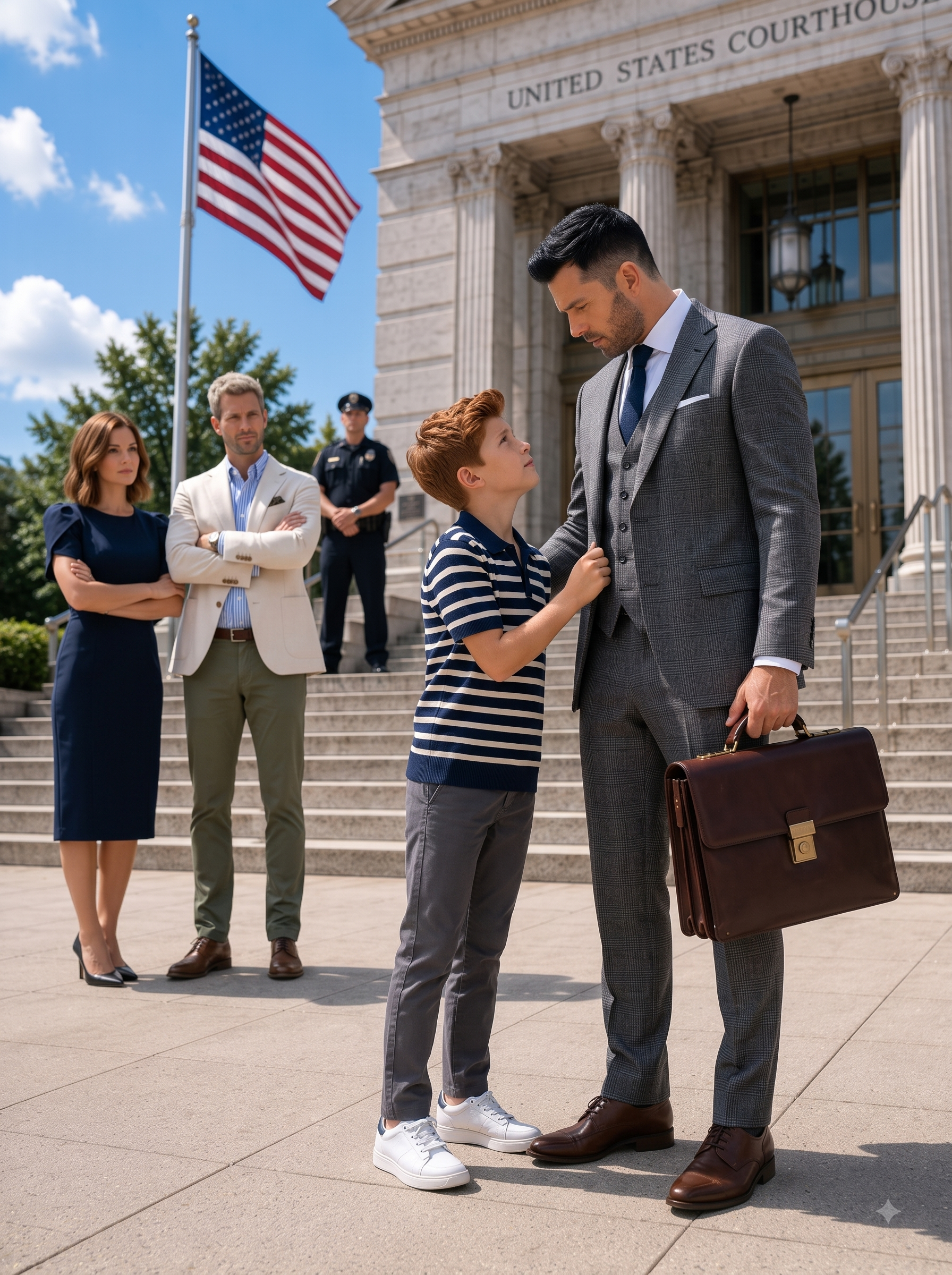
A tall man in his early forties stepped outside carrying a leather briefcase. He wore a charcoal suit, thin-framed glasses, and the tired expression of someone leaving after a long day.
Tyler watched him head toward the parking lot.
Something inside him decided there would not be another chance.
He ran.
“Sir!”
The man turned.
Tyler caught his sleeve.
“Please tell the guard I’m your son.”
The stranger stared at him.
“What?”
“Just for five minutes. Please. My stepfather is selling my mother’s house tomorrow, and she doesn’t know. If nobody listens to me now, we’ll lose it.”
The man’s expression immediately changed.
Not because of the story.
Because of Tyler.
He stared directly into the boy’s eyes.
“What is your name?”
“Tyler McKenna.”
The man’s fingers tightened around his briefcase.
“And your mother?”
“Rebecca McKenna.”
The color drained from his face.
“Rebecca?” he whispered. “Your mother’s name is Rebecca?”
Tyler nodded.
The stranger looked at him as though a door had suddenly opened into a room he had spent more than twenty years trying not to enter.
His name was Elliot Camden.
He was not only an attorney. He was the founder of the law office Tyler had just been removed from.
And for the next several minutes, Elliot forced whatever memories had surfaced back into place.
He guided Tyler inside.
“Come with me.”
The security guard looked surprised but said nothing.
Elliot gave Tyler a dry towel, asked the receptionist to bring him hot chocolate, and took him into a conference room.
Then Elliot sat across from him with a legal pad.
“Start from the beginning,” he said. “Tell me exactly what you heard. Do not add anything you are unsure about.”
Tyler told him everything.
Mabel’s death.
The inherited farmhouse.
Russell handling the paperwork.
Rebecca signing documents after a double shift.
The phone call.
The price.
The buyer.
The closing.
Elliot wrote rapidly.
“Did Russell mention the buyer’s full name?”
“Only Martin.”
“Did he say where the closing would happen?”
“Blue Ridge Title. Ten tomorrow morning.”
Elliot immediately reached for his phone.
Within minutes, he was speaking with the attorney handling the transfer.
The closing attorney confirmed that Russell Pike was scheduled to sign using a durable power of attorney granted by Rebecca McKenna. The transaction involved a farmhouse and nearly three acres outside Hendersonville.
Elliot’s voice became firm.
“I am notifying you of a credible dispute regarding the validity and use of that authority. The owner may have signed without understanding that the document allowed a sale.”
The attorney on the other end hesitated.
“You understand that I cannot cancel a transaction because of an allegation from a child.”
“I am not asking you to cancel it,” Elliot replied. “I am asking you not to finalize or release anything until Rebecca McKenna appears and confirms her intent directly.”
After a tense exchange, the attorney agreed to place the transaction on temporary hold.
Only then did Elliot contact Rebecca’s workplace.
It took several transfers, two supervisors, and almost ten minutes of explanation before someone agreed to remove Rebecca from the warehouse floor.
Forty-five minutes later, Rebecca rushed into Camden Property Law wearing a reflective work vest over a navy shirt. Her employee badge was still clipped to her pocket.
The moment she saw Tyler, she hurried toward him.
“Tyler, what happened? Why did you leave school alone?”
He wrapped his arms around her.
“Mom, Russell is selling Great-Grandma’s house.”
Rebecca stiffened.
“What?”
Tyler pointed toward Elliot.
Rebecca looked across the room.
For a moment, the crisis vanished from her face.
Confusion replaced it.
Then recognition.
“Elliot?”
He slowly stood.
“Hello, Rebecca.”

Tyler looked between them.
“You know each other?”
Rebecca’s voice dropped.
“We did. A very long time ago.”
Elliot did not explain.
Not yet.
He placed a copy of the power of attorney on the table.
“This document does not simply allow Russell to pay taxes or arrange repairs,” he said. “It gives him broad authority over the property, including the ability to transfer ownership.”
Rebecca stared at the pages.
“He told me it was for maintenance.”
“Did you read the full document before signing?”
Rebecca looked down.
“I had just finished a double shift. He said there were county deadlines. I thought I could trust my husband.”
Elliot’s expression softened.
“Trusting your husband is not a mistake you should be ashamed of. Misusing that trust is his decision, not yours.”
Rebecca blinked hard.
Elliot explained that the power of attorney could be revoked immediately. The revocation would have to be signed, delivered to the closing office, and recorded with the county.
Within an hour, he had prepared everything.
This time, Rebecca read every paragraph.
Slowly.
Carefully.
She asked questions.
Then she signed.
Elliot sent formal notice to the title company, the buyer’s representative, and the county register of deeds.
Russell’s authority was dead.
Rebecca pressed the folder against her chest.
“How much do I owe you?”
“Nothing today.”
“Attorneys do not work for nothing.”
Elliot glanced toward Tyler.
“Your son stopped something that could have taken years to repair. Consider this the first step in making sure he was heard.”
Before Rebecca could respond, her borrowed phone rang.
Russell.
She answered.
“Where are you?” he demanded. “Someone just told me you revoked the power of attorney. Who convinced you to do that?”
Rebecca’s eyes moved from Tyler to Elliot.
“The better question is why you were trying to sell my grandmother’s house without telling me.”
Silence.
Then Russell’s voice became calm.
Too calm.
“Rebecca, you don’t understand. It was an investment for our family.”
“Our family does not begin with you deceiving me.”
She hung up.
That evening, Rebecca placed the revocation documents on the kitchen table.
Russell arrived acting insulted rather than afraid.
“This has been blown completely out of proportion.”
“You told me I was signing tax documents.”
“I was trying to protect the property.”
Tyler stepped forward.
“You said she would not find out until the deed belonged to someone else.”
Russell turned sharply.
Tyler repeated the conversation word for word.
The $480,000 price.
The future highway exit.
Martin.
The planned closing.
Russell did not deny any of it.
Instead, he accused Tyler of spying.
Then he turned on Rebecca.
“You’re being ungrateful. I managed the opportunity. Do you have any idea how much work I put into this?”
Rebecca stared at the man she had married.
For years, exhaustion had made confrontation feel impossible.
That night, something changed.
She pointed toward the bedroom.
“Pack your things. You are leaving tonight.”
Russell laughed once.
“You have no idea who you are challenging.”
Rebecca did not raise her voice.
“For the first time, I know exactly who I am standing against.”
Three days later, Rebecca and Tyler returned to Elliot’s office to begin a formal complaint.
While Elliot worked through documents, Rebecca noticed a faded photograph on a shelf.
She picked it up.
A nineteen-year-old girl stood beneath an apple tree beside a young man with untidy hair and a nervous smile.
Rebecca stared at her younger face.
“Why do you still have this?”
Elliot stopped writing.
He closed the office door.
Then he opened a drawer and placed six envelopes on the desk.
All were old.
All were addressed to the apartment where Rebecca had lived with her mother more than twenty-two years earlier.
Rebecca touched the first envelope.
“You never wrote to me.”
“I wrote six times.”
Her eyes lifted.
“What?”
“I thought you refused to answer.”
Rebecca shook her head.
“I never saw these.”
Slowly, painfully, the truth emerged.
Rebecca’s mother had never approved of Elliot. He had been a college student with no money, no established career, and no security to offer.
So she had intercepted his letters.
She told Rebecca that Elliot had appeared with another woman and no longer wanted her.
And when Elliot came looking for Rebecca, her mother told him that Rebecca was engaged and wanted nothing more to do with him.
“I checked the mailbox every day,” Rebecca whispered.
Elliot stared at the desk.
“I waited outside your building for nearly three hours.”
“My mother told me you had forgotten me.”
“She told me you wanted a more secure future.”
Twenty-two years sat between them.
Rebecca wiped tears from her cheeks.
Elliot did not touch her.
He did not turn an old betrayal into a romantic opportunity.
He simply said, “We were both given a lie and asked to build our lives around it.”
The investigation into Russell revealed that the farmhouse had never been his only target.
Martin Kepler, the proposed buyer, was his business partner.
Their plan had been to purchase Rebecca’s property far below its likely future value, move the proceeds into a private account, then resell the land once information about the highway development became public.
But investigators found other names.
Other properties.
Other women.
Russell had approached people who had recently inherited homes or land, offered to “help” with taxes and paperwork, and persuaded them to sign documents broad enough to give him control.
One woman had nearly lost a lakeside cabin inherited from her father.
Another discovered her land had been pledged as security for a business loan.
Rebecca’s complaint connected the cases.
Russell insisted she had approved everything.
He accused Elliot of manipulating her.
He claimed Tyler had misunderstood an ordinary business discussion.
But Tyler remembered too much.
The exact time.
The exact price.
The buyer’s first name.
The closing office.
The words Russell had spoken.
During an interview, a child specialist asked him why he had gone to Camden Property Law alone.
Tyler answered without hesitation.
“Adults always tell kids to ask for help. The first adult would not listen, so I kept looking until one did.”
That statement became impossible to forget.
Investigators searched Russell’s rented office and discovered copies of property records, powers of attorney, private agreements, and files connected to several families.
Martin eventually agreed to cooperate.
Faced with overwhelming evidence, Russell accepted responsibility for attempting to misuse Rebecca’s legal authority and participating in deceptive property transactions.
After the final hearing, he looked across the room at Rebecca.
“You ruined my life.”

Rebecca held his gaze.
“No. You made your choice when you decided my exhaustion was something you could use against me.”
The legal process lasted nearly a year.
When it finally ended, Rebecca and Tyler returned to the farmhouse near Hendersonville.
The place needed work.
Weeds covered the garden. One window was cracked. Rain stains marked part of the kitchen ceiling.
But the house was still standing.
Mabel had replaced the roof before her death, and her gardening tools remained neatly arranged inside the shed.
Tyler opened every window.
Mountain air rushed inside carrying the scent of wet soil and apple blossoms.
“Are we going to live here?” he asked.
“Maybe one day,” Rebecca said.
Then she looked around again.
“No. Actually, we’ll spend the summer here. We’ll fix it together.”
Inside a kitchen cabinet, Rebecca found embroidered tablecloths, old photographs, and Mabel’s handwritten recipe book.
On the final page were words Rebecca had never seen before.
“Old trees are not useless because they produce less fruit. Their roots hold the ground steady for everything that grows after them.”
Rebecca sat down on the kitchen floor.
And cried.
She cried for Mabel.
For the six letters she had never received.
For twenty-two years spent believing Elliot had abandoned her without explanation.
For the shame she carried after discovering Russell’s betrayal.
For every time she had mistaken survival for weakness.
Tyler sat beside her.
He did not tell her everything would be fine.
He simply rested his head against her shoulder.
Later that afternoon, a car stopped near the front gate.
Elliot stepped out carrying two young trees.
“I brought an apple tree and a peach tree,” he said. “The nursery owner told me spring is the best time to give them a chance.”
Tyler ran outside.
“Which one is mine?”
“The apple tree, but only if you help dig.”
Rebecca chose a spot near the old apple tree where she and Elliot had once sat as teenagers.
Tyler held the young trunk steady.
Elliot dug.
Rebecca spread the roots carefully and covered them with fresh soil.
Nobody called it a new beginning.
Calling it one would have almost made it too fragile.
When Tyler walked toward the house to fill a watering can, Elliot stayed beside Rebecca.
“I do not want you to feel that helping Tyler means you owe me a place in your life.”
“I do not owe you anything.”
“I know.”
Rebecca looked toward the farmhouse.
“But I also do not want to spend the rest of my life believing everyone will eventually deceive me.”
Then she extended her hand.
It was not a promise to reclaim the past.
The lost years were still lost.
It was not an answer about what they would become.
It was simply permission to walk beside her.
Elliot accepted her hand gently.
That evening, Rebecca, Tyler, and Elliot sat beneath the old apple tree with lemonade in mismatched glasses.
Elliot told Tyler an embarrassing story about his first day of law school.
Tyler laughed so loudly that a bird flew from the roof.
Behind them, the farmhouse stood quietly against the fading mountain light.
To Russell, it had been an asset.
Three acres.
A future highway exit.
A chance to double his money.
To Rebecca, it had become something else.
Proof.
Proof that a lie could steal years without owning the rest of a person’s life.
Proof that trusting someone did not make her foolish.
Proof that exhaustion should never be mistaken for consent.
And proof that the smallest voice in the room could still be the one that saved everything.
Tyler had been thirteen years old when he heard a man say his mother would not know the truth until it was too late.
He had been thirteen when one adult refused to listen.
So he found another.
And another door opened.
When Tyler asked if they could return the following weekend, Rebecca did not tell him they would come back “someday.”
She did not mention work.
She did not mention bills.
She did not promise to try.
She looked directly at her son.
“Yes,” she said. “This time, we are coming back.”
For the first time in many years, returning did not mean reopening an old wound.
It meant protecting what remained.
It meant reading every page before signing.
It meant refusing to carry shame for another person’s deception.
It meant understanding that family property could hold more than financial value because walls, trees, recipes, and worn photographs often carried the sacrifices of the people who came before.
It meant learning that genuine support did not demand repayment, affection, or immediate trust.
And above all, it meant remembering what Tyler had already understood on that rain-soaked afternoon in Asheville:
Asking for help was not weakness.
Being ignored once did not mean the truth no longer mattered.
Sometimes you simply had to keep knocking until somebody finally opened the door.