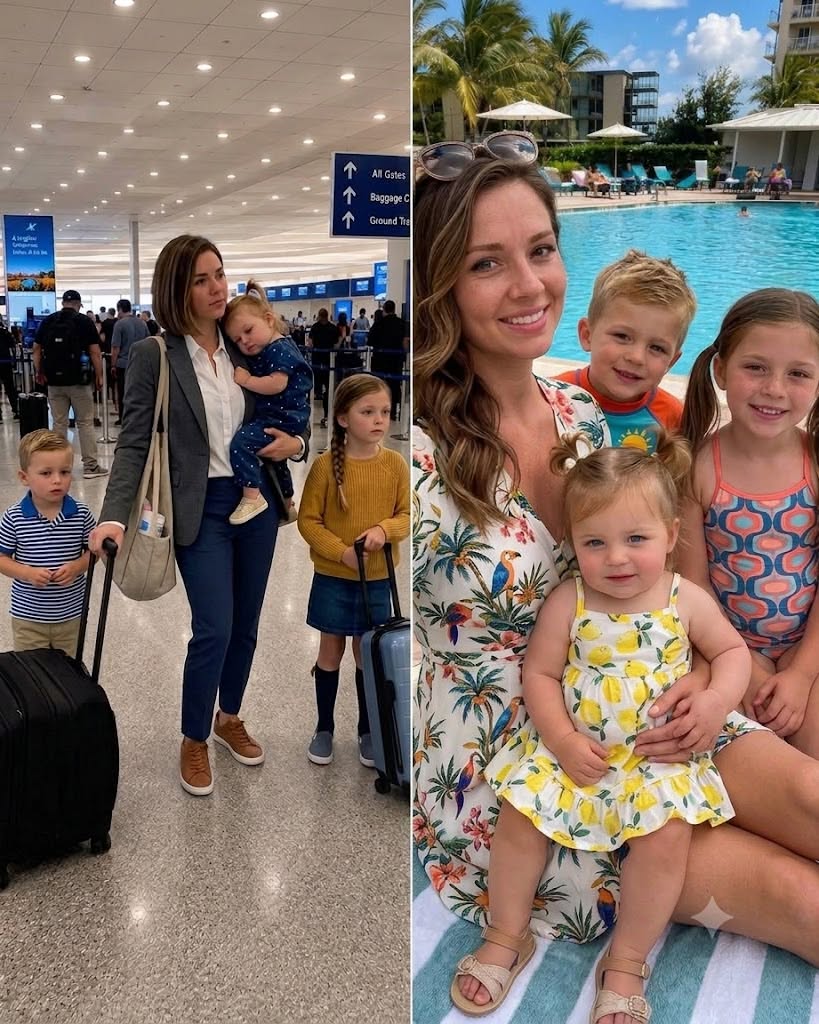
My name is Sarah. Mark and I had been married for six years, and I had spent eight months planning our first real family vacation. I booked the hotel, saved for the plane tickets, and carefully planned activities our three children would enjoy. Mark’s main concern, as usual, was how much everything would cost.
Maybe I shouldn’t have been surprised.

On one of our earliest trips together, Mark secretly upgraded himself to first class and left me sitting in economy because he claimed he “needed to decompress.”
That was Mark.
He always needed something.
Quiet after work. Weekends to recharge. Space whenever life felt overwhelming.
And I was always the one making sure he had it.
No one ever seemed to ask when I got to rest.
That’s why this vacation meant so much to me. I had planned every detail because, for once, I wanted us to experience something together as a family.
But barely had we arrived in Florida and collected our luggage when Mark casually dropped his bomb.
“By the way, the guys are staying about an hour from here.”
I turned toward him.
“What guys?”
“Jason and a few of my college friends. I’m gonna stay with them for three days. Golf, fishing, you know.”
I stared at him.
“You already arranged this?”
He simply shrugged.
“Come on, Sarah. It’s only three days. You’ve got the resort. The kids have the pool. You’ll be fine.”
You’ll be fine.
Those three words hit harder than they should have.
I’d spent eight months making sure everyone else would be fine.
And once again, nobody had asked what I wanted.
But this time, I didn’t argue.
I smiled.
“Have fun.”
The next morning, Mark packed his bag, kissed the kids goodbye, and drove away.
I stood on the balcony and watched his car disappear down the road.
Then I picked up my phone and made one call.
By noon, our suitcases were packed.
“Mom,” my five-year-old asked, “are we going home?”
I looked at my three children and smiled.
“No, sweetheart. We’re finally going on vacation.”
Three days later, Mark called.
The moment I answered, I knew he had discovered what I’d done.
“Sarah…”
His voice cracked.
“Please tell me you didn’t.”
I said nothing.
Then I heard something I had never heard from my husband before.
He was crying.
For a few seconds, I simply listened to him cry.
Not the quiet kind of crying Mark usually did in movies when he wanted to make fun of someone.
This was different.
His breathing was broken. His voice kept catching between words.
“Sarah, please. Just talk to me.”
I sat on the balcony of our new hotel, watching my three children play in the shallow pool below.
They were laughing.
Actually laughing.
My five-year-old had a bright yellow float around his waist. My daughter was trying to teach her little brother how to dive. For the first time in years, I wasn’t checking the clock, planning the next meal, or wondering whether Mark needed anything.
I was simply watching my children enjoy themselves.
“What exactly do you think I did?” I asked.
Mark went silent.
Then he whispered, “You left.”
“No.”
I smiled bitterly.
“You left.”
“I mean… you took the kids.”
“Yes.”
“You moved hotels.”
“Yes.”
“You canceled our room.”
“I did.”
His breathing became heavier.
“Sarah, you can’t just do that.”
I almost laughed.
“Can’t I?”
“You know what I mean.”
“No, Mark. I really don’t.”
He said nothing.
So I continued.
“You told me I would be fine. You told me the kids would be fine. You decided three days with your friends mattered more than the family vacation I’d spent eight months planning.”
“I made a mistake.”
“You made a choice.”
“I didn’t think you’d actually—”
“That’s the problem.”
My voice softened.
“You never thought I would.”
Another silence.
Then Mark asked quietly, “Where are you?”
I looked down at the children.
“Somewhere peaceful.”
“Please tell me where.”
“No.”
“Sarah…”
“I don’t want you to come here.”
His voice broke again.
“Please don’t do this.”
I closed my eyes.

For years, I had mistaken keeping the peace for keeping a marriage together.
But peace that depended on one person constantly swallowing their feelings wasn’t peace.
It was exhaustion.
“I didn’t leave you to punish you, Mark.”
“Then why?”
“Because I wanted my children to remember this vacation for something other than their father abandoning it.”
He inhaled sharply.
“I didn’t abandon them.”
“You left.”
“I thought you’d understand.”
“I always understood.”
That sentence silenced him.
“I understood every time you needed space. Every time you needed rest. Every time you needed a weekend with your friends.”
My eyes filled with tears.
“But you never understood when I needed the same thing.”
Mark began crying again.
“I was selfish.”
“Yes.”
“I was stupid.”
“Yes.”
“I don’t want to lose you.”
I looked at the wedding ring on my finger.
For the first time, I didn’t feel afraid of that possibility.
“You haven’t lost me yet,” I said.
His breathing stopped.
“But you don’t get to come back and pretend nothing happened.”
“I won’t.”
“You don’t get to say sorry once and expect everything to be fixed.”
“I know.”
“And you don’t get to make me responsible for your happiness anymore.”
“I understand.”
I stared at the pool.
“Do you?”
“Yes.”
His answer came without hesitation.
Then he said something I never expected.
“Sarah, I think I finally understand why you’ve been so tired.”
I didn’t respond.
“I thought because you handled everything so well, everything was easy for you.”
A tear rolled down my cheek.
“That wasn’t strength, Mark.”
“I know.”
“That was me having no choice.”
“I know.”
For a long moment, neither of us spoke.
Then he asked, “Can I see the kids?”
I thought about it.
“Not tonight.”
His voice dropped.
“Okay.”
“But you can call them.”
A few minutes later, I handed my phone to my five-year-old.
“Daddy!”
I heard Mark laugh through his tears.
“Hey, buddy.”
“Mom took us somewhere awesome!”
“I know.”
“There’s a huge pool!”
“I wish I was there.”
My son giggled.
“You should’ve stayed!”
I covered my mouth to hide my smile.
“I know,” Mark replied softly.
After the call ended, I sat alone for a while.
I expected to feel victorious.
Instead, I felt sad.
Because this had never been about making my husband suffer.
I didn’t want revenge.
I wanted him to understand.
Three days later, Mark returned home.
But instead of walking into the house expecting dinner, he found a note on the kitchen counter.
We’re still on vacation. We’ll be home tomorrow.
Underneath it, I had written:
When we return, we need to talk. Not as enemies. As two people who need to decide whether we can build something better.
The next evening, when we finally came home, Mark was waiting outside.
He didn’t bring flowers.
He didn’t make excuses.
He simply stood there.
When the children ran toward him, he dropped to his knees and hugged them so tightly that all three disappeared into his arms.
Then he looked at me.
“I’ve been thinking.”
“That can be dangerous,” I said.
He smiled faintly.
“I deserve that.”
We sat together at the kitchen table.
For the first time in six years, Mark didn’t interrupt me.
I told him everything.
How tired I was.
How invisible I sometimes felt.
How often I put everyone else’s needs before my own.
How much it hurt to spend eight months planning something for our family, only to be told I would be “fine” without him.
He listened.
And when I finished, he didn’t defend himself.
He simply said:
“I don’t want you to be fine without me.”
I looked at him.
“I want you to be happy with me.”
That sentence broke something open inside me.
Not because it fixed everything.
It didn’t.
Trust wasn’t rebuilt in one conversation.
But it was a beginning.
Over the next few months, Mark changed in ways I hadn’t expected.
He started taking the children to school.
He learned how to cook more than three meals.
He planned weekends where I could go somewhere alone without feeling guilty.
And every Sunday, he asked me one question.
“What do you need this week?”

At first, I didn’t know how to answer.
Then I slowly learned.
Sometimes the answer was an afternoon alone.
Sometimes it was help with the children.
Sometimes it was simply, “I need you to listen.”
And he did.
A year later, we took another family vacation.
This time, Mark didn’t make secret plans with his friends.
He helped pack the suitcases.
He checked the reservations.
He carried the children’s bags.
And when we arrived at the hotel, he handed me a small envelope.
Inside was a photograph from our first vacation.
The four of us were standing together beside the pool.
On the back, Mark had written:
I spent years asking for space from my family. I should have been asking how I could make more space for you.
I looked at him.
“You wrote this?”
He nodded.
“I’m still learning.”
I smiled.
“So am I.”
Then our children came running toward us, shouting that they had found the pool.
Mark reached for my hand.
This time, I took it willingly.
Because our marriage hadn’t been saved by revenge.
It had been saved by something much harder.
Two people finally admitting that love wasn’t about one person constantly giving while the other constantly took.
Love meant noticing when the person beside you was tired.
Listening before they had to beg.
And making sure that, after years of saying “You’ll be fine,” you finally learned to ask:
“Are you okay?”
And this time, when Mark asked me that question, I smiled.
“Yes,” I said.
“For the first time in a long time, I really am.”