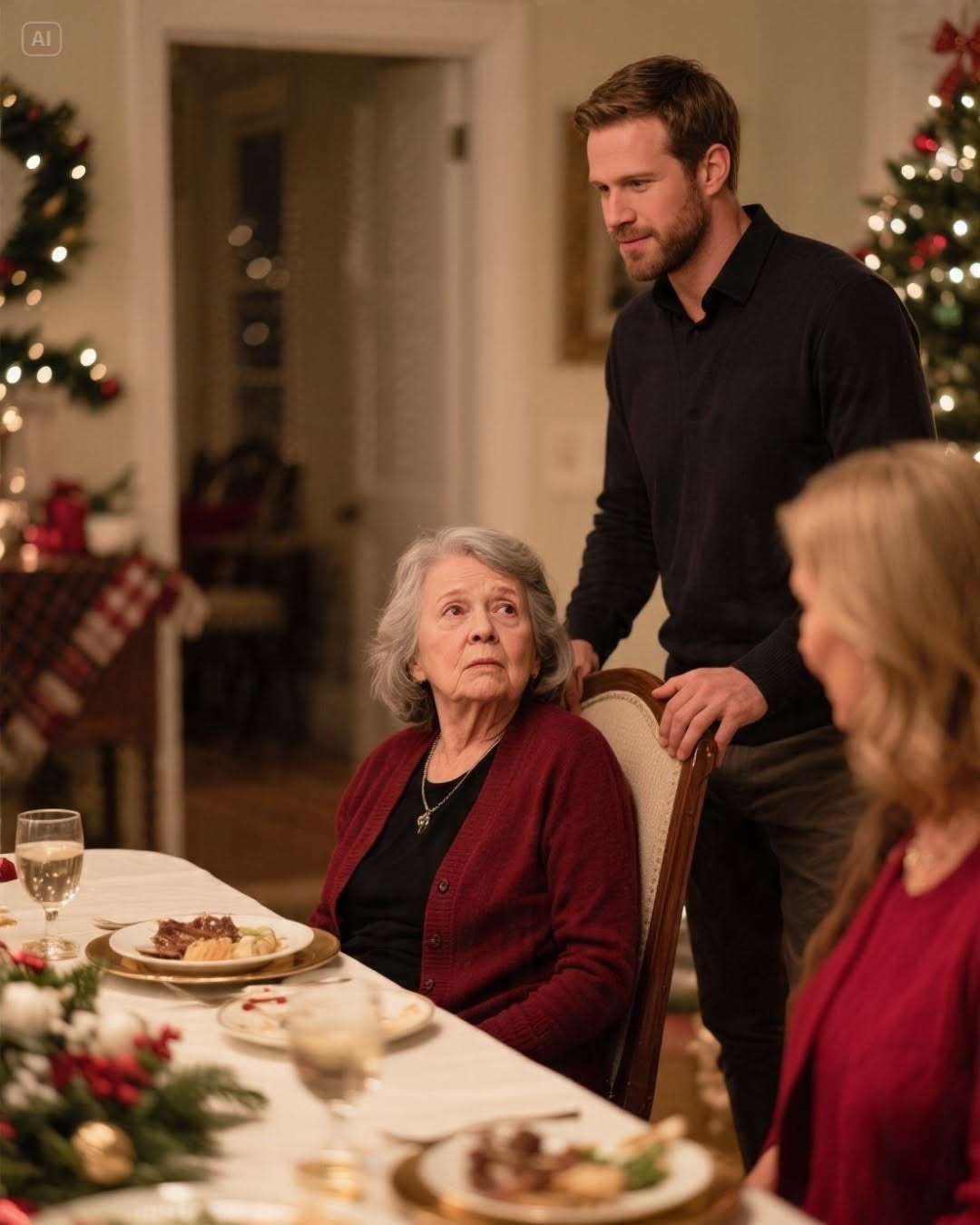
My son-in-law, Ryan Caldwell, spoke softly enough to keep the children in the living room from hearing.
But every person around the Christmas dinner table heard him clearly.
“You can’t sit there.”
He was pointing at my chair.

There was no nameplate attached to it, but for thirty-one years, that chair had been mine. It stood at the head of the dining table in the Ohio home my late husband, Henry, and I had bought together.
From that seat, I had served birthday dinners, Thanksgiving meals, graduations, and every Christmas since my daughter Emily was six years old.
I slowly looked from Ryan’s hand to his face.
He was wearing the navy sweater I had given him.
Behind him, his mother, Linda, was sitting comfortably in my chair, her red-painted fingers curled around a glass of wine.
“Excuse me?” I asked.
Ryan gave me a cold smile.
“My mother is sitting there. She’s the guest of honor this year.”
Emily stood near the kitchen doorway with a bowl of mashed potatoes in her hands.
Her face had gone pale.
She looked at me for barely a second before lowering her eyes.
That was enough.
I understood immediately.
This wasn’t spontaneous.
They had planned it.
The table was filled with Ryan’s relatives. My grandchildren, Ava and Noah, had been pushed between their cousins. Linda sat proudly at the head of the table as though she had every right to be there.
And I had spent the previous two days preparing everything.
I had bought the prime rib, the wine, the desserts, the decorations, and the expensive presents beneath the Christmas tree.
I had opened my home because Emily had quietly asked me to help make this Christmas peaceful.
Now her husband was telling me I didn’t belong at my own table.
“Ryan,” Emily said quietly.
He immediately turned toward her.
“Don’t start. Your mother always has to make everything about herself.”
Something inside me went completely quiet.
I placed the gravy boat back on the table.
Then I untied my apron and folded it neatly beside my plate.
“You’re right,” I said.
Ryan frowned.
“What?”
“I can’t sit here.”
I picked up my purse and coat.
“Mom?” Emily called as I reached the doorway.
I turned around one last time.
“The dinner is finished,” I said calmly.
Then I looked toward the room they had treated as though it belonged to them.
“But this house isn’t.”
I stepped outside into the snowy Christmas night.
Behind me, they remained seated around my table.
They had no idea what I was about to do next.
I drove six blocks to a small café near the public library. The owner, Mrs. Rao, remained open on Christmas because she believed loneliness did not take holidays.
She brought me a coffee and settled me into a quiet booth.
My phone started ringing.
Emily called twice. Then Ryan called.
I ignored him and answered my daughter.
“Please come back,” she whispered.
“Are you asking because you want me there, or because Ryan is embarrassed?”
Emily said nothing.
Within that silence, I heard years of excuses.
Ryan didn’t like me visiting without permission. He said I spoiled the children. He became annoyed whenever Emily disagreed with him.
And every year, my daughter’s voice seemed to grow smaller.
“He didn’t mean it that way,” she finally said.
“Yes, he did.”
“The children are upset.”
“So am I.”
“I know.”
“No,” I replied gently. “You don’t understand yet.”

After Henry died, I promised to keep our family together. But somewhere along the way, keeping everyone together became an excuse for allowing Ryan to decide where I belonged.
“I’m not coming back tonight,” I said. “Tomorrow, you and the children may come speak with me. Ryan is not invited.”
“He’s my husband.”
“And I am your mother. I also own that house, pay expenses when your family cannot, and have stayed silent because I thought silence was helping you.”
Emily’s voice cracked.
“I don’t know what to do.”
“Feed the children. Put them to bed. Then ask yourself why your husband felt comfortable humiliating me in my own home.”
Later, Ryan sent a message.
You overreacted. You ruined Christmas.
I answered:
No, Ryan. I ended a performance.
That night, I barely slept.
Not because I was angry.
Because I kept thinking about Ava and Noah.
They had done nothing wrong.
Children should remember Christmas as warmth, laughter, and the smell of cinnamon—not as the night their grandmother walked out because adults couldn’t treat one another with dignity.
The next morning, there was a knock at my apartment door.
I opened it and found Emily standing there with Ava and Noah.
Ryan wasn’t with them.
Emily looked exhausted.
Ava immediately ran into my arms.
“Grandma, are you mad at us?”
My heart broke.
“No, sweetheart. Never.”
Noah wrapped his arms around my waist.
“We didn’t want you to leave.”
“I know.”
I looked at Emily.
“Where is Ryan?”
“He stayed home.”
“Why?”
She took a breath.
“Because I told him he wasn’t welcome here until he could apologize to you without making excuses.”
For the first time in years, I saw something different in my daughter’s eyes.
Not fear.
Resolve.
I stepped aside and let them in.
We spent the morning together.
We ate the food I had prepared the night before. We opened a few presents. Ava told me about a book she had received, while Noah built a crooked tower from his new blocks.
For a few hours, it almost felt like Christmas again.
Then Emily sat across from me at the kitchen table.
“Mom, I need to tell you something.”
I waited.
“I knew Ryan planned to put Linda in your chair.”
I stared at her.
“You knew?”
She lowered her eyes.
“He told me earlier that he wanted his mother to feel important. I told him it wasn’t right.”
“But you didn’t stop him.”
“No.”
Her eyes filled with tears.
“I was afraid.”
That admission hurt more than anything Ryan had said.
Emily continued.
“I kept telling myself that if I stayed quiet, things wouldn’t get worse. That if I just kept everyone happy, eventually he’d change.”
She wiped her face.
“But yesterday, when you walked out, I realized something.”
“What?”
“I was teaching my children that being peaceful means letting someone hurt you.”
The room went silent.
Then Emily reached across the table and took my hand.
“I’m sorry, Mom.”
I squeezed her fingers.
“I forgive you.”
She looked surprised.
“But forgiveness doesn’t mean we pretend nothing happened.”
“I know.”
“And it doesn’t mean Ryan gets to keep treating people however he wants.”
“I know.”
That afternoon, Ryan finally came.
He stood outside my door for nearly a minute before knocking again.
When I opened it, he wasn’t wearing the confident expression from the night before.
He looked tired.
He held something in his hands.
My old Christmas apron.
“I found this on the chair,” he said.
I didn’t take it.
“Why are you here, Ryan?”
He swallowed.
“To apologize.”
I waited.
He looked directly at me.
“I was disrespectful to you.”
“Yes.”
“I embarrassed you in front of your family.”
“Yes.”
“I made your home feel like it wasn’t yours.”
“Yes.”
His eyes dropped.
“And I did it because my mother complained for years that she never felt important in this family. I thought giving her your seat would make her happy.”
I looked at him carefully.
“And did it?”
“No.”
He shook his head.
“She told me afterward that she didn’t want the chair. She wanted me to prove that she mattered more than you.”
I almost smiled sadly.
“And you thought humiliating me was the way to prove it?”
“I was wrong.”
For once, there was no excuse attached to his words.
Just regret.
“I can’t undo what I did,” he said. “But I can stop doing it.”
I opened the door wider.
“Then start by understanding something.”
He looked up.
“This house isn’t a prize. My chair isn’t a throne. And my family isn’t something you get to divide into people who matter and people who don’t.”
He nodded.
“I understand.”
“No,” I said gently. “You understand because you almost lost something.”
He was silent.
“You’ll truly understand when you learn to show respect even when there’s nothing to gain from it.”
His eyes became wet.
“I’ll try.”
“That is all I can ask.”
Then something unexpected happened.
Ryan stepped aside.
Linda was standing several feet behind him.
She had heard everything.
She slowly approached me.
“I owe you an apology too,” she said.
I looked at her.
She wasn’t the proud woman from the Christmas table anymore.
“I was jealous of you,” she admitted. “You had a place in this family that I couldn’t demand for myself.”
Her voice trembled.
“So I convinced myself that taking your chair would make me feel important.”
I studied her for a long moment.
“You didn’t need my chair.”
She nodded.
“You’re right.”
“You needed to believe you already mattered.”
A tear rolled down her cheek.
“I think I did.”
I stepped aside.
“Then come inside.”
She looked surprised.
“Why?”
“Because Christmas shouldn’t end with everyone sitting in separate houses.”
She began crying.

Not dramatically.
Quietly.
The kind of crying that comes when someone finally puts down a burden they’ve been carrying too long.
That evening, we returned to the house.
The dining room looked exactly as I had left it.
The candles had burned low.
The food had gone cold.
My chair was still at the head of the table.
Linda walked toward it, then stopped.
She looked at me.
“This is yours.”
I shook my head.
“No.”
She looked confused.
I pulled the chair away from the table.
“This belongs to the house.”
Then I moved it to the side and brought another chair beside it.
“This year, nobody sits above anyone else.”
Ava laughed.
“Can I sit next to Grandma?”
“Of course.”
Noah immediately grabbed another chair.
“Then I sit next to Grandma too.”
Soon everyone was squeezing around the table.
Ryan helped warm the food.
Emily brought out fresh plates.
Linda quietly carried the desserts into the dining room.
There was no perfect apology.
No magical transformation.
Just people who had finally understood how easily pride could hurt the people they claimed to love.
Before dinner, Ryan raised his glass.
“I want to say one thing.”
Everyone became quiet.
He looked at me.
“Thank you for not closing the door.”
I smiled.
“Don’t make me regret it.”
The table erupted in nervous laughter.
And for the first time that Christmas, I laughed too.
Years later, that chair remained in the house.
But something had changed.
Nobody treated it as a symbol of authority anymore.
Sometimes Ava sat there.
Sometimes Noah.
Sometimes Emily.
Sometimes Linda.
And whenever Ryan visited, he would jokingly ask,
“Who gets the famous chair tonight?”
I always answered the same way.
“Whoever needs reminding that they’re loved.”
Because in the end, I learned something Henry had understood long before me:
A family isn’t held together by a house, a dining table, or a particular seat.
It’s held together when people choose respect over pride, forgiveness over revenge, and love over the need to be right.
And that Christmas, I didn’t lose my place at the table.
I finally taught everyone what that place was really supposed to mean.