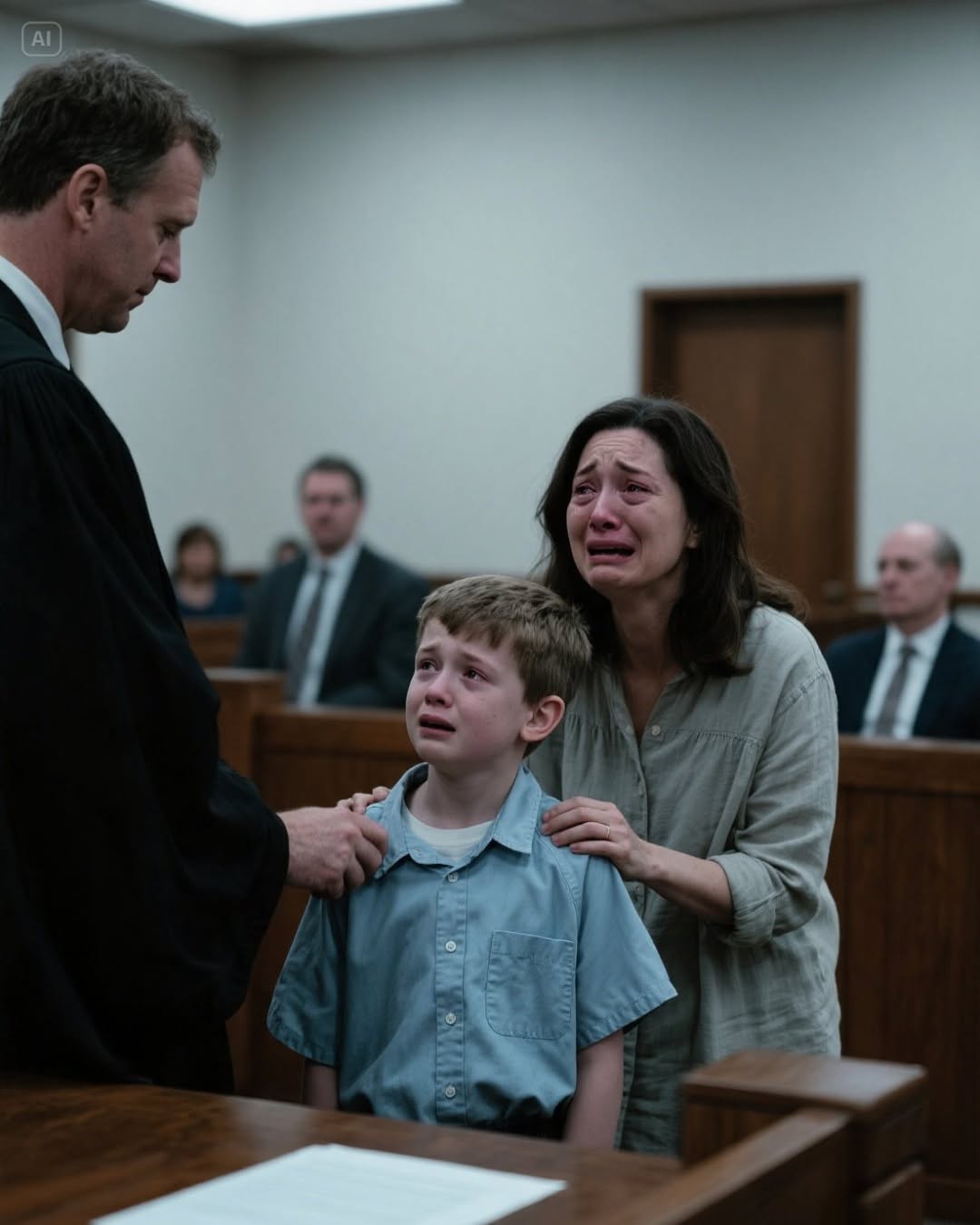
The Knoxville, Tennessee, courtroom felt colder than the January wind pressing against the windows outside.
I sat at the defense table with my eight-year-old son, Oliver, beside me. His little feet hung above the floor, swinging back and forth beneath the chair whenever his nerves got the better of him.
That morning, I had dressed him in his favorite navy-blue shirt, a clean pair of jeans, and the only sneakers we owned. I had spent the night before scrubbing those shoes until they looked almost new.
The shirt, however, had clearly seen better days.

Years of washing had softened the fabric, and a stubborn stain near the hem remained no matter how many times I tried to remove it.
Across the courtroom sat my ex-husband, Victor.
He looked like the picture of success in an expensive charcoal suit, polished leather shoes, and the luxury watch he had purchased not long after telling me he could no longer afford child support.
I couldn’t afford a lawyer.
Instead, I had brought neatly organized folders filled with school records, medical reports, rent receipts, work schedules, and months of unanswered messages documenting every promise Victor had failed to keep.
His attorney rose confidently and faced the judge.
“Your Honor,” he said, “this case is not about whether Mrs. Vance loves her son. It is about whether love can provide the stable life this child deserves.”
Then he raised a large photograph.
It showed Oliver leaving school three days earlier.
Wearing that same faded navy shirt.
The attorney pointed toward the worn fabric.
“The child repeatedly appears in clothing that is clearly old and stained. His mother works several low-paying jobs, struggles financially, and cannot provide even the basic necessities.”
Quiet whispers moved through the courtroom.
Oliver stopped swinging his feet.
His head slowly dropped, and he said nothing.
That was when I understood.
Victor wasn’t simply fighting for custody.
He wanted everyone in that courtroom to believe that being poor made me a bad mother.
Two years earlier, Victor had walked away from our marriage with nearly everything he considered valuable—including most of our savings.
He had promised we could handle child support between ourselves.
Within a few months, he had virtually disappeared from our lives.
My mother moved into our tiny apartment above a neighborhood bakery with one suitcase and more determination than I had ever seen in anyone.
I worked mornings at a diner, cleaned offices at night, and delivered groceries on weekends just to make sure there was food on our table.
Some nights, I went without dinner so Oliver could have the last piece of chicken.
Some mornings, I slipped handwritten notes into his lunchbox before rushing off to work.
He noticed every sacrifice.
One evening, he found me sitting among a pile of unpaid bills.
“Are we in trouble?” he asked.
I smiled and quickly covered the papers.
“No, sweetheart. I’m just figuring out what I need to solve first.”
He climbed into the chair beside me and smiled.
“When I have lots of homework,” he said, “I always finish the easiest assignment first.”
Then he squeezed my hand.
“Maybe grown-up problems work that way too.”
That was Oliver.
No matter how difficult life became, he somehow always found a reason to believe tomorrow could be better.
The courtroom remained silent after Oliver finished speaking.
Even the faint rustle of papers seemed to disappear.
Judge Thorne looked at the words written inside the shirt one more time.
MY MOM MAKES OUR SMALL HOME FEEL LIKE THE WHOLE WORLD.
Then he slowly lowered the fabric.
“Oliver,” he said gently, “did you write this yourself?”
Oliver nodded.
“When?”
“A few weeks ago.”
“Why?”
Oliver looked at me.
“Because Mom thinks she doesn’t give me enough.”
My heart broke.
The judge’s expression softened.
“Enough of what?”
“Everything.”
Oliver took a breath.
“She thinks I need a bigger house. Better clothes. More toys. But I don’t.”
Victor shifted uncomfortably in his chair.
Oliver continued.
“I just need Mom.”
A tear slipped down my cheek before I could stop it.
For two years, I had worked so hard to protect my son from the ugliness of our divorce that I had forgotten something important.
Children don’t measure love by the size of a house.
They measure it by who waits beside their bed when they’re sick.
Who remembers their favorite cereal.
Who stays awake when they have a nightmare.
Who shows up.
Every single time.
Judge Thorne turned toward Victor.
“Mr. Vance, I’d like to ask you a few questions.”
Victor straightened.
“Yes, Your Honor.”
“How many times have you attended Oliver’s parent-teacher conferences during the past school year?”
Victor hesitated.
“I’ve been busy with work.”
“That wasn’t my question.”
He swallowed.
“None.”
“How many doctor appointments?”
“I’m not sure.”
“School performances?”
Victor said nothing.
Judge Thorne looked down at the documents.
“Fourteen school events. Three medical appointments. Two parent conferences.”
He paused.
“Mrs. Vance attended all of them.”
Victor’s attorney stood.
“Your Honor, attendance alone does not determine parental fitness.”
“Correct,” Judge Thorne replied. “Neither does the condition of a child’s shirt.”
The attorney sat down.
For the first time that morning, I saw Victor’s confidence disappear.
But the judge wasn’t finished.
He turned to the financial records.
“Mr. Vance, you testified that you were concerned about your son’s living conditions.”
“Yes.”
“And yet you were five months behind on child support.”
“I had unexpected expenses.”
“What kind?”
Victor hesitated again.
“Business expenses.”
Judge Thorne lifted another document.
“According to these records, during those same five months, you purchased a new vehicle, paid for a luxury vacation, and purchased a watch valued at several thousand dollars.”
The courtroom became painfully quiet.
Victor’s face reddened.
“My finances are private.”
“Not when they directly affect a child.”
No one spoke.
Then Oliver reached for my hand.
His fingers were tiny.
Warm.
Steady.
I squeezed them.
The judge reviewed the final page.
“Mr. Vance, this court is not going to punish you for being financially successful.”
Victor looked up.
“But neither will it reward you for using that success to make your child ashamed of his mother.”

Victor stared at the floor.
I expected to feel victorious.
Instead, I felt exhausted.
Because this had never really been about winning.
It had always been about keeping my son from believing that his mother’s sacrifices were something to be ashamed of.
After a long pause, Judge Thorne delivered his ruling.
“Primary custody will remain with Mrs. Vance.”
My breath caught.
Oliver squeezed my hand.
“Mr. Vance will receive a structured visitation schedule. Child support will be recalculated based on verified income, and all outstanding payments will be addressed.”
Victor’s attorney began to object.
The judge raised his hand.
“This court is adjourned.”
The gavel struck.
Once.
The sound echoed through the room.
And just like that, the battle was over.
Or at least this part of it was.
I turned toward Oliver.
He was smiling.
Not because we had won.
Because we were going home.
Outside the courthouse, the January wind hit us immediately.
My mother was waiting on the steps.
The moment she saw Oliver, she opened her arms.
He ran straight into them.
“Grandma!”
She hugged him tightly.
Then she looked at me.
For a moment, neither of us spoke.
She simply walked over and wrapped one arm around me.
“You did it,” she whispered.
I shook my head.
“No.”
I looked down at Oliver.
“He did.”
My mother smiled through tears.
That evening, we stopped at the grocery store.
For the first time in months, I didn’t calculate every item in my cart.
Oliver wanted chocolate cereal.
My mother wanted fresh strawberries.
I bought both.
At home, we made pancakes for dinner.
Not because it was a special occasion.
Because Oliver said victory tasted better with syrup.
We laughed.
Really laughed.
The kind of laughter that had become rare in our apartment.
Later that night, after Oliver fell asleep, I stood outside his bedroom.
The moonlight came through the window.
His navy-blue shirt was folded neatly over the back of a chair.
I picked it up.
The stain was still there.
The fabric was still faded.
And the handwritten message was still visible inside.
MY MOM MAKES OUR SMALL HOME FEEL LIKE THE WHOLE WORLD.
I pressed the shirt against my chest.
Then I heard a sleepy voice behind me.
“Mom?”
I turned.
Oliver was standing in the doorway, rubbing his eyes.
“Why are you awake?”
He shrugged.
“I wanted water.”
I walked him to the kitchen.
He climbed onto the chair while I poured him a glass.
Then he looked at me.
“Are you sad?”
I smiled.
“No.”
“Are you sure?”
I nodded.
“I’m happy.”
He thought for a moment.
“Because we won?”
I shook my head.
“Because you know the truth.”
He smiled.
“What truth?”
I knelt beside him.
“That you were never the reason we didn’t have more.”
He frowned.
“I know.”
“And that you never needed more.”
He smiled again.
“I have you.”
Those four words broke something open inside me.
I pulled him into my arms.
For a long time, neither of us spoke.
I could hear the refrigerator humming.
The old heater rattling.
My mother’s footsteps in the hallway.
Ordinary sounds.
Our ordinary life.
And suddenly, I realized how extraordinary it was.
A year later, things looked different.
I had found a better-paying administrative job with regular hours.
My mother had started working part-time at the bakery downstairs, mostly because she enjoyed talking to customers.
Oliver was doing well at school.
His science teacher said he had an unusual ability to turn difficult questions into simple ones.
One Saturday morning, he came running into the kitchen carrying a school project.
“Mom! Look!”
He had built a model of the solar system from cardboard, string, and painted paper.
At the center was Earth.
Around it, he had written one sentence.

HOME IS WHERE SOMEONE ALWAYS COMES BACK FOR YOU.
I stared at it.
“Did you write that?”
He nodded.
“It’s for my school presentation.”
I hugged him.
“You’re going to make me cry.”
He laughed.
“Don’t cry. I haven’t even shown you the best part.”
He turned the model around.
At the bottom was a tiny cardboard house.
Three figures stood outside it.
A boy.
A grandmother.
And a mother.
I pointed at the figures.
“Who’s this?”
“That’s you.”
“And that’s Grandma.”
“And that’s me.”
I smiled.
“Why are we standing outside?”
He shrugged.
“Because we’re waiting for the stars.”
That night, we took blankets onto the apartment roof.
The city lights stretched beneath us.
Oliver pointed toward the sky.
“Mom, do you think there’s somewhere out there bigger than this?”
I looked at him.
“Probably.”
“Would you ever want to live somewhere bigger?”
I thought about the courtroom.
The expensive suit.
The luxury watch.
The large house Victor had promised him.
Then I looked at my son lying beside me beneath the stars.
“No,” I said.
“Why?”
I smiled.
“Because I already have everything I need.”
He leaned against my shoulder.
And for the first time, I believed it completely.
The faded shirt was eventually too small for him.
But I never threw it away.
I framed it.
Not because it reminded me of the courtroom.
Not because it reminded me of Victor.
But because it reminded me of the moment my eight-year-old son taught me something I had forgotten.
Being a good mother was never about what I could afford.
It was about what I was willing to give.
My time.
My patience.
My last piece of chicken.
My sleep.
My strength.
My whole heart.
Years later, when Oliver was old enough to understand everything that had happened, he asked me one question.
“Mom, were you embarrassed that I wore that shirt?”
I smiled.
“No.”
“Then why did you cry?”
I looked at the framed shirt hanging in our hallway.
“Because I was afraid the world would look at what we didn’t have and never see what we did.”
He was quiet for a moment.
Then he hugged me.
“You don’t have to worry anymore.”
“Why?”
“Because I see it.”
I closed my eyes.
And held him tighter.
Sometimes, the greatest thing a child can give a parent isn’t money, protection, or success.
Sometimes, it’s simply the courage to remind them that they were already enough.
And that faded little shirt became the proof I would carry with me forever.
Not proof that we had been poor.
Proof that, even when we had almost nothing…
we had never been without love.