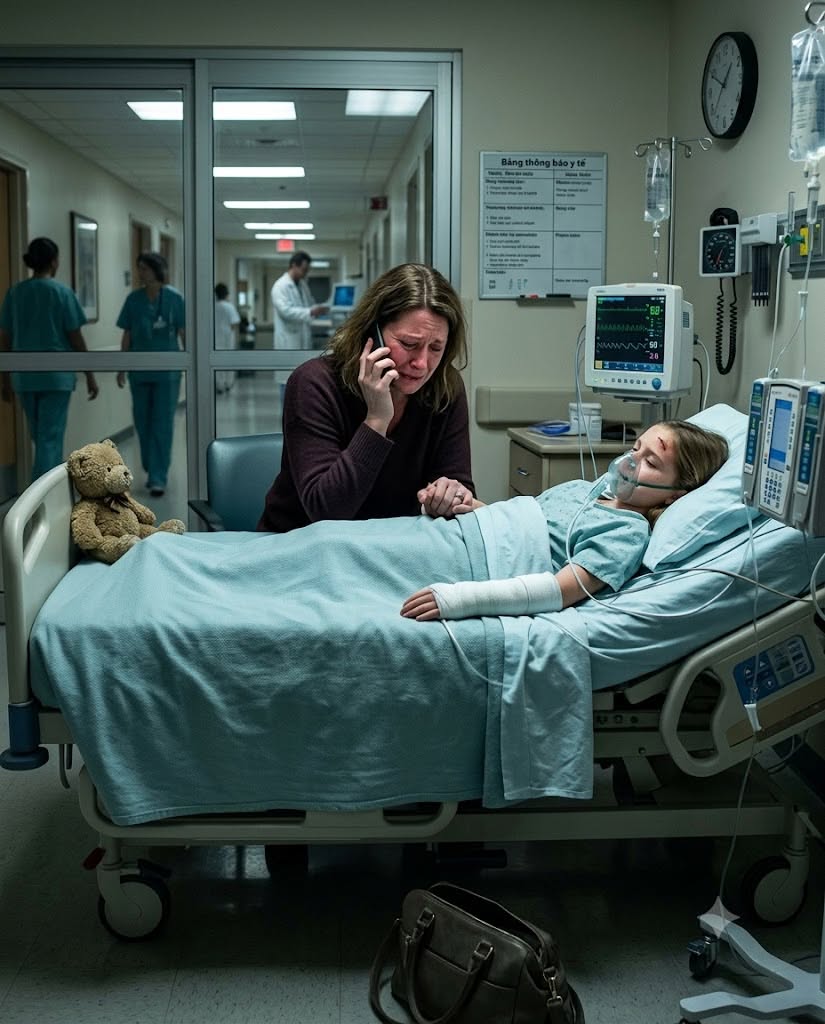
The call came while I was standing beneath the harsh fluorescent lights of the hospital, staring through the glass at my ten-year-old daughter lying motionless in the ICU.
My little girl, Katie, had always been a whirlwind of energy. She was all messy ribbons, scraped knees, and stubborn determination. She practiced cartwheels in the hallway despite my constant warnings about knocking over the furniture, and she never gave up on anything she set her mind to.
But that Tuesday afternoon, everything changed.

Katie had been walking to gymnastics along the same familiar route she took every week when a car struck her and fled the scene. By the time the sun began to set, I was sitting in a hospital corridor, signing consent forms with trembling hands while doctors fought to stabilize my daughter.
First, they told me she was stable.
Then they told me she needed intensive care.
I couldn’t understand how those two statements could possibly belong in the same conversation.
I sat beside Katie’s bed, holding her small hand while the machines around us monitored every fragile heartbeat. An IV was taped to her wrist, and a dark bruise near her temple made her look impossibly young.
My husband, Andrew, still hadn’t arrived.
When my phone lit up with his name, I answered immediately, desperate for some explanation, some reassurance that he was on his way to be with our daughter.
But it wasn’t Andrew on the other end.
It was his mother, Barbara.
And she sounded annoyed.
“Where are you?” she demanded, without even bothering to ask how I was doing.
“I’m at the hospital,” I replied, struggling to keep my voice steady. “Katie was hit by a car.”
There was a brief silence.
Then Barbara sighed as if I’d just inconvenienced her.
“Andrew told me she’s stable. So there’s no reason for you to keep acting like this is the end of the world. My birthday dinner is tomorrow, and the guests are already expecting you to cook.”
For a moment, I genuinely thought I’d misunderstood her.
My daughter was lying unconscious in the intensive care unit, and my mother-in-law was worried about her birthday dinner.
She had invited relatives and friends, promising them the special chicken dish I always prepared. Apparently, she had decided that I would be responsible for making her celebration perfect, regardless of what happened in my own life.
“Barbara,” I said slowly, looking at Katie’s pale face, “my daughter is in intensive care. I am not leaving her side.”
“You’re being dramatic,” she snapped.
Those two words settled inside me like a stone.
I had spent eight years trying to maintain peace in my marriage, swallowing insults and accommodating Barbara’s endless demands. I’d convinced myself that keeping the family together was worth the sacrifice.
But standing beside my daughter’s hospital bed, I finally understood how much that sacrifice had cost me.
Barbara lowered her voice, turning her next words into a threat.
“If you don’t come home tonight and get everything ready for my birthday, don’t bother coming back. You can forget about living in that house.”
I stared at my phone.
The house she was threatening to take away wasn’t hers. She hadn’t paid the mortgage, contributed to the down payment, or lifted a finger to maintain it.
It was my home.
Yet Barbara had spent years behaving as though she had the right to dictate every decision made under its roof. Andrew had allowed it for so long that his mother genuinely believed she could decide whether I deserved to live there.
In the background, I heard Andrew’s voice.
“Mom, stop.”
For one fleeting second, I thought he might finally stand up for me.
Then he took the phone.
“Amanda, she’s just stressed about the party,” he said wearily. “Katie’s stable, isn’t she? Maybe you could come home for a little while and help Mom calm down.”
I couldn’t believe what I was hearing.
Our daughter was fighting for her life, and he was asking me to soothe his mother’s feelings.
“Andrew, have you even come to see Katie?”
He didn’t answer directly.
“You’re making this more difficult than it needs to be.”
I looked at my little girl, at the bruises on her face and the tiny fingers resting against my palm.
Something inside me went completely still.
“No,” I said.
One word. Nothing more.
I wasn’t going to explain myself. I wasn’t going to negotiate. And I certainly wasn’t going to ask my husband for permission to be a mother.
Andrew fell silent.
Barbara muttered something angrily in the background before the call abruptly ended.
I turned my phone facedown and returned my attention to Katie.
That night, I held her hand through every examination, every whispered conversation between nurses, and every agonizing minute when the monitor seemed to be the only thing connecting me to the child I loved more than anything in the world.
I barely slept.
Every time my phone vibrated, I ignored it.
For once, I didn’t care how angry Barbara was or what Andrew might say about my behavior. Nothing mattered beyond the small girl lying in that bed.
Then morning arrived.
Gray light crept through the blinds, illuminating the untouched coffee beside my chair. My back ached, my eyes burned, and I felt as though I’d aged ten years overnight.
I was leaning over Katie’s blanket, counting her breaths as I had done countless times during the night, when I felt her fingers move.
At first, I thought I had imagined it.
Then her hand tightened around mine.
Her eyelids fluttered.
“Katie?” I whispered, leaning closer. “Sweetheart, Mommy’s here.”

Her eyes opened slowly. She looked confused, frightened, and exhausted.
A nurse hurried over, checked her vital signs, and gently reminded me to give her a moment.
I nodded, barely able to breathe.
Katie’s gaze wandered across the room before finally settling on me. Her lips parted, but the first attempt at speaking produced nothing more than a faint sound.
I bent down until my ear was close to her mouth.
“Mom…”
“I’m here, baby. I’m right here.”
Her fingers trembled against mine.
Then she whispered three words that shattered everything I thought I knew about my family.
“Andrew did it.”
For a moment, my mind refused to understand.
“What did you say, sweetheart?”
Katie swallowed painfully. Tears gathered in the corners of her eyes.
“He pushed me.”
The room seemed to tilt around me.
I wanted to believe she was confused. I wanted to believe the medication, the trauma, or the fear had somehow tangled her memories.
But Katie squeezed my hand again.
“He was angry,” she whispered. “He told me not to tell you.”
I pressed the call button, struggling to keep my voice steady as I asked the nurse to contact the police.
My husband had stood beside me in our wedding photographs. He had kissed our daughter goodnight and promised to protect her.
And now our little girl was lying in a hospital bed, telling me that he had pushed her into the path of a moving car.
I didn’t know what to believe about the man I’d married.
But I knew I couldn’t ignore what my child had told me.
By noon, Detective Reynolds arrived at the hospital. He spoke to Katie gently, allowing her to explain what she remembered without pressuring her.
According to Katie, Andrew had met her along the route to gymnastics. He had been angry about an argument we’d had the previous evening and wanted her to convince me to attend Barbara’s birthday dinner.
When Katie refused to get into his car, he grabbed her arm.
She remembered trying to pull away. She remembered him shoving her backward.
Then came the impact, the terrible pain, and the sound of a horn.
After listening to her account, Detective Reynolds closed his notebook.
His expression was controlled, but something in his eyes told me the situation was far more serious than I had imagined.
He turned toward me.
“Amanda, I need you to do something very important.”
“What?”
“Don’t call your husband. Don’t tell him what Katie has said. And whatever you do, don’t go home alone.”
My stomach tightened.
“Why?”
He exchanged a glance with the uniformed officer standing near the door.
“Because this may be about more than what happened to your daughter.”
He explained that the police had already begun investigating the hit-and-run. The vehicle involved had been identified, and they were working to establish who had been driving it.
But during their preliminary inquiries, another matter had surfaced.
A document had recently been submitted to initiate the sale of my house.
The paperwork claimed that I had granted Andrew authority to sell the property on my behalf through a power of attorney.
I had never signed such a document.
I felt the blood drain from my face.
“That’s impossible,” I whispered. “I never authorized him to sell my house.”
Detective Reynolds nodded.
“That’s exactly why we’re looking into it.”
He told me that the signature on the document appeared suspicious and that the authorization would need to be examined by a forensic document specialist. The police also wanted to determine who had submitted the paperwork and who stood to benefit from the sale.
Suddenly, Barbara’s threat from the previous night took on a terrifying new meaning.
If you don’t come home, don’t expect to get back into the house.
She hadn’t sounded like someone making an empty threat.
She had sounded like someone who believed she already had the power to carry it out.
“Does my mother-in-law know about the document?” I asked.
“We’re still establishing that,” Reynolds replied. “But I want you to think carefully. Has your husband ever pressured you to sign financial documents? Has anyone tried to gain access to your property records or personal identification?”
My mind raced through the previous few months.
Andrew had repeatedly asked me to leave certain financial matters to him. Barbara had made strange comments about how much money we could make if we sold the house and moved somewhere smaller.
At the time, I’d dismissed them as another one of her intrusive suggestions.
Now, those conversations felt different.
Detective Reynolds stood.
“We’re going to speak with your husband and his mother. But first, I need to make sure you and Katie are protected.”
I looked toward my daughter’s bed.
“Whatever happens,” I said, “I’m not letting them near her.”
For the first time since the accident, I felt something stronger than fear.
I felt determination.
And I had no idea just how much my family had been hiding from me.
By late afternoon, Detective Reynolds had arranged for another officer to remain nearby while Katie received treatment. I stayed beside her, refusing to leave even when a nurse offered to bring me something to eat.
Then Reynolds returned.
“We’ve located your husband,” he said. “And we’d like you to come with us to identify some documents.”
My heart began pounding.
“Has Andrew confessed?”
“Not yet.”

He led me to a small conference room away from the main ward. On the table lay several sheets of paper, a copy of the disputed power of attorney, and a printed record of communications connected to the attempted sale.
I recognized the address of my house immediately.
Then I saw my name.
And beneath it was a signature that looked almost exactly like mine.
Almost.
Someone had copied my handwriting carefully, even reproducing the slight upward curve at the end of my last name. But the pressure was wrong, and the final letter was too neat.
I knew I hadn’t signed it.
“Who submitted this?” I asked.
“The real estate agent received it through your husband’s email account,” Reynolds explained. “The proposed sale was moving forward, but the agent became concerned when some details didn’t match the property records.”
I stared at the papers.
“Where was the money supposed to go?”
“That’s one of the things we’re investigating.”
He turned another page toward me.
There was a bank account listed for the proceeds of the sale. It wasn’t our joint account, and it wasn’t an account I recognized.
The account was associated with a company registered under a name I had never heard before.
But the mailing address belonged to Barbara.
My hands began to shake.
“She was involved.”
“We haven’t established the full extent of her involvement,” Reynolds said carefully. “But we have enough to ask her some serious questions.”
Then he showed me a message sent from Andrew’s account to the real estate agent.
My wife has already agreed. She is just emotional right now, but I have full authority to proceed.
I felt sick.
He had not only forged my authorization. He had told strangers that I had consented, counting on the fact that no one would question him.
And while he was trying to sell my home without my permission, our daughter was lying in intensive care.
I covered my mouth, struggling to contain the wave of anger rising inside me.
“What happens now?”
“We’ll follow the evidence,” Reynolds replied. “And we won’t let the property transfer proceed while the alleged forgery is under investigation.”
For the first time in hours, I could breathe a little easier.
My house was not yet lost.
But my marriage was another matter entirely.
That evening, the police brought Andrew and Barbara in for separate interviews.
I didn’t see Andrew until later, when Detective Reynolds asked whether I was prepared to hear what he had to say. I agreed, provided the conversation took place with officers present.
Andrew entered the room looking nothing like the man I had married.
His shirt was wrinkled, his eyes were bloodshot, and the confidence he usually wore around his mother had vanished.
“Amanda,” he began, “you have to listen to me.”
I didn’t answer.
He glanced at the documents on the table.
“This is all a misunderstanding.”
“A misunderstanding?” My voice trembled despite my effort to control it. “Katie told me you pushed her.”
His face changed.
For one brief second, I saw something flicker in his eyes. It wasn’t confusion.
It was fear.
“She was upset,” he said quickly. “She doesn’t understand what happened.”
“Then tell me what happened.”
Andrew looked down.
He admitted that he had confronted Katie on her way to gymnastics. He claimed he’d only wanted to frighten her into listening to him, that he’d grabbed her arm during an argument, and that she’d stumbled when she pulled away.
But when Detective Reynolds asked why he hadn’t immediately reported the incident or come to the hospital, Andrew had no convincing answer.
Then the detective placed the power of attorney in front of him.
“Did you forge your wife’s signature?”
Andrew stared at the paper.
“No.”
“Did you ask anyone else to do it?”
Silence.
Finally, Andrew rubbed his face and whispered, “My mother said it was the only way.”
I felt as though the air had been knocked out of my lungs.
He explained that Barbara had been pressuring him to sell the house for months. She had convinced him that the property was worth more than we could afford to maintain and that selling it would give the family a fresh start.
But the proposed sale wasn’t simply about downsizing.
Barbara had debts she hadn’t told the family about. She wanted access to the money from the sale, and Andrew had agreed to help her obtain it.

They had planned to transfer the proceeds through the company associated with Barbara’s address before dividing the money between them.
“And you thought you could steal my home to pay your mother’s debts?” I asked.
Andrew shook his head desperately.
“I never wanted things to go this far.”
“But you signed the documents. You lied to the agent. And you left our daughter alone in a hospital while you worried about your mother’s birthday dinner.”
He had no answer.
Then Detective Reynolds asked the question that changed everything.
“Mr. Andrew, why did your wife receive a threat about losing her home before the police discovered the forged document?”
Andrew’s expression collapsed.
He admitted that Barbara had called me because she wanted to make sure I returned home. She believed that if she could intimidate me into cooperating, she could prevent me from interfering with the sale.
But when Katie had refused to help persuade me, Andrew had lost his temper.
He insisted that he hadn’t intended for her to be seriously hurt.
I looked at him, unable to recognize the man sitting across from me.
“You didn’t have to intend this,” I said quietly. “You only had to make the choice to hurt her.”
For once, he didn’t try to argue.
Barbara’s interview was even more revealing.
At first, she denied knowing anything about the forged power of attorney. She insisted that Andrew had handled the paperwork himself and that she had merely offered advice about the house.
But the detectives had already obtained messages that contradicted her story.
One message showed her reminding Andrew to make sure the documents were submitted before I returned home.
Another contained a warning.
If Amanda starts asking questions, tell her the sale is already too far along to stop.
When Detective Reynolds placed the messages in front of her, Barbara’s composure finally cracked.
She demanded to know who had given the police permission to examine her private affairs.
Then she insisted that the entire arrangement had been Andrew’s idea.
But the evidence told a different story.
The proposed company was connected to her address. The communications showed that she had discussed the sale with Andrew, and the real estate agent confirmed that she had contacted the office to ask about the expected proceeds.
Barbara had spent years treating me as someone who existed to serve her needs.
She had expected me to cook her birthday dinner while my daughter lay in intensive care. She had threatened to throw me out of a house she had no right to control. And she had believed she could use intimidation to make me surrender my home.
Now, sitting beneath the same unforgiving lights that had illuminated my daughter’s hospital bed, she finally understood that her words no longer controlled the situation.
“You cannot do this to me,” she snapped at Detective Reynolds.
He remained calm.
“We’re not doing anything to you, ma’am. We’re investigating the evidence.”
Barbara turned toward me as though she expected me to intervene.
“Amanda, tell them this has gone too far. We’re family.”
I stared at her.
“Family doesn’t forge documents to steal someone’s home.”
Her mouth opened, but no words came out.
“And family doesn’t threaten a mother while her child is fighting for her life.”
For the first time in eight years, I wasn’t afraid of her anger.
I didn’t need to raise my voice or insult her. I simply refused to protect her from the consequences of her own actions.
The detectives informed Barbara that the alleged forgery and attempted fraudulent sale were being formally investigated. Andrew was also under investigation, and the police were continuing to examine the circumstances surrounding Katie’s injuries.
Neither of them was allowed to contact Katie while the investigation proceeded.
As I walked out of the station, I expected to feel victorious.
Instead, I felt exhausted.
The people I had trusted most had turned my life into something I barely recognized. I had lost the security of my marriage, the illusion of a loving family, and the belief that my home was a place where I would always be safe.
But I had not lost my daughter.
And I had not lost my voice.
The following days were filled with medical updates, police interviews, and paperwork.
Katie remained under close observation, but her condition gradually improved. The doctors warned me that her recovery would take time, and I promised her that she wouldn’t have to face a single day of it alone.
When she was finally able to sit up for longer periods, I brought her favorite blanket from home and tucked it around her shoulders.
“Mom?” she asked one afternoon.
“Yes, sweetheart?”
“Is Andrew coming back?”
I paused, choosing my words carefully.
“No, baby. Not right now.”
She looked down at her hands.
“Did I do something wrong?”
My heart broke.
I sat beside her and gently lifted her chin so she could see my face.
“Absolutely not. You did nothing wrong. What happened was not your fault, and you never have to protect someone who makes you feel unsafe.”
Katie began to cry, and I held her until the trembling stopped.
For the first time since she had opened her eyes, she allowed herself to relax against me.
That moment mattered more than anything Andrew or Barbara could ever say.
Meanwhile, the police confirmed that the attempted property sale had been halted. A forensic examination of the disputed signature supported the suspicion that it had not been written by me, and investigators continued gathering evidence about who had prepared and submitted the documents.
The consequences for Andrew and Barbara would be determined through the legal process. I couldn’t undo what had happened, but I could make sure they no longer had access to my home, my finances, or my daughter’s life.
With the help of a lawyer, I began taking steps to protect the property and separate my financial affairs from Andrew’s. I also began the process of ending our marriage.
Andrew sent messages through relatives, claiming he was sorry and begging me to remember the good years we had shared.
He said he had made a terrible mistake.
Perhaps, in his own mind, that was true.
But some mistakes were not accidents. Some were choices made repeatedly, each one requiring another lie to hide the last.
I had spent eight years believing that Andrew’s refusal to stand up to his mother was a weakness I could work around.
Now I understood that his silence had been a choice, too.
And when the moment came to protect our daughter, he had made the wrong one.
I did not respond to his messages.
Three weeks later, Katie came home.
She was still recovering, and there were nights when she woke from nightmares, frightened by memories she couldn’t fully explain. I sat with her until she fell asleep again, reminding her that she was safe and that no one would hurt her in our home.
Our home.
Those two words meant something different now.
The locks had been changed. My lawyer had helped me secure the necessary property records, and the attempted sale remained blocked while the legal proceedings continued. I no longer had to wonder whether Barbara might appear at the door and announce that she had decided how I should live.
She had no authority over my house.
She had no authority over my daughter.
And she no longer had authority over me.
The investigation continued, and both Andrew and Barbara faced the consequences of the evidence gathered against them. I understood that the legal process would take time, and I made no promises to myself about how quickly justice would come.
Instead, I focused on the things I could control.
I helped Katie return to school when she was ready. I took her to her follow-up appointments. I listened when she wanted to talk and sat quietly beside her when she didn’t.
Slowly, the laughter began to return.
One evening, as we sat together on the couch, Katie leaned against my shoulder.
“Mom?”
“Yes?”
“Are we going to be okay?”
I kissed the top of her head.
“Yes, sweetheart. We are.”
And for the first time in weeks, I believed it without having to convince myself.
I had once thought protecting my family meant keeping my marriage together at any cost. I had believed that patience could fix Andrew’s behavior and that kindness might eventually earn Barbara’s respect.
I was wrong.
Protecting my family meant protecting the people who were vulnerable, even when doing so meant walking away from the people I had once loved.
It meant refusing to let fear make my decisions.
And it meant teaching my daughter that love should never require her to remain silent about being hurt.
On the night of Barbara’s birthday, I had stayed beside Katie instead of obeying a threat.
That single decision had exposed a lie that might otherwise have cost me my home and destroyed our lives.
Barbara had believed she could frighten me into submission.
Andrew had believed he could hide behind his mother’s influence.
Both had mistaken my patience for weakness.
They would never make that mistake again.
Because when Katie whispered the truth from her hospital bed, I finally understood something I should have known all along.
I didn’t have to save my marriage.
I had to save my daughter.
And I would spend the rest of my life making sure she knew that I had chosen her—not just that night, but every day afterward.