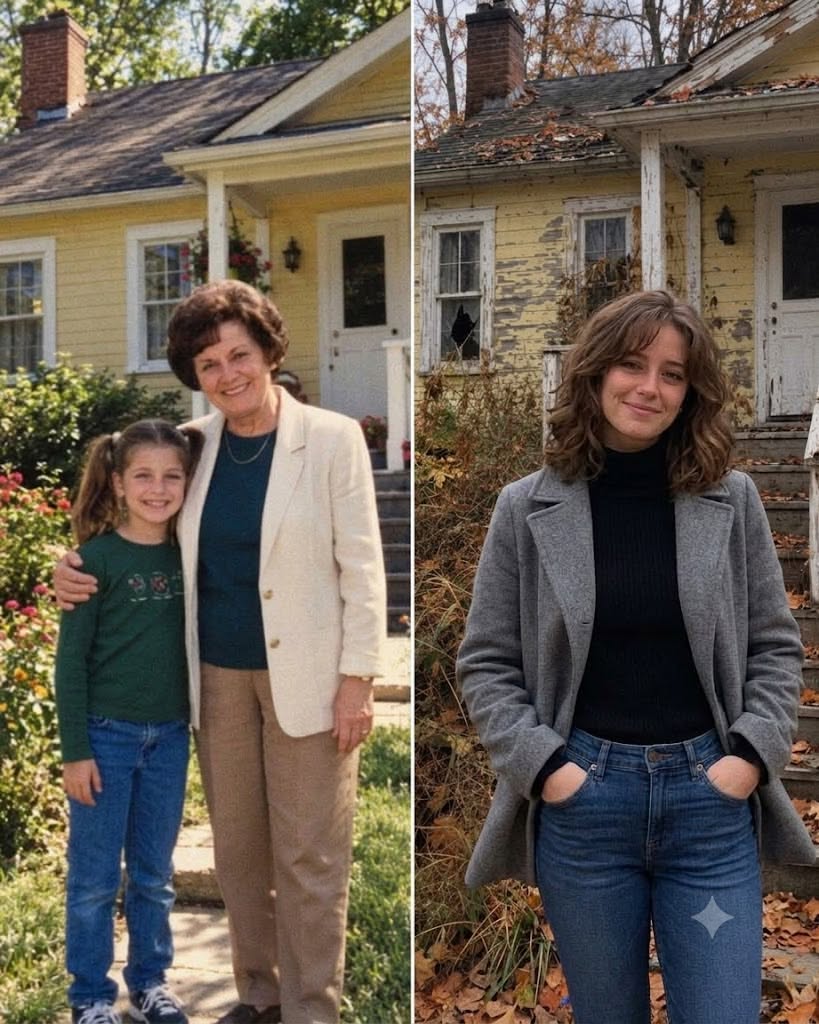
When I told my husband, Declan, that I had used my inheritance to buy back my late grandmother’s house, he laughed in my face.
“Congratulations, Layla. You’ve found the most ridiculous way to waste your money.”
I stared at him across the breakfast table.
“You haven’t even asked how much I paid.”
“I don’t need to. I’ve seen that place. The roof is falling apart, the windows are broken, and the garden looks like a jungle.”
“I know what it looks like.”
“Then you should know better.”

Declan had always been like that. He could spend thousands restoring his beloved Mustang, yet he questioned every dollar I spent on something I cared about. He had bought a boat he barely used and filled his garage with expensive tools. Somehow, those purchases were investments in his happiness. My dream, however, was a waste of money.
But this house was different.
I had spent every childhood summer there with Grandma Rose. She taught me to bake apple pies in her tiny kitchen and let me help her decorate them, even when my crusts looked terrible. On rainy afternoons, we sat together on the porch beneath a blanket, listening to the water hit the roof.
That house had been the safest place in my world.
When Grandma died, the property went to my uncle Frank, who sold it shortly after the funeral. I was nineteen then, with very little money and no way to buy it myself. Losing the house felt like losing her all over again.
Years passed. I saved and invested the money Grandma had left me. Then, last spring, I discovered that the current owners had put the house up for sale.
For the first time, I had a chance to bring it back into my life.
I bought it with my own inheritance. I planned to repair it gradually, restore the porch, and create a small room where our ten-year-old son, Owen, could read his comic books and play.
Declan had other ideas.
“You’ll never finish those repairs,” he said. “You’ll spend every penny, and then what?”
“I have estimates from contractors. I know what needs to be done first.”
“With what money?”
“Mine. I’m not asking you to pay for it.”
He shook his head.
“That’s the worst decision you’ve ever made.”
Then he walked away.
For the next two days, he criticized every part of my plan. When I mentioned repairing the kitchen, he told me to fix the roof first. When I talked about rebuilding the porch, he complained about lumber prices.
At dinner, Owen finally spoke up.
“Mom, can I have my own room there? With shelves for my comics?”
“Of course, sweetheart.”
Declan snorted.
“If your mother doesn’t spend all her money fixing that dump.”
Owen lowered his fork.
“It’s not a dump, Dad. Grandma Rose loved that house.”
“Loving something doesn’t make it valuable.”
My son looked at his father.
“Would you sell your Mustang if someone said it wasn’t worth fixing?”
Declan frowned.
“That’s different.”
“Why?”
“Because I know what I’m doing with that car.”
I put my fork down.
“And I know what I’m doing with the house.”
That evening, I decided I would stop waiting for Declan’s approval. I would begin cleaning the property that weekend, whether he helped me or not.
He barely looked up from his phone.
“Fine. Don’t expect me to get involved.”
I didn’t.
Three days after I bought the house, my phone rang. Declan was calling from the property.
His voice sounded strange.
“Layla, you need to come here.”
“Why? What happened?”
“I found something. Just get in the car. You need to see this.”

I rushed over, expecting water damage or another expensive problem. Instead, I found Declan standing in the storage room, looking unusually pale.
A section of the wall had been opened. Beside him stood a man I had never met, holding a folder.
On the floor sat a small, rusty metal chest.
“What is going on?” I demanded.
Declan gestured toward the stranger.
“This is Robert. He’s a property appraiser. I asked him to look at the house.”
I stared at my husband.
“You brought someone here to appraise my house without telling me?”
“I wanted to know what it was worth. Maybe if you saw the numbers, you’d understand why selling it makes sense.”
“You were planning to sell it behind my back.”
“I never said that!”
Robert shifted uncomfortably. He explained that the chest had been found behind an old built-in closet. Declan had removed the plywood covering the opening so they could inspect the wall.
Inside the closet were old jars, rusty tools, and forgotten household items. The chest had been sitting on the lowest shelf.
“We couldn’t open it,” Declan said. “I thought your grandmother might have told you where the key was.”
“She never mentioned a chest.”
Declan pointed at it impatiently.
“It could be money or jewelry. Robert has a tool in his truck that could force it open.”
“No,” I said firmly.
Robert glanced between us.
“Mrs. Layla, I should probably mention that the contents might not automatically belong to the homeowner. It may be worth establishing their history first.”
“Thank you, Robert,” I said. “You can leave now.”
Declan looked furious.
“You’re embarrassing me!”
“You did that yourself when you brought him into my house without permission.”
After Robert left, Declan launched into another argument about money. He insisted he was trying to protect our family’s finances. I reminded him that I had never questioned his expensive hobbies or tried to sell his possessions behind his back.
“You think my house is foolish because you don’t care about it,” I told him. “That doesn’t give you the right to make decisions for me.”
He pointed angrily at the chest.
“You wouldn’t even have found this without me!”
Then he kicked it.
The metal box scraped across the wooden floor. Something small fell from its underside and landed with a faint metallic click.
I bent down.
It was a tiny key, held in place beneath the chest with a strip of old, yellowed tape.
Declan immediately leaned closer.
“Open it.”
The key resisted at first, but after a few careful turns, the lock clicked.
Inside were several flat packages, each wrapped in protective paper.
I opened the first.
A comic book stared back at me, its cover featuring Superman.
Declan’s expression fell.
“You’ve got to be kidding me. That’s what we found?”
I unwrapped another. Then another. Every book had been carefully protected and stored away.
“They’re comic books,” he muttered. “Your grandmother hid a box of junk.”
But something about the first cover caught my attention. The title read Action Comics. Beneath it was the number one, along with the year 1938.
I remembered Owen showing me videos about rare comics and the incredible prices collectors paid for certain editions.
I immediately called him on a video chat.
“Sweetheart, I need you to look at something.”
I held the comic up to the camera.
Owen’s eyes widened.
“Mom, bring it closer!”

I did.
“Is that really Action Comics No. 1? From 1938?”
“That’s what it says.”
“Mom, that’s Superman’s first appearance! A genuine copy can be worth millions!”
The room went silent.
Declan stared at the comic.
“Millions?”
“Don’t bend it!” Owen shouted through the phone. “You need an expert to check it!”
Declan reached for the book, but I moved it out of his grasp.
“You just called it junk,” I reminded him.
“I didn’t know what it was!”
“Neither did I.”
But unlike him, I wasn’t suddenly imagining expensive cars or a luxurious new life. I was thinking about Grandma Rose, who had protected those books for reasons I couldn’t yet understand.
The next morning, Declan was already searching auction listings and showing me examples of comics that had sold for enormous sums.
“We need to find a buyer,” he insisted.
“First, we need to know whether they’re genuine.”
I contacted a specialist in rare comics and arranged for the collection to be examined. Because the house had changed hands several times, I also sought legal advice before making any decisions about ownership.
Declan grew impatient with every passing day. I refused to rush.
Three weeks later, the expert confirmed the incredible news. One of the books was an authentic, remarkably well-preserved copy of Action Comics No. 1. It could be worth several million dollars, depending on its condition and the final sale.
When I told Owen, he screamed with excitement.
Declan immediately began talking about what we could buy.
“We could get a better car. Maybe even a bigger house!”
I looked at him.
“We haven’t sold anything yet.”
“But we will!”
His excitement bothered me. For days, he had treated my dream as a financial disaster. Now that it might make us rich, he suddenly considered my decision brilliant.
I planned to sell the rarest comic through a reputable auction house. The remaining books would stay with Owen, who treasured them far more than their potential market value.
“And the house?” Owen asked me one afternoon as we sat on Grandma’s old porch.
“We’re keeping it.”
“Even if the comic is worth that much?”
I smiled.
“I didn’t buy this house to get rich. I bought it because I love it.”
We talked about repairing the roof, restoring the kitchen, and building the comic-book room he had dreamed of. For the first time, the future of the house felt real.
Declan eventually apologized. He admitted that he had been wrong to mock my inheritance, dismiss Grandma’s belongings, and bring an appraiser into the property without my permission.
I listened, but I couldn’t immediately forgive him.
“Would you still be apologizing if that chest had been empty?” I asked.
He didn’t answer right away.
That silence told me more than his apology could.
Perhaps he genuinely regretted his behavior. Perhaps discovering the comic’s value had forced him to see what he had refused to understand before. Only time would tell.
The money might change our financial future, but it couldn’t erase the way he had treated me.
Grandma’s house had been worth saving long before we discovered the treasure hidden inside its walls.
And I was determined to make it a home again—not because of what it might be worth, but because of everything it already meant to me.