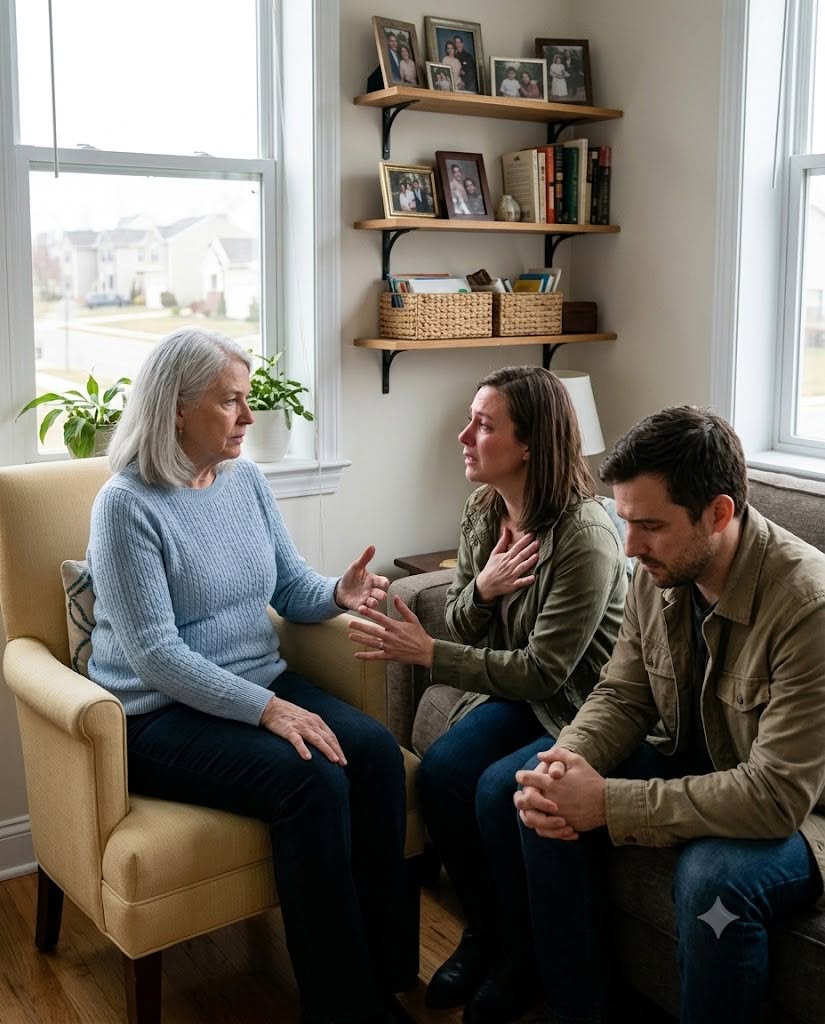
My daughter offered me a place to live in her basement for $800 a month out of my Social Security check. On top of that, I would have to babysit her children four days a week to “earn my keep.”
I thanked her politely.
Then I found a little two-room house of my own for just $550 a month.

I never imagined that such a small decision would expose a family secret—and change my relationship with my daughter forever.
It happened on a Saturday afternoon, shortly after lunch.
We were sitting around Michelle’s kitchen table when her husband, Todd, pushed a sheet of notebook paper toward me.
There was one number written in the center.
$800.
He had circled it twice.
“That covers your room, the bills, and part of the groceries,” Michelle explained. “And you’d watch the kids four days a week. That way, you’d be contributing something, Mom.”
Contributing something.
I was sixty-seven years old.
I had raised Michelle on the modest income her father earned as a hired farmhand. I had worked hard, stretched every dollar, and done my best to give her a good life.
This coming March would mark two years since my husband, Dale, passed away.
If he had been sitting beside me that afternoon, I knew exactly what he would have thought of that piece of paper.
But Dale was gone.
And I was sitting across from my only daughter, trying to understand when our relationship had become a business arrangement.
Todd stared at the salt shaker instead of looking me in the eye.
My monthly Social Security check was $1,640. I had spent twenty-two years handling accounts at the local lumberyard. I didn’t need a calculator to see what they were asking of me.
Nearly half my monthly income.
In return, I would get a basement room with one tiny window, barely larger than a cake pan, and a dehumidifier humming away in the corner.
“Could I take another look at the room?” I asked.
Michelle seemed relieved.
“Of course, Mom.”
We went down thirteen stairs to the basement.
The air smelled of damp cardboard and laundry detergent. The ceiling felt low, and the only window was so small that I wondered how much sunlight it ever let in.
My four-year-old granddaughter, Sadie, followed us downstairs.
“Grandma, are you going to sleep in the underneath?” she asked, looking around curiously.
“Maybe, sweetheart. We’ll see.”
She smiled and took my hand.
That little gesture nearly broke my heart.
I wanted to say no right then and there. I wanted to tell Michelle that I had not spent sixty-seven years working, raising a family, and caring for others just to become a tenant in my own daughter’s basement.
But refusing your only child while standing in her house is rarely as simple as it sounds.
I could already imagine the argument. Michelle would say I was being ungrateful. Todd would insist they were only trying to help. And somehow, I would end up apologizing for having feelings.
So I swallowed my disappointment and smiled.
“Thank you, honey. I’ll give it some thought.”
I folded Todd’s paper and slipped it into my handbag.
I didn’t have much time to decide.
I needed to leave the farmhouse before November first. The house had come with Dale’s job, and after his death, the Olson family had generously allowed me to stay for another two years.
Now their son was returning to run the farm with his wife and new baby.
They needed the house, and I couldn’t blame them.
Still, the thought of leaving the only home Dale and I had shared for so many years filled me with sadness.
On my way home that afternoon, I stopped at the feed store four blocks away.
For three weeks, I had noticed a handwritten sign beside the cash register.
Small house available. Two rooms and bathroom. Ask Brandt.
I had passed it several times without asking.
That day, something made me stop.
“Is that little house still available?” I asked Mr. Brandt.
He looked up from his paperwork.
“It is. Want to see it?”
We drove over together.
The house stood on a quiet street behind the grain elevator. It had white siding, a small porch swing, and just one step leading to the front door.
Harvest was underway, so a fine layer of corn dust coated the porch rail and windowsills.
It wasn’t fancy. The kitchen was small, the paint was faded, and the bathroom could use some work.
But it was clean.
And it was mine to rent.
Mr. Brandt scratched his head.
“It’s nothing special, Judy. I don’t want you expecting too much.”
I looked at the front entrance.
“It’s got its own door. That’s enough for me.”

He smiled.
“Rent’s $550 a month. Electricity is separate.”
I didn’t hesitate.
Standing beside the hood of my old Buick, I wrote the deposit check.
Mr. Brandt handed me two keys attached to a metal ring.
One opened the front door.
The other opened the back.
I held them in my palm for a long moment.
For the first time in my life, I had chosen a home entirely for myself. No one had assigned me a room. No one had calculated what I owed them. And no one had told me how many hours of childcare I needed to provide to deserve a place to sleep.
It was a little house.
But when I unlocked that front door, I felt something I hadn’t felt in months.
Freedom.
I moved my belongings in over the next few days, arranging Dale’s old armchair near the window and hanging our wedding photograph above the mantel.
The house was quiet, but it was peaceful.
I thought I had made my decision without hurting anyone.
I was wrong.
I waited nine days before telling Michelle. I know I should have spoken to her sooner, but I was afraid of hurting her feelings.
Then Todd happened to drive past my new place on his way to the plant. He recognized my Buick parked outside.
That evening, my phone rang.
It was Michelle.
“So you’d rather hand your money to a complete stranger than help your own family?”
Her words stung more than I expected.
I took a breath before answering.
“I’d rather be your mother than somebody paying rent to you.”
Silence.
Then she hung up.
For the next ten days, I heard nothing.
No calls. No messages. Not even a photograph of the grandchildren.
Every evening, I sat on my porch swing and watched the grain trucks line up to be weighed. Their engines rumbled in the distance, and the smell of harvest drifted through the cool air.
I had my own home.
My own keys.
My own front door.
But I missed Sadie and the other grandchildren so much that some nights I wondered whether independence was worth the loneliness.
I told myself I had done nothing wrong. Still, a mother’s heart has a way of questioning itself, even when her mind knows better.
Then, on a Thursday evening, just before supper, I heard a pickup pull up outside.
A door slammed.
Michelle climbed out of the passenger seat. Her eyes were swollen and red, as though she had been crying for hours.
Todd followed her toward the porch.
He was carrying a yellow legal pad.
The first page was covered from top to bottom in his handwriting.
I opened the screen door before they could knock.
Todd looked straight at me.
“Judy, I’m the one who came up with that $800 figure,” he said. “Michelle didn’t.”
I stood there, unsure what to say.
He walked inside, set the legal pad on my kitchen table, and turned it toward me.
“I owe you the truth,” he continued. “And I need you to hear the whole thing before you decide what kind of man I am.”
My stomach tightened.
“What truth, Todd?”
He lowered his eyes to the page.
“The money wasn’t really about rent.”
I stared at him.
“What do you mean?”
Todd took a shaky breath.
“Michelle and I have been in trouble financially for months. We fell behind on the mortgage, and we’ve been struggling to keep up with the bills. I thought if you moved in, the $800 would help us stay afloat.”

Michelle began to cry.
“I didn’t know he was going to ask for that much, Mom,” she whispered. “When he told me his plan, I thought it would be temporary. But I was afraid to argue with him. I was afraid we’d lose the house.”
Todd nodded, ashamed.
“I convinced myself it was reasonable because you needed somewhere to live. I told myself the basement was better than nothing, and that babysitting was just part of being family. I never stopped to think about how it would sound to you.”
He turned the legal pad around again.
This time, I noticed the figures beneath his confession.
A list of overdue bills. The mortgage balance. The money they had borrowed from a credit card. And, at the bottom, a number that made my breath catch.
$18,400.
“That’s how far behind we are,” Todd admitted. “I was trying to find a way out, and I made you part of a problem you never created.”
I looked at Michelle.
“Is that true?”
She wiped her cheeks and nodded.
“I should have stood up for you, Mom. Instead, I let you think I wanted to charge you for being part of our family. I’m sorry.”
For a long moment, no one spoke.
I felt sorry for them. I knew what it was like to worry about money, to lie awake wondering how to make everything stretch until the next paycheck.
But understanding their desperation didn’t mean I had to surrender my independence.
“I’m sorry you’re struggling,” I said gently. “But I can’t be the solution to every problem in your house. I’m your mother, not your bank account. And I won’t pay for the privilege of being Grandma.”
Todd nodded.
“You’re right.”
Then Michelle reached across the table and took my hand.
“I don’t want your money, Mom. I want you back in my life. I miss you. The kids miss you.”
I squeezed her fingers.
“Then let me be your mother again. Let me visit because I want to, not because I’ve paid for the right to be there.”
She broke down completely.
That evening, we talked for hours. Todd agreed to contact the mortgage company and work out a payment plan. Michelle began looking for ways to reduce their expenses, and they promised never to make decisions about my money or my living arrangements without my consent.
I didn’t offer them my savings. I didn’t move back into the basement. And I didn’t promise to babysit four days a week.
Instead, I offered to watch the children occasionally when I was available—and only when I wanted to.
It wasn’t a grand rescue. It wasn’t an instant solution to their financial troubles.
But it was an honest beginning.
Over the following weeks, Michelle started visiting every Sunday. Sometimes she brought the children. Sometimes she came alone, bringing a pie or a cup of coffee.
At first, our conversations were awkward. Trust doesn’t return just because someone apologizes.
But slowly, we began to find our way back to each other.
One afternoon, Sadie ran through my front door, threw her arms around my waist, and announced, “Grandma, your house is my favorite!”
I laughed and hugged her close.
“Mine too, sweetheart.”
As I watched her run toward the porch swing, I glanced at the two keys hanging beside my door.
They reminded me of the choice I had made that autumn—not to punish my daughter, not to prove a point, but to protect the little bit of independence I had left.
I had spent most of my life making sure everyone else had a place to belong.
At sixty-seven, I finally learned that I deserved one, too.
And the best part?
I didn’t have to pay $800 a month—or give away four days of my life every week—to earn it.
Because family should make room for you out of love, not send you a bill for belonging.