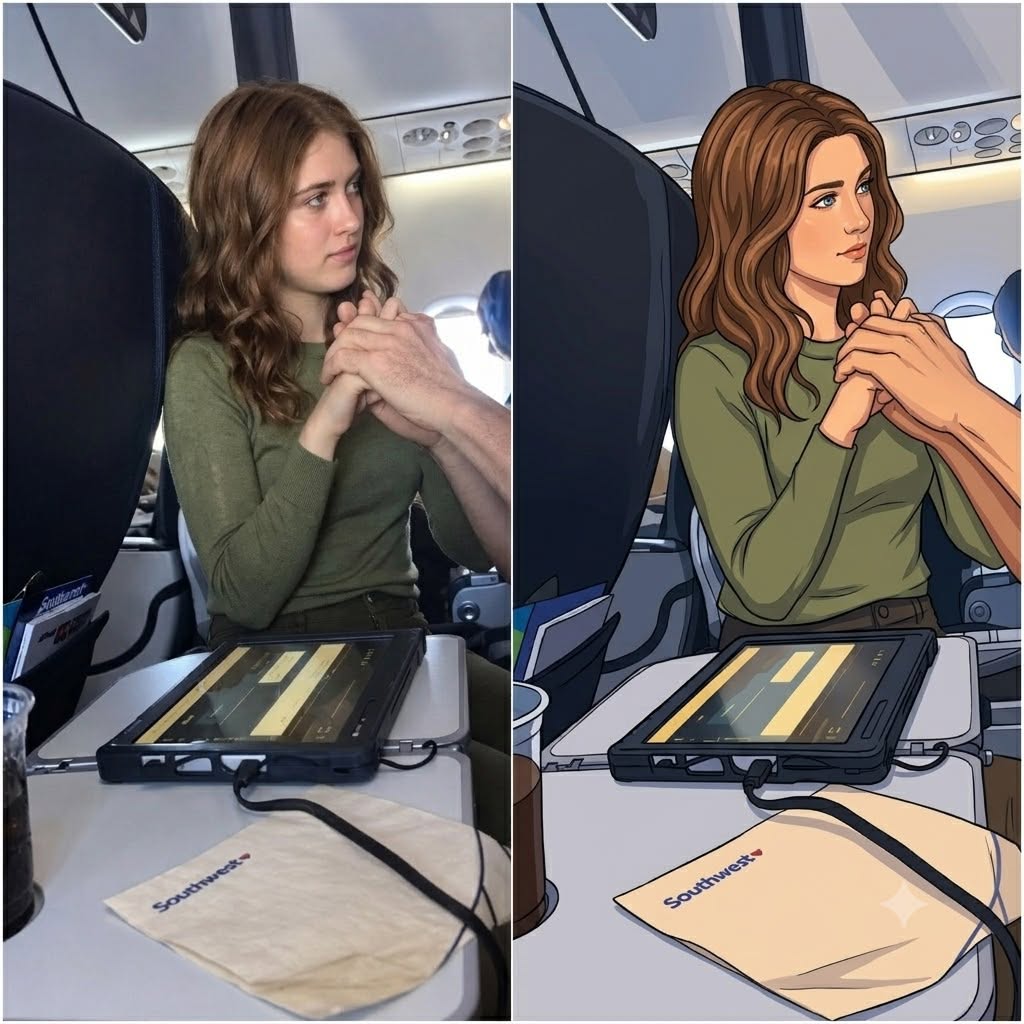
At Boston’s Logan Airport, an ordinary flight was about to become an unforgettable reminder of how much one small act of kindness can mean.
Among the passengers was a man named Tim, who was traveling with his sister. Tim was both deaf and blind, and watching them together was deeply moving. His sister communicated with him by gently tracing signs into the palm of his hand, allowing him to understand her through touch.
But once they reached the airport, Tim’s journey took a difficult turn.

His sister couldn’t accompany him for the rest of the trip, which meant he would have to navigate the flight on his own. For someone who couldn’t see or hear the world around him, even the simplest tasks could become overwhelming.
At first, Tim was assigned a middle seat. When the passenger sitting beside him in the aisle seat realized the situation, he immediately offered to switch places with him.
It was a small gesture, but it made a real difference.
With a little more room and easier access to the aisle, Tim could settle in more comfortably. The other passenger didn’t make a big deal of his kindness. He simply recognized that someone needed help and acted without hesitation.
Once the plane was in the air, the flight attendants did everything they could to make Tim comfortable.
They approached him gently and tried to communicate, but without a shared method of communication, even basic questions became difficult. Tim occasionally reached out to touch their hands, faces, or arms, trying to understand who was speaking to him and what was happening.
The attendants remained patient. Rather than pulling away or showing frustration, they allowed him to explore through touch and continued searching for a way to help him.
The man sitting beside Tim also began assisting him with small but important tasks. When Tim wanted coffee, his seatmate opened the creamer and helped add it to his drink. When Tim later tried to stand and find his way to the restroom, the man quickly got up to guide him safely.
No one was treating Tim as a burden. They were simply trying to make sure he didn’t have to face every challenge alone.
Still, one problem remained.

Despite everyone’s efforts, meaningful communication was almost impossible. The crew knew Tim might need something, but they couldn’t reliably ask him what he wanted or explain what was happening around him.
They began discussing possible solutions.
Then someone suggested making an announcement over the intercom to ask whether any passenger knew sign language.
The request went out across the cabin.
For a moment, nothing happened.
Then a 15-year-old girl named Clara stepped forward.
She wasn’t a professional interpreter. She was just a teenager traveling on an ordinary flight. But she had learned American Sign Language, or ASL, because her dyslexia had made it one of the easiest foreign languages for her to learn.
What she knew might not have seemed particularly important before that moment.
Now, it could change someone’s entire journey.
Clara approached Tim and gently introduced herself. She began spelling words into his palm, carefully forming each letter with her fingers.
At first, everyone watched quietly, unsure whether the attempt would work.
Then Tim responded.
He understood her fingerspelling.
The change was remarkable. After spending much of the flight struggling to communicate with the people around him, Tim finally had someone who could understand what he was trying to say.
Clara stayed beside him, patiently spelling words into his hand and giving him time to respond. Little by little, their conversation became more relaxed and animated.
Tim was no longer simply receiving help with practical tasks. He was participating in a real conversation.
He could ask questions, share his thoughts, and connect with another person.
For the first time on that flight, he wasn’t isolated by the communication barrier that had made everything so difficult.
And then came a moment that brought smiles to the people nearby.
Tim asked Clara whether she was pretty.
The unexpected question caught the teenager off guard. She blushed and laughed, clearly amused by his playful curiosity.
The passenger sitting beside Tim had also picked up a few signs during the flight. Eager to join in, he enthusiastically signed back that Clara certainly was!
The cabin filled with smiles and laughter.
What had begun as a stressful situation had turned into a moment of genuine human connection. Even passengers who couldn’t understand the conversation could sense the warmth between them.
Clara didn’t seem to mind the attention. She continued communicating with Tim, treating him naturally and warmly rather than making him feel different from everyone else.
That was what made her kindness so special.
She wasn’t simply helping a deafblind passenger get through a flight. She was giving him the opportunity to joke, ask questions, and share a moment with someone new.

For Tim, those moments mattered.
For the people watching, they offered a powerful lesson in empathy.
The flight attendants had shown extraordinary patience. The seatmate had helped with practical needs without hesitation. And Clara had stepped forward when the crew needed someone who could bridge the communication gap.
Each person had contributed something different, and together they had made a difficult journey much easier.
As the flight continued, Clara remained attentive to Tim, making sure he had someone to communicate with whenever he needed it. The cabin no longer felt like a place where he was struggling to make himself understood. It had become a place where strangers were willing to meet him halfway.
When the plane finally began its descent, the atmosphere had changed completely.
The passengers who had witnessed the encounter had seen something they were unlikely to forget. A simple announcement had brought an unexpected helper forward, and a language learned by a teenager for her own reasons had become a lifeline for someone who desperately needed it.
Before they parted ways, Clara had given Tim something that no seat change, cup of coffee, or helping hand could provide on its own: the feeling of being understood.
The story could have ended there, as a touching moment on an ordinary flight. But for those who witnessed it, the memory would last far longer than the journey itself.
Perhaps Clara never imagined that learning ASL would one day allow her to make such a difference. She may have thought of it as just another language she was good at.
Yet when the opportunity came, she didn’t hesitate to use what she knew.
And that is what made her actions so remarkable.
She was only 15 years old, but she understood something that adults sometimes forget. Kindness doesn’t always require money, special equipment, or grand gestures. Sometimes, it begins with noticing that someone is struggling and being willing to step forward.
The crew of Alaska Airlines deserved recognition for their patience and care. The seatmate deserved appreciation for his quiet generosity. And Clara deserved to be celebrated for using her knowledge to help someone feel less alone.
In a world where people often rush past one another, this flight became a reminder that compassion can bring strangers together in the most unexpected places.
Tim boarded a plane facing a difficult journey. He left that experience having shared laughter and conversation with people who had chosen to help him.
And Clara? She showed everyone on board that being young doesn’t mean being too young to make a meaningful difference.
Sometimes, the smallest act of kindness becomes the most unforgettable part of the journey.