I always believed that a family’s greatest responsibility was to protect its future.
To me, that meant raising children, passing down our values, and making sure the next generation had a better life than the one before it.
I had spent decades working hard and saving money. Every dollar had a purpose. I wanted to leave something meaningful behind when I was gone.

And I always assumed my only daughter, Emily, would eventually have children of her own.
But Emily had other plans.
For years, she had told me she didn’t want to become a mother. She wanted to continue her education, build her career, and experience life on her own terms. Whenever the subject came up, I convinced myself she would change her mind eventually.
After all, I thought, she was still young.
But as the years passed, her decision never changed.
Our latest argument began over dinner. I had been discussing my will and explaining how I hoped my savings would help support the family long after I was gone.
Emily listened quietly before saying, “Dad, I know what you want, but I need you to understand that I’m not going to have children. I’ve made peace with that decision.”
I put down my fork.
“Have you really thought about what that means for our family?”
She looked confused. “What do you mean?”
“Who will carry on the family name? Who will inherit what we’ve worked so hard to build?”
Emily sighed. “You can leave your money to me, and I can use it to build a meaningful life. Having children isn’t the only way to contribute to the world.”
Her answer frustrated me.
I had imagined grandchildren running through my house, celebrating holidays around my table, and eventually inheriting the things I had spent a lifetime accumulating. I wanted to see our family traditions continue.
Instead of admitting that I was afraid of losing that future, I turned my fear into anger.
“That money was saved for raising the next generation, not for your never-ending education,” I snapped.
The moment the words left my mouth, Emily’s expression changed.
She stared at me as though she no longer recognized the man sitting across from her.
“So that’s what I am to you?” she asked. “A disappointment because I don’t want children?”
“That’s not what I said.”
“It’s exactly what you meant.”

She stood, grabbed her coat, and walked toward the door.
Before leaving, she turned back one last time.
“You don’t want me to have a happy life. You want me to live the life you’ve chosen for me.”
Then the door slammed shut.
I remained at the table, telling myself that she was being unreasonable. I had worked too hard for my money to watch it go toward a future I didn’t believe in.
The following morning, I made a decision.
I contacted my attorney and changed my will.
Instead of leaving my estate to Emily, I named my niece, Sarah, as my primary heir. Sarah had two young children, and I convinced myself that the inheritance would serve its intended purpose by helping raise the next generation.
At first, the decision brought me a strange sense of relief.
I told myself I was being practical. I was protecting the future I had always envisioned.
But I hadn’t considered how quickly news traveled through a family.
About a week later, Emily learned what I had done through a cousin.
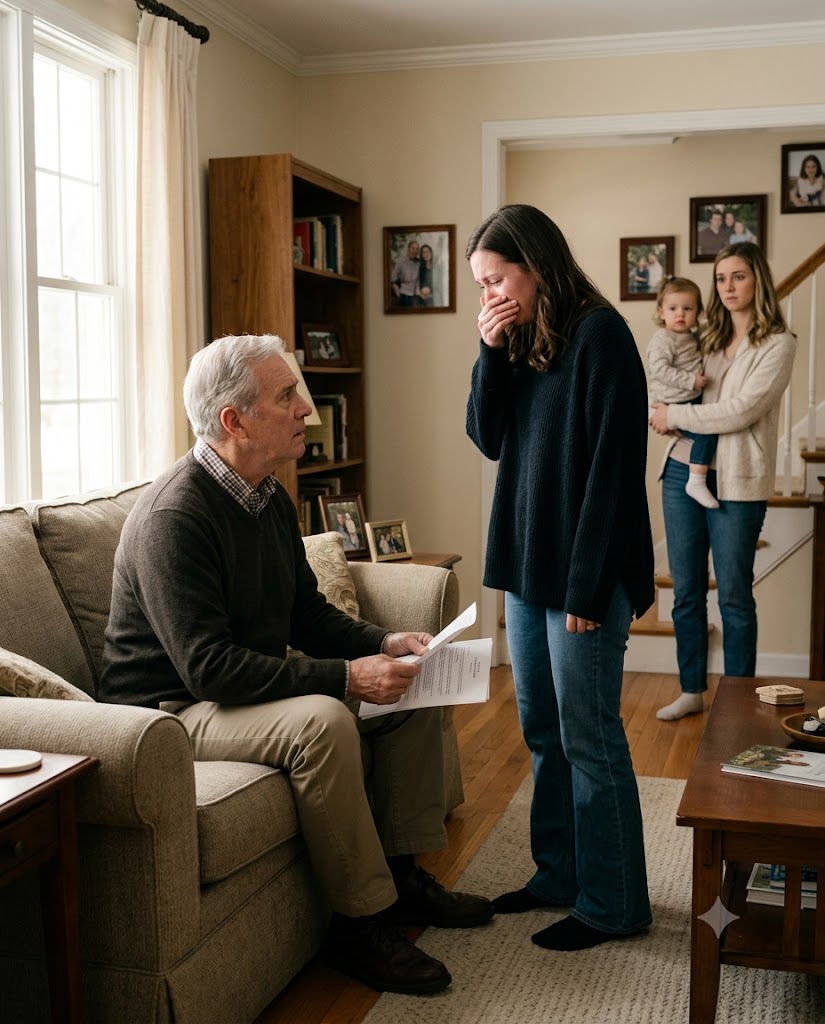
She came to my house without calling first. Her face was pale, and she held her phone tightly in one hand.
“Is it true?” she asked.
I knew immediately what she meant.
“I’ve made changes to my will.”
“You removed me completely?”
“I believe the money should go to someone who will use it to support the next generation.”
Emily stared at me in disbelief.
“You’ve made it clear that you don’t care about me unless I give you grandchildren.”
“That isn’t fair.”
“No, Dad. What’s unfair is making me feel as though I have to give birth to earn your love.”
I tried to explain that I wanted to preserve our family legacy, but she shook her head.
“You don’t want a daughter. You want someone to produce children so you can feel that your family name will survive.”
Her words cut deeply, partly because I wanted to deny them and partly because I couldn’t find an answer that made them untrue.
“I’ve given you everything I could,” I said.
“And I’ve never asked you to give me anything in return,” she replied. “I’ve only asked you to respect my choices.”
She told me that she had spent years trying to make me understand her decision. She had listened to my worries, answered my questions, and repeatedly reassured me that her choice wasn’t a rejection of our family.
Yet I had treated her future as a personal betrayal.
“I love you,” she said, her voice trembling. “But I can’t keep coming back to prove that I’m worthy of being your daughter.”
Then she left.
This time, she didn’t slam the door.
Somehow, that hurt even more.
In the days that followed, the house felt unbearably quiet. I kept expecting Emily to call, as she usually did, to tell me about work or ask whether I needed anything from the grocery store.
She didn’t.
Sarah eventually learned that I had named her in my will. Rather than celebrating, she called me, deeply uncomfortable.
“Uncle, I appreciate that you care about my children,” she said, “but I don’t want an inheritance that comes at the cost of your relationship with Emily.”
I tried to reassure her that I had made my own decision.
But Sarah continued.
“Having children doesn’t make someone more deserving of love. Emily is still your daughter. Why are you making her choose between her own future and your approval?”
I had no response.
For the first time, I began to wonder whether I had confused my hopes for the family with what my daughter actually owed me.
I had spent years saving money because I wanted to protect the people I loved. Yet I had turned that same money into a weapon, using it to punish the one person I had always claimed to be protecting.
I had imagined that my inheritance would preserve my family.
Instead, it had driven my daughter away.

One evening, I sat alone in my study and looked through old photographs. There was Emily at five, missing her front teeth. Emily at sixteen, proudly holding her school award. Emily at twenty-two, standing beside me after her university graduation.
In every photograph, I saw the same person.
My daughter.
Not a future mother. Not a carrier of our family name. Not a promise of grandchildren.
Just Emily, who had loved me long before she was old enough to understand what inheritance meant.
I finally understood that I had been so focused on the generation that might come after her that I had neglected the one already standing in front of me.
I still wished I could have grandchildren. That longing hadn’t disappeared overnight.
But it was my longing, not a debt Emily owed me.
I couldn’t demand that she build her life around my expectations. And I couldn’t use money to force her to make a choice she didn’t want.
I called my attorney again and asked to discuss my will. I hadn’t yet decided exactly how to distribute my estate, but I knew I could no longer treat inheritance as a reward for living the way I wanted.
Then I wrote Emily a letter.
I told her I was sorry for making her feel that my love depended on whether she gave me grandchildren. I admitted that I had allowed my fears about the future to overshadow the daughter I already had.
I didn’t ask her to change her mind about children.
I didn’t ask her to forgive me immediately.
I simply told her that I loved her, that her life belonged to her, and that I wanted to rebuild our relationship without conditions.
I mailed the letter and waited.
Emily didn’t respond that week.
Or the next.
But one Sunday afternoon, my phone rang.
It was her.
“Dad,” she said quietly, “I read your letter.”
I held my breath.
“I don’t know if I can forget what happened,” she continued. “But I don’t want to lose you either.”
My eyes filled with tears.
“You shouldn’t have to choose between being yourself and having a relationship with me,” I said. “I’m sorry I made you feel that way.”
We talked for nearly an hour. We didn’t solve everything, and she didn’t promise that we would return to the way things had been before.
But she agreed to have dinner with me the following weekend.
For the first time in weeks, I felt hope.
I still didn’t know what my family’s future would look like. Perhaps Emily would never have children. Perhaps the traditions I cherished would change or eventually disappear.
But I finally understood something I should have learned long ago.
An inheritance is only money and possessions. A family legacy is built through love, trust, and the way we treat the people who are already here.
I had spent my life trying to provide for a generation that might never exist.
In doing so, I nearly lost the daughter I already had.
And no amount of money could ever replace her.