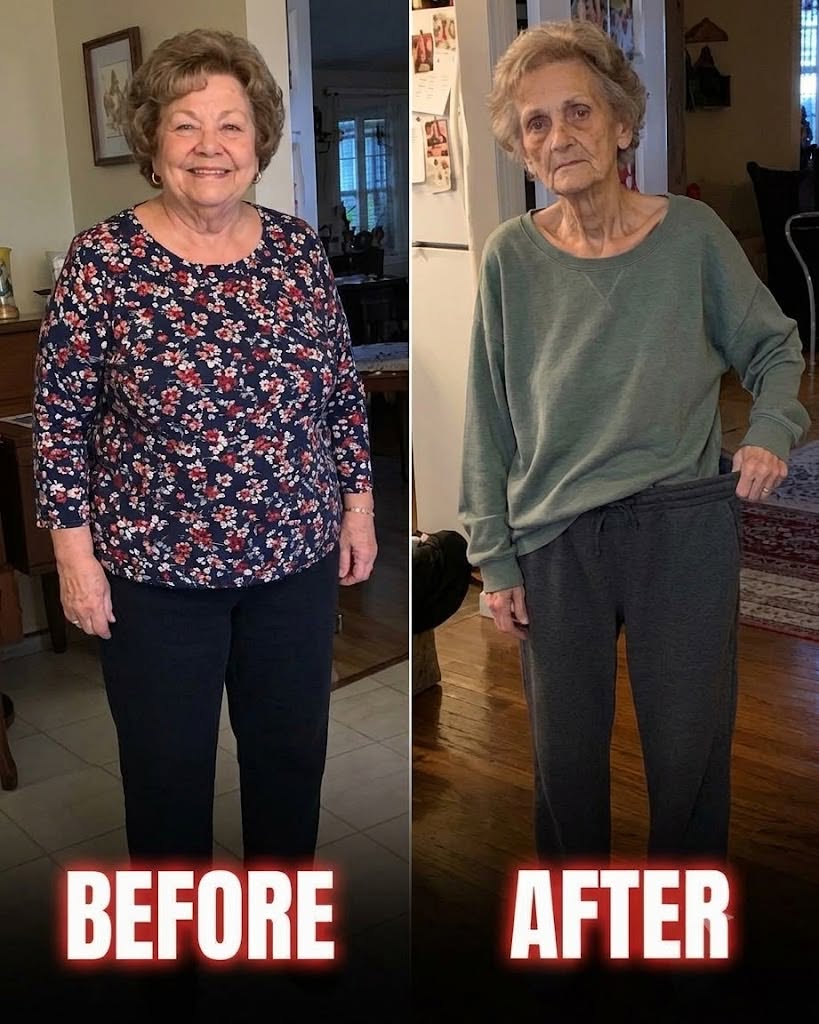
I knew something was wrong the moment I saw my mother at the train station.
At eighty, Evelyn was usually cheerful, a little round around the middle, and always ready with a joke. She loved baking pies, tending to her flowers, and filling my kitchen with the smell of freshly baked cookies every Sunday.
But the woman standing beside the platform bench looked like a stranger.

Her cardigan hung loosely from her shoulders. Her cheeks had become hollow, and even the way she stood seemed different, as though every movement required more energy than she could spare.
Beside her sat an enormous black suitcase.
“Mom?” I called, hurrying toward her.
She looked up and smiled faintly.
“There you are, sweetheart.”
I stopped in front of her, searching her face.
“What happened to you? You look terribly unwell.”
“Nothing serious,” she said. “My stomach has been bothering me a little.”
“You’ve lost so much weight. We’re going to the hospital.”
“No, Laura. I just want to go home.”
Her voice was gentle, but there was an unmistakable firmness beneath it.
I wanted to argue. Instead, I took the suitcase and helped her toward my car.
The bag was surprisingly heavy.
And it wasn’t the one she’d taken with her.
A week earlier, my mother had announced that she was visiting Margaret, her childhood friend. They had known each other since they were girls, but twenty years had passed since their last visit.
Margaret supposedly lived three hours away. Her daughter had invited Mom to stay for a week, and I had encouraged her to go.
“You deserve a little adventure,” I’d told her.
Mom had laughed and promised to bring back stories, photographs, and perhaps a new recipe.
She’d packed a small blue travel bag, her medication, and a tin of homemade cookies.
Before boarding the train, she gave me a telephone number.
“That’s Margaret’s number,” she explained. “Keep it in case you need to reach me.”
I saved it without thinking twice.
During the week, we spoke briefly on the phone. Mom always claimed she was having a wonderful time, but she never let me speak to Margaret. Whenever I asked what they’d been doing, she changed the subject.
At the time, I assumed they were simply enjoying their reunion.
Now, watching her struggle to climb the stairs at home, I began to wonder what had really happened.
“Where’s your blue bag?” I asked.
Mom tightened her fingers around the black suitcase handle.
“Margaret gave me this one. Mine broke.”
She carried it into her bedroom and shut the door.
Then she locked it.
My mother had never locked her bedroom during the day.
That evening, she barely touched the soup I prepared. I checked her temperature, brought her water, and asked again whether she would see a doctor.
“Tomorrow, perhaps,” she murmured.
I tried to smile.
“Mom, you’re worrying me.”
She reached across the table and squeezed my hand.
“I’m all right, darling. Just tired.”
But I couldn’t shake the feeling that she was hiding something.
After she went to bed, I called the number she’d given me.
A man answered.
“Hello?”
“Hi. I’m looking for Margaret. I’m Evelyn’s daughter.”
There was a pause.
“I’m afraid Margaret hasn’t lived here for eight years.”
I stared at my phone.
“I’m sorry. Could you repeat that?”
“Eight years. I’ve had this number for a long time.”
I thanked him and ended the call.
For several minutes, I sat motionless.
My mother had traveled for a week to visit someone who supposedly lived at an address where she hadn’t been for eight years.
The following morning, I found Mom asleep in her armchair.
Beside her lay a train ticket dated three days before I had collected her.
Underneath it was a luggage tag.
The name printed on it was Ellen.
Not Margaret.
Not Evelyn.
My hands began to tremble.
I looked toward the hallway. The black suitcase stood beside my mother’s dresser, and her bedroom door was open.
I knew I shouldn’t search through her belongings.
But she was visibly ill, her story didn’t make sense, and I was terrified that something had happened to her.
I carried the suitcase into the hallway and opened it.
Inside were neatly folded clothes, a sealed brown envelope, and an old digital camera. Beneath the clothes lay a faded yellow child’s sweater and a small wooden rolling pin.
I recognized the rolling pin immediately.
I had owned one just like it as a little girl.

My mother used to let me stand on a kitchen chair and roll dough while she baked. For years, I had assumed those memories belonged entirely to our own kitchen.
Why was something so familiar inside a stranger’s suitcase?
I picked up the camera.
Its battery was almost empty, but four photographs remained.
The first showed my mother outside a modest brick house.
The second showed her sitting beside a frail elderly woman.
The third captured a handwritten schedule attached to a refrigerator, with meal times, medication reminders, and instructions for helping someone move safely.
Then I opened the final photograph.
It showed an old printed picture of a woman standing outside a little white house, holding a toddler in a yellow sweater.
I recognized the child.
It was me.
And the woman holding me was someone I hadn’t thought about in decades.
“Aunt Maggie,” I whispered.
She hadn’t been my aunt by blood. When I was small, my mother had introduced her as a close family friend. She lived nearby and often watched me while Mom worked.
Then, one day, she was simply gone from our lives.
I’d assumed she’d moved away permanently.
At the bottom of the photograph was an address.
I knew the street.
Without waking my mother, I grabbed my car keys and drove there.
The little white house was still standing, although its porch had changed. I knocked on the door, but the man who answered knew very little about the previous owner.
He confirmed that Margaret had once lived there, but she had moved away years ago.
I returned to my car and studied the other photographs again.
The brick house in the first image had a street number beside its front door. I entered the address into my phone.
Three hours away.
That was where my mother had gone.
And if Margaret was the woman I’d once called Aunt Maggie, I needed to know why Mom had concealed the truth.
When I returned home, Mom was awake at the kitchen table.
The black suitcase stood beside her chair.
“You opened it,” she said quietly.
“I did. I’m sorry, but I was frightened. Who is Aunt Maggie?”
My mother went completely still.
“Where did you hear that name?”
“I remember her. I remember the white house, the kitchen, and the little wooden rolling pin. Why didn’t you tell me she was Margaret?”
Mom lowered her eyes.
“Because I didn’t think you’d remember.”
I sat opposite her.
“Mom, I remember her holding me in that photograph. I remember baking with her. What happened?”
For a long moment, she said nothing.
Then she began to cry.
“Your father had just left,” she finally whispered. “You were four years old. I was working two jobs, and I had no idea how I was going to manage everything.”
I knew my father had abandoned us when I was young. But I’d never understood how difficult those years had been for my mother.
“Margaret lived nearby,” Mom continued. “She looked after you while I worked evenings. Sometimes you stayed at her house. She fed you, taught you your letters, and made little pies with you.”
“For how long?”
“Almost two years.”
I stared at her.
Two years of my childhood had been shaped by a woman I had nearly forgotten.
“Why did you stop seeing her?”
Mom rubbed her hands together.
“I became ashamed. She was always helping me, and I felt as though I couldn’t take care of my own daughter.”
“So you stopped calling?”
“Gradually. I missed visits. I let weeks pass without contacting her. Eventually, too much time had gone by, and I didn’t know how to make things right.”
“Did she ever blame you?”
Mom shook her head.
“No. That was the worst part. She never made me feel guilty. I was the one who couldn’t forgive myself.”
I glanced at the suitcase.
“Then why did you visit her now?”
My mother took a shaky breath.
“Her daughter, Ellen, contacted me. Margaret had recently been in the hospital, and she needed help at home. Ellen was working and struggling to manage everything herself. When she asked if I could come for a few days, I thought it was my chance to finally do something for Margaret.”
“Mom, you’re eighty years old yourself!”
“I know.”
“You could barely stand at the station.”
“I didn’t realize how exhausting it would be.”

She explained that Margaret needed assistance with meals, medication, and ordinary daily activities. Mom had stayed awake listening for her during the night. She had skipped meals when she was too tired to eat and tried to do more than her body could manage.
By the fourth day, she felt sick and could hardly keep food down.
She had even bought a ticket home.
“But when I was about to leave, Margaret had a difficult morning,” she confessed. “Ellen was at work. I couldn’t bring myself to walk away when she needed someone.”
“So you stayed.”
“I thought I could manage a little longer.”
Her voice broke.
“I wanted to repay her for everything she’d done for us.”
I reached across the table and held her hand.
“Mom, friendship isn’t a debt. You don’t have to make yourself sick to prove how grateful you are.”
She covered her face and wept.
For the first time, I understood that the suitcase hadn’t contained a sinister secret. It held the remains of a friendship that had quietly shaped both our lives.
But understanding her reasons didn’t make her condition any less serious.
When Mom suddenly became dizzy and struggled to stand, I took her to the hospital. The doctors found that she was dehydrated and severely weakened. They monitored her condition, treated the dehydration, and advised her to rest and attend follow-up appointments.
She finally agreed to let me help.
A few days later, I opened the brown envelope.
Inside were old photographs, birthday cards, and letters exchanged between Mom and Margaret decades earlier.
One letter, written by my mother when I was five, caught my attention.
She had thanked Margaret for giving me a safe place to stay when she had been forced to work late. She had apologized repeatedly for needing so much help.
Margaret’s reply was simple.
You haven’t failed your daughter. You’ve worked hard to give her a good life. Please stop apologizing for letting me love her.
I read the words twice.
Then I looked at Mom.
“She understood,” I said.
My mother nodded.
“She always did. I just couldn’t understand it myself.”
Two weeks later, after Mom had recovered enough to travel, I drove her to Ellen’s house.
This time, she wasn’t going alone, and she wasn’t expected to care for anyone by herself.
When Margaret saw us, her face brightened.
“Laura?”
I crossed the room and embraced her.
The familiar scent of vanilla brought back memories I hadn’t realized I still carried.
“You used to let me eat pie dough,” I told her.
She laughed.
“You used to steal it!”
Mom sat beside her and took her hand.
They talked for hours, remembering the years they’d lost and the friendship neither had truly forgotten.
Before we left, I thanked Margaret for everything she had done for us.
She shook her head.
“Your mother worked hard. I simply helped when she needed me.”
“That wasn’t a small thing,” I replied.
She squeezed my hand.
“No,” she admitted. “I suppose it wasn’t.”
Over the following months, Ellen arranged additional support for Margaret, and Mom visited only when she was well enough. I made sure she ate properly, rested, and never felt she had to prove her worth through sacrifice.
Our Sunday dinners continued.
The difference was that Mom no longer had to bring an entire meal every week. Sometimes she brought a recipe instead, and we baked together in my kitchen.
One afternoon, my daughter began rolling dough with the little wooden rolling pin Margaret had preserved.
Mom watched her carefully.
“Not so hard,” she advised.
My daughter giggled.
“You sound just like Grandma Maggie!”
Mom looked at me, then smiled.
For twenty years, she had believed she owed her old friend a debt she could never repay. But Margaret had never wanted repayment.
She had wanted her friend back.
And the black suitcase my mother brought home contained something far more precious than clothes and photographs.
It held the proof that even after years of silence, love could still find its way home.
Sometimes, the people who once helped us through our hardest years don’t need us to repay them. They simply need us to remember that we were never alone.