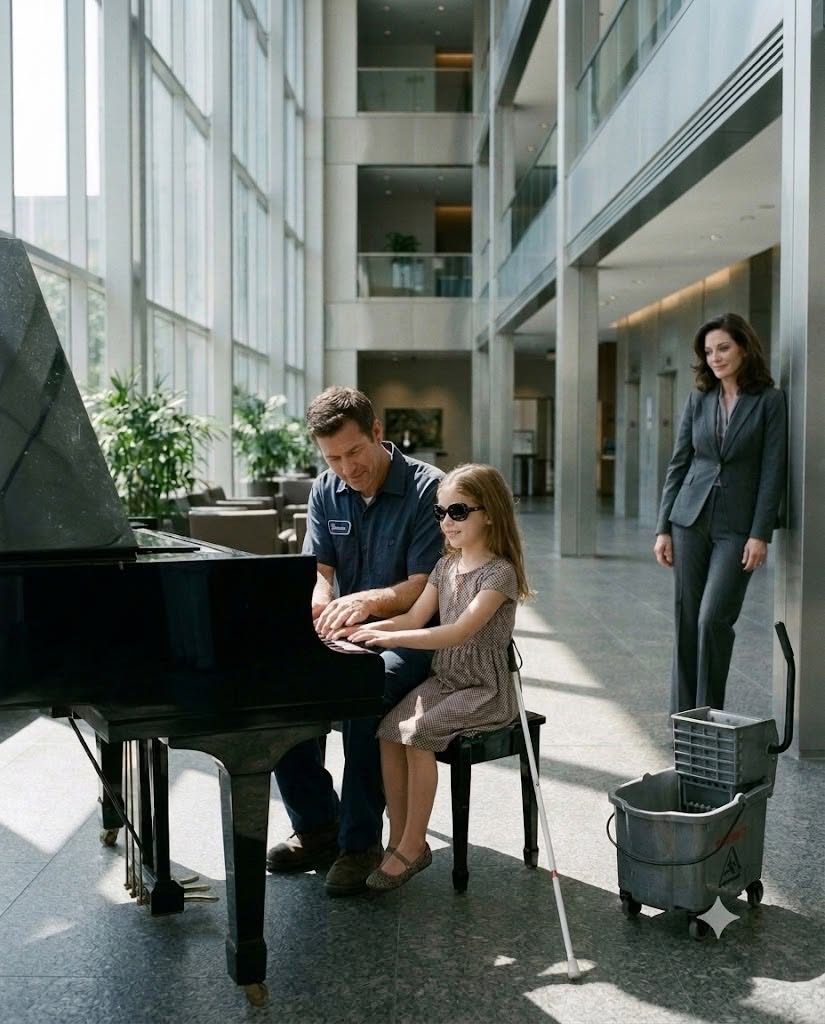
Late at night, the 20th floor of the Helios Group building was almost completely silent.
The offices were dark. The elevators stood idle. Only the soft sound of a mop moving across the marble floor broke the silence.
Jack Rowan, a 42-year-old janitor, was finishing his shift when he heard something unusual.
Piano music.
The notes were clumsy and disconnected, coming from the music room at the end of the hallway.
Jack stopped mopping.

He hadn’t touched a piano in ten years.
Yet something about that imperfect melody made him put down his mop and walk toward the sound.
Inside, a little girl sat at the grand piano. She couldn’t have been more than nine years old. Her eyes stared straight ahead without focusing on anything. Her small fingers moved cautiously across the keys, searching for the right notes.
She was blind.
Jack stood quietly in the doorway, listening.
The melody sounded familiar.
Clair de Lune.
He recognized the piece immediately, even though several notes were missing.
The girl sighed in frustration.
“I wish I could make it sound right.”
Jack hesitated before stepping inside.
“May I join you?”
The girl turned toward his voice.
“Who are you?”
“Jack. I work downstairs.”
“Are you a musician?”
Jack glanced at his worn uniform.
“Not anymore.”
She tilted her head.
“What does that mean?”
“It means I used to play.”
“Then you must know how to fix my song!”
Her enthusiasm caught him off guard.
Jack approached the second piano in the room and slowly sat down. His fingers hovered above the keys.
For ten years, he had avoided this moment.
He had convinced himself that music belonged to another life, one that had ended the night he lost his wife.
But the little girl was waiting.
So Jack took a breath and began to play.
The melody flowed effortlessly from his hands. The missing notes fell into place, and the room filled with the delicate beauty of Debussy’s music.
The girl sat perfectly still.
When the final note faded, she whispered, “It sounds like the ocean.”
Jack smiled faintly.
“That’s a beautiful way to describe it.”
“I’ve never seen the ocean,” she said. “But I imagine it sounds like that. Something big and beautiful that never stops moving.”
Jack felt a familiar ache in his chest.
“What is your name?”
“Lily.”
“That’s a beautiful name.”
She touched the silver bracelet on her wrist.
“My dad used to call me his little melody.”
Jack noticed the inscription engraved on the bracelet.
Hear with your heart.
“Did your father give you that?”
Lily nodded.
“Before he left.”
Jack almost asked what had happened, but something in her voice stopped him.
He knew what it meant to carry a loss that other people didn’t understand.
Instead, he asked, “Would you like me to teach you that song?”
Lily’s face brightened.
“Really?”
“Really.”
And just like that, Jack Rowan began playing the piano again.
He had no idea that a woman standing behind the half-open door had heard every note.
She wore a white designer suit and held a leather briefcase against her chest.
Her name was Victoria Hayes, CEO of Helios Group.
And she was Lily’s mother.
Tears streamed down her face as she listened to the stranger playing the song her daughter had been trying to master for months.
For the first time in years, Lily was smiling while playing music.
Victoria quietly stepped away before either of them noticed her.
She needed a moment to understand what she had just witnessed.
Because Jack Rowan wasn’t simply playing a piano.
He was reaching a part of her daughter that Victoria had been desperately trying to reach herself.
Ten years earlier, Jack had lived an entirely different life.
He had been a talented pianist in a military orchestra, performing at official ceremonies and special events. Music had been his passion since childhood, and his wife, Sarah, had been his greatest supporter.
She never missed a performance.
No matter how crowded the auditorium was, Jack always searched for her face in the front row.
She would smile at him, and suddenly the entire room seemed to disappear.
Then came the accident.
One rainy night, a drunk driver ran a red light and struck Sarah’s car.
She never made it home.
Jack remembered the hospital corridor, the harsh white lights, and the unbearable silence after the doctor delivered the news.
For months, he couldn’t bring himself to enter their living room. The piano they had saved for together remained untouched beneath a sheet.
Eventually, he stopped performing altogether.
He took whatever work he could find, eventually becoming a janitor at Helios Group.
The job paid enough to support his daughter, Emma, who was now twelve. It offered steady hours and little attention from others.
That was exactly what Jack wanted.
He had learned to survive by keeping his head down and his feelings buried.
Until Lily.
The following evening, Jack returned to the music room after finishing his shift.
Lily was already waiting.
“Uncle Jack!”
She recognized his footsteps before he even reached the piano.
“You came back!”
“I promised I would.”
They practiced scales, arpeggios, and the difficult passages that had frustrated her the night before.
Lily learned quickly. She had an extraordinary ear and could remember melodies after hearing them only a few times.
But she struggled with one particular passage.
“I can’t get it right,” she complained, pressing her lips together.

Jack sat beside her.
“Don’t fight the music, Lily.”
“But my fingers keep getting lost.”
“Then don’t think about where your fingers should go. Think about where the music wants to take you.”
He guided her hands gently across the keys, teaching her to recognize the distance between notes through touch.
“Music isn’t just about hitting the right keys,” he explained. “It’s about feeling the space between them.”
Lily tried again.
This time, the melody flowed a little more smoothly.
She broke into a delighted smile.
“I did it!”
“You did.”
Behind the door, Victoria watched again.
She had returned early from a meeting, hoping to understand why her daughter had suddenly become so eager to come to work.
Now she knew.
Every night, while Victoria sat in her office answering emails and making business decisions, Jack was giving Lily something money had never been able to buy.
Hope.
Victoria began asking discreet questions about him.
She learned that he was a single father who worked nights, rarely complained, and had never asked the company for special treatment.
She also discovered that he had once performed with a military orchestra.
Yet when she asked why he had stopped, no one could give her an answer.
Victoria could have summoned him to her office immediately.
Instead, she continued watching from a distance.
She wanted to understand the man who had helped her daughter without knowing who she was.
Weeks passed.
Lily’s playing improved dramatically.
Jack taught her how to listen for changes in rhythm, how to recognize chords, and how to turn mistakes into part of the learning process.
He never treated her blindness as a limitation.
Whenever she became discouraged, he reminded her that every musician had something to overcome.
“You don’t need to see the keys to make them beautiful,” he told her one evening. “You need to trust yourself.”
Lily remembered those words.
One night, she asked him a question.
“Uncle Jack, why did you stop playing?”
His hands went still.
For a long moment, he stared at the keys.
“My wife died in an accident,” he finally said. “She loved hearing me play. After she was gone, every song reminded me of her.”
Lily reached across the piano and gently touched his hand.
“My dad died, too.”
Jack turned toward her.
“He was sick,” she continued. “Mom says he wanted me to keep playing because music was the one thing that made me happy even when I couldn’t see.”
Jack swallowed hard.
“Then I think your dad would be very proud of you.”
Lily smiled, but her eyes filled with tears.
“Sometimes I worry that I’ll forget his voice.”
Jack thought of Sarah, whose laughter he could still remember but whose voice was becoming harder to recall.
“That’s why we keep the things they taught us alive,” he said softly. “Not because we can stop time, but because love doesn’t disappear when someone is gone.”
Outside the room, Victoria covered her mouth.
She had spent years trying to protect Lily from grief. She had filled their home with expensive toys, hired specialists, and arranged the best education money could provide.
But she had rarely spoken openly about Lily’s father.
Every time Lily asked a question, Victoria had worried that answering it would reopen an old wound.
Now she realized that her silence had left her daughter alone with questions she didn’t know how to ask.
And a man in a janitor’s uniform had helped Lily speak about her grief in a way she had never managed to do herself.
That night, Victoria made a decision.
She would stop hiding behind her office door.
The next evening, Jack was halfway through a lesson when the music room door opened.
He turned, startled.
Victoria Hayes stood in the doorway.
“Mr. Rowan,” she said. “May I speak with you?”
Jack immediately stood.
“Of course, ma’am.”
He assumed he had violated a company policy. Perhaps he had used the piano without permission, or stayed on the floor after his shift.
“I apologize if I’ve been somewhere I shouldn’t be.”
Victoria shook her head.
“You have nothing to apologize for.”
She looked at Lily, whose face had already broken into a smile.
“Mom! Uncle Jack taught me the whole song!”
“I heard.”
Victoria’s voice trembled slightly.
“I’ve been listening for weeks.”
Jack looked surprised.
“You have?”
Victoria nodded.
“I’ve watched you teach my daughter. I’ve seen her become more confident, more hopeful, and more willing to talk about her father.”
She paused.
“I want to thank you.”
Jack shifted uncomfortably.
“She has a natural gift. I’m only helping her discover it.”
“No,” Victoria replied. “You’re doing much more than that.”
She told him how Lily had struggled with loneliness after her father’s death. How the best tutors had focused on technique, but none had managed to make her enjoy music again.
“You never asked for anything,” Victoria said. “You didn’t even know who she was.”
Jack glanced at Lily.
“She was a little girl who wanted to learn a song.”

For a moment, Victoria couldn’t speak.
Then she offered him a position as Lily’s personal piano instructor, with a salary that would allow him to leave his night job if he wished.
Jack looked at the offer, then slowly shook his head.
“I’m grateful, but I can’t accept money for something I promised to do.”
Victoria studied him.
“Even if that money could make life easier for your daughter?”
That stopped him.
She continued gently.
“This isn’t charity, Mr. Rowan. You’re a talented musician, and Lily deserves a teacher who understands her. I would be paying you for your time and skill.”
Jack thought of Emma’s school expenses, the repairs his old car needed, and the bills that seemed to arrive faster than he could pay them.
For years, he had worked himself exhausted because he believed that was what being a good father required.
Perhaps accepting help wasn’t the same as failing.
He looked at Lily.
She was waiting quietly, her hands resting on the keys.
“I’ll accept,” he said at last. “But I have one condition.”
Victoria raised an eyebrow.
“What is it?”
“I want Lily to keep learning because she loves music. Not because anyone expects her to become a famous pianist.”
Victoria smiled through her tears.
“Agreed.”
Three months later, Helios Group hosted a charity concert to raise funds for music education for children with disabilities.
Victoria had arranged for Lily to perform.
When Jack learned about it, he worried that the pressure might overwhelm her.
“You don’t have to do this,” he told Lily during their final rehearsal. “There’s no shame in being nervous.”
Lily shook her head.
“I want to do it.”
She touched the silver bracelet on her wrist.
“My dad would have wanted me to try.”
Jack smiled.
“Then we’ll do it together.”
On the evening of the concert, the auditorium filled with executives, musicians, journalists, and families.
Victoria sat in the front row.
Jack stood backstage beside Lily, adjusting the cuffs of his borrowed black suit.
He hadn’t performed in front of an audience in ten years.
His hands were trembling.
Lily reached for him.
“Uncle Jack?”
“Yes?”
“Are you nervous?”
“A little.”
She smiled.
“Then remember what you taught me. Feel the music.”
Jack laughed softly.
“You’re right.”
When they walked onto the stage, the audience applauded.
Lily sat at the grand piano. Jack took the seat beside her.
For a moment, the room fell silent.
Then they began to play Clair de Lune.
The first notes were delicate and uncertain. Gradually, the melody grew stronger, filling the auditorium with warmth and emotion.
Lily’s fingers moved confidently across the keys.
Jack followed her rhythm, supporting her when the passage became difficult.
She didn’t need to see the audience.
She didn’t need to see the lights.
She was listening with her heart.
As the final notes faded, the auditorium remained silent for a brief moment.
Then the audience rose to its feet.
Victoria stood among them, crying openly.
Jack looked across the room and saw Emma sitting beside her, clapping with tears in her eyes.
For the first time in ten years, he had performed in front of an audience without feeling that he was betraying the memory of his wife.
Instead, he felt as though Sarah’s love had followed him back to the piano.
After the concert, Victoria approached him backstage.
“You gave Lily something extraordinary,” she said.
Jack shook his head.
“She reminded me that I still had something to give.”
Victoria smiled.
“Then perhaps we helped each other.”
In the months that followed, Jack continued teaching Lily while helping establish a music program for children with visual impairments. Victoria funded the program, but Jack helped design its lessons around touch, sound, and confidence rather than sight.
He also began performing again, starting with small charity events before eventually joining a community orchestra.
And at home, Emma noticed something she hadn’t seen in years.
Her father was smiling more.
One evening, she found him sitting at their old piano, playing a melody her mother used to love.
“Dad,” she whispered. “I thought you didn’t play anymore.”
Jack turned toward her.
“I thought so, too.”
Emma sat beside him and leaned her head against his shoulder.
“Mom would be happy.”
Jack closed his eyes.
For the first time, remembering Sarah didn’t feel like reopening a wound.
It felt like hearing a familiar song.
A year earlier, Jack had been an invisible man cleaning empty offices long after everyone else had gone home.
He had believed his life as a musician was over.
Then he heard a little girl struggling to play a melody.
He sat beside her, thinking he was giving her a lesson.
He never imagined that she would help him find his way back to the person he used to be.
And Victoria Hayes, the powerful CEO who had stood silently behind a half-open door, learned something no business success had ever taught her.
Sometimes, the person who changes your child’s life isn’t the wealthiest person in the room.
Sometimes, he’s the man everyone walks past without noticing.
And sometimes, the most beautiful music begins when two broken hearts finally find the courage to play again.