When my father passed away, I thought the hardest part would be learning how to live without him.
I was wrong.
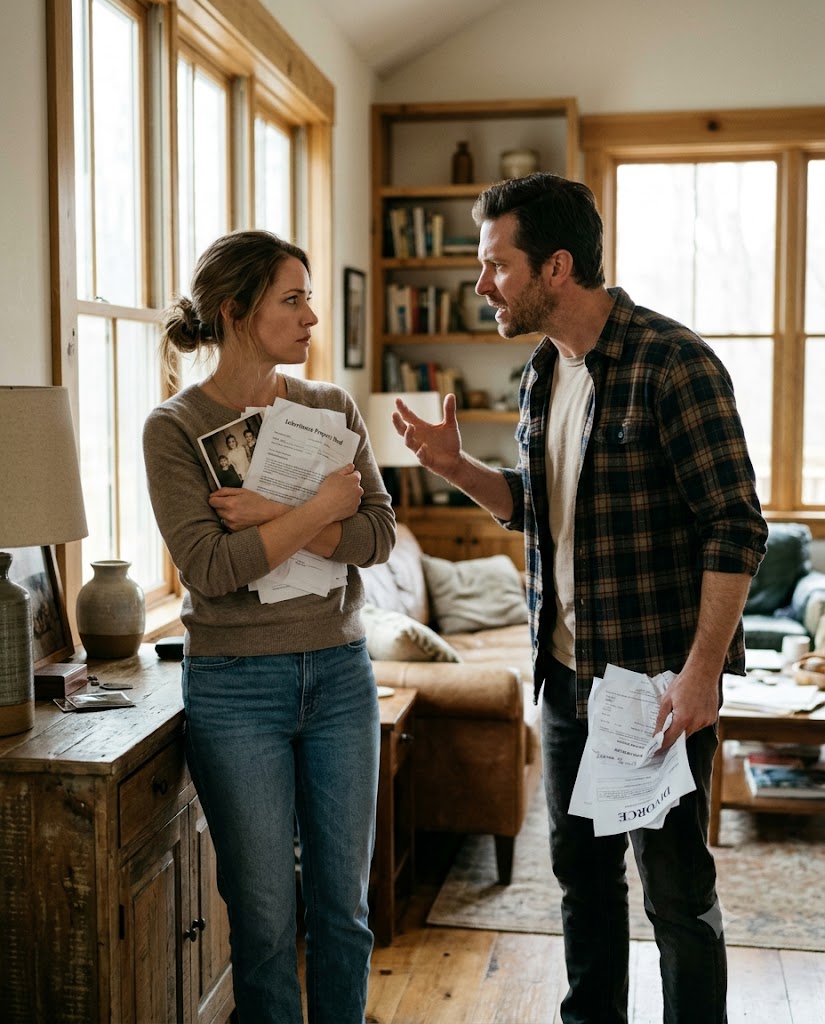
The hardest part began when I inherited his house—and discovered that my husband believed marriage gave him the right to claim half of it.

My name is Georgia. For seven years, my husband, Daniel, and I had lived in a small studio apartment in New York. It was cramped, expensive, and far from the comfortable life we had imagined when we first got married. Our bed sat only a few steps from the kitchen. We had to squeeze past each other to open the closet, and every winter, cold air slipped through the old windows.
Still, it was our home.
We paid the rent together, split the bills, and tried to save whatever money we could. We often talked about buying a house someday, somewhere we could have more space and finally stop worrying about rent increases.
My father knew how much we wanted that.
His house was where I had grown up. It had a small garden, a wide front porch, and a kitchen where my mother used to bake on Sunday mornings. After she died, my father kept everything almost exactly the same. He said the house held too many memories to change carelessly.
Before he passed away, he told me something I would never forget.
“Take care of that house, Georgia. It’s more than bricks and wood. It’s part of our family.”
I promised him I would.
When the inheritance was settled, I stood alone in the living room, holding the keys in my hand. I cried as I ran my fingers over the familiar furniture and looked out at the garden.
For the first time in years, I felt that the future might finally become easier.
Daniel hugged me when I told him we could move into the house.
“No more tiny apartment,” he said, smiling. “No more throwing money away on rent. We can finally start our life properly.”
I was happy. I imagined us eating breakfast on the porch, planting flowers in the garden, and inviting friends over without worrying that there wouldn’t be enough room.
Then, a few days later, Daniel brought up something I hadn’t expected.
“We need to talk about the ownership papers,” he said over dinner.
I looked up from my plate. “What about them?”
“I think my name should be added to the deed.”
I assumed I had misunderstood him.
“Why?”
“Because we’re married, Georgia. We’re moving into the house together. It should belong to both of us.”
I put down my fork.
“The house belonged to my parents. My father left it to me.”
“And I’m your husband,” he replied. “What’s yours is mine, and what’s mine is yours. That’s what marriage means.”
I understood the idea of sharing a life. Daniel and I had shared rent, groceries, responsibilities, and difficult years. But this house was different. It wasn’t something we had purchased together. It was an inheritance from my father, something deeply personal that I had promised to protect.
“I want us to live there together,” I told him. “But I don’t want to change the ownership.”
His expression hardened.
“So you want me to live in your house like a tenant?”
“No. I want you to live there as my husband.”
“Then why won’t you put my name on it?”
“Because I don’t believe loving you means I have to give up sole ownership of something my father left me.”
Daniel pushed his chair back.
“That’s a convenient way to look at marriage when you’re the one getting the property.”
I was stunned by his words. Until that moment, I had believed we were simply discussing a difficult decision. Now it felt as though he was questioning my love for him because I had refused to give him a legal share of my inheritance.
We argued for nearly an hour. I explained that I wasn’t trying to exclude him from our home. I wanted us to build a life there, maintain the property together, and make decisions as a couple. But I wasn’t comfortable changing the deed simply because he demanded it.
Daniel refused to listen.
Finally, he said something that made my heart sink.
“If you’re going to treat me like a stranger, then you can pay me back half the rent we’ve paid over the last seven years.”
I stared at him.
“What?”
“You heard me. I’ve spent seven years paying rent for a place that wasn’t mine. If you’re going to claim that your house belongs only to you, then I want my half of the money back.”
I couldn’t believe what I was hearing.
We had both lived in that apartment. We had both used it as our home. We had both agreed to pay the rent because we needed somewhere to live. Neither of us had treated those payments as a loan.
“You can’t suddenly turn our living expenses into a debt because I won’t give you part of my inheritance,” I said.
Daniel’s face turned red.
“Then maybe we have a bigger problem than the house.”
He walked away without finishing dinner.

That night, I barely slept. I kept replaying our conversation, wondering whether I had been selfish. Was I being unfair by refusing to add his name? Was this simply a disagreement about what marriage should mean?
But another thought kept returning.
If I agreed because I was afraid of losing him, would I ever be able to say no to him again?
The following morning, Daniel barely spoke to me. He left early and didn’t return until that evening. When he finally came home, he placed his phone on the table and announced that he had spoken to a lawyer.
My stomach tightened.
“About what?”
“About my options. If you insist on keeping the house entirely in your name, I may have to reconsider this marriage.”
He said it calmly, as though he were discussing an ordinary household expense.
I felt something inside me shift. I had expected anger, perhaps a few days of silence. I hadn’t expected my husband to use the possibility of divorce to pressure me into giving him a share of my father’s house.
“Are you threatening to leave me unless I put your name on the deed?” I asked.
“I’m telling you that marriage requires fairness.”
“And you think fairness means I owe you half a house you never paid for?”
“I think it means you shouldn’t make major decisions without considering me.”
“I am considering you. That’s why I want us to discuss how we’ll live there. But considering you doesn’t mean I have to agree to everything you demand.”
For a moment, neither of us spoke.
Then Daniel picked up his phone and walked into the bedroom.
I sat at the table for a long time, staring at the empty chair across from me. The house that had brought me so much hope was suddenly at the center of a battle I had never wanted.
The next day, I contacted an independent property lawyer. I wanted to understand my options before making any decisions under pressure. I brought the inheritance documents and explained everything, including Daniel’s demand for half of our rent.
The lawyer listened carefully.
She explained that property and inheritance rules could depend on the circumstances and the law that applied. She advised me not to sign anything without understanding its consequences and to obtain clear, independent legal guidance before making decisions about the house.
Most importantly, she told me not to confuse a marital disagreement with an obligation I had never agreed to.
I left her office feeling calmer. I still loved Daniel, but I no longer believed I had to surrender something important simply to prove it.
That evening, I asked him to sit down with me.
“I want us to have a future together,” I began. “I want you in that house. I want us to make it our home. But I won’t transfer ownership because you’re threatening divorce, and I won’t agree that our past rent payments were a loan.”
Daniel crossed his arms.
“So that’s your final decision?”
“That’s my decision about the house. If you have concerns about our finances or our future, I’m willing to discuss them. If you want to talk to a lawyer, that’s your choice. But I won’t sign away part of my inheritance out of fear.”
For the first time, he had no immediate answer.
I continued, my voice trembling slightly.
“My father left me that house because he wanted me to have security. He worked his whole life for it. Keeping it in my name isn’t a declaration that I don’t love you. It’s a boundary I’m entitled to have.”
Daniel looked away.
“You’re choosing a house over your marriage,” he muttered.
“No,” I replied. “I’m asking whether our marriage can survive a disagreement without one of us threatening the other.”
The room fell silent.
Over the next few days, we barely spoke about anything beyond practical matters. Daniel remained angry, and I couldn’t pretend that one conversation had solved everything. I knew we might need counseling, more honest discussions, and perhaps difficult decisions about our future.
But I also knew that signing the deed under pressure would not repair our relationship. It would only hide the problem until the next disagreement.
Eventually, Daniel agreed to attend counseling with me. During one session, we began discussing what had really frightened him. He admitted that moving into a house he didn’t own made him feel insecure about his place in our marriage. He worried that he could spend years building a life there and still have no legal claim to the property.
I listened. For the first time, I could hear the fear beneath his anger.
But I also explained my own fear: that an inheritance meant to give me stability had become a test of my willingness to surrender control.
We did not solve everything that day. Daniel still wished I would share ownership, and I still wanted to keep the house in my name. We would have to decide whether we could respect that difference and make practical arrangements that protected both of us.
I didn’t know exactly what our future would look like.
What I did know was that love could not be measured by the portion of an inheritance I was willing to give away.
My father had left me a house, but he had also left me a reminder of where I came from and the sacrifices that had made my life possible.
I was willing to share that home with my husband.
I was willing to share my time, my plans, my responsibilities, and my future.
But I was no longer willing to accept the idea that saying no to one demand meant saying no to my marriage.
And if Daniel and I were going to build a lasting life together, we would have to begin with something far more important than a name on a deed.
We would have to learn how to respect each other—even when we didn’t get our way.