
Part 1: The Room They Thought They Had Won
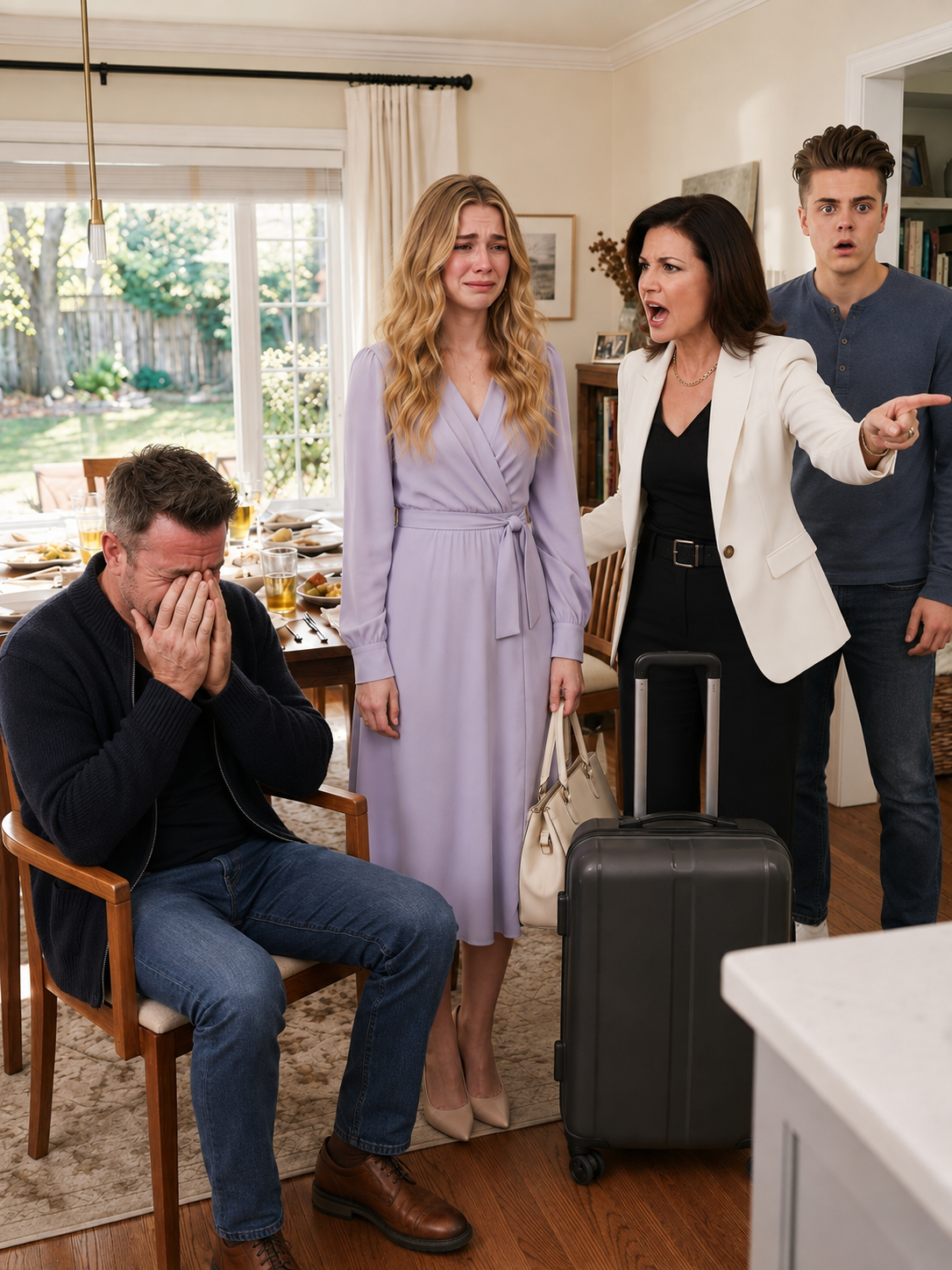
Saturday dinner had barely begun before Monica Bennett decided to change my life.
The roasted chicken had barely been passed around the table when she placed her fork neatly on her plate, looked directly at me, and smiled the way people do when they’ve already rehearsed a speech.
“Give your bedroom to Dylan,” she said calmly, pointing toward the staircase. “Or pack your things and leave.”
The room became so quiet that even the ticking clock above the refrigerator sounded loud.
My father, Richard, lowered his eyes to his mashed potatoes as though they required his complete attention.
Across from me, my twenty-two-year-old stepbrother Dylan leaned back in his chair with an unmistakable grin. He didn’t look surprised.
He looked prepared.
That told me everything.
This conversation hadn’t started at the dinner table.
It had started long before I walked into the room.
Monica folded her hands.
“Dylan needs the upstairs bedroom. It has the private bathroom, better closet space, and more natural light. He’s starting his future.”
I blinked once.
“And what exactly am I doing?”
She shrugged.
“You can use the downstairs guest room. Or, if you don’t like that arrangement, you’re free to leave.”
She said it with the confidence of someone convinced she owned everything around her.
Including me.
What made the moment almost unbelievable wasn’t simply the demand.
It was the fact that I had spent the previous four years paying property taxes, contributing toward the mortgage, replacing the roof after storm damage, repairing broken plumbing, and quietly covering countless household expenses while everyone else treated the house like an endless bank account.
Yet suddenly, according to Monica, I was only a guest.
Richard finally cleared his throat.
“Claire…”
I looked at him hopefully.
He said nothing else.
Silence had always been his favorite language.
I folded my napkin carefully.
“Okay.”
Monica frowned.
“Okay?”
“I heard you.”
I carried my plate to the sink, rinsed it, dried my hands, and walked upstairs.
No shouting.
No tears.
No argument.
Behind me I heard Dylan laugh.
“See? I told you she’d cave.”
I smiled to myself.
He misunderstood what was happening.
Exactly twenty-two minutes later, I came back downstairs carrying two suitcases, my laptop bag, and the small cedar box that contained every important document my late mother had ever left me.
Richard stood so abruptly that his chair scraped across the hardwood floor.
“Claire, don’t be dramatic.”
I met his eyes.
“I’m doing exactly what your wife told me to do.”
Monica crossed her arms as if she’d just won a championship.
Dylan reached toward the wall, lifted my bedroom key from its hook, and spun it around his finger.
“Guess it’s my room now.”
I didn’t answer.
Because by then, none of it mattered anymore.
None of them knew the truth.
I had already decided to leave weeks earlier.
The dinner wasn’t the beginning.
It was simply the final confirmation.
The house had originally belonged to my mother, Laura.
Before cancer took her, she had rewritten her will with extraordinary care.
She left forty percent ownership of the property to me.
The remaining sixty percent went to Richard.
She had insisted on that division because she wanted me protected.
Richard had promised he would always honor her wishes.
After she died, he convinced me to postpone selling the property.
“We’ll wait until the market improves,” he said.
“It’ll be better for both of us.”
I believed him.
Month after month became year after year.
During that time, I continued paying my share—and often much more than my share—because I wanted to preserve the house my mother had loved.
Meanwhile Monica gradually moved in, redecorated rooms without asking, replaced my mother’s curtains, stored Dylan’s belongings everywhere, and slowly behaved as though my mother’s home had always belonged to her.
I tolerated it.
Until two weeks before the dinner.
That afternoon Monica demanded I help pay Dylan’s overdue car loan.
“He’s family,” she insisted.
“You make good money.”
“I already help pay this house.”
“That’s different.”
“No,” I replied quietly. “It’s exactly the same.”
That conversation finally pushed me to schedule an appointment with attorney Sandra Patel.
Sandra reviewed every document.
The deed.
The probate records.
Tax payments.
Mortgage statements.
When she finished reading, she looked up.
“Claire, your ownership is completely secure.”
“So they can’t simply force me out?”
“They can ask.”
She smiled slightly.
“But legally? Absolutely not.”
Sandra also recommended obtaining a professional appraisal.
The value of my ownership share came to approximately $186,000.
Seeing that number changed something inside me.
For years I’d been emotionally attached to the house.
Now I saw it differently.
It wasn’t my mother’s anymore.
It had become a battlefield.
Around that same time, I found a modest cedar-sided home overlooking the hills outside Asheville.
It wasn’t large.
It didn’t have expensive finishes.
But when I stood on the back deck overlooking the valley, surrounded by quiet woods and fresh mountain air, something inside me relaxed for the first time in years.
The owner wanted a quick closing.
My mother had quietly built an investment account in my name years earlier and had instructed no one to touch it unless absolutely necessary.
I finally understood why.
By Tuesday morning, only three days after leaving dinner with two suitcases, I held the keys to that little hillside house.
It wasn’t luxurious.
It wasn’t impressive.
But every inch of it belonged to me.
Nobody could decide which room I deserved.
Nobody could threaten to throw me out.
Nobody could erase my mother from its walls.
On Wednesday afternoon I sat on my new deck drinking coffee while rain drifted gently across the distant mountains.
My phone began vibrating.
Again.
Again.
Again.
Twenty missed calls.
Seven voicemails.
Nine text messages.
Richard finally sent a photograph.
Monica stood in the driveway of the old house holding an envelope with both hands.
Her face looked pale.
Sandra had filed a petition asking the court to order a forced sale unless Richard purchased my forty-percent ownership share at its appraised value.
The number printed inside was simple.
$186,000.
Richard didn’t have it.
He called immediately.
“Withdraw the petition.”
“No.”
“Monica was angry.”
“I know.”
“She didn’t mean it.”
“She understood every word she said.”
He sighed heavily.
“You’re making us homeless over a bedroom.”
I looked across the peaceful valley outside my kitchen window.
“No.”
“I’m ending a financial arrangement that should have ended years ago.”
Behind him I heard Monica shouting.
“Dylan is family!”
I answered without raising my voice.
“Wonderful.”
“Then Dylan can help pay for the house.”
The call ended.
Within hours relatives flooded social media accusing me of abandoning my father.
I read every message.
Then I replied exactly once inside the family group chat.
“Anyone who believes Richard should remain in the house is welcome to contribute toward purchasing my ownership share. The amount is $186,000.”
The conversation died instantly.
No one offered even one dollar.
The following morning Dylan uploaded a smug photograph from what had once been my bedroom.
He stretched across my old bed wearing headphones.
Wrapped around him was my mother’s handmade quilt.
In the corner stood her antique walnut jewelry cabinet.
He’d filled its drawers with watches, sunglasses, and video game controllers.
I stared at the picture for several seconds.
Then I forwarded it to Sandra.
Within hours she obtained an emergency notice prohibiting anyone from moving, damaging, or disposing of inherited property.
Soon afterward the court authorized a full inspection.
Walking through the house felt like visiting the grave of someone I loved.
My former bedroom smelled strongly of cigarette smoke.
Fresh burn marks scarred the carpet.
Someone had scratched the walnut cabinet.
Water dripped slowly from an upstairs bathroom pipe into the kitchen ceiling.
The basement showed signs of moisture damage.
Cabinet doors hung crooked.
Walls had been patched poorly.
Altogether the property’s value had already fallen by nearly twelve thousand dollars.
The judge reacted quickly.
Further alterations were prohibited.
Security cameras were approved throughout the property until the ownership dispute concluded.
Monica called it spying.
I called it protecting what remained of my mother’s legacy.
At that point, I believed the worst was finally behind me.
I couldn’t have been more wrong.
Because Monica wasn’t preparing to lose.
She was preparing to destroy everything.
And she almost succeeded.

Part 2: The Fire They Never Expected to Be Caught
The mediation session lasted exactly twenty-three minutes.
That was all it took for Monica Bennett to reveal that she still believed intimidation could accomplish what the law never would.
She walked into the conference room carrying two large photo albums tied together with a satin ribbon.
At first glance, they looked sentimental.
Family vacations.
Christmas mornings.
Birthday parties.
Photographs carefully arranged to remind everyone that this was, supposedly, a family dispute rather than a legal one.
Sandra Patel barely glanced at them.
“They’re lovely,” she said politely. “Now let’s discuss the property.”
Monica slid the albums toward me.
“You’ve always cared more about your mother than anyone else. These memories should matter more than money.”
I opened the first page.
There was my mother, smiling in the backyard beneath the old maple tree, only months before she became ill.
The sight tightened my chest.
Monica watched carefully, waiting for emotion to weaken my resolve.
Instead, I quietly closed the album.
“What exactly are you proposing?”
She smiled.
“You surrender your forty-percent ownership.”
“And in return?”
“We’ll let you remove your mother’s furniture before we renovate.”
Sandra folded her hands.
“What compensation will Ms. Bennett receive for her equity?”
Monica looked genuinely confused.
“She’ll still have her family.”
The room became silent.
I met Monica’s eyes.
“I’ve already paid enough for that.”
Sandra gathered our documents.
“I believe this meeting is over.”
Monica stood.
“You’re tearing this family apart over a house.”
“No,” I answered calmly.
“The house only exposed what was already broken.”
We walked out.
By the time I reached my car, Sandra smiled.
“She expected guilt to be a negotiation strategy.”
“It always has been.”
“This time,” Sandra replied, “the law doesn’t negotiate with guilt.”
I drove back to my hillside home feeling strangely peaceful.
Rain clouds drifted across the valley outside my kitchen windows.
That evening I grilled vegetables on the deck, watched deer move across the distant hillside, and reminded myself that for the first time in years I didn’t have to brace for another argument before going to sleep.
Just after midnight my phone exploded with alerts.
Security Camera Motion Detected.
Garage Entrance.
Rear Yard.
I sat upright immediately.
The court-ordered cameras had been installed only two days earlier.
Opening the live feed, I felt my stomach tighten.
Dylan walked across the backyard carrying two bright red gasoline cans.
He glanced over both shoulders before approaching the detached garage.
Seconds later another figure appeared.
Monica.
She carried a large cardboard box with both hands.
When she reached the camera, she paused.
For one brief second she looked directly into the lens.
Then she slowly pulled her hood over her head.
The expression on her face wasn’t frightened.
It was determined.
She disappeared inside the garage.
Thirty seconds later…
The camera feed went black.
I didn’t hesitate.
I dialed emergency services before my brain had fully processed what I’d seen.
“My family’s property,” I told the dispatcher. “The court installed surveillance cameras there. The feed just went dark after two people entered carrying gasoline.”
Units were dispatched immediately.
I was already driving.
The old house sat less than thirty minutes away.
As I turned onto the street, flashing red and blue lights reflected across every neighboring home.
Fire engines blocked both ends of the road.
Smoke rolled beneath the garage door.
Neighbors stood outside in pajamas, whispering nervously.
Police officers rushed back and forth between patrol cars.
Yellow tape stretched across the front yard.
I parked several houses away and hurried toward the scene.
An officer stopped me.
“I’m Claire Bennett.”
“I co-own this property.”
He checked his notes.
“Please remain behind the tape.”
I nodded.
Near the driveway, Monica stood shouting at two officers while Dylan sat handcuffed on the curb.
Richard stood frozen on the front lawn wearing slippers and a wrinkled bathrobe.
His face looked as pale as the smoke drifting into the night sky.
A firefighter emerged from the garage carrying Monica’s cardboard box.
He placed it carefully on the pavement.
One detective opened it.
Inside were insurance papers.
Work gloves.
Electrical wiring.
A digital timer.
And a modified portable space heater with pieces already connected together.
The detective exchanged a long look with another investigator.
Neither said a word.
They didn’t need to.
Monica finally noticed me standing behind the police tape.
Her eyes widened with fury.
“This is your fault!”
She struggled against the officers.
“If you hadn’t forced the sale, none of this would’ve happened!”
Before I could answer, another vehicle pulled into the street.
Sandra stepped out.
She took one look at the smoke, the investigators, and the evidence sitting on the asphalt.
Then she looked at me.
“This,” she said quietly, “is proof.”
The firefighters managed to contain the blaze before it spread into the main house.
It had come terrifyingly close.
Inside the garage investigators discovered gasoline covering large sections of the concrete floor.
Oil-soaked rags had been placed strategically against one interior wall.
The timer had been connected to the modified heater in a way investigators believed could have ignited the vapors after enough delay for everyone involved to leave.
One investigator later explained that only a combination of equipment failure and the quick emergency response had prevented a catastrophic explosion.
As daylight approached, more disturbing facts surfaced.
Only six days earlier, Monica had dramatically increased the homeowner’s insurance policy.
Additional coverage included fire damage.
Temporary housing.
Replacement of personal property.
Emergency living expenses.
Nearly every expanded section had been highlighted.
When questioned, Monica insisted she entered the garage because she smelled gasoline.
“I was trying to protect the house.”
Investigators weren’t convinced.
Dylan claimed the gasoline belonged to the lawn mower.
An officer glanced toward the side yard.
“The lawn mower is electric.”
No one spoke after that.
Hours later detectives reviewed additional surveillance footage.
Court cameras showed Dylan removing the gasoline cans from Monica’s SUV earlier that evening.
A nearby convenience store produced receipts showing Monica had purchased the portable heater only three days earlier.
A neighbor’s security camera captured both of them carrying the equipment into the garage shortly before midnight.
The timeline fit almost perfectly.
Richard sat inside the back of a patrol vehicle giving his statement.
When I finally approached him, he looked exhausted.
“I didn’t know.”
I believed him.
But belief no longer mattered.
“You’ve said that before.”
He closed his eyes.
“I never imagined she’d do something like this.”
I nodded slowly.
“You never imagined she’d pressure me into paying Dylan’s debts.”
Silence.
“You never imagined she’d move Mom’s belongings.”
Silence again.
“You never imagined she’d throw me out.”
He lowered his head.
Every excuse sounded exactly like the one before.
Every surprise came after years of looking away.
His silence had protected Monica more effectively than any lie she ever told.
The insurance company immediately froze the claim.
The mortgage lender launched its own fraud investigation.
The court appointed a neutral receiver to manage the property while criminal proceedings moved forward.
Then came another devastating discovery.
As investigators cataloged every room inside the house, several pieces of my mother’s property were missing.
Her sterling silver tea service.
Two original landscape paintings.
Her pearl earrings.
A wooden box containing old gold and silver coins collected by my grandfather.
Police traced the silver to a local pawn shop.
The owner produced paperwork identifying Dylan as the seller.
One painting had already been sold through a consignment gallery.
The second remained in storage and was recovered before delivery.
Detectives located the pearl earrings inside Monica’s jewelry box during a search warrant.
The coin collection, however, had vanished.
No one could account for it.
To this day, those coins have never been found.
Several weeks later Richard sat across from Sandra and me inside her office.
He held copies of the pawn shop receipts with trembling hands.
“I honestly didn’t know.”
Sandra remained silent.
I answered.
“You lived in that house.”
He swallowed.
“I should’ve paid attention.”
“Yes.”
“I should’ve asked questions.”
“Yes.”
“I should’ve protected your mother’s things.”
I looked at him for several seconds.
“Yes.”
For the first time in my life, I didn’t soften the truth to spare his feelings.
The honesty hurt him.
But it also felt overdue.
As prosecutors continued building their case, Dylan made an unexpected decision.
He agreed to cooperate.
According to his statement, Monica had spent weeks discussing ways to stop the forced sale.
When every legal option failed, she proposed a different solution.
Burn the garage.
Collect the insurance money.
Delay the court proceedings long enough to save the house.
She promised Dylan fifteen thousand dollars if he helped.
“No one will get hurt,” she reportedly told him.
“It’s detached.”
Investigators disagreed completely.
Engineering reports later revealed that the garage shared structural framing with the rear kitchen wall.
If the flames had spread only a few more minutes, they likely would have entered the main house.
Richard had been asleep upstairs.
Several firefighters admitted afterward that he easily could have died.
That realization finally broke whatever remained of his loyalty.
Within forty-eight hours Richard packed his belongings and moved into a small furnished apartment across town.
For the first time since marrying Monica, he walked away from her.
Not because she had mistreated me.
Not because she had stolen my mother’s belongings.
Not because she had remained silent while I was forced from my own home.
He left because, at last, her choices had threatened his own life.
I couldn’t decide whether that truth made me sad…
or simply tired.
The criminal case moved forward.
The civil case continued.
And everyone knew the final courtroom battle over the house was now only weeks away.
This time, however, Monica no longer held any cards.
She had already burned them herself.

Part 3: The Door Only I Could Close
By the time the final hearing arrived, the courtroom felt less like a place for legal arguments and more like the closing chapter of a story that had begun years before my stepmother ever told me to surrender my bedroom.
The criminal investigation was still moving through the system, but the civil case over ownership of my mother’s house had reached its conclusion.
Sandra Patel arranged our documents neatly across the counsel table.
The original deed.
My mother’s will.
The probate order.
Property tax records.
Mortgage statements.
Receipts showing every repair I had helped finance.
Years of paperwork told a far more honest story than anyone’s memory ever could.
Monica entered the courtroom wearing a navy-blue suit that made her appear far calmer than she actually was. She carried another thick folder beneath her arm, occasionally whispering to her attorney with an expression that suggested she still believed she could somehow escape the consequences.
Richard arrived alone.
He looked older than he had only a few months earlier.
His shoulders were permanently slumped, and the confidence I’d once associated with my father had disappeared entirely.
The judge reviewed the file before looking toward Monica.
“Mrs. Bennett, you are claiming the decedent intended the entire property to pass to Mr. Richard Bennett?”
“Yes, Your Honor.”
“And your evidence?”
“My husband told me Laura always wanted him to have everything.”
Sandra stood.
“Objection. Hearsay.”
“Sustained.”
Monica tried again.
“Laura said it verbally.”
The judge adjusted his glasses.
“Do you possess any written documentation?”
“No.”
“A recording?”
“No.”
“Any witness besides yourself?”
Monica hesitated.
“No.”
Sandra calmly approached the bench and handed over the original documents.
“My client’s ownership is clearly established through the executed will, recorded deed, probate judgment, and years of documented tax payments.”
The judge slowly examined each page.
Everything aligned perfectly.
Every signature.
Every filing date.
Every legal requirement.
Nothing supported Monica’s claim.
Then came the moment no one expected.
Richard was called to testify.
He walked slowly toward the witness stand, took the oath, and sat down without looking at either Monica or me.
For several long seconds, the courtroom remained completely silent.
The judge finally asked the question.
“Mr. Bennett, did your late wife intentionally leave forty percent ownership of this property to your daughter?”
Richard closed his eyes briefly.
When he opened them again, something inside him seemed different.
He turned toward Monica.
She gave him an almost desperate look, silently pleading for him to support her version of events.
Instead, he looked at me.
Then he answered.
“Yes.”
The courtroom remained silent.
“Laura wanted Claire protected.”
His voice trembled.
“She worried that if something happened to her, Claire might someday be left with nothing.”
He swallowed hard.
“The ownership was intentional.”
Monica’s face drained of color.
Richard continued speaking.
“I knew exactly why Laura wrote the will that way.”
“You knew?” Monica whispered.
He nodded without looking at her.
“I always knew.”
The judge made several notes before closing the file.
“Mrs. Bennett’s claim regarding ownership is denied.”
Just like that, the final obstacle disappeared.
The forced sale proceeded exactly as the court had previously ordered.
Less than six weeks later, a young couple with two small children purchased the property for $472,000.
Watching strangers walk through the front door during the final showing stirred emotions I hadn’t expected.
That house had once echoed with my mother’s laughter.
She had baked cinnamon bread in that kitchen.
She had planted tulips beneath the front windows every spring.
She had read books beside the living room fireplace while rain tapped gently against the glass.
The house deserved another family.
It deserved children running through the hallway again.
It deserved people who would love it instead of fighting over it.
After the mortgage balance, repair costs, legal expenses, liens, and court fees were deducted, my portion totaled just over $181,000.
The money represented far more than equity.
It represented independence.
I invested part of it into my own hillside home.
The aging wooden deck was rebuilt using cedar planks that overlooked the valley.
Large picture windows replaced the smaller originals, filling the living room with golden afternoon sunlight.
I converted one of the spare bedrooms into a quiet office with built-in bookshelves overlooking the mountains.
Every improvement felt less like spending money and more like building the peaceful life I had postponed for years.
The final piece to arrive was my mother’s walnut jewelry cabinet.
A master furniture restorer carefully repaired the deep scratches Dylan had left across its surface.
When he finished, he apologized.
“I couldn’t remove every mark.”
I gently ran my fingers across the faint lines still visible beneath the polished finish.
“Please don’t.”
He looked confused.
“I don’t want it to look brand new.”
He smiled.
“You want it to remember.”
Exactly.
The cabinet had survived.
So had I.
Several months later Monica appeared for sentencing.
She accepted a plea agreement covering attempted insurance fraud, theft of inherited property, conspiracy, and charges connected to the garage fire.
Standing before the judge, she tried one final time to portray herself as a victim.
“I was under tremendous pressure.”
She dabbed at her eyes with a tissue.
“I only wanted to keep my family together.”
The prosecutor quietly reviewed the evidence once more.
Security footage.
Insurance records.
Receipts.
Witness statements.
Dylan’s testimony.
There was very little left to debate.
Before sentencing concluded, Monica turned toward me.
Even then she still searched for someone else to blame.
“You could’ve prevented all of this.”
Her voice echoed through the courtroom.
“You only had to let Dylan have the room.”
Every head turned toward me.
Perhaps they expected an emotional speech.
Perhaps they expected anger.
Instead, I answered with complete calm.
“I did let him have the room.”
Monica frowned.
“What?”
“I packed my bags.”
“I walked away.”
“I gave him exactly what you demanded.”
The judge looked directly at Monica.
“Face forward.”
She never spoke to me again.
The court sentenced her according to the plea agreement.
She avoided the maximum possible penalties but received significant consequences for the insurance scheme, theft, and her role in planning the fire.
The criminal record would follow her far longer than any prison sentence ever could.
Dylan’s future unfolded differently.
Because he cooperated early, returned what property could still be recovered, and testified honestly against Monica, prosecutors recommended probation instead of incarceration.
He received mandatory employment requirements, community service, restitution payments, and regular supervision.
Several months later, my phone buzzed with an unfamiliar number.
It was Dylan.
His message surprised me.
“I’m sorry.”
“I never should’ve touched your mom’s things.”
“I can’t change what happened.”
“I know.”
I stared at the screen for a long moment before replying.
“Send the restitution payments through the court.”
Nothing more.
Some apologies belong in conversations.
Others belong in actions.
Richard, however, continued reaching out.
At first I ignored his calls.
Then his letters.
Finally, nearly eight months after everything ended, I agreed to meet him at a small coffee shop halfway between our homes.
He looked nervous as he stirred a cup that had long since gone cold.
“I’ve replayed that dinner in my head every day.”
I waited quietly.
“I should’ve stopped Monica.”
“Yes.”
“I should’ve stopped her years before that.”
“Yes.”
“I convinced myself staying quiet kept the peace.”
I looked directly at him.
“It didn’t keep the peace.”
“It kept you comfortable.”
He slowly lowered his eyes.
“I know.”

For the first time since my mother died, he didn’t defend himself.
He didn’t blame Monica.
He didn’t blame circumstances.
He accepted responsibility.
That didn’t erase the past.
Some wounds never disappear completely.
But accountability, even when it arrives late, matters.
We never became the father and daughter we once might have been.
There was no dramatic embrace.
No miraculous reconciliation.
No promise that everything would somehow return to normal.
Instead, we built something much smaller.
Something honest.
Occasionally we met for coffee.
Sometimes lunch.
Always in public places.
Always with clear boundaries.
He never asked for a key to my house.
I never offered one.
Trust, once broken, grows back slowly—if it grows back at all.
Exactly one year after the dinner that changed everything, I invited Sandra and two close friends to my hillside home.
Rain drifted gently across the mountains while we shared roasted chicken, fresh bread, grilled vegetables, and homemade blackberry pie around my long oak dining table.
The conversation flowed easily.
Nobody raised their voice.
Nobody demanded anything.
Nobody measured love by what someone else surrendered.
As evening settled over the valley, Sandra carried her coffee onto the deck.
She looked toward the distant mountains.
“Do you ever miss the old house?”
I thought about my mother’s garden.
The front porch swing.
The smell of cinnamon drifting through the kitchen every autumn.
Finally I answered.
“I miss my mother inside that house.”
I smiled softly.
“That’s very different from missing the house itself.”
Sandra nodded.
“I understand.”
After everyone left, I wandered upstairs.
The largest bedroom belonged to me.
The second served as my office.
The third remained empty, waiting until I decided what purpose it should someday have.
A guest room.
A library.
Perhaps a nursery years from now.
The decision belonged to no one else.
My mother’s walnut cabinet stood quietly beside the bedroom window where the morning sun touched its polished surface every day.
The tiny scratches beneath the finish caught the light if I looked closely enough.
They reminded me that surviving doesn’t mean pretending nothing happened.
It means refusing to let what happened define everything afterward.
Before going to bed, I opened the closet.
On the highest shelf rested the same two suitcases I had carried out of my father’s house.
I hadn’t unpacked them completely.
Not because I expected to leave again.
Because they reminded me how surprisingly little freedom had required.
Two suitcases.
One laptop bag.
A cedar box filled with my mother’s papers.
And one quiet decision made at the exact moment everyone else believed I had lost.
That night, before turning off the lights, I walked downstairs and locked my front door.
No one stood outside demanding a bedroom.
No one waited to tell me where I belonged.
No one had the authority to order me to pack my things ever again.
I stood for a moment listening to the rain fall gently across the hillside.
Then I smiled, switched off the porch light, and walked back inside.
For years I had believed my greatest inheritance was a share of my mother’s house.
I had been wrong.
The greatest inheritance she left me wasn’t measured in square footage or property value.
It was the courage to know exactly when it was time to walk away.
Sometimes freedom doesn’t begin with winning a courtroom battle.
Sometimes it begins the moment you quietly pick up two suitcases, refuse to argue with people who have already decided not to value you, and choose a future they never imagined you could build.
That evening, as I closed the front door behind me, I realized something else.
It wasn’t just a house I finally owned.
It was my peace.
And this time, the only person who held the key was me.