
Aug
The Silence That Broke at 3 AM
At 3:07 in the morning, the Hawthorne mansion was so quiet that Daniel Hawthorne could hear the faint hum of the heating system behind the walls.
Then the crying began.
Two voices.
Two frightened little boys calling out from the far end of the second floor.
“Daddy!”
Daniel opened his eyes and stared into the darkness.
For several seconds, he did not move.
He knew those cries.
He had been hearing them almost every night for nearly two years.
Sometimes they began at midnight. Sometimes at two in the morning. Sometimes just before dawn.
But the pattern never really changed.
His three-year-old twin sons, Noah and Ethan, would wake terrified. A nanny would rush in. Milk would be warmed. Lights would be dimmed. Lullabies would be sung.
Nothing worked for long.
Eventually, the boys would cry themselves into exhaustion.
And Daniel would lie awake in another room, telling himself there was nothing more he could do.
Tonight, however, something inside him snapped.
“Not again,” he whispered.
He pushed the blankets aside and stood.
The Hawthorne mansion in northern New Jersey had once been a lively place. Daniel’s late wife, Rachel, had filled every room with music, flowers, half-finished cups of tea, and laughter.
After she died, Daniel had slowly removed all of it.
The piano remained closed.
The fresh flowers disappeared.
The curtains stayed perfectly arranged.
The toys were returned to baskets almost as soon as the twins stopped playing with them.
Daniel told himself he was creating stability.
What he had really created was silence.
He just didn’t know it yet.
Rachel had died after a sudden illness when Noah and Ethan were barely a year old.
Daniel had responded to the loss the only way he knew how: by controlling everything he still could.
He returned to work too soon.
He hired the best childcare agencies.
He installed schedules on the refrigerator.
Meals at seven.
Outdoor play at ten.
Nap at one.
Bath at seven.
Bedtime at eight.
Nothing was supposed to be unpredictable.
Because unpredictable things could disappear.
People could disappear.
And Daniel had already lost the one person he had believed would always be there.
The crying grew louder.
He walked quickly toward the twins’ room.
Sophie Bennett, the newest nanny, had been there for only six days.
She was the fifth caregiver in seven months.
The first had quit because the twins refused to sleep.
The second lasted six weeks.
The third complained that the children became inconsolable whenever the house was too quiet.
The fourth had been dismissed by Daniel’s mother after she allowed them to sleep beside her on the nursery floor.
Sophie was supposed to be different.
Twenty-eight years old. Calm. Educated. Experienced with young children.
The agency had described her as “unusually patient.”
Daniel had stopped believing agency descriptions.
He reached the nursery door and prepared himself for another disaster.
Then he stopped.
The crying had vanished.
Instead, his sons were laughing.
Not giggling.
Laughing.
The kind of laughter that made breathing difficult.
Daniel slowly pushed open the door.
And stared.
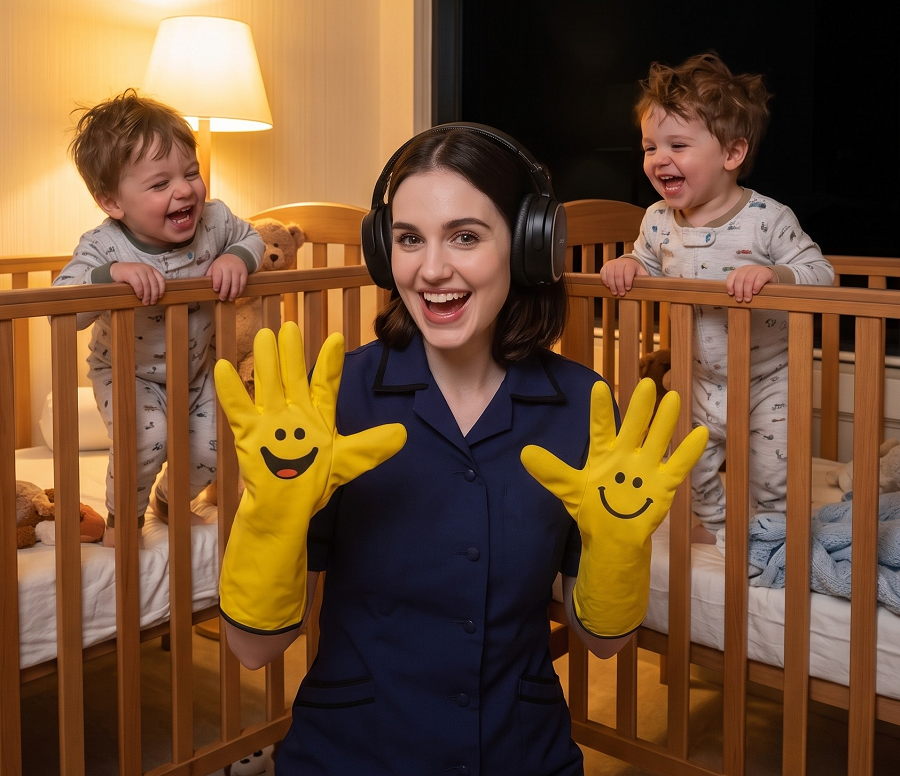
Sophie stood in the center of the nursery wearing a pair of enormous yellow rubber kitchen gloves.
One glove had two black dots drawn on it for eyes.
The other had a crooked smile.
She was making the gloves “argue.”
“No, Mr. Banana Hands!” she whispered dramatically. “You may not eat the moon!”
Her left hand shook furiously.
Her right hand appeared offended.
Noah squealed.
Ethan collapsed backward onto his pillow, laughing.
Sophie spun around, made one glove hide behind her head, then popped it out again.
The boys laughed even harder.
For several seconds, Daniel simply watched.
Something unfamiliar tightened in his chest.
He had forgotten what the twins sounded like when they laughed in the middle of the night.
Sophie finally noticed him.
Her smile disappeared.
“Mr. Hawthorne.”
Daniel folded his arms.
“What exactly are you doing?”
She removed one of the gloves.
“Getting them back to sleep.”
“By putting on a puppet show at three in the morning?”
Her face flushed slightly.
“I tried rocking them. I tried warm milk. I tried the music box. None of it helped.”
Daniel glanced toward his sons.
Both boys had stopped laughing now. They were watching him carefully.
Sophie lowered her voice.
“I think they’re afraid of the quiet.”
Daniel frowned.
“That doesn’t make sense.”
“It might.”
She glanced at the twins.
“When the room gets completely silent, they become alert. They listen for something. Then they panic.”
Daniel felt himself stiffen.
“They have a bedtime routine.”
“I know.”
“They need structure.”
“I agree.”
“Then why are you turning bedtime into a circus?”
Sophie paused.
Most employees became nervous when Daniel used that tone.
She did not.
“Because tonight they didn’t need more structure,” she said gently. “They needed to feel safe.”
The sentence struck him harder than he expected.
He immediately disliked that.
“This house has rules, Miss Bennett.”
“I understand.”
“They need calm.”
“Yes.”
“Not chaos.”
Sophie looked at Noah and Ethan.
Then back at him.
“Sometimes calm and silence aren’t the same thing.”
Daniel said nothing.
She handed the yellow gloves to him.
“I’ll put them back.”
He did not take them.
“Good night, Miss Bennett.”
He left.
But as he walked back toward his bedroom, he heard Noah whisper behind him.
“Again, Sophie.”
Then laughter.
Daniel did not sleep for the rest of the night.

The House That Had Forgotten How to Live
The following morning, gray clouds hung low over the estate.
Daniel was halfway through breakfast when his mother arrived.
Margaret Hawthorne never needed to announce herself.
At sixty-six, she moved through the house as though every room still belonged to her.
She entered the dining room wearing a cream wool coat, handed her gloves to the housekeeper, and kissed Daniel lightly on the cheek.
“I came early.”
“So I noticed.”
She looked toward the hallway.
Two seconds later, Noah ran past holding a wooden train.
Ethan followed.
Sophie came after them.
“Walking feet, gentlemen,” she reminded them.
Noah slowed.
Ethan did not.
Sophie caught him gently around the waist.
“Are you a race car?”
“Yes!”
“Race cars belong outside.”
He considered this.
“Can I race outside?”
“After breakfast.”
Margaret watched the interaction with an expression Daniel knew well.
Evaluation.
Sophie noticed her.
“Good morning, Mrs. Hawthorne.”
Margaret gave a small nod.
“So you’re the new nanny.”
“Sophie Bennett.”
“She looks young,” Margaret said to Daniel, even though Sophie was standing six feet away.
Daniel frowned.
“She’s twenty-eight.”
“I didn’t ask her age.”
Sophie remained polite.
“I’ll get the boys settled.”
When she left, Margaret sat opposite her son.
“She’s too familiar with them.”
“She’s their nanny.”
“She should maintain boundaries.”
Daniel lifted his coffee.
“They like her.”
“Children like sugar for breakfast too. That doesn’t mean we give it to them.”
Daniel almost smiled.
Almost.
Margaret had never understood Rachel.
Rachel had been spontaneous.
Margaret believed spontaneity was another word for irresponsibility.
Rachel allowed the children to finger-paint in the kitchen.
Margaret worried about the marble.
Rachel opened windows during summer rainstorms.
Margaret complained about the floors.
Rachel danced barefoot while cooking.
Margaret called it undignified.
After Rachel died, Daniel had unconsciously allowed his mother’s approach to become the law of the house.
Order.
Cleanliness.
Quiet.
Control.
He had thought discipline might keep his family from falling apart.
Instead, his sons were waking every night terrified.
That evening, Daniel returned home later than usual.
The boys were already asleep.
He went downstairs for water and passed the small staff sitting room.
A lamp was still on.
Sophie was asleep on the sofa.
A book lay open across her chest.
Something had fallen beside her hand.
A photograph.
Daniel almost walked past.
Then he saw the woman standing in the picture.
His breath caught.
Rachel.
The photograph had been taken years earlier.
Rachel looked younger, perhaps twenty-nine or thirty.
She was standing beside a teenage girl wearing a pale blue ballet costume.
The girl was Sophie.
Daniel picked up the photograph.
On the back was Rachel’s handwriting.
For Sophie—never let anyone convince you that the stage is too big for you. Keep dancing. Love, Rachel.
Daniel stared at the words.
Memory returned in pieces.
Rachel had volunteered at an arts program for teenagers.
She had once told him about a girl whose mother worked two jobs and could not afford advanced dance training.
“Sophie is remarkable,” Rachel had said one night.
Daniel had been answering emails.
“That’s good.”
“No, Daniel. You’re not listening. She could really go somewhere.”
“I’m listening.”
“You’re typing.”
He remembered Rachel laughing and shutting his laptop.
The memory made him close his eyes.
Afterward, Rachel had established a small scholarship through the Hawthorne Family Foundation.
When she died, Daniel had frozen nearly every charitable program she had managed.
He had called it financial restructuring.
In reality, he simply could not bear to enter her office or hear people mention projects that had belonged to her.
The scholarship program disappeared with everything else.
Daniel looked at the sleeping woman on the sofa.
Sophie had been that girl.
He quietly placed the photograph on the table.
The next morning, he waited until the twins were playing outside before approaching her.
“You knew my wife.”
Sophie froze.
Daniel held out the photograph.
For the first time since he had met her, her composure vanished.
“I wondered when you’d find out.”
“Why didn’t you tell me?”
“Would it have changed whether you hired me?”
“Yes.”
“That’s why.”
He stared at her.
Sophie sighed.
“Rachel helped me when I was sixteen. My mother was raising me alone. Dance lessons were becoming too expensive. Your wife arranged a scholarship.”
“What happened after she died?”
Sophie looked down.
“The program ended.”
Daniel felt shame rise through him.
“I didn’t know.”
“I assumed you didn’t.”
“Why?”
“Because Rachel wouldn’t have ended it without telling us.”
He had no answer.
Sophie continued.
“I got another scholarship eventually. I trained for several years. Then my mother became ill and I came home to help her.”
“Do you still dance?”
“Sometimes.”
“Why childcare?”
She looked through the window at Noah and Ethan.
“Because I’m good with children.”
Then she smiled faintly.
“And because your wife once told me that the most important thing about talent wasn’t what you could do with it. It was whether you could use it to bring something good into a room.”
Daniel looked toward his sons.
For the first time, he wondered how many good things he had removed from their home because they reminded him of Rachel.
The Storm
Three nights later, a powerful storm moved across the region.
By ten, wind slammed against the windows.
At eleven, the electricity flickered.
At 11:18, the house went dark.
The backup generator started, failed, then went silent.
Daniel was in his study when Sophie appeared at the door carrying a flashlight.
“The boys are awake.”
He followed her immediately.
Noah and Ethan were crying, but something was different.
Noah was flushed.
Ethan looked exhausted.
Sophie touched Noah’s forehead.
“He feels very warm.”
Daniel’s stomach tightened.
He reached for his phone.
No signal.
The storm had knocked out service across the area.
They managed to contact the family doctor briefly using the landline before the connection failed. Following the doctor’s instructions, they kept the boys comfortable while waiting for the roads to clear enough for medical help to reach the property.
Still, Daniel began to panic.
He hated uncertainty.
He hated not being able to fix something immediately.
“Why isn’t anyone here yet?”
“The roads are flooded near the lower bridge,” Sophie said.
“I’ll drive them myself.”
“The doctor specifically told us not to take that road.”
“I’m not standing here doing nothing.”
Sophie stepped between him and the door.
“You’re not doing nothing.”
Daniel glared at her.
“My children are sick.”
“I know.”
“You don’t understand.”
“I understand that they’re frightened, and right now they’re watching you.”
He looked toward the bed.
Two small pairs of eyes stared back at him.
Sophie lowered her voice.
“They don’t need you to solve the storm. They need you to stay.”
Something inside Daniel cracked.
Stay.
He had spent two years doing everything except that.
He hired people.
He paid people.
He scheduled people.
He controlled every part of his sons’ lives from a safe emotional distance.
But when they cried at night, someone else comforted them.
Because their cries reminded him too much of the hospital.
Of Rachel.
Of the night he learned that money, influence, planning, and intelligence could not protect him from losing someone.
Daniel sat beside Noah.
The little boy immediately reached for him.
“Daddy.”
Daniel lifted him into his arms.
“I’m here.”
Ethan reached out too.
Daniel pulled both boys close.
Sophie stayed nearby.
After a while, she began humming.
Daniel stopped breathing for a moment.
He knew the melody.
Rachel used to sing it.
“She taught you that?”
Sophie nodded.
“At the dance studio.”
Daniel lowered his head.
For the first time since Rachel’s funeral, he allowed himself to cry in front of another person.
Quietly.
Not dramatically.
Just two years of grief finally finding somewhere to go.
Noah touched his face.
“Daddy sad?”
Daniel looked at his son.
He could have denied it.
Instead, he said, “A little.”
“Because Mommy?”
Daniel stared at him.
They rarely spoke about Rachel.
Margaret believed the boys were too young.
Daniel had accepted that excuse because it protected him too.
“Yes,” he whispered. “Because Mommy.”
Noah rested his head against Daniel’s chest.
“Me too.”
Those two words nearly broke him.
The twins remembered more than he had realized.
Maybe not specific moments.
Maybe not her voice clearly.
But they remembered absence.
They had lost her too.
Daniel had been so consumed by his own grief that he had mistaken their grief for a behavioral problem.
Sophie sat across from him.
“Talk to them about her.”
Daniel swallowed.
“What do I say?”
“Anything true.”
So he did.
He told them Rachel loved pancakes with too many blueberries.
He told them she danced in the kitchen.
He told them she used to call Noah “little moon” and Ethan “little star.”
The boys listened.
Eventually, their breathing slowed.
Shortly before sunrise, the storm weakened.
The boys’ temperatures had come down, and the family doctor finally arrived once the road reopened. He examined them, reassured Daniel that they were stable, and stayed long enough to make sure there were no concerning changes.
By then, Daniel was exhausted.
Sophie sat on the nursery floor against the wall.
“You should sleep,” he said.
“So should you.”
He looked at the twins.
“I think I’ve been asleep for two years.”
She did not answer.
He turned toward her.
“You didn’t just help them tonight.”
Sophie’s eyes softened.
Daniel continued.
“You made me see what I’ve been doing.”
“And what have you been doing?”
“Trying to make this house so controlled that nothing painful could happen inside it.”
He looked around the room.
“But I think I also made sure nothing joyful could happen either.”

The Morning Everything Changed
Daniel fell asleep in the chair beside the twins.
Sophie fell asleep on the rug.
Margaret arrived shortly after eight.
She found them there.
She saw Sophie asleep on the nursery floor, blankets scattered around, dishes on the dresser, towels nearby.
And she immediately drew her own conclusion.
When Sophie woke, Margaret was standing over her.
“This is completely unacceptable.”
Sophie sat up.
“Mrs. Hawthorne—”
“You were hired to maintain routine, not turn the nursery into a disaster.”
“The boys were sick last night.”
“And Daniel?”
“He stayed with them.”
Margaret looked toward her sleeping son.
Her face hardened.
“You’ve encouraged all of this.”
“All of what?”
“This emotional chaos.”
Sophie stood.
“With respect, Mrs. Hawthorne, I think this family has had enough silence.”
Margaret stared at her.
Within twenty minutes, Sophie was told to leave.
The housekeeper tried to intervene.
Margaret insisted Daniel would agree.
Sophie knew she could wake him.
She could argue.
But she was tired of being treated as though kindness required permission.
She packed one suitcase.
Before leaving, she went to the nursery.
Noah was awake.
“Where go?”
Sophie knelt.
“I have to leave for a little while.”
“No.”
His face crumpled.
Ethan woke next.
Within seconds, both boys were crying.
Sophie hugged them.
“I’m sorry.”
Then she left before she changed her mind.
Daniel woke forty minutes later.
The crying had returned.
He stood abruptly.
“Where’s Sophie?”
Margaret stepped into the hall.
“She’s gone.”
Daniel stared at her.
“What?”
“I dismissed her.”
For several seconds, the hallway became completely still.
Then Daniel said, “You did what?”
“She was inappropriate. The children have become dependent on her. You were sleeping on the floor beside them like some—”
“I was sitting beside my sons.”
Margaret stopped.
Daniel’s voice remained calm.
That made it more powerful.
“They were sick last night.”
“I didn’t know.”
“You didn’t ask.”
“She has blurred boundaries.”
“No, Mother. You have.”
Margaret’s face changed.
Daniel had spent most of his life avoiding confrontation with her.
Not anymore.
“This is my home,” he said. “Those are my children. You do not dismiss people who work for me. You do not decide what kind of father I should be. And you do not erase Rachel from this house because remembering her makes us uncomfortable.”
“I was trying to help you survive.”
Daniel’s anger softened slightly.
“I know.”
Margaret looked surprised.
“But surviving isn’t enough anymore.”
He picked up his keys.
“Where are you going?”
“To bring Sophie back.”
Not As Family—Not Yet
Daniel found Sophie at a bus shelter nearly two miles away.
Rainwater still ran along the curb.
Her suitcase sat beside her.
When his car stopped, she stood.
Daniel stepped out.
“You didn’t have to come.”
“Yes, I did.”
“Your mother fired me.”
“She had no authority to do that.”
Sophie looked away.
“I don’t want to come back if nothing changes.”
“It will.”
She gave him a doubtful look.
Daniel reached into his coat and removed the old photograph.
“I found some of Rachel’s foundation records this morning.”
Sophie said nothing.
“The scholarship program wasn’t properly closed. It was simply abandoned.”
“That sounds about right.”
“I’m reopening it.”
Her expression changed.
“Daniel—”
“Not because I owe you something.”
“You don’t.”
“I know.”
He stepped closer.
“I’m doing it because Rachel believed in something I stopped believing in after she died.”
“What?”
“That grief doesn’t have to be the last thing we build.”
Sophie looked down.
Daniel continued.
“I want you to come back.”
She waited.
“As the boys’ nanny?”
“For now, yes. With a contract that only I can terminate.”
That earned the faintest smile.
“And I’d like you to help me rebuild Rachel’s arts scholarship when you’re ready.”
Sophie stared at him.
“That’s a very different job.”
“I know.”
“And your mother?”
“Will learn that knocking is a useful skill.”
Sophie laughed.
It was the first time Daniel realized he liked hearing her laugh even when his children weren’t in the room.
But he said nothing.
There were boundaries that mattered.
And some things needed time.
Sophie looked toward the approaching bus.
Then at Daniel.
Finally, she picked up her suitcase.
“I have conditions.”
“Of course you do.”
“The yellow gloves stay.”
Daniel sighed.
“Fine.”
“Music comes back into the house.”
“Reasonable.”
“The boys are allowed to make messes.”
“Define mess.”
“Finger paint.”
Daniel looked genuinely alarmed.
Sophie smiled.
“We’ll negotiate.”

Eighteen Months Later
The Hawthorne mansion was no longer quiet.
It was loud.
Wonderfully loud.
There were crayons beneath furniture.
Small shoes in the hallway.
Music in the kitchen.
The grand piano had been opened for the first time in years.
Rachel’s photographs had returned to the walls.
Daniel spoke about her without lowering his voice.
Noah and Ethan knew stories about their mother.
They knew she loved rainstorms.
They knew she burned toast constantly.
They knew she once planted twenty-seven tulip bulbs upside down.
Most importantly, they knew they were allowed to miss her.
And slowly, the nightmares became less frequent.
The Rachel Hawthorne Arts Scholarship reopened that spring.
Sophie became its program director.
She stopped working as the twins’ nanny once they began preschool, though by then she had already become an important person in their lives.
Her relationship with Daniel changed gradually.
Coffee after meetings.
Long conversations after the boys went to bed.
Arguments about funding.
Laughter.
Trust.
Months passed before Daniel asked her to dinner somewhere that had nothing to do with work or children.
More months passed before either of them dared call what was growing between them love.
Neither tried to replace Rachel.
That mattered.
Rachel belonged to one chapter of Daniel’s life.
Sophie was not asked to erase it.
She helped him understand that loving someone who had died and loving someone still living were not betrayals of each other.
On a warm Saturday eighteen months after the storm, the foundation held its first student performance in the Hawthorne ballroom.
Dozens of young dancers filled the house.
Parents crowded the hallway.
Children laughed.
Music echoed beneath the chandeliers.
Margaret sat in the front row.
She and Daniel had not repaired everything.
But they were repairing something.
That was enough.
After the final performance, Sophie walked onto the empty dance floor.
Noah and Ethan ran toward her.
“Dance!”
“I’m not dressed for dancing.”
“You always say that,” Noah complained.
Daniel appeared behind them.
“I believe they’ve made a reasonable request.”
Sophie turned.
He held out his hand.
She smiled.
“Are you asking me to dance, Mr. Hawthorne?”
“I am.”
“You’re terrible at it.”
“I’m aware.”
She placed her hand in his anyway.
The twins clapped.
Music began again.
Daniel looked around the room.
For years, he had believed healing would mean learning how to live without Rachel.
He had been wrong.
Healing meant learning how to carry her memory without allowing the loss to close every door that remained.
He thought of one night at three in the morning.
Two terrified little boys.
A young woman wearing ridiculous yellow kitchen gloves.
And a father standing in a doorway, mistaking silence for peace.
Daniel looked at Sophie.
Then at his sons.
His home had not been saved by money.
It had not been saved by schedules.
It had not been saved by pretending pain could be organized out of existence.
It had been saved slowly.
By laughter.
By memory.
By people willing to stay.
By a woman who understood that frightened children sometimes needed permission to laugh before they could sleep.
And by a father who finally understood that being strong did not mean controlling every storm.
Sometimes it simply meant remaining in the room when the storm arrived.
The twins squeezed between Daniel and Sophie, demanding to join the dance.
Daniel lifted Ethan.
Sophie took Noah’s hands.
And together, beneath the warm lights of a house that had finally learned how to live again, they moved awkwardly across the floor.
Not perfectly.
Not quietly.
But together.
And for Daniel Hawthorne, that was more than enough.
Note: This story is a work of fiction inspired by real events. Names, characters, and details have been altered. Any resemblance is coincidental. The author and publisher disclaim accuracy, liability, and responsibility for interpretations or reliance. All images are for illustration purposes only.