
Aug
When my daughter-in-law invited me to spend a week at her house, I thought she was offering me something priceless: seven uninterrupted days with my grandchildren.
I had no idea that before the week was over, she would place a typed bill beside my morning coffee and demand $2,000 from me for the privilege of staying under her roof.
She looked almost triumphant when she handed it to me.
By the next morning, that confidence was gone.
PART 1 — THE INVITATION I COULDN’T REFUSE
Melissa called me while my son, Jason, was preparing for a business trip.
“Why don’t you come stay with us for the week?” she asked. “The kids keep asking about you.”
That was all she needed to say.
My granddaughter Emma was six, and my grandson Thomas was four. Seven months had passed since I had last been able to spend real time with them, and I missed them more than I liked admitting.
So I immediately said yes.
The night before I left, I packed carefully.
I brought four jars of strawberry jam I had made myself, two quilts I had spent months sewing for the children, and a handful of little gifts I had collected whenever something reminded me of them.
The drive to their home outside Columbus took nearly four hours.
But every mile felt worthwhile when I pulled into the driveway and saw Emma and Thomas racing toward my car.
“Grandma!”
Emma reached me first and wrapped both arms around my waist. Thomas came seconds later, squeezing in beside her.
For that moment, nothing else mattered.
I forgot the long drive, my stiff back, and the quiet house I had left behind.
That first evening was exactly what I had imagined.
We ate together. The children showed me their drawings and toys. Emma told me everything happening at school, while Thomas proudly demonstrated a puzzle he had learned to complete by himself.
Later, I tucked them beneath the quilts I had made.
I remember standing in the doorway afterward, watching them sleep, feeling overwhelmingly grateful.
I thought I had been invited because Melissa wanted the children to have time with their grandmother.
By Wednesday morning, I began to understand that there was another reason.
The house needed help.
A great deal of it.
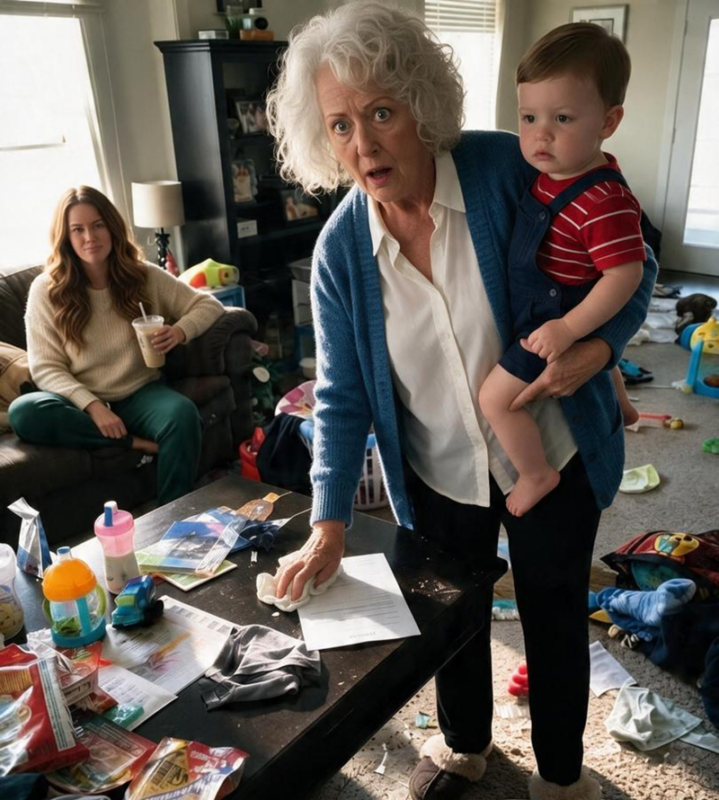
The kitchen counters were sticky. Laundry had accumulated everywhere. The bathrooms clearly had not been properly cleaned in some time. The children’s bedrooms were overflowing with clothes, toys, papers, and half-finished household tasks.
At first, I assumed Melissa had simply fallen behind.
Life with two young children could be exhausting. I knew that better than most.
I had raised Jason while working for thirty years. I understood busy seasons.
So I did not judge her.
Then Melissa came downstairs close to noon with her phone in her hand.
Without much of a greeting, she looked around the kitchen.
“The bathrooms really need to be done,” she said. “And someone needs to go through the refrigerator. The kids want spaghetti tonight too.”
She paused, then added something about how Jason’s mother had always kept a tidy home.
I looked at her for a moment.
Jason’s mother.
Me.
It was strange hearing myself discussed as though I were some example she was using to make a point.
Still, I let it go.
I had come to spend time with Emma and Thomas. If cleaning a bathroom or making dinner helped everyone, I was willing.
But the requests did not remain requests for long.
They became instructions.
Clean this.
Organize that.
Move the summer clothes.
Sort the pantry.
Pack the lunches.
Vacuum underneath the furniture.
Each morning, Melissa slept late while I prepared breakfast with the children.
Emma stirred pancake batter while Thomas insisted on cracking eggs, usually with pieces of shell included.
We went to the park.
We read books.
We worked on puzzles.
I listened to stories that only made sense to a four-year-old and laughed anyway.
Those were the parts of the visit I treasured.
But between those moments, I was also slowly restoring the house.
I cleaned.
I cooked.
I washed clothes.
I folded tiny socks and shirts.
I sorted closets.
I scrubbed counters.
I packed lunches.
And almost every time I passed through the living room, Melissa was sitting with her phone.
Then Friday afternoon, she made a joke that stopped me for a second.
“Don’t turn into one of those lazy grandmothers,” she said with a laugh.
I looked down at the basket of clean laundry in my arms.
Lazy.
The word stung more than I expected.
I had worked most of my adult life.
I had raised Jason.
I had maintained my own home.
And after my husband, Gerald, died nine years earlier, I had learned to manage everything alone.
There had been no one to carry the groceries when my knees hurt.
No one to fix the leaking faucet before dinner.
No one sitting on the other side of the bed when the house became too quiet at night.
I had built a peaceful, independent life after losing the person I thought I would grow old beside.
Being called lazy after spending days cleaning someone else’s home should have angered me.
Instead, I looked toward the children.
I swallowed my response.
They were the reason I stayed.
By the end of that week, I had cleaned nearly the entire house, prepared every dinner, washed three loads of laundry, packed fourteen lunches, organized two closets, bought groceries, and cared for two young children.
And then Thursday morning came.
I walked into the kitchen expecting coffee.
Beside my cup was a piece of paper.
At first, I assumed it was a grocery list.
Then I saw the heading.
It was an invoice.
For me.
I picked it up and read it once.
Then again.
Guest-room accommodation: $900
Food and utilities: $650
Household amenities: $450
TOTAL: $2,000
For several seconds, I simply stood there.
I honestly wondered whether it was some strange joke.
Then Melissa walked into the kitchen.
Her expression told me it wasn’t.

PART 2 — THE $2,000 BILL
I held up the paper.
“Melissa, you asked me to come here.”
She barely reacted.
“You still stayed in my house,” she replied. “Electricity isn’t free. Neither is water, food, or air-conditioning.”
I could hardly believe what I was hearing.
“I bought groceries.”
“That doesn’t cover everything.”
“I cooked every meal.”
“You chose to.”
“I cleaned your house.”
Again, she shrugged.
“No one forced you to do that.”
I felt something inside me become very still.
Not furious.
Not explosive.
Just clear.
She continued as if discussing an ordinary household expense.
“I expect the money before you leave.”
I looked at the bill again.
Two thousand dollars.
For staying in a house where I had been invited.
For sleeping in a guest room while spending my days caring for her children and restoring the home around her.
Years earlier, I might have argued immediately.
Age had taught me something more useful.
Not every insult deserved an instant reaction.
Sometimes people revealed far more when you gave them enough silence.
So I folded the invoice neatly.
“All right,” I said. “Give me until tomorrow to arrange it.”
For the first time that morning, Melissa smiled.
She apparently believed the conversation was finished.
It wasn’t.
I went upstairs, closed the bedroom door, and called my son.
Jason answered from his hotel in Denver.
I did not begin by insulting his wife.
I did not exaggerate.
I simply told him what the week had been like.
The condition of the house.
The chores.
The lunches.
The meals.
Melissa sleeping late.
Her comment about me being lazy.
And finally, the invoice.
There was silence on the phone.
Then Jason said, “She wants you to pay two thousand dollars?”
“Exactly two thousand.”
“She actually made a bill?”
“Itemized.”
Another silence.
I could hear his disbelief turning into something heavier.
I told him I was not calling so he could shout at Melissa.
This was their marriage.
Their home.
They would need to deal with that themselves.
But he deserved to know what had happened while he was away.
Then I explained what I planned to do the following morning.
Jason listened.
When I finished, he said quietly, “I’m changing my flight.”
He told me he would be home around nine.
After ending the call, I made three more.
The first was to Dorothy, a retired accountant who had been my friend for years.
The second was to my neighbor Robert, who owned a truck and never hesitated when someone needed help.
The third was to Gerald’s brother, a contractor.
When the calls were finished, I sat at the little desk in the guest room and began making a list.
If Melissa wanted to turn family into a financial transaction, then perhaps she needed to see what that transaction actually looked like.
I calculated seven days of childcare for two children.
$1,400.
Then a full deep cleaning of the house.
$800.
Fourteen meals and fourteen packed lunches.
$700.
And groceries I had purchased myself, with receipts.
$312.
Total:
$3,212.
Dorothy helped format the document to match Melissa’s invoice almost perfectly.
Same neat layout.
Same businesslike appearance.
Even the same font.
When I finally went to sleep, I did so peacefully.
For the first time all week, I knew exactly what I was going to do.

PART 3 — MY INVOICE
Robert arrived early the next morning.
Together, we began loading my bags into his truck.
I took my clothes.
I took my toiletries.
I took three jars of strawberry jam.
But I left the quilts exactly where they were.
Those had been made for Emma and Thomas.
Whatever disagreement existed between the adults had nothing to do with them.
I also left Thomas one jar of jam because he had already declared it “the best jam in the entire world,” a judgment I suspected might have been slightly biased.
At seven, Gerald’s brother arrived.
Months earlier, Jason had talked about building a deck in the backyard.
The materials had been sitting beneath a tarp for eight months.
Jason had approved the work that morning, and his uncle had offered to complete it at the family rate.
Soon, the sound of tools filled the backyard.
By the time Melissa came downstairs at around nine-fifteen, workers were setting the first posts.
She stopped in the kitchen doorway.
“What is going on?”
“Jason approved the deck,” I said calmly. “He should be home soon.”
Her eyes moved from the backyard to the packed boxes near the door.
Then I slid a piece of paper across the kitchen table.
“My bill,” I said.
She stared at me.
Then she looked down.
Her eyes moved line by line.
Childcare.
Cleaning.
Meals.
Lunches.
Groceries.
Total: $3,212.
I watched the confidence disappear from her face.
“You can’t charge me for this.”
I almost smiled.
“You charged me for staying somewhere I was invited to stay. I’m charging you for the work I performed while I was here.”
She looked again at the totals.
After subtracting her $2,000 invoice, she still owed me more than twelve hundred dollars.
For perhaps the first time that week, Melissa had nothing to say.
But I had not created that invoice because I wanted her money.
I wanted her to understand something.
So I sat across from her.
“I’m not collecting it.”
She looked up.
“I didn’t take care of Emma and Thomas because I expected to be paid,” I told her. “I did it because I love them.”
My voice remained calm.
“I cooked because they needed dinner. I cleaned because the house needed help. I packed their lunches because they needed lunches the next day.”
I tapped the invoice gently.
“This paper is what happens when every act of kindness becomes a transaction.”
Melissa stared at the table.
“And family cannot survive very long if everyone keeps a running total of what everyone else owes.”
PART 4 — WHEN JASON CAME HOME
A few minutes later, we heard a vehicle pull into the driveway.
Emma reached the window first.
“Daddy!”
She and Thomas raced outside.
Jason barely had time to close his truck door before both children wrapped themselves around him.
Whatever frustration he had carried home disappeared from his expression for several seconds as he hugged them.
Then he came inside.
His eyes went first to me.
Then to Melissa.
Then to the two invoices lying beside each other on the kitchen table.
Finally, he looked through the back door and saw his uncle working on the long-delayed deck.
For a moment, relief crossed his face.
Emma ran back inside and wrapped both arms around my leg.
“Grandma, can you stay another day?”
That nearly undid me.
I stroked her hair.
Then I looked at Melissa.
There was no smug smile now.
No dismissive shrug.
She looked embarrassed, tired, and perhaps a little ashamed.
“You can stay,” she said softly.
It was the first time all week that the invitation sounded sincere.
But Robert had driven four hours to help me, and my own home had been waiting for me.
“My garden needs me,” I told Emma. “But I’ll come again.”
Then I looked at Jason.
“Next time, when your father invites me.”
Jason understood immediately.
“You never need permission to come see us, Mom,” he said. “I should have made that clear a long time ago.”
I hugged him.
Then Emma.
Then Thomas.
At the door, Melissa approached me carrying the three jars of strawberry jam I had packed.
“These are yours,” she said.
I looked at Thomas.
His face immediately fell.
I took two jars.
“The other one stays.”
Thomas grinned.
That was enough for me.

PART 5 — WHAT HAPPENED AFTERWARD
Jason called me that evening.
His voice sounded exhausted.
“I’m sorry, Mom.”
“You didn’t know what was happening.”
“I should have.”
I paused.
There are moments when comforting your child is easy.
And moments when loving them means refusing to make the lesson disappear.
“Yes,” I said. “You should pay more attention.”
He was quiet.
Then he promised he would.
Three weeks later, Jason called again.
Things in their household were changing.
Melissa had taken a part-time job.
They had arranged reliable childcare.
More importantly, they had created a routine so Emma and Thomas had greater consistency each day.
Jason’s uncle finished the deck too.
Life did not magically become perfect.
But everyone had begun participating in it again.
Then November came.
Jason called and asked whether the four of them could spend a weekend at my house.
This time, the invitation worked in the opposite direction.
I said yes.
Emma and Thomas slept beneath the quilts I had made for them.
We used the last strawberries from my garden to make jam.
In the evenings, we sat near the fire.
In the mornings, Jason and I drank coffee while the children wandered around in pajamas.
There were no bills waiting beside anyone’s cup.
No one was measuring how much water had been used.
No one calculated the price of breakfast.
We simply lived like a family.
One afternoon, Melissa joined me in the kitchen while I prepared another batch of jam.
Her second jar failed to seal properly.
Months earlier, perhaps she would have become defensive.
And perhaps months earlier, I might have been tempted to correct her sharply.
Instead, I showed her what had gone wrong.
No criticism.
No embarrassment.
Just a quiet explanation.
She tried again.
The third jar sealed perfectly.
Melissa stared at it for a moment with an unexpected smile.
“My grandmother used to make jam,” she said softly. “I haven’t thought about that in years.”
I looked at her.
“Some things never completely leave us,” I said. “Sometimes they just need a little time before they come back.”
She nodded.
And together, we finished the rest of the batch.
That weekend did not erase everything that had happened.
It did not turn Melissa and me into best friends overnight.
Real families rarely heal that neatly.
But something important had changed.
We had stopped calculating every favor.
We had stopped treating kindness like currency.
And we had begun doing something much harder—and much more valuable.
We were paying attention to one another.
We were making an effort.
We were learning how to be family again.
Sometimes rebuilding a relationship does not begin with a dramatic apology.
Sometimes it begins with something much smaller.
A jar of strawberry jam.
A quiet lesson in the kitchen.
A child sleeping beneath a handmade quilt.
And the understanding that the people we love should never have to wonder what our kindness is going to cost them.