
Aug
The Dress in the Attic
The oldest thing in my house was not the upright piano in the living room, though its ivory keys had yellowed with age. It was not the walnut clock that had belonged to my grandfather or the blue-and-white quilt my grandmother stitched by hand.
It was a simple ivory prom dress hanging inside a garment bag in the attic.
The dress had no lace train, crystal beads, or designer label. My mother, Rose, had sewn it at our dining room table in the spring of 1969. A narrow band of tiny seed pearls circled the waist.
I had worn it only once—to my senior prom with Daniel Bennett.
Every April, I climbed the attic stairs, opened the cedar chest, and lifted out the garment bag. I inspected the fabric, aired it beside the little round window, and wrapped it again in fresh tissue paper.
My friends stopped asking why long ago.
Some people called it stubbornness. Others thought I had allowed the past to take too much from me.
I called it keeping my word.
Daniel and I met when we were fifteen. He was the quiet boy who sat behind me in chemistry class and always carried two sharpened pencils. I was the girl who knew most of the answers but hated raising her hand.
During a test one morning, my pencil broke. Before I could panic, Daniel slid one of his across the desk without looking up.
After class, I tried to return it.
“Keep it,” he said. “You might need rescuing again.”
I laughed so loudly that our teacher looked over his glasses at us.
From then on, we were rarely apart. We studied at the library, shared french fries at Henderson’s Diner, and spent summer evenings talking about places we had never seen.
We were not the loudest couple at school. We were not crowned prom king and queen, and our photograph never appeared in the center of the yearbook.
We simply fit.
Daniel understood that I became quiet when I was worried. I knew he whistled whenever he was trying to solve a problem. He could make me laugh without making me feel foolish, and I could settle his nerves with a look.
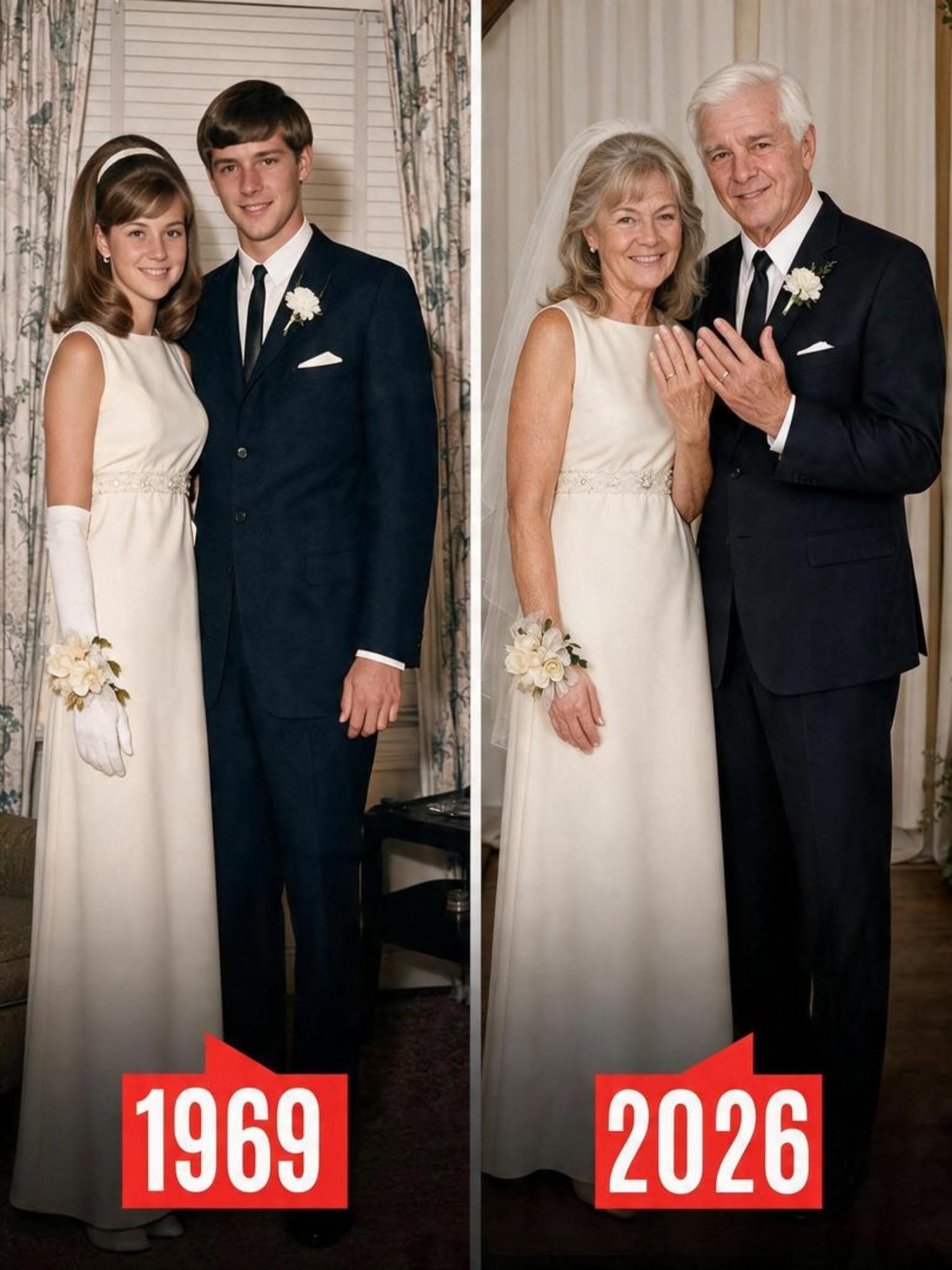
At our senior prom, we danced beneath silver paper stars in the high school gym. Daniel wore a dark suit borrowed from his cousin and a white carnation on his lapel. I wore the ivory dress my mother had made.
“You look like the rest of my life,” he told me.
It was an awkward sentence from an eighteen-year-old boy, but I remembered every word.
Two weeks after graduation, Daniel received orders to serve overseas.
And the night before he left, I made him a promise that would shape the next fifty-five years of my life.

The Promise on Willow Hill
We drove to Willow Hill, where the lights of our small Ohio town looked like scattered coins below us. We stayed until the sky began to pale, talking about the life we believed was waiting for us.
We imagined a white house with green shutters, a kitchen big enough for Sunday dinners, and children who would be allowed to make all the noise they wanted.
I had brought my prom dress in its new garment bag because my mother had helped me prepare it for storage that afternoon. Daniel smiled when he saw it lying across the back seat.
He touched the sleeve lightly.
“Don’t let anyone else see you walk down the aisle in this,” he said. “Save it for me.”
“I will,” I promised.
At the bus station the next morning, he kissed my forehead, picked up his duffel bag, and walked away. He turned three times before boarding.
For nine months, his letters arrived almost every week.
Daniel wrote about terrible coffee, relentless heat, and a stray brown dog near his post. He asked about my father’s hardware store and my younger cousin.
At the bottom of every letter, he drew a tiny house with green shutters.
I answered every one.
Then his letters stopped.
At first, everyone told me that overseas mail was unreliable. After six weeks, Daniel’s parents received an official visit. He had been declared missing in action.
There was no funeral because there was no certainty. There was only an empty place at church, a mother who jumped whenever the telephone rang, and a young woman who checked the mailbox every afternoon.
I postponed college for a year. Then another.
My mother tried to be gentle at first.
“You can love him and still live your life,” she told me.
But I did not know how to separate those things. Loving Daniel and waiting for him felt like the same act.
Eventually, I trained as an elementary school teacher. I moved two towns away, rented a small apartment, and filled my days with spelling tests, construction-paper projects, and children who often needed more kindness than they knew how to request.
There were other men over the years.
A music teacher brought me daisies. A widowed father invited me to dinner. A kind accountant named Frank once said he did not mind competing with a memory.
But I minded.
I never asked anyone else to wait with me. Instead, I built the fullest life I could. I taught for thirty-eight years, cared for my parents as they aged, traveled with friends, and became “Aunt Ellie” to children who were not related to me.
I was not lonely every day. That was what people misunderstood.
I had friendships, work, music, and a house rarely empty during the holidays. Still, there was a quiet room inside my heart that no one else entered.
And every spring, I aired out the ivory dress.
Fifty-Five Years of Silence
My father, Harold, disliked my yearly ritual.
“Enough, Ellie,” he said once after finding me on the attic stairs. “A promise made at eighteen should not decide your whole life.”
My mother immediately changed the subject.
I assumed my parents were worried about me. I never guessed they were afraid of what I might discover.
Years became decades.
Daniel’s parents passed away without learning what had happened to their son. I attended both services and sat in the last pew. My mother held my hand through each one.
When I was forty-two, the military changed Daniel’s official status from missing to presumed deceased. A thick government envelope arrived at my home.
I placed it, unopened, inside the cedar chest beneath the dress.
“Paper does not know what happened to him,” I told my mother.
She turned toward the kitchen window. At the time, I thought she was crying out of sympathy.
After my parents died and I retired, I moved back home. I painted the kitchen pale yellow, restored the piano, and turned my father’s office into a reading room.
I searched through veterans’ groups, public records, and the early internet. I wrote to men who had served with Daniel, but every reply led nowhere.
Eventually, searching became less like an action and more like breathing—always present, mostly invisible.
Then, on a rainy afternoon in October, someone knocked on my front door.
I was seventy-three and halfway through a crossword puzzle. I expected a delivery driver or my neighbor June asking to borrow cinnamon.
Instead, an elderly man stood on my porch beneath the gray sky.
He was tall but slightly stooped. Silver hair fell across his forehead, and one hand trembled around the handle of a worn leather suitcase. Time had altered nearly everything about his face.
It had not altered his eyes.
I gripped the edge of the door.
He looked at me as though he had reached the end of a journey he no longer believed he could finish.
“Ellie?”
Only one person had ever said my name that way.
My knees weakened.
“Daniel?”
He nodded. His mouth opened, but no sound came. Then he drew a shaky breath.
“I’ve been trying to find my way back to you.”
For several seconds, neither of us moved.
I had imagined that moment thousands of times, but in every version I had been young. I had never imagined gray hair, aching knees, or two people staring at each other across all the life they had lost.
At last, I stepped aside.
“You’d better come in,” I whispered. “It took you long enough.”
Daniel gave one broken laugh as tears filled his eyes.
Inside, I made tea that neither of us drank.

The Man Who Came Back
Daniel’s story came in pieces.
He had survived. He had been badly injured and separated from his unit, then treated far from any American base. Months passed before officials confirmed his identity. A spelling error in transferred records listed him as “Bennet,” with one final t, while conflicting reports delayed notification to his family.
By the time he returned to the United States, almost three years had passed.
His recovery took longer. Some memories returned clearly; others came back like photographs pulled from water. He said my face had remained sharp through all of it.
“I remembered the dress,” he told me. “Before I remembered my own telephone number, I remembered that dress.”
He did not explain everything that first afternoon. He said only that he had come home, tried to find me, and failed.
I wanted to ask how a person could fail for more than half a century. But he looked exhausted, and the miracle of his presence felt too fragile to question.
We talked until midnight.
The next morning, Daniel returned with the leather suitcase. He opened it on my dining room table. Inside were photographs, official papers, and a stack of letters tied with faded blue ribbon.
Every envelope bore my name.
Every one had been returned.
Across several envelopes, someone had written, “No longer at this address.” On another were the words, “She does not wish to be contacted.”
I recognized the handwriting, though I did not yet let myself understand what that meant.
“Where did you get these?” I asked.
Daniel closed the suitcase.
“I’ve carried them for years.”
Before I could question him further, June burst through the back door with a casserole. By evening, half the town knew that Daniel Bennett had returned from the dead.
During the next three weeks, we received more attention than either of us had known in seventy-three years.
Former students brought flowers. Old classmates called from other states. June supplied enough food to last until Christmas.
Daniel rented a room at the Maple Street Inn, but he spent every day with me. We revisited Willow Hill, ate lunch at the diner that had replaced Henderson’s, and walked through our old high school gym, which had been renovated beyond recognition.
There were awkward silences as well as laughter. We were not teenagers preserved in amber. Daniel drank his coffee black now. I had learned to enjoy quiet mornings. He saved every receipt; I threw mine away before reaching the car.
Yet beneath those small differences, something familiar remained.
He still whistled when trying to solve a problem.
I still became quiet when I was worried.
One afternoon, I led him up to the attic and unzipped the garment bag.
The dress was softer in color than it had been in 1969. A faint line marked the hem, and several seed pearls were loose at the waist. But it was whole.
Daniel stood three steps below me, staring.
“You kept it.”
“I told you I would.”
He sat down hard on the stair and covered his face.
That was the moment I decided I did not want to spend another season waiting.
The Wedding We Waited a Lifetime For
We married three weeks after Daniel knocked on my door.
Some people said it was too soon. I thought fifty-five years was long enough.
One of my former students, now a seamstress, reinforced the old seams and carefully replaced the missing pearls. The dress no longer fit exactly as it had when I was young, so she added discreet panels along the sides.
No one tried to make me look seventeen again. That was not the point.
I wore my silver hair beneath a simple veil. Daniel chose a dark navy suit and pinned a white carnation to his lapel.
We married in my living room beside the old piano. June served as my maid of honor, and Daniel’s niece Megan stood with him. Twenty guests crowded inside while rain tapped against the windows.
When I appeared at the foot of the stairs, Daniel pressed one hand to his heart.
“There you are,” he said.
The pastor asked us to promise only what we still had time to give: honesty, patience, companionship, and care.
We both answered, “I will.”
Afterward, we ate lemon cake from mismatched china and moved slowly across the living room floor.
For one golden evening, the years between us seemed less like a wall and more like a long road that had finally brought us to the same door.
At nine, the last guests left.
The house fell silent.
I changed into a blue robe and found Daniel sitting in the upstairs sitting room, turning his wedding ring around his finger. After a moment, he pulled it off, stared at it, and slipped it back on.
Something in his face made me stop.
“What is it?”
He looked toward the leather suitcase near the door.
“There is something I should have told you before today.”
My happiness tightened into fear.
“Then tell me now.”
He drew a slow breath.
“I wasn’t kept away from you for fifty-five years because of the war.”
I stared at him.
“What do you mean?”
“The war kept me away for three years. Recovery took two more. But I came back to this town in 1974.”
The room seemed to tilt.
“You came here?”
“I came to this house.”
I remembered 1974. I had been twenty-three, teaching second grade in Dayton and returning home nearly every weekend. I had still checked my mailbox every day.
“Then why didn’t you find me?”
Daniel’s eyes filled with pain.
“Because someone told me you knew I was alive. She said you had waited, then fallen in love with someone else. She said you were engaged and did not want me appearing at your door.”
I could barely breathe.
“Who?”
Daniel hesitated.
Then he spoke the name that drained the color from my face.
“Your mother. Rose.”

My Mother’s Handwriting
I stood so quickly that my chair struck the wall.
“No.”
“Ellie—”
“My mother sat beside me for years while I waited for you. She helped me write to government offices. She watched me open every empty mailbox.”
Daniel opened the suitcase and removed the bundle of returned letters.
“Look at the writing.”
I did not want to look. I already knew.
The long curve of the capital S. The narrow, slanted t. My mother had written thousands of grocery lists, birthday cards, and school notes in that same hand.
On the top envelope were seven words:
Eleanor has chosen another life. Please stop.
My mother had written them.
Daniel told me that Rose had met him on our porch in 1974. My father was at work, and I was teaching in Dayton. She said I was engaged to another teacher and moving to California. When Daniel asked for my address, she refused.
“She said seeing me would reopen everything you had worked to overcome,” he explained. “I told her you had promised to wait. She said that promise had nearly ruined your life.”
Daniel wrote anyway—eleven letters over four years. All came back. Rose answered the last one directly, telling him I had married and asking him, as an act of love, to leave me in peace.
“Why did you believe her?” I asked.
“Because she was your mother. Because I was not well, and I thought you deserved someone who had come home whole. Most of all, because I believed that if you wanted me, you would have written.”
“I did write.”
“I know that now.”
He reached into the suitcase again and removed a small tin box I recognized immediately. It had once sat on my mother’s sewing table, filled with buttons.
Inside were my letters to Daniel—dozens of them, never mailed.
Some were open. Some were still sealed.
I stared at them.
“How did you get this?”
“Your cousin Martha found it last winter while clearing out her mother’s house. Rose had left it there shortly before she died, along with a letter addressed to me. Martha tracked down Megan through a veterans’ organization.”
Daniel handed me a yellowed envelope.
Inside was my mother’s confession.
She admitted that she had intercepted my outgoing letters whenever she could, telling herself she was preventing false hope. When Daniel returned—thin, uncertain, and still recovering—she became convinced that a reunion would destroy the stable future I was beginning to build.
Rose had watched her own mother spend years caring for a husband whose illness dominated their home. She confused fear with wisdom and control with love.
At first, she believed I would eventually marry someone else.
When I did not, she became trapped by what she had done. Each passing year made the truth harder to confess. She hid the letters at her sister’s house and carried the guilt for the rest of her life.
Her final lines were simple:
I thought I was saving my daughter from a life of waiting. Instead, I stole her right to choose. There is no excuse. If there is still time, please tell her the truth.
I lowered the letter.
The house in which I had spent so many loving years with my mother suddenly felt unfamiliar.
Memories rearranged themselves around me—Rose turning away when the military letter arrived, insisting another search would only cause pain, volunteering to take my letters to the post office, and crying at Daniel’s mother’s funeral.
All those moments now carried a second meaning.
Then another truth struck me.
Daniel had known all of this before our wedding.
The Ring on the Dresser
“You knew,” I said.
Daniel nodded.
“Why didn’t you tell me before the ceremony?”
“I was afraid.”
“So was she.” I held up my mother’s confession. “Look what fear did.”
He flinched.
Daniel did not defend himself. He did not reach for me or ask me to forgive him.
“You’re right,” he said. “I told myself I wanted to give you one happy day before changing your memories of your mother forever. But part of me was afraid you would send me away. Waiting until after we married was selfish. I am sorry.”
I removed my wedding ring and placed it on the dresser.
Daniel’s face went still.
“I need to think,” I said.
He picked up his suitcase and slept in the guest room.
I spent the night at the dining room table, reading fifty-five years of silence.
There were Daniel’s letters from 1974, hopeful at first and resigned later. My own unsent pages described schoolchildren, birthdays, my father’s declining health, and the day I nearly accepted Frank’s proposal.
Near dawn, I found a note I had written when I was twenty-five:
If you are alive somewhere, I hope no one is making your choices for you. That would be worse than waiting.
I wept—not only for Daniel, but for the young woman whose trust had been used against her.
When daylight came, I climbed to the attic and opened the cedar chest.
For the first time, the dress did not feel like proof that waiting had been noble. It felt like proof that love without truth could become a prison, even when the person holding the key claimed to mean well.
I heard Daniel stop at the bottom of the stairs.
“I can leave,” he said quietly. “If that is what you want, I will not make you ask twice.”
I looked at the dress and then at the man below.
“Do you have any other secrets?”
“No.”
“Any other truth you decided I could not handle?”
“No.”
“If there ever is one?”
“You will hear it first, even if I am terrified.”
I descended the stairs slowly.
“I cannot forgive my mother this morning,” I said. “Maybe I never will in the way people expect. And I am angry that you waited until after the ceremony.”
“You have every right to be.”
“But I will not let one more frightened decision steal another day from me.”
I reached into the pocket of my robe and found my wedding ring. I had carried it upstairs without realizing it.
I held it out to Daniel.
“This time,” I said, “ask me with the whole truth between us.”

The Whole Truth Between Us
Daniel’s hands trembled as he took the ring.
“Eleanor Hale, knowing where I have been, what I failed to do, and what was done to us, will you still share whatever time we have left?”
I looked at him for a long moment.
“Yes,” I said. “But no more protecting me from my own life.”
“Never again.”
He placed the ring back on my finger.
Our marriage did not erase what had happened. Some losses could not be repaired with a ceremony, a confession, or even forgiveness.
We never had the children we once imagined on Willow Hill. We never bought the white house with green shutters. We could not return to the spring of 1969 and tell two hopeful teenagers to guard their letters more carefully.
But we did have mornings.
We had coffee at the yellow kitchen table, arguments about receipts, and long drives without needing to fill every silence. Daniel repaired the attic window. I taught him video calling, although he pressed the wrong button at least once a week.
We read the old letters together slowly, one each Sunday.
My mother’s confession remained in the tin box. I did not burn it, and I did not hide it. I placed it with the others because secrecy had already taken enough from us.
Forgiving her was not a single choice I could make one morning. It came in small and uneven pieces.
I could remember the soup she made when I was ill and still condemn what she had done. I could be grateful for the dress she sewed and furious that she had turned it into a symbol of a promise she secretly prevented me from keeping.
Love did not require me to rewrite the truth.
That became one of the most important lessons of my life.
Months later, I donated our prom photograph and copies of several letters to the town historical society for an exhibit about local families and the way people once communicated across great distances.
I kept the dress.
Above it in the attic, I hung a small card written in my own hand:
Promises matter. But truth is what allows love to keep them.
The Road Home
On our first anniversary, Daniel drove me back to Willow Hill.
The old overlook had become a small park with two benches and a paved walking path. The town below was brighter than it had been in our youth, but from a distance the lights still looked like scattered coins.
We sat beneath the evening sky.
“We missed a lot,” Daniel said.
I nodded. I would not insult our younger selves by pretending otherwise.
“Yes,” I said. “We did.”
Then I took his hand.
“But we are here now.”
Daniel looked at me with the same gentle eyes I had memorized when I was young.
This time, there was no intercepted letter, no closed door, and no one else deciding what we could survive.
Below us, the lights came on one by one.
And together, at last, we watched the road home.