
Aug
For half a year, my daughter placed one painted stone on her father’s grave every Sunday. Then, without warning, the entire collection vanished. The only things left behind were an ordinary gray rock, a miniature brass key, and a message that forced me to question how well I had known the man I loved.
Part One—The Stones That Kept Him Close
The sun had barely lifted above the neighboring rooftops when I stepped onto the porch with Chloe’s newest stone cupped in my hand. She had painted it the night before: a bright yellow sun with uneven rays and a smile that tilted toward one side. The paint was dry, but I kept turning the stone over in my palm as if its warmth might steady me.
Six months had passed since Ian died in the accident. People spoke of time as if it were a gentle river that carried pain away. To me, those six months felt more like standing beneath a clock that moved while I remained fixed in place. Every morning arrived, every evening followed, and somehow I kept doing what needed to be done. Yet part of me was still waiting for Ian to walk through the door and ask what we were having for dinner.
From the kitchen came the quick tap of bare feet. A moment later, Chloe appeared in the doorway, still wearing her star-covered pajamas. Her brown hair surrounded her face in a sleepy cloud.
“Is Daddy’s stone ready?” she asked.
“All ready,” I told her. “The sun turned out beautifully.”
She climbed onto the chair opposite me and accepted it with both hands. She studied the painted face, solemn and careful, as though she were inspecting something precious enough to break.
“He needs a cheerful one today,” she decided. “The blue moon from last Sunday looked lonely.”
“You could tell?”
“Of course. Rocks tell you things if you pay attention.”
That answer sounded so much like Ian that I had to look away. He had always treated Chloe’s imagination as a place worth visiting. When she was three, the two of them began painting stones at our kitchen table. Under their brushes, ordinary pebbles became tiny planets, brave animals, secret houses, and explorers with crooked smiles. Ian invented a story for each one, while Chloe supplied the impossible details.
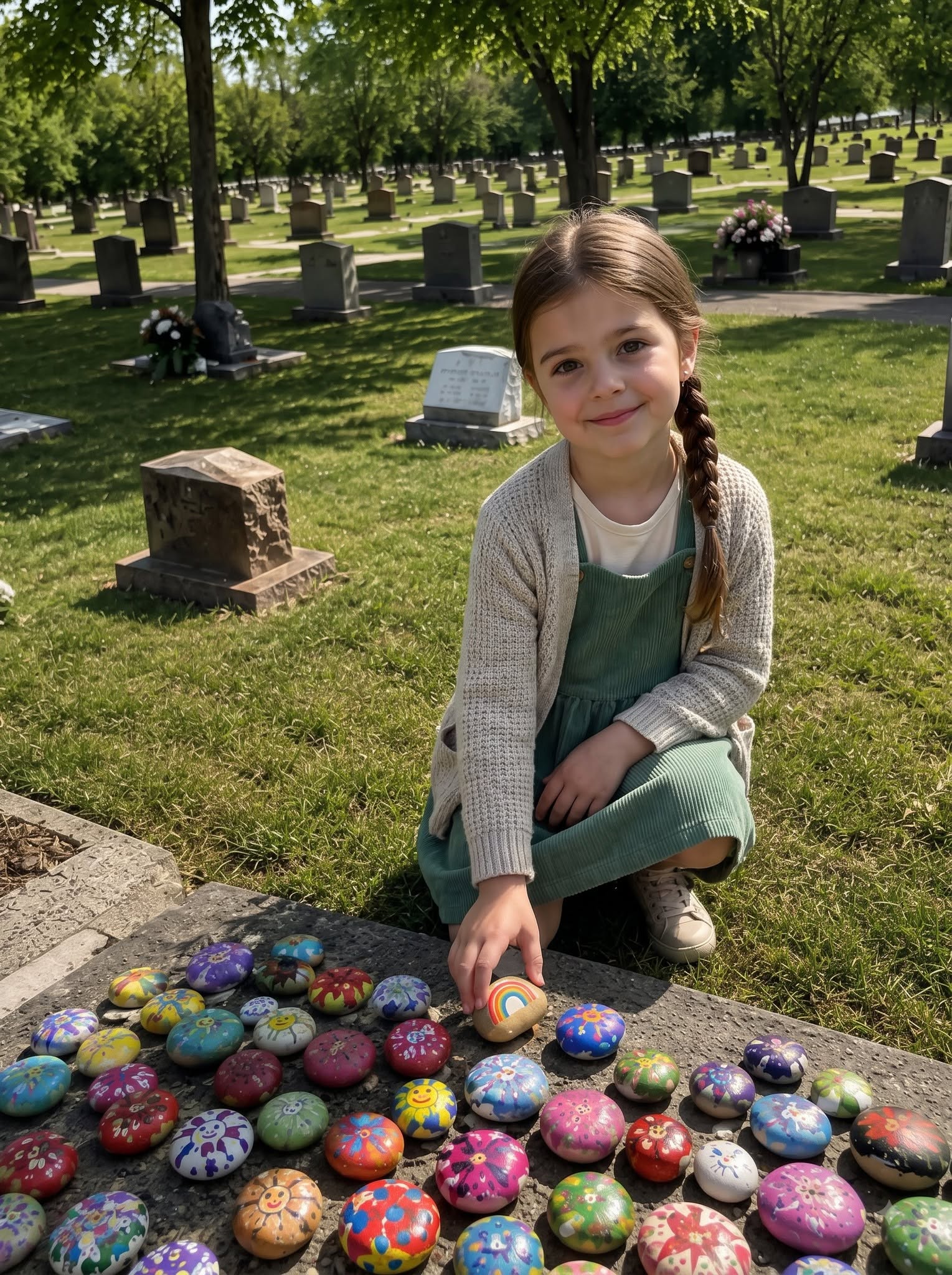
After his funeral, she asked whether she could take one stone to him every week. She said he would need new stories wherever he had gone. I agreed before grief could close my throat around the word no. Since then, Sunday had become our promise. Whatever the weather, we painted on Saturday and visited him the following morning.
The cemetery was quiet when we arrived. Dew silvered the grass, and the young maple beside Ian’s headstone had begun to scatter red leaves. At the foot of the granite lay more than twenty painted stones, bright against the earth. There were suns, stars, flowers, a smiling cloud, and one bulky purple creature Chloe insisted was a horse, although even Ian had privately admitted it looked more like a dinosaur.
Chloe knelt and chose a place for the yellow sun. She pressed it into the grass, adjusted it twice, and then rested her fingers on it.
“Have a happy trip this week, Daddy.”
I knelt beside her and said that he would treasure it. We remained there while Chloe described her week to the painted faces: the spelling word she had mastered, the caterpillar she had rescued from the sidewalk, and the pancake she had tried to flip without help. Listening to her, I could almost imagine Ian beside us, smiling with that patient attention he gave her whenever she believed something mattered.
“Did you paint stones with your mommy when you were little?” Chloe asked.
The question reached a room inside me I usually kept closed. My mother died when I was very young. I possessed only a few blurred impressions of her – the sound of humming, the scent of hand cream, perhaps a pale dress near a window. I could no longer tell which memories were genuine and which had been built from stories other people told me.
“No,” I answered gently. “I don’t remember doing anything like this with her.”
Chloe leaned against my arm without asking anything else. Beneath the maple, surrounded by the little stones she and Ian had created, the ache in my chest loosened for the first time in weeks. I did not know that, seven days later, that small peace would be torn open.

Part Two—The Morning Everything Disappeared
The next Sunday arrived beneath a low gray sky. Chloe wore her red jacket and carried a stone painted like a silver rocket, complete with two crooked flames. She hummed from the back seat while I drove, and I remember feeling grateful for how ordinary the morning seemed.
Then we rounded the path beneath the maple, and the world shifted.
“Mommy… where did they go?”
Ian’s grave was bare. I stared at the empty strip of grass and could not make sense of it. Then I dropped to my knees and searched with both hands, pushing aside damp leaves as though two dozen stones might somehow have rolled beneath them.
They were gone – every sun, every star, every odd little animal Chloe had carried there for six months. Only shallow impressions remained in the mud, dark outlines marking all the places where her gifts had rested. Seeing those empty shapes hurt almost as much as seeing the empty grave had on the day of the funeral. Someone had not merely taken painted rocks. They had reached into the private language my daughter shared with her father and erased it.
Except for one stone.
A colorless gray rock had been placed on the center of the headstone. Beneath its edge, a triangle of white paper showed against the dark granite. I lifted the stone. A tiny brass key slipped onto the grass, followed by a tightly folded note.
“What does it say?” Chloe whispered.
I turned slightly so she could not see the page and unfolded it. The message contained only three short lines.
You were never told the whole story.
Bring this key to the address below.
Come without anyone else.
An address followed, written in precise block letters. There was no signature and no explanation. I read the message again, hoping familiarity would make it less menacing. It did not.
“Is something wrong with Daddy?” Chloe asked.
“No, sweetheart. Someone moved the stones, and I’m going to find out why.”
She watched me with the quiet, knowing expression children wear when an adult’s words do not match her face. Then she tucked the rocket against her chest and took my hand.
On the drive home, she fell asleep in her car seat. I kept checking the mirror to reassure myself that she was safe. The key seemed impossibly heavy inside my pocket. Each turn of the road produced a new fear. Had Ian owed someone money? Had there been another woman? Another child? Had our marriage contained a locked room I had never noticed because I trusted him too completely? By the time I pulled into our driveway, suspicion had begun rewriting every memory I owned.
Part Three—The Choice I Could Not Avoid
That night, after Chloe was asleep, I placed the key and note beneath the kitchen light. Ian’s chair stood across from me. I hated the empty shape of it. I hated the message for making me look at that chair and wonder whether the man who once sat there had carried a secret all along.
I called Priya, my closest friend. She interrupted before I could finish reading the note aloud.
“Megan, absolutely not. You cannot go to an unknown address by yourself after someone has taken things from a grave.”
“If I stay home, I will never stop imagining what this means.”
“Wondering is better than walking into danger.”
She was right, and I knew it. But the person who wrote the note understood exactly which thread to pull. Those stones belonged to Chloe’s memories of her father. I could not ignore the person holding them, and I could not live under the shadow of an unfinished question about Ian.
“I’ll send you the address,” I said. “I’ll share my location before I leave. If I don’t message you within ten minutes of arriving, call me. If I fail to answer, call the police.”
“That does not make this a good idea.”
“No. It only makes it a less terrible one.”
Priya went silent for several seconds. Finally, she agreed to keep Chloe the following morning, though she made me promise three separate times that I would not enter any place that felt unsafe.
After the call ended, I typed the address into my phone. A storage complex appeared at the edge of town. Rows of small units. No houses. No businesses. Nothing that explained why Ian’s name had been pulled into this.
I closed my fingers around the brass key and spoke into the silent kitchen.
“Ian, what were you trying to keep from me?”
The next morning, I left Chloe at Priya’s house. She was still wearing one shoe when she ran back down the path to hug me a second time. I held her longer than necessary, breathing in the strawberry scent of her shampoo. Then I watched until Priya closed the door behind her.
The drive to the storage facility took twenty-three minutes. It felt like hours.

Part Four—Behind the Orange Door
The facility stood beyond an industrial park, its rows of orange doors separated by narrow gravel lanes. Wind pushed scraps of leaves against the metal. I found the unit number from the note, sent Priya my location, and stood before the lock with my pulse drumming in my ears.
I told myself that whatever waited inside could not be worse than the call that had told me Ian was gone. That was not true, but it gave me enough courage to slide the key into the padlock.
It turned immediately.
I raised the door and braced myself for photographs, hidden records, or evidence of a life that did not include Chloe and me. Instead, the unit held a single folding table. Arranged across it, in the same loose pattern they had formed around Ian’s headstone, were all of Chloe’s painted stones.
The yellow sun. The blue moon. The purple not-quite-horse. Every one of them was there, clean and unharmed.
Relief came first, sharp enough to weaken my knees. Anger followed. Someone had frightened my child and stolen a piece of our grief only to display it on a plastic table. I stepped closer, searching for another message, when gravel crunched behind me.
I spun around. A woman stood several feet away. She looked to be in her late forties, with gray beginning at her temples and a worn canvas bag over one shoulder. Both hands were raised where I could see them.
“Please don’t run,” she said. “And please don’t be frightened.”
“You took gifts from my husband’s grave and ordered me to come alone. You have about five seconds to explain before I call the police.”
Shame crossed her face. She glanced at the stones and then back at me.
“My name is Rachel Bennett. Ian hired me almost four years ago.”
The name meant nothing to me, but Ian’s name in her mouth made the ground feel unsteady.
“Hired you to do what?”
“To locate your mother’s belongings – and, if possible, the relatives who still had them.”
Of all the answers I had imagined, that one had never appeared. My anger did not vanish, but confusion interrupted it so completely that I could only grip the edge of the table and stare at her.
Part Five—The Secret Was About Me
“My mother?” I repeated.
Rachel nodded. She explained that she worked as a private family researcher. Ian had contacted her after hearing me mention, once again, how little remained from my childhood. My mother’s death had fractured her relatives. Old arguments over possessions and inheritance hardened into years of silence. Boxes changed hands. Addresses were lost. People who might have known something stopped speaking to one another.
“Why didn’t he tell me he was searching?”
“Because he refused to offer you hope until he had something real,” Rachel said. “He was afraid that another disappointment would feel like losing her again.”
I thought of all the small confessions I had made during our marriage. I had told Ian that I wished I knew my mother’s favorite song, whether she drank coffee or tea, whether my hands resembled hers. I had admitted that photographs of other women with their mothers sometimes left me aching for a history I could not touch. Ian had always listened without trying to fill the silence with easy comfort.
I had believed listening was all he could do. I had never guessed that, afterward, he was quietly gathering my scattered past.
Rachel said he had written letter after letter: to aunts, cousins, and distant relatives whose names he uncovered one at a time. Many went unanswered. Some came back unopened. Still, he continued. He asked for no money and demanded no family secrets. He only wanted photographs, letters, or a few objects that could connect me to the woman I had lost before I was old enough to know her.
“He told me he wanted to return part of your beginning to you,” Rachel said.
I sat on the edge of the table because my legs would no longer hold me. For months, I had remembered Ian mainly through the brutal finality of his absence. Now a new image of him emerged: sitting awake after Chloe and I went to bed, addressing envelopes to strangers, patiently trying to repair a family history that had broken long before he met me.
“Did anyone ever answer him?” I asked.
Rachel’s expression softened.
“Yes. Two weeks after Ian died, one of your aunts replied to a letter he had sent the previous autumn.”
The woman had kept a box that once belonged to my mother. At first, she was unsure whether she could part with it. Rachel spent months rebuilding trust, speaking with her gently and allowing her time. A few weeks earlier, the aunt had finally mailed the box.
“Ian never knew she answered,” Rachel said. “But the search he began succeeded.”
The news should have comforted me, yet another question remained.
“You had my name. Why didn’t you simply contact me? Why put Chloe and me through this?”
Rachel lowered her gaze. The phone number Ian had provided was disconnected after the accident. I had moved because remaining in the house where we had lived together became unbearable, and the letters Rachel sent there were returned. The funeral home would not release my information. Her public-record searches led nowhere current.
She had visited the cemetery on three Sundays, hoping to find me, but arrived at the wrong times. Eventually, she noticed the growing circle of painted stones and understood that whoever left them would return.
“Taking them was wrong,” she said. “I knew it while I was doing it. I thought it was the only way to make certain you found my message. I am truly sorry for frightening you and your daughter.”
I wanted to remain furious. Part of me still was. But Rachel’s regret was real, and behind her clumsy, frightening decision stood a promise she had chosen to finish for a man who could no longer finish it himself.

Part Six—The Box Ian Never Got to Give Me
Rachel stepped behind the raised door and returned carrying a weathered cardboard box. The corners had softened with age, and faded handwriting crossed the top. She set it beside the painted stones with both hands, as carefully as if it contained something alive.
“This is what Ian wanted you to have.”
My fingers shook as I lifted the lid.
On top lay a white handkerchief embroidered with my mother’s initials in pale blue thread. Beneath it was a slim silver ring, a bundle of letters tied with ribbon, and several photographs whose edges had yellowed. I picked up the first picture.
A young woman sat on a porch swing, sunlight touching one side of her face. She held a baby against her chest. The baby was me.
I had seen one formal photograph of my mother, but never one like this. Here she was not a distant face posed for a camera. She was laughing at someone beyond the frame. One hand supported my back; the other curled protectively around my tiny foot. Love was visible in the way she held me, ordinary and unquestioned.
I lowered myself onto the concrete floor. Grief moved through me, but it was different from the grief I had carried since Ian’s death. It held sorrow for both of them – the mother I could not remember and the husband who had spent years trying to return her to me. Yet inside that sorrow was proof that neither love had vanished simply because I could no longer reach the person who gave it.
“I was afraid I had invented her face,” I whispered. “But this is really her.”
Rachel knelt nearby, leaving enough space for me to breathe.
“In one of his letters, Ian wrote that he wanted you to own something that showed you were loved before your earliest memory.”
Those words broke through every careful wall I had built since the funeral. I cried for the child who had grown up with unanswered questions. I cried for Ian, who had carried those questions as if they belonged to him too. And I cried because, even after death had interrupted his plan, his love had still found a road back to me.
When the tears finally eased, I looked at the painted stones lined across the table. I could have held on to anger toward Rachel. Instead, I saw a flawed person who had made a frightening choice while trying to keep a promise.
“Thank you for completing what he began,” I said.
“Most people hire me because they want information,” Rachel replied. “Ian wanted to restore something to someone he loved. That made this search different.”
She offered me a folded sheet containing my aunt’s name and address. I placed it carefully in my wallet.
“I want to meet her,” I said. “I spent years believing my mother’s family had disappeared. I don’t want fear or old arguments to take them from me again.”
Rachel smiled through wet eyes and said Ian would have been proud to hear that.
Part Seven—What We Carried Forward
Before leaving the storage facility, I sent Priya the message she had been waiting for: I was safe. Then I called and let her hear my voice. I did not try to explain everything over the phone. Some truths are too large to be squeezed into a hurried conversation.
Rachel helped me place the stones in two padded boxes. When we reached the cemetery, we rebuilt Chloe’s bright little circle around Ian’s headstone. It was not exactly as it had been before, but perhaps that was fitting. Grief never restores a life to its former shape. It asks us to make a new shape from what remains.
“Would you come with me next Sunday?” I asked Rachel. “Chloe should meet the person who helped finish her father’s surprise.”
Rachel nodded, too moved to answer.
The following Sunday, Chloe hurried toward the grave with the silver-and-red rocket she had been unable to leave the week before. She placed it beside the yellow sun and added a tiny white stone painted with a pink heart. Then I showed her the photograph from the box.
She studied the woman on the porch swing and then looked up at me.
“That’s your mommy holding you?”
“Yes. I was even smaller than you.”
“Can we make a stone for her next Saturday?”
A familiar ache rose in my throat, but this time it did not feel empty.
“I think she would love that.”
I rested the photograph against Ian’s headstone. In a single frame were the two stories that had shaped me: the mother who loved me before I could remember, and the husband who spent years proving that love had existed. Chloe slipped her hand into mine, her fingers warm and certain.
For six months, every visit to that place had been about what death had taken from us. That morning, surrounded by painted stones returned to their places, I understood that memory could do more than preserve loss. It could open a door. It could reconnect a family. It could carry a final act of devotion beyond the person who began it.
I still missed Ian with every part of me. I always would. But I no longer stood at his grave holding only absence. In my wallet was the address of an aunt I had not yet met. In my hands was a photograph I had waited a lifetime to see. Beside me was our daughter, already planning the next stone she would paint.
And ahead of us, for the first time since Ian died, there was not merely a road away from what we had lost. There was also a road toward what his love had returned.