
My husband and I have always taken our boys to football games.
That is our family thing.
Some families save up for beach vacations. Some wear matching pajamas every Christmas morning. Some spend Sundays around a dining table with elaborate meals.
We do stadium food, cold metal seats, overpriced foam fingers, parking-lot traffic, and the kind of yelling that leaves your throat wrecked the next morning.
Our sons grew up believing that sitting beneath stadium lights on a Saturday night was as normal as eating dinner together.
So when my husband, Dean, somehow managed to get four tickets to the championship game, he came into the kitchen waving them over his head like he had just won the lottery.
“Section 112,” he announced proudly.
He laid the tickets on the counter and tapped them with one finger.
“Good angle. Close enough to feel the noise, but not so close that somebody dumps beer on us.”
I laughed.
“You say that like avoiding beer is guaranteed.”
Dean picked the tickets back up.
“A man can dream.”
By kickoff, the stadium felt less like a building and more like a living creature.
Thirty thousand people were packed into concrete and steel, stomping their feet, shouting over one another, waving towels, arguing with referees who couldn’t possibly hear them, and high-fiving complete strangers like lifelong cousins.
The field looked almost unreal beneath the lights.
Music blasted between plays.
The giant screen flashed replays and fan reactions.
My younger son could barely stay seated. He was practically vibrating with excitement.
My fourteen-year-old tried to act calmer, but every time our team made a good play, he jumped up faster than anyone.
Everything felt exactly the way a championship game should feel.
Loud.
Chaotic.
Electric.
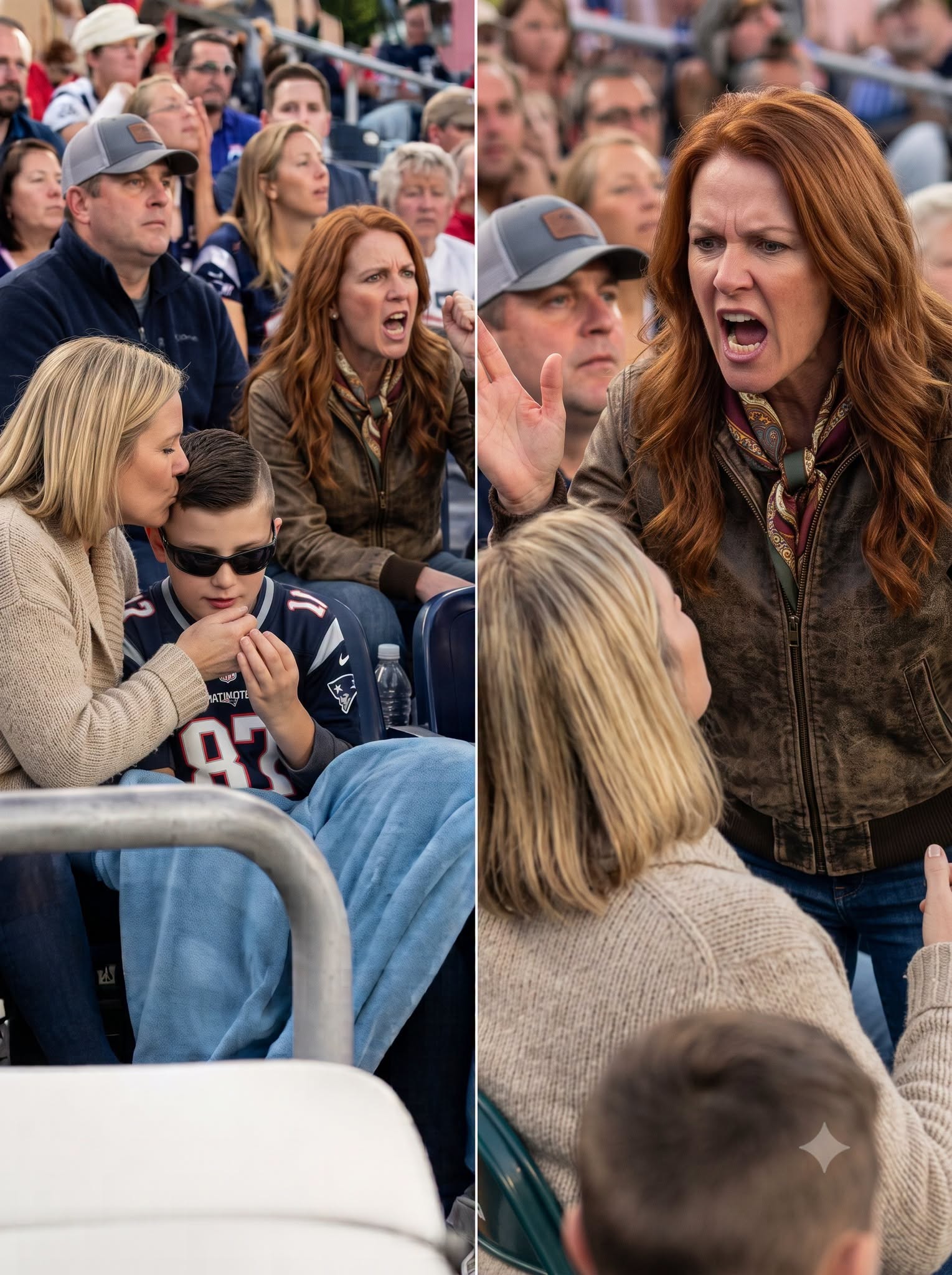
That was when I noticed the woman and the little boy sitting a few rows below us.
At first, I noticed them simply because they were so still.
Everyone around them was standing, waving rally towels and shouting toward the field.
But the boy sat quietly with both hands resting in his lap.
He looked nine or ten years old.
His shoulders were drawn inward, almost protectively, and he wore dark sunglasses even though the sky had gone completely black and the stadium lights were blazing overhead.
He did not look toward the giant screen.
He did not jump when the crowd erupted.
He did not turn his head toward the cheerleaders or the marching band.
He simply sat there, his head lowered slightly, as though he were paying attention to something the rest of us could not hear.
Beside him sat his mother.
She never seemed to watch more than a few seconds of the game at a time.
She would glance toward the field, lean close to her son, whisper into his ear, and then take his hand.
With one finger, she traced quick patterns across his palm.
Again and again.
Sometimes she whispered while moving her finger.
Sometimes she just traced.
Then she looked back toward the field and repeated the process.
I couldn’t stop watching.
At first, I wondered if the boy had sensory issues.
Then I wondered if the noise frightened him.
Maybe his mother was using some kind of calming routine.
Whatever she was doing, it seemed deliberate and constant.
Dean noticed me staring.
“What?” he asked around a bite of hot dog.
I nodded toward the pair.
“That little boy.”
Dean followed my gaze.
“Hmm.”
“Do you see what she’s doing?”
He watched for several seconds.
“I see it. I just don’t understand what they’re doing.”
“Same,” I said. “I just hope they’re okay.”
For the next several plays, I tried to focus on the game.
But my attention kept drifting back toward them.
Then I realized I wasn’t the only one watching.
A man sitting two seats away from the mother and boy had also noticed.
He had been drinking since before kickoff.
You could tell because every reaction came half a second too late and twice as loudly as everyone else’s.
He clapped too hard.
Shouted at the wrong moments.
Spilled part of his drink while arguing with a referee on the field who was at least fifty yards away.
He was a large man, broad through the shoulders, with a flushed red face and the angry restlessness of someone slowly losing control of himself.
At first, he only muttered under his breath.
“Why even come if you’re not gonna watch?”
One of his friends glanced at him.
“Forget it, man.”
But he kept staring at the woman.
A few minutes later, he said louder, “Some people who actually wanted to watch the game could’ve taken those seats.”
His friend touched his arm.
“Rick. Drop it.”
So now I knew his name.
Rick.
He ignored the warning.
By the middle of the second quarter, the game had become ugly and painfully close.
Every dropped pass felt catastrophic.
Every penalty sent half the stadium into fury.
Our entire section was tense.
Rick was worse.
The woman leaned toward her son again during a critical third down and whispered something into his ear.
Rick snapped.
“Hey!”
The shout cut through several nearby conversations.
Heads turned.
The woman froze.
She did not look at him.
Rick stood.
“Lady! Can you shut up?” he yelled. “Some of us are actually here to watch the game, not listen to you babble all night.”
The row went rigid.
People suddenly became intensely interested in the field, the floor, their phones—anything that allowed them to pretend a confrontation wasn’t happening.
The woman flinched so visibly that I felt it in my stomach.
But she still didn’t answer.
She looked toward the giant screen, took her son’s hand again, and began tracing into his palm.
Rick laughed.
It was an ugly sound.
“Oh, so now you’re ignoring me, too?”
Dean was already getting to his feet.
I put my hand on his arm.
“Go.”
He started down the steps.
But before he could reach them, Rick stepped into the woman’s row.
He loomed over her and her son.
“I’m talking to you,” he shouted. “If you can’t behave like everyone else, then leave.”
The little boy jerked.
Not dramatically.
Just enough that I could see fear move through his body.
His fingers clamped around his mother’s hand.
That was when she finally stood.
She wasn’t tall.
She wasn’t threatening.
She was simply a tired-looking woman in jeans and a gray sweatshirt placing her body between her child and a drunk stranger who probably outweighed her by seventy pounds.
Her eyes were already wet.
But she looked directly at Rick.
Then, in a voice that shook despite her effort to control it, she said, “My son cannot see the game.”
She didn’t shout.
She didn’t need to.
A strange pocket of silence had opened around them, and everyone nearby heard every word.
Rick blinked.

The woman continued before he could respond.
“He lost most of his vision three months ago.”
Her voice cracked.
“He is having surgery at 6:30 tomorrow morning. They don’t know if it will work.”
The section grew quieter.
Even people several rows away were turning now.
“They don’t know if this is his last night in darkness,” she said, “or the first night of the rest of his life.”
I felt tears gathering in my eyes.
She rested one hand on her son’s shoulder.
“His father loved this team more than anyone I have ever known.”
She swallowed hard.
“And he died last winter before he could bring him here.”
Rick’s face changed.
The anger disappeared.
But the woman wasn’t finished.
“So I’m describing the game to him the only way I know how, so he can feel close to his dad.”
Her mouth trembled.
“I am not deliberately trying to ruin your night.”
She looked down briefly at her son, then back at Rick.
“I am trying to give my son one good memory of his father before surgery tomorrow.”
Nobody moved.
Then a man sitting near my boys stood.
“She’s not lying,” he called out. “My cousin’s daughter is deafblind. They do tactile signing. Not exactly like that, but similar.”
That explanation hit me harder than I expected.
Because suddenly everything I had been watching made sense.
The whispering.
The movements across his palm.
The constant looking from the field back to him.
What had seemed unusual from a distance was actually intimate.
Necessary.
A language made from touch, love, and urgency.
And once I understood it, I felt ashamed that I had spent even a few minutes wondering why they were behaving differently.
Rick stood there staring at them.
There was no anger left in him now.
Only shock.
And then shame.
The little boy lifted one hand, searching the space beside him until his fingers caught the sleeve of his mother’s sweatshirt.
“Mom?” he whispered.
Her entire face changed.
She turned immediately, took his hand, and pressed it gently against her cheek.
“It’s okay, baby,” she whispered. “It’s okay.”
Dean had finally reached the row.
But he didn’t need to intervene anymore.
Nobody did.
Rick slowly sat down in the empty aisle seat.
He dragged both hands across his face.
“Oh my God,” he muttered.
Then he looked up.
“Ma’am.”
His voice was so different now that I almost didn’t recognize it.
“I’m so sorry.”
The woman didn’t respond.
I don’t think she had anything left to say.
My older son had followed Dean halfway down the stairs because fourteen-year-old boys apparently believe fathers require backup security.
He looked back at me.
His eyes were full of tears.
A woman sitting behind us leaned forward.
“Do you want us to quiet down?” she asked.
The boy’s mother blinked.
“No. Please don’t.”
She wiped beneath one eye.
“He likes the cheers. The groans. The celebrations.”
An older man in a team jacket called from farther up the row.
“What’s his name?”
She looked at her son.
“Eli.”
Something about hearing his name changed the mood again.
He wasn’t just the quiet kid in sunglasses anymore.
He was Eli.
A little boy sitting beside his mother on the night before surgery, trying to experience the game his late father had loved.
Before I really thought about it, I stood and made my way down.
“Hi,” I said softly when I reached them. “I’m Lana. Do you mind if I sit here for a second?”
The woman looked exhausted and slightly overwhelmed.
But she nodded.
“I’m Paula.”
Up close, she looked even more worn down than I had realized.
Not tired from one sleepless night.
Tired in the way people look when they have been carrying fear for months.
Eli leaned against her side, the stadium lights reflecting in his sunglasses like tiny black mirrors.
I spoke softly.
“Eli, I’m right here with your mom.”
His face turned toward my voice.
“Are they winning?” he asked.
That almost finished me.
I laughed through my tears.
“Not enough yet.”
The tiniest smile appeared on his face.
Behind us, Rick stood again.
Slowly this time.
Carefully.
“Can I…” He stopped and swallowed.
Paula looked up.
“Can I buy him whatever he wants?” Rick asked. “Food. A jersey. Anything. I know that doesn’t fix what I did, but…”
Paula studied him.
For one second, I thought she might tell him exactly where he could go.
Instead, she said quietly, “He likes pretzels.”
Rick nodded immediately.
“Pretzels. Got it.”
He hurried away.
Dean crouched beside us.
“Do you need anything? Water? Space? Somebody to keep people back?”
Paula gave him a shaky smile.
“No. Thank you.”
Then she looked at me.
“I almost didn’t bring him.”
I frowned.
“Why did you?”
Her eyes dropped to Eli’s hand.
Her thumb moved over his knuckles over and over, like she needed to remind herself that he was right there.
“Because he wanted to feel closer to his dad before the surgery.”
Dean looked away and rubbed his jaw.
Paula continued.
“My husband used to do play-by-play in our living room.”
A small laugh escaped her.
“He acted like he was on the radio. He’d yell at the television, then explain every single thing Eli couldn’t quite follow.”
She looked toward the field.
“Tonight I just wanted to do it as well as his father would have.”
Rick returned carrying a giant pretzel, two bottles of water, and enough candy to supply half the row.
Paula placed the warm pretzel into Eli’s hands.
Eli felt it carefully.
“Is it salted?”
Rick was standing beside him looking like a scolded child.
“Extra salted, buddy.”
Eli nodded solemnly.
“Good.”
The entire section laughed.
Not at him.
With him.
And somehow that small laugh released all the tension we had been carrying.
From then on, people began helping.
Quietly.
Without turning it into a show.

A college student across the aisle turned up the brightness on his phone so Paula could see her own hand movements more clearly while communicating with Eli.
The older man in the team jacket began quietly telling Paula about formation changes whenever players blocked her view.
My younger son appointed himself assistant commentator.
“Big run coming,” he whispered earnestly.
Paula smiled.
Then she leaned toward Eli.
“Quarterback drops back.”
Her finger moved across his palm.
“Ball to the left.”
The crowd shouted.
“Everybody is yelling because he almost got through.”
Eli smiled.
“Now they’re standing.”
Sometimes Paula whispered into his ear.
Sometimes she traced words into his hand.
Sometimes she did both.
And once you understood what was happening, it was impossible not to see the beauty in it.
At halftime, Rick returned.
This time there was no beer in his hand.
“My name’s Rick,” he said.
Paula looked up.
“And I was out of line. Way out of line.”
Nobody interrupted him.
He looked toward Eli.
“My son had surgery last year. They had to fix his leg.”
Rick rubbed at his face.
“I remember the night before. I remember thinking that if anyone so much as breathed wrong near him, I might lose my mind.”
His voice cracked.
“And then I stood here and did exactly that to you.”
He swallowed.
“I’m ashamed of myself.”
Paula’s eyes filled again.
She gave him one small nod.
Rick visibly sagged with relief.
Then Dean, who believes nearly every crisis can be improved by asking practical questions, said, “What hospital?”
Paula hesitated.
“St. Vincent’s.”
“What time?”
“Six-thirty check-in. Surgery at eight.”
The woman behind us asked, “Do you have family coming?”
Paula gave a humorless little laugh.
“No. It’s just us.”
I felt something tighten inside me.
“What about aftercare?” I asked.
Her expression changed instantly.
“It’ll be fine.”
Too fast.
Dean looked at me.
I looked at him.
Years of marriage allowed us to have an entire conversation without speaking.
No, it will not be fine.
I leaned closer.
“What does ‘fine’ mean?”
Paula looked embarrassed.
That told me almost everything before she answered.
“It means I used the last of our savings to keep an insurance gap from pushing the surgery back another month.”
She stared down at Eli’s hand.
“It means I’m supposed to take unpaid leave while he recovers, and I haven’t figured out how I’m paying the bills or medications during that time.”
There it was.
The part no one sees when they hear the word surgery.
Medication.
Rent.
Transportation.
Follow-up appointments.
Food.
Missed work.
A hundred ordinary expenses piling up around a terrified family.
Rick moved first.
He turned toward the section.
“We can’t let her handle that alone.”
The college kid already had his phone out.
“I can set up a fundraiser.”
Paula immediately shook her head.
“You don’t have to—”
“I know,” he said. “People can contribute if they want to.”
Someone nearby said, “I’ve got cash.”
Dean nodded.
“Do it.”
Rick pulled out his wallet and handed me a hundred-dollar bill.
“Start there.”
An older woman behind him raised her hand.
“I’ll match it.”
A man in a team beanie called out, “Fifty from me.”
Then another voice farther up shouted, “Hundred from us.”
Within minutes, Section 112 looked less like a football crowd and more like an emergency committee.
Phones were being passed around.
People were asking for payment handles.
Cash changed hands.
Someone offered meals.
Someone else offered rides.
Paula kept repeating, “You don’t have to do this.”
And every time, someone answered, “We know.”
Then my older son asked Paula something.
“Do you have a picture of Eli with his dad at a game?”
She looked surprised.
“Yes.”
She sent him one.
I didn’t think much of it because I was busy helping people find the fundraiser.
A few minutes later, I realized my son had gone looking for a stadium employee.
He had taken the picture to the media staff with a special request.
Between plays, the giant screen changed to a fan-memory feature.
Then a photograph appeared.
A smiling man stood in the crowd with a much younger Eli on his shoulders.
Both wore team jerseys.
Paula made a sound beside me.
A caption appeared beneath the photograph.
“For Mark, forever part of the crowd.”
The stadium erupted.
Most people had no idea what they were cheering for.
But Section 112 knew.
Paula covered her mouth.
Eli turned toward the roar.
“Mom? What happened?”
Paula took his hand.
This time, she moved slowly.
Carefully.
As though she wanted him to feel every letter.
“They put Daddy on the screen,” she whispered.
Eli went completely still.
Then he smiled.
Not a huge smile.
A quiet, private one.
And somehow it broke every adult around him.
Rick openly cried.
By the fourth quarter, the fundraiser had spread beyond Section 112.
Someone posted the story online.
A large local social-media account shared it.
Then a sports page picked up the photo of Eli and his father.
The caption read, “Section 112 showed what fandom really looks like tonight.”
Donations began arriving faster than the college kid could refresh the page.
By the final whistle, enough had been raised to cover Paula’s unpaid leave, Eli’s medication, transportation, follow-up appointments, and more.
When I showed Paula the total, she stared at my phone.
“That can’t be real.”
Dean turned the screen toward her.
“It is.”
She sat down hard.
Then she cried.
Eli still held part of his pretzel in one hand.
With the other, he reached toward her until he found her arm.
Outside the stadium, Rick stopped them one final time.
“I know I don’t deserve this,” he said. “But if you need rides this week, meals, someone to sit at the hospital, anything… I’m local.”
He handed Paula his number.
She accepted it.
Not because his apology erased what happened.
Not because one good night magically fixed grief, medical fear, or financial stress.
But because maybe the world had turned just enough that evening for her to believe in strangers again.
As we walked toward the parking lot, my younger son pulled on my sleeve.
“Do you think Eli will be okay?”
I turned around.

Near the stadium stairs, Paula had crouched in front of Eli.
Both of her hands held his face while she said something only he could hear.
I thought about her tracing the game into his palm because she refused to let fear be the loudest thing he remembered the night before surgery.
“I think whatever happens,” I told my son, “he won’t be facing it alone.”
The next afternoon, Dean texted me while he was at work.
It was a screenshot from Paula.
Surgery went well. He is resting. Thank you, Section 112.
I was sitting in my car outside the grocery store when I read it.
I cried all over my steering wheel.
I kept thinking about how close the night had come to becoming something awful.
One drunk man had nearly destroyed Paula and Eli’s final hours before surgery.
Instead, his mistake forced an entire stadium section to see what they had failed to understand.
A mother wasn’t whispering because she was rude.
A little boy wasn’t sitting quietly because he didn’t care about the game.
Paula was turning the stadium into something her son could experience without sight.
She was translating noise into meaning.
Movement into touch.
Football into memory.
Grief into something he could hold.
Eli could not see the players running beneath those bright stadium lights, but through his mother’s hand, he could feel the game his father had loved.
He could hear the cheering.
Feel the tension.
Taste an extra-salted pretzel.
And know that somewhere inside all that noise, his dad still belonged.
Maybe that is what I remember most.
Not Rick yelling.
Not the fundraiser.
Not even thirty thousand people cheering when Mark’s photograph appeared on the giant screen.
I remember Paula’s finger moving across Eli’s palm.
Again and again.
Patiently.
Lovingly.
Making sure that darkness did not mean emptiness.
Making sure that the night before surgery gave him something more powerful than fear.
A memory.
A connection to his father.
And proof that even when people judge too quickly, sometimes they can still stop, listen, understand, and become better than they were five minutes earlier.
Because that night, Section 112 came for a championship game.
But we left having witnessed something much bigger.
A frightened mother trying to give her son one beautiful night.
A grieving child trying to feel close to a father he had lost.
A man forced to confront the cruelty of his own assumptions.
And hundreds of strangers deciding that once they understood what was really happening, they would not simply look away.
Eli entered surgery the next morning surrounded by more support than Paula could have imagined when she first walked into that stadium.
And every time I think about that night, I come back to the same question:
How many times do we judge someone’s behavior before we know the story behind it?
Because sometimes the person who looks strange, disruptive, distant, or different isn’t doing anything wrong at all.
Sometimes they are simply surviving something we cannot see.