
Part 1
The first time I ever sat in first class, I spent almost ten minutes pretending I knew exactly what I was doing.
My name is Emily, and I was flying from Chicago to Seattle for a work conference. The upgrade notification had appeared on my phone that morning so unexpectedly that I honestly thought it was a mistake.
I refreshed the screen three times.
I checked the flight number.
I checked my name.
Then I checked the seat assignment again.
3A.
First class.
I had flown dozens of times for work, but always in economy. I knew how to squeeze my laptop under the seat in front of me, how to balance a coffee cup on the tiny tray table, and how to pretend I wasn’t uncomfortable when the person in front of me reclined too far.
But first class felt different.
It felt like walking into someone else’s house without knowing if you were invited.
As I stepped onto the plane, I slowed down just enough to look around without appearing like I was looking around.
The seats were wider.
The carpet was cleaner.
The passengers seemed calmer, like everyone already knew some secret rulebook that I had never been given.
I stood in the aisle trying to lift my carry-on into the overhead compartment while a few passengers waited behind me.
My face grew warm.
I pushed harder, but the bag refused to fit.
A flight attendant walked over with a gentle smile.
“Let me help you with that.”
“Oh, sorry,” I said quickly. “I’m holding everyone up.”
“You’re fine.”
She placed the bag easily into the compartment.
Then she looked at me and smiled.
“First time up here?”
I laughed quietly.
“Is it that obvious?”
“Only because you apologized three times and thanked me twice.”
Her smile made me feel less embarrassed.
She moved down the aisle, and I found my seat by the window.
3A.
I sat down, placed my hands on my lap, and looked out at the runway.
For a moment, I felt like a child pretending to be an adult.
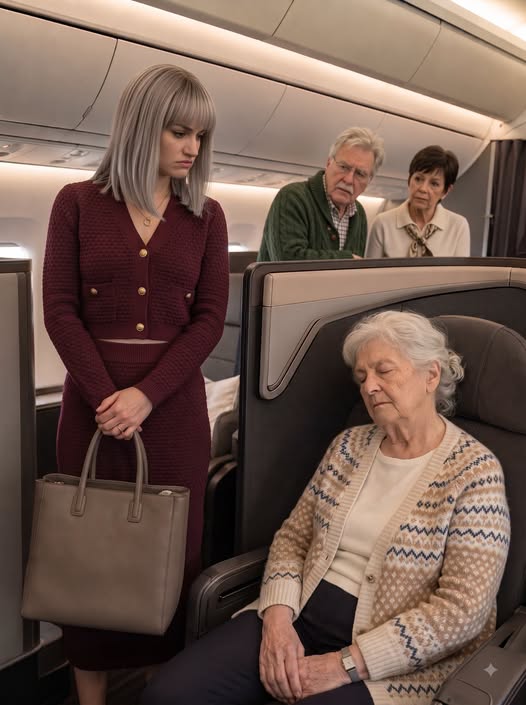
Across the aisle from me sat a woman who looked like she had never questioned whether she belonged anywhere in her life.
She wore a perfectly tailored white blazer over a silk blouse. Her dark hair was pinned neatly behind her head, with not a single strand out of place. A silver laptop sat open on her tray table, and a designer handbag occupied the empty seat beside her.
Everything about her looked expensive.
Not just her clothes.
Her confidence.
The way she moved.
The way she glanced around as though the entire world had been arranged for her convenience.
She typed quickly, barely acknowledging the people boarding around her.
Then, about five minutes later, an elderly woman entered the first-class cabin.
And almost immediately, the atmosphere changed.
The older woman walked slowly down the aisle, one hand lightly touching the backs of the seats for balance.
She wasn’t struggling.
She simply moved with the careful pace of someone who had lived long enough to stop rushing for other people.
She wore navy slacks pressed neatly at the seams, a soft cream cardigan buttoned all the way to her collar, and a pair of simple white sneakers.
The sneakers were clean.
But they were clearly old.
The fabric around the toes had begun to thin.
In one hand, she carried a small canvas purse.
In the other, she held a brown paper bag folded carefully at the top.
She smiled politely at every passenger she passed.
Most people never looked up.
They were busy with their phones, their headphones, or their own thoughts.
But I noticed her.
There was something gentle about her.
Something warm.
When she reached the row across from me, she stopped and checked her boarding pass.
Then she looked toward the window seat.
“Excuse me,” she said softly. “I believe that’s my seat.”
The woman in the white blazer looked up.
But she didn’t look at the boarding pass.
She looked at the paper bag.
Then she looked at the worn sneakers.
Then she looked at the elderly woman’s face.
And something in her expression changed.
Not surprise.
Judgment.
“You must be mistaken,” she said.
The older woman blinked.
She looked down at her ticket again.
“Oh.”
She adjusted her glasses.
“Let me check.”
She brought the boarding pass closer.
“Two F.”
She looked back up.
“Yes. This is my seat.”
The woman in white leaned back.
“Coach is farther back.”
The elderly woman nodded calmly.
“I know.”
The woman gave a small laugh.
Not a kind laugh.
A dismissive one.
“Then maybe you should go back where you belong.”
Her voice wasn’t loud.
But it didn’t need to be.
The people nearby heard it.
I heard it.
The elderly woman heard it.
And the worst part was that she didn’t become angry.
She didn’t defend herself.
She just became smaller.
Her fingers tightened around the brown paper bag.
For a second, I wanted to say something.
I wanted to tell the woman she was wrong.
That a person’s seat on an airplane had nothing to do with their shoes, their clothes, or the bag they carried.
But I stayed quiet.
And even now, I still remember that moment.
Because sometimes the words you wish you had said come to you after the opportunity has already disappeared.
The elderly woman looked toward the flight attendant.
“I don’t want any trouble.”
The flight attendant immediately walked over.
“You’re not causing any trouble, ma’am.”
She checked the boarding pass.
Then she smiled.
“Mrs. Clooney, this is definitely your seat.”
The woman in white frowned.
“Seriously?”
The flight attendant’s expression remained professional.
“Yes, ma’am.”
She pointed politely.
“Your handbag will need to come off the seat.”
The woman stared at her.
“So anyone can just walk into first class now?”
There was a sharpness in her voice.
Mrs. Clooney lowered her eyes.
“I can sit somewhere else if it’s a problem.”
The flight attendant looked genuinely surprised.
“No, ma’am.”
Her voice became firmer.
“You paid for this seat.”
The woman in white removed her designer handbag with two fingers, almost as if touching the seat again offended her.
Mrs. Clooney quietly sat beside her.
She placed the brown paper bag beneath the seat in front of her.
Then she folded her hands over her purse and looked out the window.
Before fastening her seat belt, she turned slightly toward the woman beside her.
“I’m sorry for the inconvenience.”
That sentence bothered me more than the insult.
Because Mrs. Clooney had done nothing wrong.
She had purchased a ticket.
She had a seat.
She belonged there.
Yet she was apologizing for making someone else uncomfortable.
The woman in white didn’t even look at her.
She simply opened her laptop again.
Nobody spoke.
The cabin became unusually quiet.
I looked around.
Several passengers had noticed what happened.
A man across the aisle looked uncomfortable.
A woman near the front shook her head slightly.
But everyone stayed silent.
Including me.
I sat there adjusting the air vent above my seat, pretending to be busy.
I told myself I didn’t want to create a scene.
But deep down, I knew the truth.
I was afraid.
Afraid of confrontation.
Afraid of making things awkward.
And I hated that I had allowed someone to be treated that way.
The plane pushed away from the gate.
As we taxied toward the runway, Mrs. Clooney rested two fingers gently against the window.
Below us, baggage carts moved between airplanes.
Workers in bright vests walked across the pavement.
One young ground employee looked up toward the cabin and waved.
Mrs. Clooney waved back.
Of course, he couldn’t possibly see her through the window.
But she smiled anyway.
The woman beside her noticed.
“Do you mind?”
Mrs. Clooney turned.
“I’m trying to work.”
The older woman immediately lowered her hand.
“Of course.”
She looked embarrassed.
The plane lifted into the gray Chicago sky.
Clouds surrounded us, and the city slowly disappeared beneath the wings.
A few minutes later, the seat belt sign turned off.
The flight attendants began preparing drinks.
The woman in white ordered sparkling water with lime.
Mrs. Clooney asked for tea.
“Any kind is fine, dear.”
The flight attendant smiled.
“Would you like breakfast as well?”
Mrs. Clooney looked surprised.
“Oh, no. Thank you.”
“It’s included, ma’am.”
She paused.
“Included?”
“Yes.”
Mrs. Clooney looked down at the menu.
“Then perhaps the oatmeal.”
The woman beside her let out a quiet breath of irritation.
Almost like even ordering breakfast was somehow inconvenient.
Mrs. Clooney carefully folded the menu and placed it away.
Then I noticed something.
Her eyes moved toward the brown paper bag beneath the seat.
The top had opened slightly.
And inside…
There weren’t snacks.
There weren’t personal belongings.
There were envelopes.
Dozens of them.
White envelopes.
Blue envelopes.
Some decorated with tiny balloons.
Some covered in colorful birthday designs.
Each one had a name written carefully across the front.
I leaned slightly, trying not to stare.
Mrs. Clooney noticed and quickly pressed the bag closed with her shoe.
But the woman beside her noticed too.
She looked down.
“Are you selling something?”
Mrs. Clooney looked surprised.
“No.”
“Because solicitation isn’t allowed on flights.”
The older woman’s fingers moved nervously over the edge of her cardigan.
“They’re only cards.”
“Cards?”
“For birthdays.”
The woman in white looked back at her laptop.
“How quaint.”
Mrs. Clooney didn’t respond.
She simply turned back toward the window.
At the time, none of us knew what those cards meant.
None of us knew that the small paper bag beneath her seat contained the reason a captain would soon stop an entire airplane.
And none of us knew that within twenty minutes, the woman who had judged Mrs. Clooney by her shoes and her appearance would be sitting in complete silence, unable to look anyone in the eye.
Because then the captain’s voice came over the speakers.
And he was about to tell the story of a woman who had changed a life without ever expecting anything in return.

Part 2
The captain’s voice came through the speakers just as the flight attendants finished preparing the first round of drinks.
“Ladies and gentlemen, we have now reached our cruising altitude. The weather ahead looks smooth, and we are expecting to arrive in Seattle a few minutes ahead of schedule.”
The usual sounds of the cabin returned.
The soft clicking of laptop keyboards.
The rustling of newspapers.
The quiet conversations between passengers.
People returned to their own worlds.
The woman in the white blazer continued typing, her expression unchanged. Mrs. Clooney sat beside her, calmly holding her cup of tea with both hands.
I looked back toward my window.
I remember thinking the moment was over.
A rude comment.
An uncomfortable interaction.
Something most people would forget by the end of the flight.
But then the captain paused.
And something about that pause made everyone listen.
“Before today’s service begins, I would like to take a moment to recognize someone very special who is traveling with us.”
The cabin immediately became quieter.
A flight attendant near the galley stopped pouring coffee.
A few passengers lifted their heads.
The woman in white looked toward the front of the plane, suddenly interested.
The captain continued.
“Mrs. Clooney, seated in 2F.”
For a second, the elderly woman didn’t react.
She looked behind her.
Then she looked around the cabin as if trying to figure out whether there was another Mrs. Clooney nearby.
The people around her slowly turned.
Including the woman beside her.
The captain spoke again.
“Mrs. Clooney, I don’t know whether you remember me.”
The elderly woman’s hand moved toward the brown paper bag beneath her seat.
She looked confused.
Almost nervous.
“But I have remembered you for twenty-six years.”
The entire cabin seemed to freeze.
The woman in white slowly lowered her laptop screen.
The flight attendants stopped moving.
Even the passengers who had been wearing headphones began taking them off.
The captain’s voice became softer.
“When I was eleven years old, my mother died.”
Mrs. Clooney’s fingers stopped moving.
Her eyes remained fixed on the speaker above her.
“My father disappeared from my life shortly afterward. I entered foster care with one backpack, two shirts, and a pair of shoes that were too small for my feet.”
A silence fell over the cabin.
The kind of silence where nobody wanted to interrupt.
The captain continued.
“After that, birthdays stopped feeling important.”
He took a breath.
“In foster care, birthdays can become just another day. Sometimes the adults are too busy. Sometimes records get lost. Sometimes nobody even knows the date matters.”
Mrs. Clooney’s eyes began filling with tears.
She reached down slowly and lifted the brown paper bag onto her lap.
“On my twelfth birthday, I came home from school expecting nothing.”
The captain paused.
“Honestly, I had stopped expecting anyone to remember.”
Several passengers looked down.
The woman across the aisle removed her glasses.
The captain continued.
“But when I walked into my room that day, there was an envelope sitting on my bed.”
Mrs. Clooney opened the bag slightly.
Inside were the same kinds of cards I had seen earlier.
The same carefully written envelopes.
“There was no money inside.”
His voice shook slightly.
“No gift card. No toy. No expensive present.”
A small pause.
“Just a birthday card.”
Mrs. Clooney covered her mouth.
The captain continued.
“And inside that card was one sentence.”
The cabin waited.
Nobody moved.
Then he said the words.
“Someone is celebrating that you exist today.”
A quiet breath moved through the airplane.
The words were simple.
But somehow they felt heavier than anything complicated could have been.
Mrs. Clooney closed her eyes.
A tear rolled down her cheek.
The captain continued.
“It was signed, ‘Love, Mrs. C.’”
The woman in white looked at Mrs. Clooney.
Really looked at her this time.
Not at her shoes.
Not at her old cardigan.
Not at the paper bag.
At her.
The captain spoke again.
“I didn’t know who Mrs. C was.”
His voice carried through the cabin.
“I assumed she was someone who knew me. Maybe a teacher. Maybe someone my mother had known. Maybe someone who had seen me when I felt invisible.”
He paused.
“But she didn’t know me.”
Mrs. Clooney shook her head gently.
Almost embarrassed.
The captain continued.
“Years later, I discovered that Mrs. Clooney volunteered with an organization that sent handwritten birthday cards to children in foster care.”
A few passengers exchanged surprised looks.
“She wrote hundreds of cards every year.”
His voice became emotional.
“Eventually, thousands.”
Mrs. Clooney looked down.
The captain continued.
“Most of those children never met her. Most of them never wrote back. Many of them probably forgot her name.”
He paused.
“But she wrote them anyway.”
The woman in white sat completely still.
The confidence she had carried when she entered the plane was gone.
The captain continued.
“When I saw Mrs. Clooney’s name on today’s passenger list, I couldn’t believe it.”
A flight attendant near the front wiped beneath her eye.
“I wondered if it could really be her.”
Mrs. Clooney shook her head.
“I never thought anyone would remember.”
Her voice was barely audible.
But the people closest to her heard.
The captain heard.
And he answered through the speakers.
“I remembered.”
The words affected everyone.
Because they weren’t just words from a pilot.
They were words from a child who had carried one small piece of kindness through his entire life.
The captain continued.
“I carried that card through six different foster homes.”
Mrs. Clooney’s shoulders began trembling.
“I carried it when I failed algebra.”
A few passengers smiled sadly.
“I carried it when a guidance counselor told me becoming a pilot was unrealistic for someone who had no family support and no money.”
The cabin remained silent.
“I carried it through community college.”
Another pause.
“Through my first flying lesson.”
His voice cracked slightly.
“Through the interview where I borrowed a suit because I couldn’t afford one.”
The man across the aisle wiped his eyes.
“I carried it on my first solo flight.”
Mrs. Clooney reached into her purse.
Her hands trembled as she searched through tissues, reading glasses, and a small coin pouch.
She found a handkerchief and pressed it against her face.
“And I carried it into the cockpit on my first day as a captain.”
No one spoke.
No one reached for their coffee.
No one looked at their phone.
The entire airplane was listening to one elderly woman’s kindness being returned to her after twenty-six years.
Then the captain said something that made Mrs. Clooney completely break down.
“You probably never knew what that card meant.”
Mrs. Clooney shook her head.
“I just hoped someone needed it.”
The captain’s voice softened.
“Someone did.”
A few moments later, the speaker clicked off.
But nobody returned to what they were doing.
Everyone waited.
And then, at the front of the cabin, the cockpit door opened.
The captain stepped out.
The first officer must have taken control while he came into the cabin.
He walked toward us wearing his uniform.
He was around forty years old, tall and broad-shouldered, with a calm confidence that came from years of experience.
But when he looked at Mrs. Clooney, that professional expression disappeared.
For a moment, he wasn’t a captain.
He was the eleven-year-old boy who had once felt forgotten.
He held something small in his hand.
A card.
A very old card.
The edges were worn soft.
The middle fold was almost white from being opened thousands of times.
On the front was a cartoon airplane with the words:
“HAPPY BIRTHDAY.”
Mrs. Clooney stared at it.
Her lips parted.
Then she whispered:
“I wrote that.”
The captain smiled.
“You did.”
He opened the card carefully.
Inside, beneath the printed message, was the same handwritten sentence.
The blue ink had faded slightly over time.
But the words were still clear.
“Someone is celebrating that you exist today.”
Mrs. Clooney touched the card with one trembling finger.
“I always wondered if any of them kept them.”
The captain looked at her.
“I never stopped.”
The woman beside her lowered her gaze.
For the first time since she boarded the plane, she looked ashamed.
The captain crouched beside Mrs. Clooney’s seat.
“I wanted to thank you before we landed.”
Mrs. Clooney stared at him.
Then she smiled through her tears.
“You became a pilot.”
He nodded.
“I did.”
She looked at his uniform.
At the captain’s wings.
At the person he had become.
“You grew up.”
The captain smiled.
“So did you.”
Mrs. Clooney shook her head.
“It was only a card.”
The captain gently placed the old birthday card into her hands.
“No, ma’am.”
His voice was quiet.
“It was the first proof I had that I mattered.”
And that was the moment the entire cabin understood.
The card was never just paper.
The sentence was never just a sentence.
For a child who believed nobody saw him, those words had been a lifeline.
Those words had followed him through every difficult year.
And now, twenty-six years later, they had brought him back to the woman who wrote them.

Part 3
The cabin remained completely silent.
Not the uncomfortable silence from earlier.
Not the silence of strangers trying to avoid getting involved.
This was different.
It was the kind of silence that happens when everyone witnesses something too meaningful to interrupt.
The captain stayed beside Mrs. Clooney’s seat for several more moments.
He looked at the woman who had unknowingly changed the direction of his entire life.
Then he gently placed his hand over hers.
“I spent years wondering if I would ever meet you,” he said.
Mrs. Clooney looked down at the old card resting in her hands.
“I never expected anyone to remember.”
The captain smiled sadly.
“How could I forget?”
She shook her head.
“Twenty-six years is a long time.”
“Yes.”
He looked around the cabin.
“But some people leave a mark that time can’t erase.”
Mrs. Clooney’s eyes filled with tears again.
She looked embarrassed by the attention.
“I wrote those cards because I knew what it felt like for a child to believe nobody cared.”
The captain listened carefully.
She continued.
“I never knew their stories. I never knew their names beyond what was written on the envelopes.”
She glanced at the brown paper bag.
“I just wanted them to wake up on one day of the year and know they mattered.”
The captain nodded.
“You did more than that.”
He pointed gently at the card.
“You gave me something I didn’t have.”
“What was that?”
“Hope.”
The word hung in the air.
Mrs. Clooney looked away.
For someone who had spent years giving kindness to others, receiving gratitude seemed much harder for her.
“I wish I could have done more.”
The captain’s expression changed.
“Mrs. Clooney, you need to understand something.”
He leaned closer.
“When you’re a child and you feel forgotten, you don’t need someone to fix your entire life in one moment.”
He touched the card.
“Sometimes you just need one person to remind you that your life is worth something.”
Nobody in the cabin moved.
The woman in the white blazer stared down at her hands.
The same hands that had earlier pushed a laptop aside to judge someone she didn’t know.
Now they rested silently in her lap.
The captain stood.
Mrs. Clooney reached out quickly.
“Wait.”
He turned.
She looked at the card.
“You should keep this.”
The captain smiled.
“I think you should.”
She shook her head.
“It belongs to you.”
He gently closed her fingers around it.
“It brought me here.”
He smiled.
“I think it finished its job.”
Mrs. Clooney looked at the worn birthday card.
Then she looked at the brown paper bag beneath her seat.
A bag filled with hundreds of new cards waiting for children who might never know her name.
She finally nodded.
The captain returned to the front of the plane.
But the feeling he left behind stayed with everyone.
The flight attendants slowly resumed service.
Passengers began moving again.
Coffee was poured.
Meals were delivered.
But something had changed.
The airplane no longer felt like a group of strangers traveling to the same destination.
For a little while, everyone felt connected by one simple truth.
A small act of kindness could travel farther than anyone imagined.
Mrs. Clooney ordered her oatmeal.
The same oatmeal she had hesitated to request earlier.
But this time, she smiled when it arrived.
The woman beside her didn’t say anything.
Not for several minutes.
She simply stared at the old birthday card sitting carefully on Mrs. Clooney’s tray table.
Her expression had completely changed.
The confidence.
The arrogance.
The judgment.
All of it was gone.
What remained was regret.
I watched her glance toward Mrs. Clooney several times.
Each time, she looked like she wanted to say something.
But she couldn’t find the words.
Maybe because some apologies are difficult when you realize the person you judged was far greater than you ever imagined.
The rest of the flight passed quietly.
Mrs. Clooney looked out the window.
The captain returned to the cockpit.
And everyone carried the story with them.
When we finally landed in Seattle, something unusual happened.
Nobody stood up immediately.
Usually, the moment the plane reaches the gate, everyone jumps into the aisle.
People grab their bags.
They squeeze past each other.
They rush toward their next destination.
But this time, everyone stayed seated.
Nobody wanted to break the moment.
The captain waited outside the cockpit door.
As passengers slowly exited, he greeted them.
But his eyes kept returning to one person.
Mrs. Clooney.
She moved slowly through the aisle with her purse in one hand and the brown paper bag in the other.
When she reached the woman in the white blazer, she stopped.
For a second, neither woman spoke.
Then the woman looked up.
Her eyes were red.
Her carefully applied makeup had smudged slightly.
She looked completely different from the person who had boarded the plane.
“Mrs. Clooney…”
Her voice was quiet.
The elderly woman turned.
The woman swallowed.
“I’m sorry.”
Mrs. Clooney said nothing.
The woman looked down.
“For what I said.”
A pause.
“For how I treated you.”
Another pause.
“I judged you before I knew anything about you.”
The apology sounded painful because it was honest.
“I was cruel.”
Mrs. Clooney studied her face.
For a moment, I wondered what she would say.
After everything that happened, she had every reason to ignore her.
She had every reason to walk away.
Instead, she reached out.
She took the woman’s hand gently between both of hers.
“It’s never too late to make someone feel welcome.”
The woman’s face broke.
Tears filled her eyes.
“I don’t deserve your kindness.”
Mrs. Clooney smiled softly.
“Kindness isn’t something people have to earn.”
The woman cried quietly.
Mrs. Clooney squeezed her hand once.
Then she continued toward the exit.
The captain opened his arms when he saw her.
And without hesitation, she stepped into his embrace.
The sight stayed with me.
Because at that moment, he wasn’t a captain.
He wasn’t someone important.
He wasn’t someone people looked up to.
He was simply a man thanking the woman who had once made him feel remembered.

I walked through the airport afterward, watching people reunite.
Families hugged beneath arrival signs.
Children ran toward grandparents.
People held flowers, balloons, and small gifts.
Everyone seemed to be searching for someone.
And everyone seemed to be carrying some kind of story.
Near my gate, I stopped at a small gift shop.
I don’t know exactly why.
Maybe because I couldn’t stop thinking about Mrs. Clooney.
Maybe because I couldn’t stop thinking about how close I had come to staying silent.
I picked up a fountain pen.
Then I bought a pack of blank cards.
The cashier placed them on the counter.
“Anything else?”
I looked at the cards.
Then I smiled.
“Yes.”
I pointed toward a stack of brown paper bags.
“Could I also have one of those?”
The cashier looked confused.
“A paper bag?”
“Yes.”
She placed one beside the cards.
I carefully folded the top the same way Mrs. Clooney had.
I carried it with me to my hotel.
That evening, after the conference preparations were finished, I sat alone at the desk in my hotel room.
The city lights outside the window blurred against the glass.
The brown paper bag sat in front of me.
Inside were blank cards.
No names.
No addresses.
No instructions.
Just empty spaces waiting for words.
For several minutes, I stared at the first card.
I didn’t know what to write.
How could one sentence mean so much?
How could a few simple words follow someone for twenty-six years?
Then I picked up the fountain pen.
I thought about the little boy who once believed nobody remembered him.
I thought about Mrs. Clooney walking through the airplane with worn sneakers and a paper bag.
I thought about how easily we judge people by what we see before we understand what they carry.
Slowly, I lowered the pen.
And I wrote the first line.
“Someone is celebrating that you exist today.”
I looked at the sentence for a long time.
Then I placed the card back into the brown paper bag.
Because sometimes the smallest acts of kindness become the biggest moments in someone’s life.
And sometimes the person who needs to hear they matter is sitting right beside you… waiting for someone to notice.