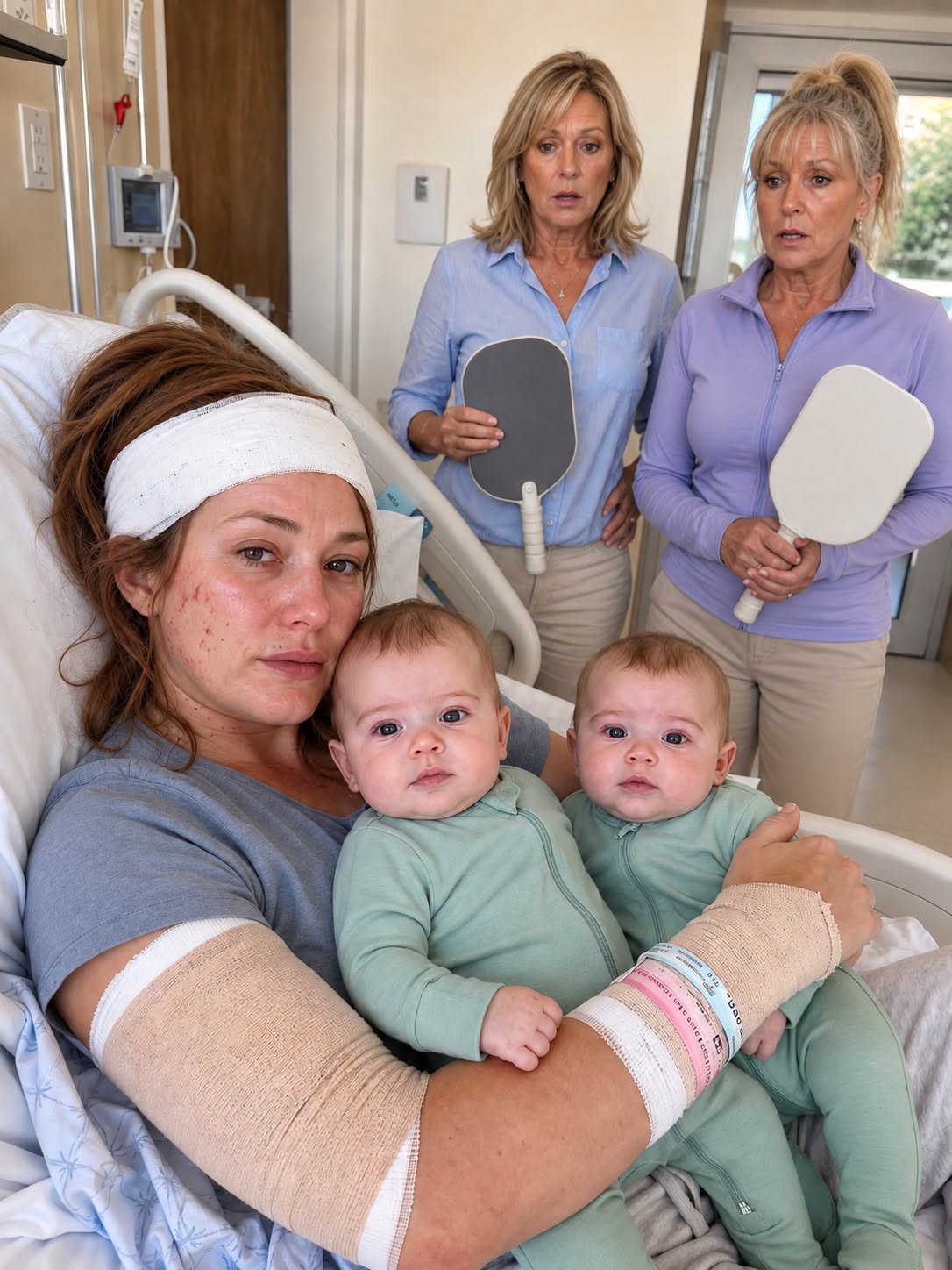
After my car accident left me unable to walk, I called my parents because my twin babies needed someone they trusted.
My mother sighed and said, “Brenna, I have pickleball this afternoon. I can’t just drop everything because you had an accident.”
For a few seconds, I honestly thought the pain medication had made me misunderstand her.
I was wrong.
That was the moment I thought my family had abandoned me.
What I didn’t know was that their refusal would force me to uncover something much worse.
For years, I hadn’t simply been helping my family.
I had been quietly carrying nearly every part of their lives.
And the moment I stopped, everything they had taken for granted began to collapse.

Part 1: The Day My Family Chose Pickleball Over My Children
The first thing I remember after the crash was the sound of metal crushing around me.
The second was the smell of burned rubber and something chemical filling the car.
Then everything disappeared.
When I opened my eyes again, fluorescent hospital lights were glowing above me.
Pain seemed to exist everywhere at once.
My pelvis was fractured. Two ribs were broken. My entire lower body felt distant, as though it belonged to someone else.
The doctors told me I was incredibly lucky.
Another driver had run a red light and struck the side of my car hard enough to send us spinning across the highway.
Somehow, my one-year-old twins, Caleb and Sophie, survived.
Their car seats had protected them.
They were frightened and bruised, but alive.
That was all I cared about.
My husband, Daniel, had died only eleven months earlier after a sudden illness. Since then, I had forced myself to become everything our children needed.
Mother.
Father.
Provider.
Comforter.
I worked during the day, woke through the night, paid bills, prepared bottles, packed daycare bags, and learned how to smile even when grief sat so heavily in my chest that breathing sometimes felt like work.
I hated asking anyone for help.
But lying in that hospital bed, unable to lift myself without assistance, I finally accepted the truth.
I could not care for two babies alone.
The hospital had arranged temporary childcare, but only for twenty-four hours.
After that, someone had to take them.
Someone safe.
Someone familiar.
So I called my mother.
“Mom,” I whispered.
My throat felt dry.
“I need you and Dad.”
There was a pause.
“Need us for what?”
I stared at the ceiling.
“To take Caleb and Sophie for a while. Just until I can move better. The doctors said it could take weeks.”
Silence followed.
Not frightened silence.
Not the silence of a mother processing that her daughter had nearly died.
Just irritated silence.
Then she sighed.
“Brenna, I don’t know what you expect me to do.”
My fingers tightened around the phone.
“I expect you to help with your grandchildren.”
“Your father and I have our own life.”
“Mom, I was almost killed.”
“And you survived.”
The words landed harder than anything the doctors had told me.
I swallowed.
“I have two babies who need someone.”
Her voice lowered, as though I were embarrassing her.
“We are not built-in babysitters. You need to figure something out.”
“Mom—”
“I have my pickleball league this week. I already paid for it. I can’t cancel everything because you made a mistake.”
A mistake.
That was what she called being struck by another driver.
Before I could respond, she added, “Your sister never puts this kind of pressure on us.”
Then she ended the call.
I didn’t cry.
That surprised me.
For years, my mother had been capable of reducing me to tears with a single sentence.
She compared me constantly to my younger sister, Paige.
Paige was spontaneous.
Fun.
Easygoing.
I was too serious.
Too ambitious.
Too responsible.
Apparently, those were flaws until somebody needed a bill paid.
Lying in that hospital room, something inside me finally shifted.
Instead of feeling rejected, I started remembering.
Eight years of remembering.
When my parents wanted a newer SUV, who helped with the down payment?
Me.
When their health insurance became too expensive?
I covered the difference.
When Dad needed major repairs on the house?
I paid the contractor.
When Paige opened a boutique and burned through her savings within six months?
I quietly covered her debts.
My mother had said the same thing every time.
“Family helps family.”
I believed her.
I never understood that, in my family, the sentence only applied when I was the one helping.
A cry came from outside my room.
“Sophie.”
My daughter.
I tried to push myself upright.
Pain tore through my body so sharply that I gasped.
A nurse hurried in.
“Don’t move.”
“But my daughter—”
“She’s okay,” the nurse said gently. “She just wants her mother.”
That sentence nearly destroyed me.
My baby wanted me.
My parents didn’t.
The nurse’s name was Rosa.
She stayed after helping me settle, and eventually she noticed that I kept staring at my phone without calling anyone.
“You have someone else you trust?” she asked.
Through the glass, I could see Caleb and Sophie sleeping in temporary hospital cribs.
Tiny hands.
Hospital blankets.
No idea that the world beneath them had suddenly changed.
I thought about all the birthdays I attended because Mom wanted family pictures.
All the vacations I helped pay for.
All the emergencies I solved.
All the times Paige cried to me because she was behind on rent or payroll.
Then I said, “No.”
I paused.
“Actually, there is one person.”
Andrew was the attorney who had handled Daniel’s estate.
When I called, he answered immediately.
“Brenna? Are you all right?”
I looked at my children.
“No,” I admitted. “But I’m going to be.”
I told him everything.
The accident.
My parents.
Paige.
The payments.
The years of being the person everyone depended on.
When I finished, Andrew stayed quiet for a moment.
Then he asked, “What do you want to do?”
For once, I didn’t think about how my answer would make anyone else feel.
“I want everything I pay for to stop.”
“Everything?”
“Yes.”
“Brenna, that will have consequences.”
I watched Caleb sleeping.
“They chose pickleball over my children.”
My voice trembled.
“So they can learn what their lives look like without me holding everything together.”
Andrew handled it carefully.
The first thing he reviewed was the house my parents lived in.
They called it their home.
They told everyone they had built a life there.
The truth was much less convenient.
Eight years earlier, my father had lost his job and my parents couldn’t qualify for a mortgage. Daniel and I bought the property as an investment and let them live there while they recovered financially.
Temporary had somehow become permanent.
Eventually, they stopped saying they were living in my house.
They started behaving as though it belonged to them.
Andrew studied the agreement.
“They’ve started treating generosity like ownership.”
I stared toward the twins.
“That sounds familiar.”
That night, the payments stopped.
Their supplemental insurance.
Dad’s car payment.
The country club membership.
The gym.
Several household expenses.
The monthly transfers keeping Paige’s boutique alive.
Everything.
The calls started almost immediately.
Six from Mom.
Then ten.
Her message appeared first.
What did you do? My card was declined.
Paige followed.
My rent payment failed. Call me now.
Then Dad.
This is not how family behaves. Fix this immediately.
I stared at the three messages.
Nobody asked if I could walk.
Nobody asked if the babies were frightened.
Nobody asked if I needed anything.
I turned my phone facedown.
The following morning, Mom called from another number.
“Brenna, your father’s car payment didn’t go through.”
I said nothing.
“Paige is having problems with her business.”
Still nothing.
“You need to reverse whatever you did.”
I looked at Caleb and Sophie sleeping close to my bed.
“Mom?”
“What?”
“You had one chance to be there when I needed you.”
Silence.
“And you chose pickleball.”
This time, the silence felt different.
This time, she understood.
For the first time in my life, I was no longer the daughter asking to be chosen.
I was the mother deciding who deserved access to my children.

Part 2: The Secret They Never Expected Me to Find
The first week after the accident was brutal, but not because of the pain.
The doctors had prepared me for that.
Months of healing.
Physical therapy.
Limited movement.
Patience.
What nobody could prepare me for was learning that the people I had spent my life protecting had no intention of protecting me.
I had always imagined my family as a safety net.
Then I fell.
And discovered there was nothing beneath me.
Thankfully, Andrew arranged a temporary caregiver through a service he trusted. Rosa helped move us into a private recovery room where the twins could remain nearby.
It wasn’t family.
But it was dependable.
Every morning, I woke to my children.
Every night, I listened to their breathing.
Meanwhile, my family unraveled.
Mom called almost daily.
“Your father’s gym membership got canceled.”
“The club says the account has a problem.”
“My friends are asking questions.”
Each time, I waited.
Maybe this time she would ask about Sophie.
Maybe this time she would ask whether Caleb still cried when I left the room.
She never did.
Eventually, I asked her directly.
“Do you want to know how your grandchildren are?”
A pause.
“Of course.”
The response sounded rehearsed.
“How are they?”
I watched them playing beside my bed.
“They miss their grandmother.”
Another silence.
Then she said, “Once this misunderstanding is over, things can go back to normal.”
Normal.
That was exactly what she wanted.
A normal where I paid.
I rescued.
I apologized.
I stayed quiet.
That version of me had not survived the accident.
A few days later, Paige appeared carrying flowers.
“Brenna, I’m worried about you.”
I looked at her.
“Are you?”
Her smile faltered.
“Of course.”
“Because the first message you sent after my accident was about your rent.”
Her face tightened.
“You’re emotional right now.”
There it was.
“You had a major accident. You’re taking medication. You’re hurt. You don’t want to destroy your relationship with Mom and Dad because of one bad moment.”
“One bad moment?”
“My children needed somewhere safe.”
“Mom said you were being dramatic.”
I stared at her.
That one sentence told me they had been discussing me while I was lying helpless in a hospital.
Paige quickly changed direction.
“Let’s be practical.”
I knew that tone.
“You need people,” she continued. “You can’t raise twins alone forever.”
It didn’t sound like concern.
It sounded like a threat disguised as advice.
“You need Mom and Dad.”
“No,” I said. “I needed Mom and Dad when I couldn’t get out of bed.”
Her smile disappeared.
Then she pulled a folder from her bag.
“I actually came because there’s something important.”
She placed it across my blanket.
“What is that?”
“Just paperwork.”
“What paperwork?”
“It’s temporary.”
I opened the folder.
The first page described a temporary management agreement.
The second authorized access to certain business accounts.
The third gave Paige control over major financial decisions if I was considered unable to manage them.
I slowly looked up.
“What is this?”
“It’s protection.”
“For who?”
“For the family.”
I almost laughed.
Family.
Again.
The word they used whenever they wanted access to something that belonged to me.
“I’m injured, Paige. I’m not unconscious.”
“You’re medicated.”
“I’m recovering.”
“You’re emotional.”
I closed the folder.
“No.”
She stared at me.
“No?”
“I’m not signing anything.”
The sweetness vanished from her face.
“Brenna, don’t make this difficult.”
“You already did.”
She leaned closer.
“You really think you can handle everything alone?”
I glanced toward my twins.
“I handled everything while all of you were comfortable.”
“That isn’t fair.”
“What wasn’t fair was leaving my children with strangers and calling me dramatic.”
She stood abruptly.
“You’re punishing us.”
“No. I’m protecting myself.”
After she left, I called Andrew.
When he arrived and read the paperwork, the expression on his face changed.
“Where did you get this?”
“Paige.”
He flipped through several pages.
“Did she tell you what these actually do?”
“She said they protect the family.”
Andrew placed the folder down.
“Brenna, these would give Paige access to your assets.”
My stomach tightened.
“Why?”
“Because somebody believes you’re vulnerable enough to sign.”
That word stayed with me.
Vulnerable.
My family had looked at the worst moment of my life and seen opportunity.
The next morning, Andrew called.
Something about the paperwork had bothered him.
The dates.
The preparation.
The lender information.
Then he discovered Paige had already contacted a financial institution about using business assets connected to me as collateral.
“She started before she visited?” I asked.
“Yes.”
My hands began shaking.
Then Andrew said, “There’s more.”
He sent screenshots.
Messages between Paige and my mother.
Mom had written:
Don’t rush her. Wait until she gets desperate.
Paige replied:
Once she signs, everything becomes easier.
I stared at those words until they blurred.
They hadn’t simply abandoned me.
They had expected my fear to make me obedient.
They wanted me desperate.
Dependent.
Weak enough to hand them control.
They had forgotten something.
I wasn’t fighting for only myself anymore.
I looked at Caleb and Sophie.
“Set up a meeting,” I told Andrew.
“With your family?”
“Yes.”
“Are you ready?”
A week earlier, I had been terrified of surviving without them.
Now I knew I had never really had them.
“Let them come.”
Andrew studied me.
“What are you planning?”
I looked at the documents Paige had wanted me to sign.
“The truth.”

Part 3: The Day They Lost Everything They Took for Granted
One week after leaving the hospital, I returned to the house where my parents had lived for eight years.
I still needed a wheelchair for longer distances. Every movement reminded me how far I had to go physically.
Mentally, I had never felt stronger.
Andrew drove.
Beside him sat a folder containing financial records, agreements, messages, and the documents Paige had brought to my hospital room.
My parents and Paige were waiting when we arrived.
Mom’s expression changed when she saw Andrew.
Not concern.
Annoyance.
“You brought a lawyer?”
“After what happened? Yes.”
She shook her head.
“I can’t believe you’re doing this to your own family.”
That word again.
Family.
Her favorite shield.
Andrew placed the first folder on the table.
“The first item is notice terminating the occupancy agreement for this property.”
Mom blinked.
“What?”
“The agreement allowing you to live here.”
“This is our home.”
I looked around the room.
“No. This is a home I provided.”
Dad’s face hardened.
“You’re throwing us out?”
“I’m ending the arrangement that allowed you to pretend my generosity was ownership.”
Mom stood.
“You’d do this after everything we’ve done for you?”
For a moment, I wanted to ask her what exactly she meant.
Was she talking about the nights after Daniel died when she rarely came over because newborn twins were “exhausting”?
The months I worked while grieving?
The hospital bed?
The pickleball league?
I didn’t ask.
She knew.
Andrew opened another file.
“This is a review of financial transfers over the past several years.”
Paige stiffened.
“We discussed those.”
“You explained them,” Andrew said. “Now we’re documenting them.”
He listed transfers to her boutique.
Rent.
Business expenses.
So-called consulting fees.
Money described as loans that had never been repaid.
Mom interrupted.
“Paige was struggling. Brenna wanted to help.”
“Yes,” I said. “I did.”
I looked directly at my sister.
“But helping someone is different from financing an entire life they refuse to build themselves.”
Andrew stated the total.
“More than three hundred thousand dollars.”
Dad went pale.
Paige immediately said, “I was going to pay her back.”
“With what?”
She looked away.
“The boutique funded by my money?”
Silence.
“The rent paid with my money?”
Nothing.
“The salary you took from a company that couldn’t survive without me?”
Tears appeared in her eyes.
“I’m your sister.”
“Yes.”
I swallowed.
“And I was your sister before I became your bank account.”
Mom began crying.
Normally, that sound would have made me stop everything.
I had spent my life trying to fix her feelings.
But I had finally learned that tears did not automatically make someone innocent.
Andrew placed one last folder on the table.
“This concerns the documents Paige brought to the hospital.”
Dad turned toward her.
“What documents?”
“It was nothing.”
Andrew opened the file.
“They would have transferred significant financial control to Paige while Brenna was medically vulnerable.”
Mom stared at Paige.
“What are you talking about?”
Paige suddenly looked frightened.
Then she said something she clearly hadn’t meant to say.
“You said she would forgive us.”
The room froze.
Mom’s face drained of color.
Andrew continued.
“We also recovered messages.”
Dad frowned.
“What messages?”
Andrew handed over printed copies.
The first message was from Mom.
Let her struggle a little. She needs to learn she can’t always expect us to fix everything.
Then another.
Once she realizes she needs us, she’ll sign whatever we put in front of her.
My parents stared at their own words.
Mom looked at me.
“Brenna…”
“No.”
She stopped.
“I don’t want an explanation.”
“But we’re your parents.”
“And I’m your daughter.”
My voice cracked despite everything.
“I called because I was terrified I might not walk again. I called because your grandchildren needed a safe place to sleep.”
I looked directly at her.
“And you cared more about pickleball and country club payments.”
Dad lowered his eyes.
Paige started crying.
“I made a mistake.”
“No. You made a choice.”
“I thought you had everything. I thought you wouldn’t miss it.”
That sentence hurt more than anything else she had said.
Because suddenly I understood.
They hadn’t seen my help as sacrifice because they didn’t see me as someone capable of running out.
I was simply the place where money came from.
The person who solved problems.
The resource that never said no.
I turned my wheelchair toward the door.
Behind me, Mom whispered, “Are you really leaving us?”
The old version of me almost turned around.
The child who wanted her mother’s approval.
The daughter who kept hoping her family would someday choose her without needing something first.
Then I thought about Caleb and Sophie.
Their hands reaching for me.
Their cries in the hospital.
Their absolute trust that I would never leave them when they were afraid.
“Yes,” I said.
I turned back once.
“Because I already know what it feels like to be abandoned by my own family.”
My voice steadied.
“And I refuse to let my children learn that lesson from me.”
The consequences didn’t happen overnight.
They unfolded slowly.
Paige eventually had to admit what she had done.
The questionable paperwork.
The attempts to access accounts.
The misuse of money.
Her boutique closed.
She was ordered to repay funds she had improperly taken.
My parents eventually moved out of the house and had to rebuild their lives without the memberships, vehicles, payments, and lifestyle I had quietly maintained.
Dad apologized first.
No excuses.
No guilt.
No demand that I forgive him immediately.
Just regret.
I accepted the apology.
But forgiveness did not mean returning to what had existed before.
Sometimes a closed door is not revenge.
Sometimes it is protection.
Almost one year after the crash, I walked across my backyard without assistance.
Caleb and Sophie ran through the grass chasing bubbles, laughing so loudly I was sure half the neighborhood could hear.
I didn’t mind.
Their laughter was proof that we had survived.
Rosa still visited.
The nurse who had sat beside me when my own family would not eventually helped me create a small support program for single parents recovering from serious emergencies.
Because I knew exactly how terrifying it felt to ask for help and hear nothing.
One evening, my phone buzzed.
A message from Mom.
I miss you. I miss the children. Can we try again?
I stared at it for a long time.
Then I looked outside at my twins.
Those two little people had taught me more about unconditional love in one year than my family had managed to teach me in a lifetime.
Finally, I typed:
You can start by becoming someone they can feel safe loving.
I placed the phone down.
The silence that followed did not feel lonely anymore.
It felt peaceful.
For years, I believed losing my family would destroy me.
I was wrong.
The accident didn’t ruin my life.
It exposed it.
It showed me who would stand beside me when I literally could not stand for myself.
It showed me which people loved me and which people loved what I provided.
And most importantly, it taught me that I did not have to keep earning a place in the hearts of people who had already decided my value depended on what I could give them.
For the first time in years, I stopped trying to save everyone else.
And that was how I finally saved myself and my children.