
Part 1
I spent six years believing that my daughter’s hair was the one thing I could give her that no one had ever been able to give me.
Choice.
That was the word that mattered.
When I was little, my mother decided everything about me, including how I looked. Every summer, without fail, she would sit me down in the kitchen, place a towel around my shoulders, and cut my hair into the same blunt bob that stopped just below my ears.
She always called it practical.
“Long hair is too much work,” she would say while sweeping my fallen hair off the floor. “You’ll thank me when you’re older.”
But I never thanked her.
I hated those moments.
I hated sitting there watching pieces of myself fall away while other girls at school ran around with long ponytails and colorful ribbons bouncing behind them. I wondered what it felt like to have something beautiful that belonged only to you.
Something nobody could decide to take away.
To my mother, my hair was just hair.
To me, it became a reminder that I had no control over my own choices.
So when my daughter, Ariana, was born with thick, beautiful curls that eventually grew all the way down to her waist, I promised myself I would do things differently.
I would never make her feel trapped.
I would never make her believe her appearance existed for anyone else.
Her hair would belong to her.
Every Sunday night became our little tradition.
Ariana would sit on the floor between my knees while I carefully worked conditioner through every curl. Sometimes she complained dramatically about the tangles. Sometimes she sang little songs she had made up herself. Sometimes she would talk for an hour about something that happened at school, and other times she would fall asleep against my leg before I finished braiding her hair for the week.
I loved those moments more than I admitted.
Maybe because those moments healed something inside me.
The little girl I used to be never got to choose what happened to her hair.
But Ariana did.
I never forced her to wear it a certain way. If she wanted braids, I braided it. If she wanted her curls loose, I let them fall naturally. If she wanted colorful clips or silly hairstyles, I helped her create them.
I wanted her to know one thing:
Her body was hers.
Her choices were hers.
And she was loved no matter what.
But somewhere deep down, I also knew her hair represented something bigger to me.
It represented the childhood I never had.
The freedom I never felt.
My husband, Tom, never fully understood why I cared so much.
He tried.
At least, I thought he tried.
When Ariana was two years old, I became sick with the flu and could barely get out of bed. Tom proudly announced that he could handle her hair for one morning.
“How hard can it be?” he joked.
A few hours later, I walked into the living room and found him sitting on the floor surrounded by broken hair ties, a bottle of detangler, and a brush tangled hopelessly in Ariana’s curls.
He looked like he had just lost a battle.
“I think her hair is stronger than me,” he said.
Ariana giggled.
After that day, Tom quietly returned hair duties to me.
But I never thought much about it.
Until the jokes started.
The first time Tom said he had always wanted a son, Ariana was only three.
She had refused to play catch with him because she didn’t want grass stains on her favorite shoes. Tom laughed and shook his head.
“I guess I should have ordered a boy,” he said.
Everyone laughed.
Even me.
I knew he was joking.
But sometimes words stayed longer than people realized.
That one stayed.
Over the years, Tom became a loving father. He played with Ariana, helped with homework, attended school events, and showed up for every important moment.
So I pushed the comment away.
I told myself I was being sensitive.
I told myself a joke was just a joke.
But recently, something began to feel different.
It started with the Tuesday afternoons.
Every second Tuesday, Tom began taking the day off work for what he called “dad-daughter days.”
At first, I thought it was wonderful.
Honestly, I was happy.
Ariana was growing quickly, and I knew those years wouldn’t last forever.
They went for pancakes in the morning, visited museums, walked through parks, and explored places around town.
I loved seeing them close.
I wanted Ariana to have a strong relationship with her father.
But after a while, I noticed something strange.
They became secretive.
Not in an obvious way.
Just enough that I felt like I was standing outside a door they had quietly closed.
Whenever I asked Ariana what she and Dad did that day, she would smile and say, “Stuff.”
“Stuff?” I would ask.
She would shrug.
“Just stuff.”
Tom would laugh and say, “Nothing exciting.”
But it was always something.
And the more they spent time together, the more Ariana’s interests started changing.
Before, she loved drawing, collecting smooth stones from our backyard, playing with dolls, and making tiny houses out of cardboard.
Then suddenly, she became fascinated with vintage cars.
Not toy cars.
Real cars.
She started spending hours in the garage with Tom.
She learned words I had never heard her say before.
Carburetor.
Radiator.
Spark plugs.
One evening, I stood in the doorway and watched Tom guide her tiny hands while she tightened a bolt on an old engine part.
“Good job,” he told her. “You’ve got it.”
Ariana’s face lit up.
She looked so proud.
And I should have been happy.
I wanted to be happy.
But instead, something uncomfortable twisted inside me.
I felt left out.
I felt like my daughter had entered a world where I no longer belonged.
I hated myself for feeling that way.
A father and daughter were supposed to have their own connection.
Their own memories.
Their own interests.
But another thought kept appearing.
What if Tom wasn’t just sharing an interest with her?
What if he was trying to turn her into the child he always imagined having?
A son.
The thought bothered me more than I wanted to admit.
Then other small things changed.
Ariana stopped asking me to braid her hair into crowns.
She started wearing Tom’s old baseball caps.
She began talking about someone named Noah almost every day, but whenever I asked who he was, she quickly changed the subject.
“Just a friend,” she would say.
Then she would run off.
I noticed everything.
Maybe too much.
Because I wasn’t just watching my daughter grow.
I was watching my own fears follow her.
And yesterday evening, everything changed.
I came home from work expecting the usual scene.
I expected to hear laughter coming from the kitchen.
I expected Ariana to run toward me with her arms open.
Instead, the moment I opened the front door, she came running down the hallway with the biggest smile on her face.
“Mommy!”
I smiled automatically.
Then I saw her.
And I stopped.
My keys were still in my hand.
My bag was still hanging from my shoulder.
I couldn’t move.
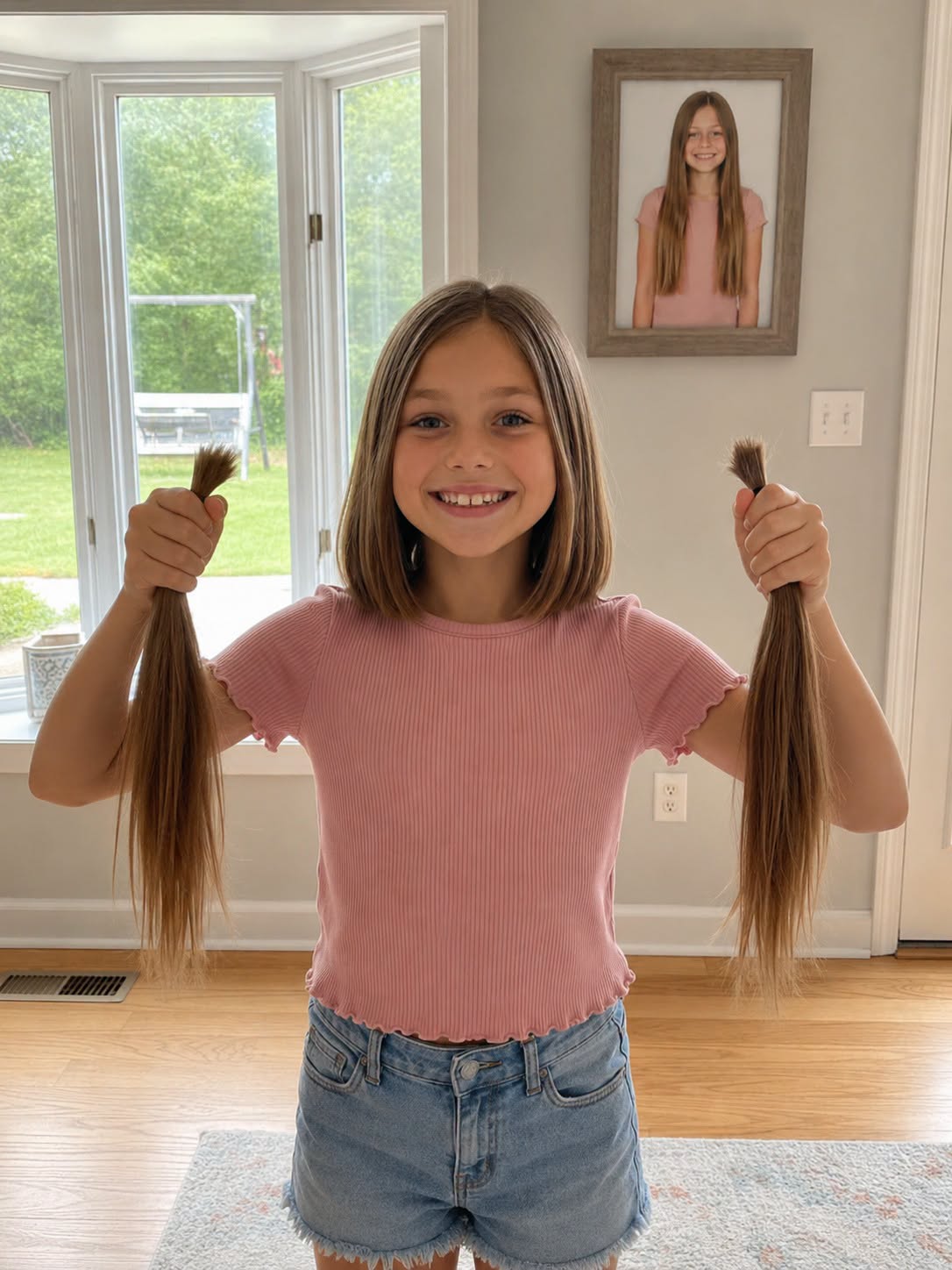
Because the hair I had spent six years caring for was gone.
Completely gone.
Ariana’s waist-length curls had been cut off.
Her hair barely reached her ears.
The curls I had washed, protected, detangled, and braided countless times were scattered somewhere behind her in a salon trash bin.
For a moment, I couldn’t breathe.
All I could see was the little girl I used to be.
Sitting on a kitchen stool.
Crying silently.
Watching my mother cut away something I loved.
“What happened?” I whispered.
Ariana’s smile faded.
Behind her, Tom stepped out of the kitchen.
The second I looked at him, my anger exploded.
But what shocked me was his expression.
He didn’t look defensive.
He didn’t look angry.
He didn’t even look like he wanted to argue.
He looked exhausted.
Pale.
Almost afraid.
And somehow, that made me even more upset.
Because I didn’t see guilt.
I saw a man who knew something I didn’t.
I saw a secret.
“How could you do this?” I demanded.
“Emma—”
“No.”
My voice shook.
“You knew what her hair meant.”
“I know.”
“You knew how much time I spent taking care of it.”
“I know.”
“Then how could you take her out alone and come home with this?”
Ariana’s eyes filled with tears.
I barely noticed.
I was too trapped inside my own memories.
“You always joked that you wanted a boy,” I said.
Tom’s face changed.
“Emma…”
“Was this your chance?”
He stared at me.
“What?”
“Was this your way of pretending you had the son you wanted?”
The room became silent.
Tom looked hurt.
Not angry.
Hurt.
“That isn’t what happened.”
“Then explain it.”
He looked at Ariana.
She looked back at him.
A tiny exchange.
A silent conversation.
And somehow, it made me feel even worse.
They had a secret.
A secret my own daughter was keeping from me.
I felt betrayed.
“I’m taking Ariana,” I said.
Tom froze.
“What?”
“I’m leaving.”
“Emma, please.”
“Don’t ask me to calm down.”
“I’m asking you to listen.”
“To what?” I snapped. “Another explanation? Another excuse?”
I turned toward the stairs.
I was going to pack a bag.
I truly believed, in that moment, that my husband had taken something precious from our daughter.
Something she could never get back.
But before I reached the first step, Ariana grabbed my hand.
“Mommy, wait.”
I kept walking.
“Mommy, please.”
Her voice broke something in me, and I stopped.
She pulled me toward her bedroom.
Then she closed the door.
And for the first time that night, she looked serious.
She walked to her backpack.
She pulled out something carefully wrapped with pink ribbons.
A braid.
A long braid of her own hair.
My breath caught.
“Mommy,” she whispered.
“You don’t understand what this is for.”
I stared at the braid.
And suddenly, the story I thought I knew began falling apart.

Part 2
I stared at the braid in Ariana’s hands, unable to understand what I was seeing.
The pink ribbons tied around both ends were the same ones she used to love putting in her hair when she was younger.
The braid looked almost unreal sitting there on her bed.
Separated from her head, it seemed even longer.
Six years of growth.
Six years of Sunday night routines.
Six years of memories.
My first instinct was still confusion.
Then fear.
“Why did you keep it?” I asked softly.
Ariana looked down at the braid.
“Because we’re sending it away.”
My eyebrows tightened.
“Sending it where?”
She didn’t answer immediately.
Instead, she reached into her backpack and pulled out an envelope.
My eyes moved over the logo on the front.
It was from an organization that created wigs for children who had lost their hair because of medical treatments.
I looked from the envelope to my daughter.
Then back to the braid.
My heart started beating differently.
“Did Dad tell you to do this?”
Ariana shook her head.
“No.”
“Then whose idea was it?”
She hesitated.
Then she pulled out another piece of paper.
A drawing.
The paper was wrinkled from being carried around so often.
On it was Ariana standing beside a little boy.
Both of them had short hair.
The boy was smiling.
At the bottom, she had written a name.
Noah.
I sat down slowly on the edge of her bed.
That name.
I knew that name.
Not because I had met him.
Because Ariana had been saying it constantly.
Noah at breakfast.
Noah in the car.
Noah while drawing at the kitchen table.
I had assumed he was just another classmate.
Another child from school.
I never imagined there was a story behind that name.
“Tell me about him,” I whispered.
Ariana climbed onto the bed beside me.
Her fingers touched the drawing.
“His name is Noah. He was gone from school for a long time.”
“Why?”
She became quiet.
Then she said:
“He had cancer.”
The word hit me harder than I expected.
Ariana continued.
“When he came back, he didn’t have hair anymore.”
I looked at my daughter’s short curls.
The haircut I had thought was a tragedy suddenly felt different.
“He lost it because of his treatment,” she explained.
“Some kids stared at him.”
My chest tightened.
“Did they say something?”
She nodded.
“Some kids laughed.”
Her voice became smaller.
“Noah started hiding.”
“Where?”
“Under the playground slide.”
I covered my mouth.
Ariana looked at me.
“He thought everyone was looking at him because he looked different.”
The anger I had carried into that room began to crack.
Not disappear.
Not instantly.
But crack.
Because for the first time, I wasn’t looking at my daughter’s missing hair.
I was looking at the reason behind it.
“Did you sit with him?” I asked.
Ariana nodded.
“Yes.”
“What did you talk about?”
A small smile appeared on her face.
“Cars.”
I froze.
The garage.
The model cars.
The sudden obsession.
All of it.
“He likes old cars,” she said. “His grandpa used to fix them before he got sick.”
I stared at her.
All those weeks, I thought Tom was pushing her toward something she didn’t want.
I thought he was trying to create a different child.
But she wasn’t becoming someone else.
She was trying to understand someone else.
“I wanted to learn about cars,” Ariana continued, “so Noah and I could talk about them.”
My eyes burned.
The toy convertible she bought.
The hours in the garage.
The questions about engines.
None of it had been about becoming the son Tom never had.
It had been about becoming a friend Noah needed.
“Is that why you kept going to the garage with Daddy?”
She nodded.
“Yes.”
“Why didn’t you tell me?”
She looked away.
That hesitation hurt more than anything.
“Because I thought you’d say no.”
The room went quiet.
Ariana didn’t say it cruelly.
She said it honestly.
And that honesty hurt.
Because deep down, I knew she might have been right.
If she had come to me and said:
“Mommy, I want to cut my hair so I can donate it to a child who needs a wig.”
What would I have done?
Would I have listened?
Or would I have seen only my own past?
Would I have remembered my mother cutting my hair and immediately decided Ariana was too young to understand?
I looked at the braid sitting beside us.
For years, I had told myself I was protecting my daughter from having choices taken away.
But maybe I had forgotten something important.
Protecting someone was not the same as controlling them.
Ariana touched the braid.
“I didn’t want Noah to be the only one.”
That sentence broke me.
Not because it was dramatic.
Because it was simple.
A child had looked at another child’s pain and decided he shouldn’t have to carry it alone.
I pulled her into my arms.
For a moment, she stayed stiff.
Then she hugged me back.
“Are you still mad?” she whispered.
My eyes filled with tears.
“No.”
I held her tighter.
“I’m sorry.”
“You yelled at Daddy.”
“I know.”
She looked at me carefully.
“Daddy kept asking if I was sure.”
I pulled back.
“What?”
“He asked a lot.”
She lifted her fingers.
“He asked me in the garage.”
One finger.
“He asked me in the car.”
Another finger.
“He asked me at the salon.”
Another.
“And he asked me again before they cut my braid.”
I stared at her.
“What did you say?”
Ariana answered without hesitation.
“I said yes every time.”
I closed my eyes.
Because suddenly, the picture in my mind changed completely.
Tom hadn’t stolen a choice from our daughter.
He had protected her choice.
He had made sure she understood what it meant.
“Daddy said you might be sad,” Ariana whispered.
My throat tightened.
“Why didn’t you tell me?”
She looked down.
“Because I thought you’d say no.”
There it was again.
The truth.
My daughter knew my heart.
But she also knew my fear.
I brushed a curl away from her face.
“Would I have said no?”
She didn’t answer.
She didn’t need to.
That silence was enough.
I looked at the braid.
“I should have listened before I shouted.”
Ariana leaned against me.
“Can you tell Daddy that?”
I nodded.
“Yes.”
When we walked downstairs, Tom was still standing near the kitchen.
He hadn’t moved much.
It looked like he had been waiting there the entire time.
The moment he saw Ariana, his eyes softened.
Then he looked at me.
“Is she okay?”
Ariana answered before I could.
“Mom understands.”
Tom’s shoulders dropped slightly.
And that was when I noticed things I had ignored.
His face was pale.
There were dark circles under his eyes.
His hands were shaking.
He looked exhausted.
Not like someone who had done something wrong.
Like someone who had carried a secret too heavy for too long.
“Why didn’t you tell me?” I asked.
Tom rubbed his face.
“Because it wasn’t my story to tell.”
“I’m her mother.”
“I know.”
“You should have called me before letting her cut six years of hair.”
He closed his eyes.
“I almost did.”
“Why didn’t you?”
He looked at Ariana.
“She asked me not to.”
I waited.
Tom took a breath.
“She said you loved her hair more than anyone. She thought you would think she didn’t love it anymore because she wanted to cut it.”
Ariana lowered her eyes.
“I do love it,” she whispered.
Then she touched her short curls.
“I just love Noah too.”
That sentence silenced all of us.
Tom sat at the kitchen table.
“I told her keeping her hair would not make her selfish,” he said. “I told her she could help Noah without changing herself.”
I looked at him.
“What did she say?”
His expression softened.
“She said she wasn’t changing herself.”
He looked directly at me.
“She said this was herself.”
I sat across from him.
For weeks, I had misunderstood everything.
The Tuesday outings.
The cars.
The secrecy.
The hospital visits I never knew about.
Tom finally explained.
Those days weren’t about cars.
They were about Noah.
His company sponsored a small volunteer program that repaired donated bicycles and restored old toys for children receiving long-term medical care.
Tom had taken Ariana once after she begged to visit Noah.
After that, every second Tuesday became their special day.
They brought model cars.
They repaired toys.
They sat with Noah during his treatments.
They gave him something normal.
Something that wasn’t about hospitals.
Something that reminded him he was still just a kid.
“Why didn’t you tell me about the hospital?” I asked.
Tom looked down.
“Noah’s mother asked us to keep his medical situation private.”
“You could have told me there was a sick child.”
“I should have.”
His voice was quiet.
“I thought Ariana would tell you when she was ready.”
I studied my husband.
“You looked terrified when I came home.”
He gave a small, tired laugh.
“I knew exactly what you would see.”
My heart sank.
“My mother.”
He nodded.
“You told me what those haircuts did to you.”
He looked toward Ariana.
“I knew you would feel like someone had taken away her choice.”
The painful truth was that he understood me.
Maybe better than I understood myself.
“But she made the choice,” I whispered.
“Yes.”
Tom swallowed.
“I also knew if I explained everything for her, it might sound like I had convinced her.”
Ariana climbed onto the chair beside him.
“Daddy cried at the salon.”
Tom immediately looked embarrassed.
“I did not cry.”
“You did.”
“I had something in my eye.”
For the first time that evening, Ariana laughed.
A real laugh.
And somehow, that sound made the whole room feel lighter.
I reached across the table and took Tom’s hand.
“I’m sorry.”
He looked at me.
“I accused you of trying to replace our daughter with a son.”
His expression softened.
“I should have stopped making those jokes years ago.”
“They hurt more than I admitted.”
“I know that now.”
Ariana pushed the braid toward me.
“Will you help me send it?”
I touched the pink ribbons.
Then I nodded.
“Yes.”
And for the first time since I walked through the door and saw my daughter’s haircut, I didn’t see what had been lost.
I saw what she had chosen to give.

Part 3
The next morning, Ariana and I sat together at the kitchen table with the donation paperwork spread out in front of us.
She was more serious than I had ever seen her.
For a seven-year-old, she handled the moment with a kind of maturity that humbled me.
She carefully filled out the form, slowly writing each letter of her name in the large, uneven handwriting she was still learning to perfect.
I watched her little fingers hold the pen.
Those same hands had once held my fingers while crossing the street.
Those same hands had once reached up and asked me to fix her hair.
Now those hands were making a decision that came entirely from her own heart.
When the form asked why she wanted to donate her hair, Ariana stopped for a moment.
She thought carefully.
Then she wrote:
“Because my friend is brave, but he shouldn’t have to be brave alone.”
I had to turn my face away.
I didn’t want her to see the tears gathering in my eyes.
Because that one sentence showed me something I had forgotten.
Children sometimes understand kindness in ways adults make complicated.
I had spent years believing my daughter’s hair was a symbol of freedom because I had been denied that freedom.
But Ariana had shown me another kind of freedom.
The freedom to give.
The freedom to choose something for herself, even when that choice looked different from what I imagined.
Later that week, Ariana asked me to come to school early.
“Noah is coming back for a half day,” she explained.
She sounded nervous.
Not scared.
Just nervous in the way people feel when something matters deeply to them.
Tom came with us.
We stood near the classroom door while Ariana waited beside her desk.
She was wearing the same blue cap she had worn the day she came home with her short haircut.
I noticed she kept touching the edge of it.
A small habit.
A little sign that maybe, despite everything, she was still getting used to seeing herself differently.
Then the classroom door opened.
A little boy walked in.
Noah.
He was smaller than I expected.
He had a hood pulled low over his head, almost covering his entire face.
His mother walked beside him, carrying his backpack.
She looked tired.
The kind of tired only a parent who has spent months worrying can understand.
The moment Noah stepped inside, I saw it.
The hesitation.
The fear.
The way his shoulders tightened when he noticed other children looking at him.
My heart broke.
Because I recognized that feeling.
Not the same experience.
Not the same pain.
But the feeling of believing everyone sees the thing you are most afraid of.
Ariana didn’t wait.
She walked across the classroom.
“Noah.”
He looked up.
His eyes moved from her face to her short curls.
For a few seconds, he didn’t say anything.
Then his expression changed.
A small smile appeared.
“I like your haircut.”
Ariana shrugged.
“Now we match.”
Noah looked surprised.
Then slowly, he reached up and lowered his hood.
He didn’t hide.
Not that day.
Not in front of Ariana.
Not in front of the classroom.
Nobody laughed.
Nobody pointed.
A girl sitting near the window smiled.
“I like your dinosaur shirt.”
Another child asked him if he wanted to see the class turtle.
Within minutes, the moment everyone had feared was over.
That was the thing I would remember forever.
Adults attach so much meaning to things.
Hair.
Appearance.
Differences.
We carry our own memories and our own wounds, and sometimes we forget children see the world differently.
To me, Ariana’s haircut represented my childhood pain.
It represented the fear that someone had taken something precious from her.
But to Ariana, it was much simpler.
It was a message.
You are not alone.
You don’t have to hide.
Months passed.
Ariana’s curls slowly began growing again.
Not as quickly as before.
Not yet.
But they were coming back.
One evening, she sat between my knees like she had done countless times before.
I worked conditioner gently through her shorter curls.
There wasn’t enough length to create the elaborate braids she used to love.
So instead, I shaped each curl carefully with my fingers.
She looked peaceful.
Happy.
Exactly the same daughter I had always known.
“Do you miss it?” I asked.
She glanced up.
“My long hair?”
I nodded.
“Yes.”
She thought about it.
“Sometimes.”
I smiled.
“Do you regret cutting it?”
Ariana was quiet for a moment.
Then she shook her head.
“No.”
The answer came with complete certainty.
No hesitation.
No sadness.
Just peace.
I kissed the top of her head.
Neither did I.
For years, I thought protecting my daughter meant making sure nobody ever took away the choices I had lost.
I thought love meant guarding every piece of her from pain.
But I learned something important.
Sometimes love also means trusting the person you love.
Even when their choices scare you.
Even when their choices bring up memories you thought you had healed from.
The hardest part was realizing that my biggest fear had almost made me become the person I spent my entire life trying not to be.
My mother had taken away my choice because she believed she knew what was best for me.
And without realizing it, I almost did the same thing to Ariana.
Not because I didn’t love her.
Because I loved her so much that I was afraid.
Her hair mattered to me.
It always would.
Those curls represented something powerful.
They represented the little girl I used to be.
The girl who wanted someone to tell her that she mattered.
The girl who wanted something beautiful that belonged only to her.
But Ariana taught me something my younger self never understood.
Freedom is not about keeping something forever.
Freedom is about having the right to decide what happens to it.
The braid Ariana donated eventually became part of a wig for a child who needed it.
A small piece of my daughter became a reminder for someone else that they were not alone.
And every time I looked at Ariana’s growing curls, I no longer saw what had been cut away.
I saw what she had given.
I saw courage.
I saw compassion.
I saw a little girl who had looked at another child’s pain and decided to carry a small part of it with him.
One Sunday evening, months after everything happened, Ariana sat between my knees again.
The routine was almost the same.
The conditioner.
The quiet music.
The conversations about school.
But something was different.
I wasn’t holding onto her hair like it was something I needed to protect from the world.
I was simply enjoying the moment.
“Mommy?”
“Yeah?”
“When my hair gets long again, can I still donate it someday?”
I smiled.
Because the old version of me might have felt a little sadness.
Might have thought about losing those curls again.
But this time, I didn’t.
“Yes,” I said.
“If that’s what you choose.”
She smiled.
And that answer felt like the greatest gift I could give her.
Not perfect hair.
Not a perfect childhood.
Not a life without difficult choices.
Just the knowledge that she was allowed to make them.
Because in the end, my daughter’s hair was never the thing I was protecting.
It was her freedom.
And I finally understood that freedom only means something when it belongs to the person who carries it.