
I never imagined that the place where I felt closest to my grandmother would become the center of a family conflict.
The lake house she left me had always been more than a property. To everyone else, it was an old house sitting beside a quiet lake, surrounded by trees and an overgrown garden. But to me, it was the last piece of Grandma Penny that still existed in this world.
Every corner carried a memory.
The wooden porch where she drank coffee every morning. The kitchen where she taught me how to make her famous soup. The old rocking chair where she would tell me stories about her childhood.
But the garden was the part of the property that meant the most.
Grandma didn’t just plant flowers.
She planted memories.
The peonies near the fence marked the year I was born. The lavender along the walkway was planted after she recovered from a major surgery because she wanted something beautiful waiting for her when she came home. The roses beside the porch represented her wedding anniversary with Grandpa. The white daisies appeared after my first school recital because she said she wanted a flower that reminded her of my courage.
When Grandma passed away, she left me the lake house with a simple handwritten note.
“Keep it lived in.”
That was all she wrote.
Not “keep it perfect.”
Not “make it valuable.”
Just keep it lived in.
So I did.
I repaired broken windows, fixed the old plumbing, replaced damaged boards, and maintained the garden exactly as she had cared for it. I didn’t change much because I wanted the place to feel like her.
My husband Zac understood that.
He knew the lake house wasn’t just a house.
It was my connection to the woman who raised me.
His sister Kelsey, however, never really understood.
She saw an empty venue.
I saw my grandmother’s legacy.
Two days before Kelsey’s wedding, she showed up at our house looking completely overwhelmed.
Her wedding reception venue had been destroyed after a pipe burst inside the restaurant she booked. The damage was so severe that the owners had to close immediately. With hundreds of guests already traveling and every nearby venue booked, she was running out of options.
She arrived with her wedding binder pressed against her chest, tears in her eyes.
“Nadia, I don’t know what I’m going to do,” she said.
I felt terrible for her. No bride deserved to watch months of planning fall apart just days before her wedding.
Then she opened her binder.
Inside was a picture of my lake house.
“We can have it here.”
I immediately shook my head.
“No, Kelsey.”
Her expression changed.
“Please. Just listen.”
“I’m sorry, but that’s not what the house is for.”
She started explaining how desperate she was. She talked about guests flying in, deposits she couldn’t recover, and how this was supposed to be the happiest day of her life.
Zac looked at me.
“Nadia…”
I knew that look.
He wanted me to help.
After several minutes, I finally gave in.
“Fine. You can use the lake house.”
Kelsey immediately hugged me.
“Oh my God, thank you. You’re saving my wedding.”
But before she left, I made the rules very clear.
“Three things.”
She nodded.
“First, do not touch Grandma’s garden. Not one flower.”
“Of course.”
“Second, nothing inside the house gets damaged or moved.”
“Absolutely.”
“And third, when the wedding is over, every piece of trash leaves with you.”
She smiled.
“Nadia, relax. I understand. I know how special this place is.”
I wanted to believe her.
I really did.
But I should have paid closer attention to the way she said it.
Like she understood the words.
Not the meaning.
The morning of the wedding, something unexpected happened.
My aunt collapsed.
One minute we were getting ready to leave for the ceremony, and the next, we were rushing her to the hospital.
Zac and I spent the entire day there.
Before entering the emergency room, I called Kelsey.
“I know everything is chaotic, but remember what we talked about.”
She sighed.
“Yes, Nadia. I remember the sacred flowers.”
Her tone sounded slightly annoyed.
I ignored it.
“My grandmother’s garden matters to me.”
“Don’t worry.”
My aunt stabilized late that night.
By the time we finally returned home, the wedding was already over.
I expected a mess.
I expected some cleanup.
I expected empty cups or leftover decorations.
What I didn’t expect was what I saw.
The moment I turned onto the driveway, my stomach dropped.
A handmade cushion from the ceremony was lying soaked beside the road.
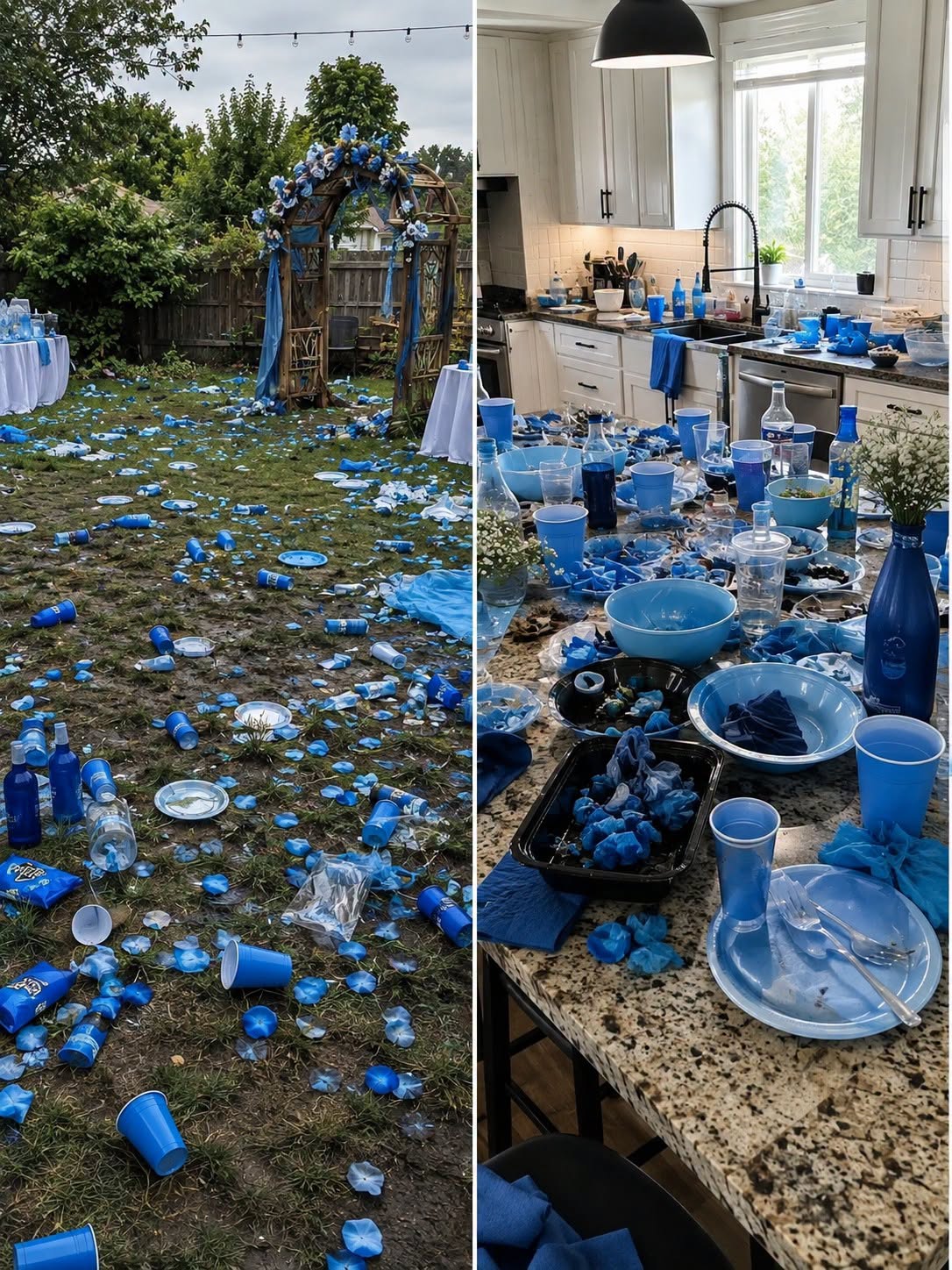
Plastic cups covered the grass.
Empty bottles were scattered near the dock.
Food containers were piled near the trees.
And deep tire tracks cut across the lawn where the ground was usually soft and carefully maintained.
Then I saw the wedding arch.
At first, I thought it was beautiful.
Then I realized why.

It wasn’t decorated with store-bought flowers.
It was covered with Grandma’s flowers.
My heart stopped.
The anniversary roses beside the porch were gone.
The lavender pathway Grandma planted after surgery had been ripped apart.
The daisies from my childhood memory were cut and tied together with ribbons.
And the peonies…
The peonies were completely gone.
They had been pulled from the ground.
I stood there staring at the empty flower beds, unable to process what I was seeing.
Those flowers weren’t decorations.
They were pieces of my life.
Inside the house, things were even worse.
Wine stains covered the cushions.
Someone had scratched the wooden table.
Grandma’s old rocking chair had been damaged.
The house looked like it had been used by strangers who never cared that anyone loved it before them.
I immediately called Kelsey.
She answered cheerfully.
“Hey! Did you see the photos? The wedding looked amazing.”
I didn’t respond.
“Kelsey.”
“What?”
“What happened to Grandma’s garden?”
There was a pause.
Then she said casually:
“Oh.”
“Oh?”
“We needed fresh flowers for the arch.”
My hands tightened around the phone.
“You cut them?”
“Nadia, it was my wedding.”
“You promised me you wouldn’t touch them.”
She laughed.
Actually laughed.
“They’re flowers.”
I couldn’t believe what I was hearing.
“They’re not just flowers.”
“They grow back.”
I looked outside at the destroyed garden.
“You ripped out plants that were decades old.”
“You own the place, so clean it yourself.”
Then she hung up.
I stood there in silence.
The person I had trusted with the most important place in my life had looked at everything my grandmother created and decided it was disposable.
Normally, Zac would have tried to calm everyone down.
He would have told me to give Kelsey the benefit of the doubt.
He would have searched for a compromise.
But this time, he didn’t.
He walked outside, looked at the ruined garden, and quietly asked:
“What do you need?”
I swallowed.
“Grandma’s garden map.”
Without asking another question, he went inside.
A few minutes later, he returned carrying a long cardboard tube from the study.
Inside was something I hadn’t looked at in years.
Grandma’s hand-drawn garden plan.
She had created it herself.
Every flower bed had a number.
Beside every number, she wrote the type of plant, when she planted it, and why it mattered.
Peonies — the summer Nadia was born.
Lavender — the year I recovered.
Daisies — Nadia’s first recital.
Roses — our anniversary.
I sat there holding the map, realizing something.
Kelsey didn’t just destroy plants.
She destroyed memories.
Zac and I spent the entire afternoon comparing Grandma’s map with what remained of the garden.
By sunset, we had counted everything.
Two hundred eighty-six plants.
Two hundred eighty-six pieces of Grandma’s garden that were gone.
That number stayed in my mind.
Then I had an idea.
I went into Grandma’s old storage room and found her seed box.
She had saved everything.
Seeds.
Bulbs.
Cuttings.
Replacement roots.
Things she had collected over decades.
I spent the next several days creating something.
Two hundred eighty-six numbered packets.
Each one contained what was needed to replace something Kelsey destroyed.
At the bottom of the box, I placed a laminated copy of Grandma’s garden map.
Then I added a small plaque.
It read:
RESTORATION KIT.
I sent it to Kelsey the next afternoon.
Less than an hour later, my phone rang.
“What did you send me?”
I smiled slightly.
“My wedding gift.”
“You sent me dirt!”
“No. I sent you everything you said would grow back.”

There was silence.
Then she noticed the numbers.
“You expect me to plant 286 flowers?”
“No.”
“Then what?”
“I expect you to restore 286 memories.”
Her voice became frustrated.
“Nadia, this is ridiculous. I can hire someone.”
“No.”
“I’ll pay for a professional landscaper.”
“No.”
Finally, she snapped.
“What do you want from me?”
I answered calmly.
“Come here every Saturday until the garden is restored.”
She laughed.
“You’re serious?”
“Yes.”
“I am not spending my weekends gardening.”
“You don’t have to.”
“Good.”
“But then I’ll tell the family that the flowers you said would grow back apparently needed someone else to do the work.”
She went quiet.
The following Saturday, Kelsey arrived.
She was wearing brand-new gardening gloves.
“This is humiliating,” she said.
I handed her packet number one.
“Lavender.”
She looked at the map.
“Where does it go?”
I pointed.
By lunchtime, she had dirt on her shoes and mud on her jeans.
“How many did I plant?”
“Eight.”
She stared at me.
“Eight?”
I nodded.
“Only 278 left.”
She looked horrified.
But she came back the next Saturday.
This time, she wore old jeans instead of expensive clothes.
That was the first sign something had changed.
Week after week, she returned.
At first, she complained about everything.
The dirt.
The weather.
The time.
But slowly, something shifted.
She started asking questions.
One afternoon, while planting flowers near an old wooden bench, she looked at me.
“Why are these arranged this way?”
I told her.
“Grandma and Grandpa sat here every anniversary.”
Kelsey looked at the bench differently after that.
Another week, she asked about the bee balm.
I explained that Grandma planted it after a difficult summer because she wanted something cheerful that refused to disappear.
The neighbors started sharing stories too.
They told Kelsey about the roses that survived storms.
The herbs Grandma used for soup.
The lilies she planted after my graduation.
And slowly, Kelsey stopped seeing a garden.
She started seeing a history.
One afternoon, she stood beneath the same wedding arch where she had taken Grandma’s flowers.
“I thought it looked beautiful,” she whispered.
I stayed quiet.
“I didn’t realize I was taking beauty from somewhere else to create it.”
That was the first time I believed she truly understood.
By the eighth Saturday, only one packet remained.
Number 286.
A peony root.
Kelsey held it carefully.
“The last one?”
I nodded.
She walked to the place marked on Grandma’s map.
She measured twice.
She dug carefully.
Then she placed the root into the soil and covered it gently.
No rushing.
No complaining.
When she stood up, her hands were covered in dirt.
“These were planted when you were born, right?”
“Yes.”
She looked across the garden.
“I thought I was only cutting flowers.”
Her voice cracked slightly.
“I didn’t understand I was destroying things people built memories around.”
For the first time since the wedding, I believed her apology.
Then Zac surprised both of us.
“I owe Nadia an apology too.”
We both looked at him.
He sighed.
“For years, whenever Kelsey caused problems, I asked Nadia to be the reasonable one.”
He looked at me.

“Because I knew you were easier to talk to.”
He shook his head.
“That wasn’t keeping the peace.”
“It was making the kinder person carry the cost.”
Kelsey lowered her eyes.
“I’m sorry.”
The following spring, Grandma’s garden came alive again.
The flowers returned.
The colors returned.
The lake house felt warm again.
One Saturday morning, I arrived and found Kelsey already there.
She was kneeling beside the peonies, pulling weeds.
A little girl from a nearby cottage reached toward one of the flowers.
Kelsey gently stopped her.
“Careful.”
The child looked confused.
“Why?”
Kelsey smiled.
“Because somebody loved that flower long before we did.”
I stood quietly on the porch.
For the first time since Grandma died, the yard no longer felt frozen in the past.
It felt alive.
Grandma always said flowers were better than photographs.
A photograph preserves a moment.
A garden proves someone cared enough to keep coming back.
And finally, after everything, Kelsey understood exactly what Grandma meant.