
Aug
Part 1 — The Suitcase That Should Never Have Left the Closet
For an entire year, I learned how to wake up every morning with a question no mother should ever have to carry.
Where was my daughter?
Was she frightened? Was she hurt? Was she calling for me somewhere I couldn’t hear her?
Or was she already gone?
I had asked myself those questions so many times that eventually they stopped feeling like thoughts and became part of my breathing.
Then, one Monday morning, an ordinary broken zipper led me to the truth.
I was standing beneath the harsh fluorescent lights of airport security, watching my suitcase disappear through the scanner for the second time.
The TSA officer studying the monitor leaned closer.
Then he called another officer over.
A few seconds later, a third person joined them.
My stomach tightened.
The suitcase reversed on the conveyor belt and went through the machine again.
Something was wrong.
At the time, I thought I was worried about missing my flight.
I had no idea that within minutes, the life I’d been living for the past year would collapse.
But to understand why that suitcase terrified me, I have to go back to the beginning.
One year earlier.
To Disney.
To my daughter Cynthia.
And to the night my husband called and told me she had disappeared.
Part 2 — Only My Husband Came Home
Cynthia was fourteen when my husband, Gary, took her on a trip to Disney.
I was supposed to go with them.
Work made that impossible.
I had felt terrible about it, but Cynthia hadn’t seemed particularly upset. She loved me, but there was no denying she’d always had a special bond with her dad.
Gary could make her laugh when she was angry. He knew which ridiculous snacks she liked. They could spend an hour arguing about movies and somehow both walk away smiling.
So I kissed them goodbye and told Cynthia to send me pictures.
She did.
For the first three days, my phone was constantly buzzing.
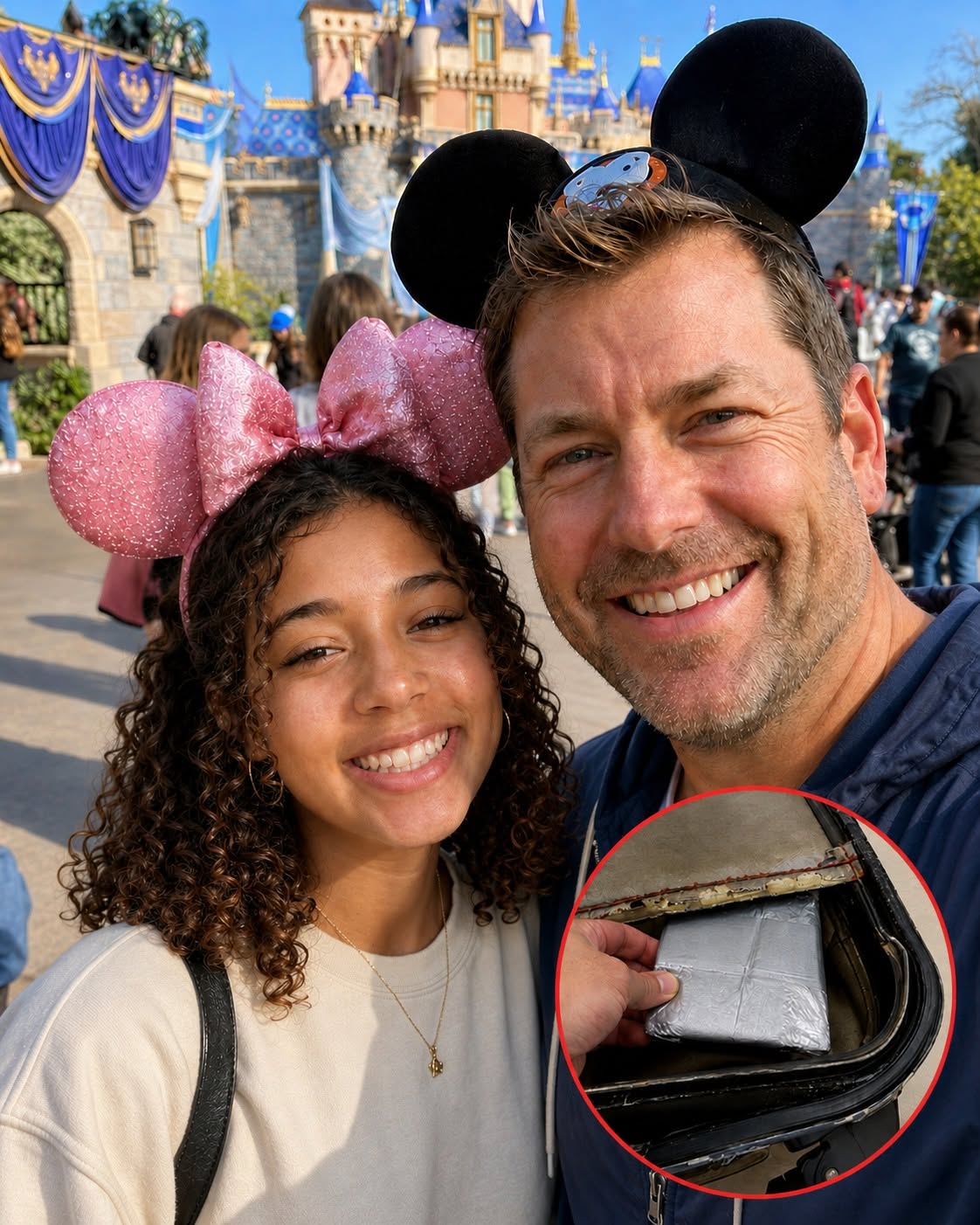
There was Cynthia wearing mouse ears and grinning at the camera.
Cynthia holding a sundae so enormous it looked like it could feed five people.
Cynthia beside Gary before a ride, both of them making exaggerated terrified faces.
Every photo made me smile.
I missed them, but I was happy they were happy.
Then, on the fourth night, my phone rang at 2:13 a.m.
I remember the time because after that night, those numbers seemed burned into my memory.
Gary was crying.
Not quietly.
Not normally.
He was struggling so hard to speak that I couldn’t understand him at first.
“Gary? What’s wrong?”
“It’s Cynthia.”
I sat upright in bed.
“What happened?”
“She’s gone.”
Two words.
That was all it took to divide my life into a before and an after.
According to Gary, he’d left their hotel room for less than fifteen minutes to pick up a food order from a restaurant they liked.
Cynthia had stayed behind.
When he returned, she wasn’t there.
Her things were still in the room.
But my daughter had vanished.
Police were called immediately.
Search teams became involved.
People questioned hotel staff, guests, drivers—anyone who might have seen something.
I flew there as quickly as I could.
I remember hallways.
Police officers.
Forms.
Questions.
Security footage.
People telling me to eat.
People telling me to sleep.
People telling me they were doing everything possible.
For weeks, I lived inside a nightmare where every ringing phone could change everything.
Eventually, investigators told us what they believed had happened.
Someone had likely taken Cynthia.
There was no proof of where she’d gone.
No meaningful lead brought her home.
The case remained open.
And somehow, the rest of the world kept moving.
Part 3 — Grief Changed Our House
I dealt with Cynthia’s disappearance by working.
It wasn’t healthy. I knew that.
But work gave me something grief couldn’t.
Tasks with answers.
Emails could be replied to.
Reports could be completed.
Meetings started and ended at predictable times.
There were problems I could actually solve.
At home, nothing could be solved.
Gary went in the opposite direction.
He almost disappeared inside himself.
He stopped traveling.
Stopped seeing friends.
Stopped caring about the things he’d once enjoyed.
Many nights, I’d find him sitting on the couch staring at old photographs of Cynthia.
He blamed himself.
At least, that was what I believed.
“I shouldn’t have left that room,” he’d say.
I’d try to comfort him even while I was falling apart myself.
“It was fifteen minutes, Gary. You couldn’t have known.”
But he never seemed to forgive himself.
Neither of us was really living.
We were surviving beside each other.
Cynthia’s photographs still hung in our hallway.
Some mornings, I would stop in front of one and simply stare.
Five minutes.
Ten minutes.
Sometimes so long that I’d suddenly realize I hadn’t eaten breakfast and was going to be late for work.
I studied her smile as if I could find clues hidden inside it.
Where are you?
Please be alive.
Please know I didn’t stop looking.
Please know your mother still loves you.
There was one object from the trip that Gary treated differently from everything else.
His suitcase.
The suitcase he’d taken to Disney.
When he returned home without Cynthia, he shoved it into the back of our closet and left it there.
Months later, I suggested that maybe we should donate it.
His reaction startled me.
“Don’t.”
The word came out sharp enough to make me freeze.
“Don’t ever touch that suitcase.”
I gave a nervous little laugh.
“Okay. Fine.”
He seemed to realize how harsh he’d sounded, but he didn’t apologize.
After that, I left it alone.
I told myself grief made people behave strangely.
I told myself the suitcase probably reminded him of the worst day of his life.
There was also a small white Tile tracker attached inside one of its front pockets.
I’d noticed it while searching for a charger.
“What’s this doing here?” I asked.
Gary barely looked over.
“In case the suitcase gets lost.”
I stared at him.
The suitcase had been sitting in the same closet for months.
“How exactly is it going to get lost from—”
I stopped myself.
Never mind.
What was the point?
Nothing about our lives felt logical anymore.
Then I began noticing something else.
Sometimes, when I opened the closet, Gary’s phone would make a sound.
He would check it.
Occasionally, he’d come over and glance at the suitcase before returning it carefully to its place.
I noticed.
Then I explained it away.
Because that was what I had become very good at doing.
Grief.
Everything strange became grief.

Part 4 — The Tiny Details That Didn’t Fit
The first real crack appeared during dinner one evening.
A neighbor had stopped by, and somehow the conversation turned to Cynthia.
Gary began telling one of his Disney stories.
He mentioned the mouse ears Cynthia had chosen.
“The pink ones,” he said.
My hand paused around my wineglass.
Pink?
I remembered something very clearly.
During one of our interviews with the detectives, Gary had said Cynthia chose purple ears.
It was such a tiny detail.
Completely meaningless on its own.
But after spending a year replaying the same days in my head, details mattered.
“Pink?” I asked casually. “I thought they were purple.”
Gary didn’t hesitate.
“Were they?” He gave a tired little laugh. “Goodness, I can’t keep anything straight anymore.”
Our neighbor looked at him with sympathy.
I tried to do the same.
But something uneasy settled inside me.
There were other things.
Whenever I brought up Gary’s sister, Rhonda, he changed the subject.
I had never really known her.
Gary said they’d been estranged for years after a family disagreement.
She lived somewhere near the coast.
Whenever I suggested contacting her, even just because tragedy sometimes brought families back together, Gary found a reason not to discuss it.
Work.
The weather.
Anything.
And after Cynthia vanished, my marriage changed too.
I had assumed that shared grief would bring us closer.
Instead, Gary became more distant.
We lived beneath the same roof but sometimes felt like two strangers standing on opposite sides of an invisible wall.
Still, I never suspected the truth.
How could I?
The truth was too cruel to imagine.
Part 5 — The Broken Zipper
On Sunday night, I packed for an early work flight the next morning.
Gary fell asleep on the couch with a documentary playing softly in the background.
Monday morning was chaos.
I was already running late when I pulled on the zipper of my suitcase.
It ripped apart in my hand.
I stared at it.
“No. No, no, no.”
The cab was already outside.
I didn’t have time to buy another bag.
Gary was still asleep on the couch, one arm thrown across his eyes.
Then I remembered the suitcase in the closet.
The Disney suitcase.
I hesitated.
Gary had made it very clear that he didn’t want anyone touching it.
But I was about to miss a flight.
It was luggage.
Nothing more.
At least, that’s what I told myself.
I pulled it from the back of the closet and placed it on the floor.
For the first time in a year, I opened it.
The main compartment was empty.
A faint smell of old sunscreen lingered inside.
My chest tightened.
For one painful second, I pictured Cynthia packing for the trip.
Laughing.
Excited.
Alive and safe.
“Just a suitcase,” I whispered.
I transferred my belongings into it, zipped it closed, and hurried outside.
During the cab ride, I noticed something strange.
The bag felt heavier than it should have.
Not dramatically heavier.
Just enough to notice.
I shifted it across my knees.
The driver looked at me through the mirror.
“Everything okay, ma’am?”
“Fine,” I said.
“I’m just tired.”
The suitcase remained on my lap the rest of the way to the airport.
Silent.
Ordinary.
Carrying the truth I’d been searching for all year.
Part 6 — Airport Security Found the Seam
The security line moved quickly at first.
Then my suitcase entered the scanner.
And stopped.
It reversed.
Went through again.
An officer leaned toward the screen.
Another joined him.
My mouth went dry.
Finally, a tall TSA officer approached me.
His name tag read Delgado.
“Ma’am, would you step over here with me?”
My heart began pounding.
“Is something wrong?”
“There’s something unusual underneath the inner lining of your suitcase.”
The words didn’t immediately make sense.
“Under the lining?”
He brought the suitcase to a metal inspection table.
I followed.
Delgado opened it and carefully moved my folders and clothing aside.
Then he ran his gloved fingers along the black interior.
His hand stopped near the bottom.
“Ma’am, look here.”
I leaned closer.
Along one section of the seam were tiny stitches made with red thread.
They were neat.
Deliberate.
And very different from the original stitching.
“That’s not factory stitching,” Delgado said.
A chill traveled through me.
“I don’t know anything about it.”
“Is this your bag?”
I swallowed.
“My husband’s.”
Something changed in his expression.
Not suspicion exactly.
Attention.
“Do I have your permission to open this section?”
“Yes.”
My voice sounded distant.
“Yes, please.”
Using a small tool, Delgado cut the first red stitch.
Then another.
He carefully lifted the lining.
He studied the holes.
“These stitches look fairly recent.”
I stared at him.
“Recent?”
He nodded.
“Weeks, possibly.”
I felt as though the floor had shifted beneath me.
“That suitcase hasn’t been used in a year.”
Another officer examined the seam.
“The lining has been opened before,” he said. “There are older puncture marks.”
Opened before.
More than once.
My fingers tightened around the edge of the table.
Delgado reached beneath the lining.
When his hand emerged, he was holding a flat package wrapped in clear plastic and thick silver tape.
He placed it in front of me.
“Do you recognize this?”
“No.”
I shook my head immediately.
“I’ve never seen it.”
They began removing the layers.
Plastic.
Tape.
More plastic.
And then my phone vibrated against the table.
I glanced down.
Missed calls.
Several of them.
All from Gary.
Suddenly I remembered the Tile tracker.
Gary knew the suitcase had moved.
He had probably known from the moment I took it out of the house.
I answered.
“Where are you?” he demanded.
Something about his voice frightened me.
“I’m at the airport.”
A pause.
“With security.”
His breathing changed.
“Melissa…”
Then he said the words that made my blood turn cold.
“Please tell me you didn’t take my Disney suitcase.”
I couldn’t answer for a moment.
“Gary…”
“Come home,” he said quickly. “Just come home. I’ll explain everything.”
I looked at Delgado.
He was still opening the package.
“Don’t let them open it,” Gary begged. “Please.”
My knees almost gave out.
“Explain what?”
“Not on the phone. Melissa, please.”
And then Delgado removed the final layer.

Part 7 — My Daughter’s Face
There was no weapon inside.
No terrible physical evidence.
Nothing I had imagined during the few seconds when panic overwhelmed me.
There were documents.
A thick stack of them.
A cheap black phone I had never seen before.
Receipts.
A passport.
The passport fell open.
And I saw my daughter’s face.
Cynthia.
I stopped breathing.
Her photograph.
Her eyes.
Her hair.
But beside that familiar face was a name that wasn’t hers.
“No…”
I reached toward it.
“No. No, no…”
Beneath the passport was a folded sheet of drawing paper.
My hands shook so violently I could barely open it.
There was a pencil drawing of a beach house.
A dog.
And in the bottom corner, handwriting I would have recognized anywhere.
Love, Cynthia.
I looked at the date.
Three months earlier.
Three months.
My daughter had drawn that picture three months ago.
She had been alive.
After nine months of watching me grieve, Gary had somehow possessed a drawing made by our daughter.
There was also an envelope.
The postmark came from a coastal town.
The same area Gary had once mentioned when talking about Rhonda.
His estranged sister.
Other items began forming a picture I couldn’t yet bear to accept.
A Greyhound ticket.
Orlando to a transfer point two states away.
A rental car receipt dated the day after Cynthia disappeared.
The red stitches.
The older holes.
Gary checking his phone whenever the closet opened.
His strange attachment to the suitcase.
The Tile tracker.
The mail.
The changing stories.
Everything collided at once.
My daughter hadn’t vanished into the unknown.
She had been alive.
Someone knew where she was.
And that someone was my husband.
I screamed.
Through the phone, Gary’s voice became small.
“Melissa? Honey, please calm down.”
Calm down?
For a year, I had imagined my daughter’s final moments.
I had prayed for miracles.
I had lain awake wondering whether I had failed her by staying home because of work.
And the man sleeping beside me every night had known more than he ever told me.
“You told me she was gone,” I whispered.
“I can explain.”
“You let me believe someone took her.”
“Melissa—”
“You watched me cry!”
“I did it for her.”
Those words hit me harder than anything else.
“For her?”
“You have to let me explain. Come home first. Don’t talk to anyone else. Come home, and I’ll tell you everything.”
“Where is she?”
“I’ll take you to her.”
My entire body went cold.
So he knew.
There was no longer any doubt.
“Where is my daughter, Gary?”
“Please don’t do this here.”
“WHERE IS SHE?”
People turned toward us.
I didn’t care.
Gary kept pleading.
“Don’t do this to us. I love Cynthia. I love you.”
I stared at the drawing.
The beach house.
The dog.
Cynthia’s handwriting.
Then something inside me hardened.
For a year, Gary had controlled the story.
He had decided what I knew.
What I believed.
What I mourned.
Not anymore.
I looked at Officer Delgado.
Then I lowered the phone from my ear.
“You need to hear this conversation.”
I handed him my phone.
And for the first time since Cynthia disappeared, I stopped protecting my husband’s grief.
Because I finally understood.
It hadn’t been grief.
It had been guilt.
Part 8 — The Truth About Rhonda
I missed my flight.
Instead, I found myself sitting inside a small room connected to the airport precinct.
A detective named Marsh placed photocopies of the documents in front of me.
A family liaison sat nearby.
My hands wouldn’t stop trembling.
Detective Marsh explained what investigators had begun piecing together.
Two years before the Disney trip, Gary had opened accounts connected to a relative’s name.
The postmark on Cynthia’s drawing pointed toward the coastal town where his sister lived.
“Rhonda,” I whispered.
The detective nodded.
Rhonda had married and taken her husband’s surname.
Gary had never included that married name on family paperwork.
During the original investigation, when police asked about relatives, he’d given them Rhonda’s maiden name and insisted they had been estranged for years.
He had even provided old evidence of their dispute.
Emails.
Documents from an inheritance disagreement.
Everything supported the story that Gary and Rhonda wanted nothing to do with each other.
The investigators now believed that history had helped conceal Cynthia.
Police searching for Gary’s estranged sister under one identity had no reason to connect her with the married woman living in that coastal town.
I felt sick.
This hadn’t been a desperate decision made during the Disney trip.
Pieces of it had been arranged earlier.
Detective Marsh asked me to make another call to Gary.
This time, they would listen.
Gary answered immediately.
He was crying.
“Please come home.”
“Tell me where Cynthia is.”
“Melissa…”
“Tell me.”
Then the explanation finally began spilling out.
He said Cynthia had been unhappy.
He said my work schedule was too demanding.
He said my traveling meant I wasn’t around enough.
He said he had been afraid of losing Cynthia emotionally.
He said he believed a quieter life with Rhonda would be better for her.
And then he said something that made me understand the full depth of his betrayal.
“I thought a custody fight would destroy everyone.”
“So you did this instead?”
Silence.
“You let me grieve my living child.”
“I know.”
“You watched me stand in front of her photographs every morning.”
“I know.”
Each time he said those words, they felt worse.
Because he had known.
He had watched my suffering while knowing there was an address where Cynthia could be found.
He had watched me mourn someone who was still breathing.
And somehow he’d convinced himself that he was doing the right thing.
Part 9 — “Mom!”
Two days later, I sat in a quiet office waiting for my daughter.
I don’t remember much about those minutes.
Only the door.
I stared at it.
I was terrified to look away.
Then it opened.
Cynthia stepped inside.
She looked taller.
Thinner.
Older somehow.
But she was alive.
My baby was alive.
For one second, neither of us moved.
Then her face broke.
“Mom!”
She ran toward me.
I don’t remember standing.
I only remember her hitting my arms and me holding her.
I held her as if I could somehow make up for an entire lost year with one embrace.
I touched her hair.
Her shoulders.
Her face.
I kept whispering her name.
“Cynthia. Cynthia. Cynthia.”
I needed to hear myself say it.
Needed to feel her breathing against me.
She was real.
She was here.
Eventually, she pulled back enough to look at me.
“They told me you agreed,” she said.
My heart broke all over again.
“Agreed to what?”
“To me staying with Aunt Rhonda.”
I stared at her.
Cynthia explained that Gary had told her I knew about the arrangement.
That I believed she would be happier there.
At first, whenever Cynthia asked why she couldn’t talk to me, she was told I was busy.
Work.
Travel.
Later, the excuses became harder to believe.
Then, several months earlier, Cynthia had directly asked to contact me.
She had been told that I didn’t want her reaching out.
That was the moment she knew something was wrong.
“I knew you wouldn’t do that,” she whispered. “You’d never just stop talking to me.”
My eyes filled again.
“I never agreed to any of this.”
“I know.”
She told me about the drawing.
The beach house.
The dog.
She had slipped hope into that piece of paper.
Some part of her believed that perhaps I would find it.
Perhaps the message would somehow reach me before her father did.
“I hoped you’d see it and come get me.”
I pulled her back into my arms.
“I’m here now.”
And this time, neither of us let go for a long while.
Part 10 — The Life We Built Afterward
Months have passed since the airport.
Cynthia and I live together in a small apartment now.
It isn’t perfect.
Healing never happens as neatly as people imagine.
We have therapy on Thursdays.
Some conversations are difficult.
Some nights, Cynthia still asks questions neither of us knows how to answer.
Sometimes I still wake up with the old panic before remembering that her bedroom is only a few steps away.
But we are building something honest.
Something no one else gets to decide for us.
Sunday mornings belong to pancakes.
Sometimes Cynthia burns the first one.
Sometimes I do.
We laugh about it.
And after losing a year together, even ordinary laughter feels precious.
Gary is answering for what he did through the court system.
His explanation has never changed very much.
He believed my long work hours and frequent travel meant Cynthia needed another kind of life.
Instead of talking to me, confronting our problems, seeking help, or making decisions with Cynthia’s mother present, he secretly reconnected with Rhonda.
He arranged for Cynthia to live with her.
Then he used the Disney trip to make her disappearance look real.
He told our daughter that I had agreed.
He returned home alone.
And he allowed me to believe a stranger had taken my child.
For an entire year.
Gary called it protecting Cynthia.
But protection doesn’t require destroying one parent in order to control another person’s life.
He had decided, without me, that I didn’t deserve to raise my own daughter.
And somehow he had convinced himself that his reasons justified what he did.
Sometimes I still think about that Monday morning.
My broken suitcase.
The cab waiting outside.
Gary asleep on the couch.
The decision to reach into the closet and take the one bag he’d warned me never to touch.
One broken zipper changed everything.
If my suitcase hadn’t torn…
If I had found another bag…
If I had decided missing my flight was easier than upsetting Gary…
I might never have taken his Disney suitcase.
Airport security might never have noticed the unusual lining.
Those red stitches might have remained hidden.
And I might still be standing in front of Cynthia’s photograph every morning, mourning a daughter who was alive somewhere, waiting for her mother to find her.
For a year, I believed Cynthia had disappeared.
The truth was far more painful.
My daughter had never disappeared at all.
She had been hidden from me by someone I trusted completely.
And in the end, the smallest accident—a broken zipper—finally brought her home.