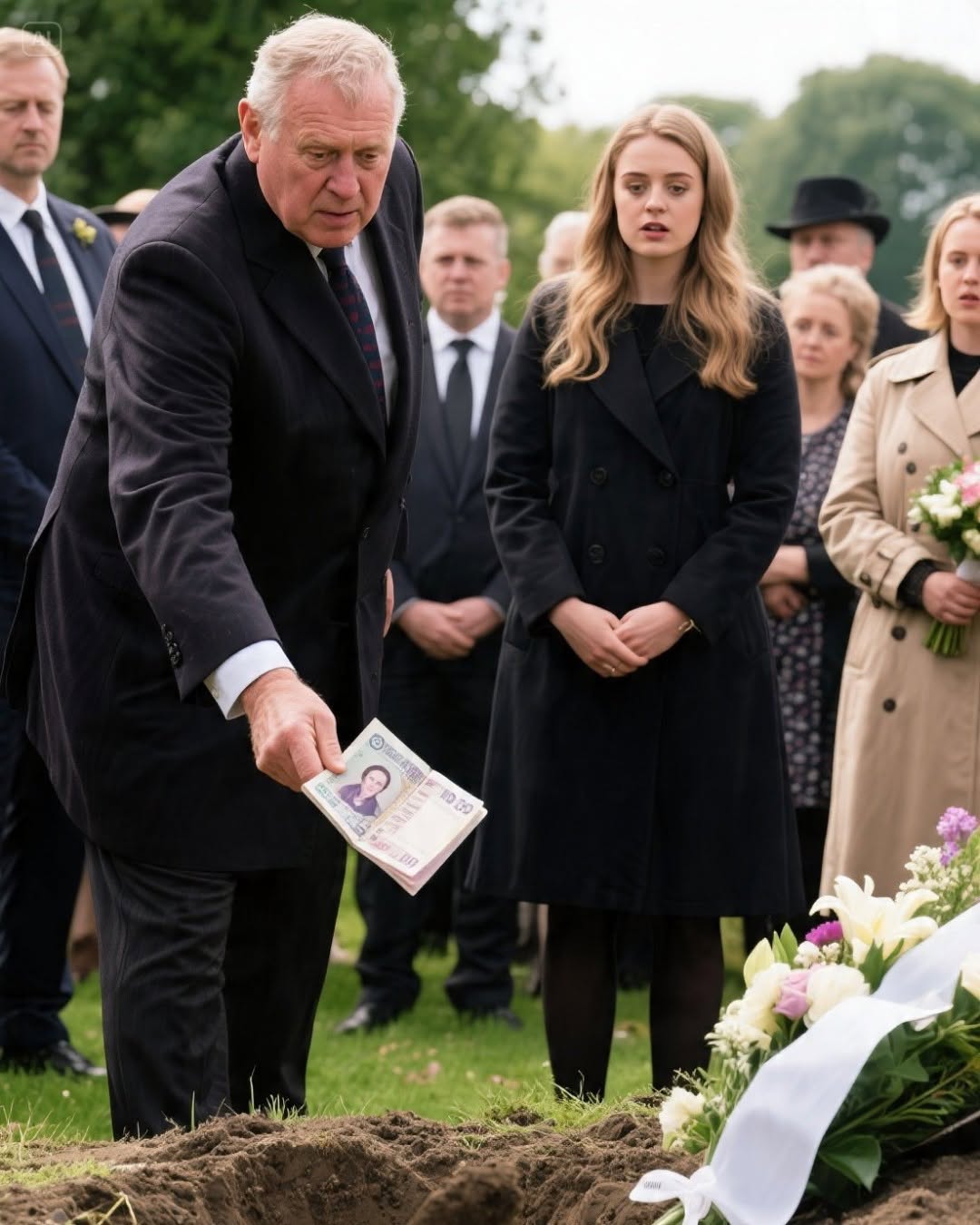
“That book isn’t worth a dime. Let it rot with the old lady.”
My father threw the small blue passbook onto Grandma Maggie’s open coffin. It landed against her chest, surrounded by damp soil and wilted flowers. No one moved. Not my uncles. Not my cousins. Not even the pastor, who had just finished the final prayer at Oakfield Cemetery.

Two nights earlier, Grandma Margaret Henderson had squeezed my hand and whispered, “Chloe… don’t let Richard find it.”
Richard was my father.
And apparently, he was the person she feared most.
I was twenty-seven, standing in a borrowed black dress while my cheap flats sank into the wet earth. Dad adjusted his black gloves and gave me the smug smile I knew too well.
It was the same expression he wore whenever he called my tears “drama,” took the money from my college scholarship, or threatened me until Grandma stepped between us.
“There’s your inheritance, Chloe,” he said, pointing toward the grave. “An old notebook. No house. No land. No money.”
Susan, my stepmother, chuckled behind her designer sunglasses.
Tyler, my half-brother, leaned toward me.
“If there’s fifty bucks in there, burgers are on you.”
Several cousins laughed.
I couldn’t.
For years, Grandma had kept that passbook hidden inside an embroidered napkin, tucked into an old butter-cookie tin beneath her bed. Once a month, she carried it to the bank in her knitted cardigan and clasp purse.
When I was little, I sometimes saw it resting beside the porcelain angel on her kitchen table.
“This little paper is for when I’m gone,” she once told me.
Then she had squeezed my hand.
“But only you should know, sweetie.”
When the funeral attendants began lowering her coffin, Dad never shed a tear.
He simply watched the dirt falling into the grave.
It was almost as though he wanted to make certain something stayed buried forever.
Soon, everyone began leaving.
I stayed behind.
I listened to footsteps fading across the gravel.
Car doors slammed.
Engines started.
Then silence returned to the cemetery.
I dropped to my knees.
With my bare hands, I dug through the cold, wet dirt until my fingers finally touched the blue passbook.
I pulled it free, wiped the mud from its cover, and opened the first page.
Margaret Henderson.
Beneath her name, Grandma had written a single sentence in shaky blue ink:
“If Richard says it’s worth nothing, it’s because he already tried to cash it.”
My heart stopped.
I ran.
That night, I locked myself inside my tiny apartment near the downtown market. I pushed a wooden chair beneath the doorknob and spread the passbook beneath the harsh yellow light.
At first, everything looked ordinary.
Fifty dollars.
One hundred and twenty.
Three hundred.
Occasionally, a thousand.
They were modest savings Grandma had accumulated from baking, doing laundry, and hemming clothes.
Then the numbers suddenly changed.
Large withdrawals.
Unexpected transfers.
Amounts far beyond anything Grandma should have been able to move.
And beside them appeared the same initials.
R.H.
Richard Henderson.
My father.
My hands began shaking.
Then I discovered a folded piece of paper hidden between two pages.
It was Grandma’s handwriting.
“Chloe, if you are reading this, forgive me for waiting so long. Your father didn’t just take money from me. He also tried to take something that has belonged to you since the day you were born.”
My breath caught.
At the bottom, she had written:
“Don’t go to the family. Don’t trust Susan. Go directly to the bank. Ask for the account marked with the red stamp.”
I searched every page.
Finally, I found it.
A faded red circle.
Beside it was a handwritten routing code.
I didn’t sleep that night.
At eight the next morning, still wearing the black dress stained with cemetery mud, I walked into the main branch on Main Street.
The passbook was hidden inside a paper grocery bag and wrapped in a kitchen towel.
Inside the bank, everything looked painfully ordinary.
People were arguing about debit cards.
Children were whining.
Customers waited in line.
But my entire life was about to change.
A young teller smiled politely.
“Good morning. How can I help you?”
I slowly unwrapped the book.
“It belonged to my grandmother. She passed away yesterday. She told me I needed to come here.”
The teller entered the account number.
She stopped.
Then typed it again.
Her expression changed.
She looked at the screen.
Then at the passbook.
Then at me.
The color drained completely from her face.
“Are you a direct relative of the account holder?”
“I’m her granddaughter.”
“Your full name?”
“Chloe Henderson.”

She asked for my identification.
I handed it over.
Her fingers trembled as she compared my information with the records on her screen.
Then she suddenly reached for the phone.
“Manager, I need you at window four.”
She paused.
“And please contact security.”
My heart began pounding.
Before I could ask what was happening, she made another call.
This time, I heard one word clearly.
“Police.”
Moments later, a man in a gray suit rushed toward us, his name tag hanging crookedly from his jacket.
He immediately flipped the Window Closed sign into place.
Then he reached across the counter and took the muddy blue passbook from the teller.
He stared at the final page.
His expression became one of absolute disbelief.
Then he looked directly at me.
“Miss Henderson…”
His voice was barely above a whisper.
“Do you know what your grandmother actually left you?”
The manager opened the passbook precisely where Grandma had placed the faded red stamp. He examined the routing code, then looked at my driver’s license once more.
Once.
Twice.
His expression grew tense.
“Ms. Henderson,” he said quietly, “I need you to stay inside the bank.”
“Why?”
He didn’t respond.
The teller remained behind him, staring at her monitor as if she had discovered something she was never meant to see. I could hear customers speaking several windows away, but window four suddenly seemed completely cut off from the rest of the branch.
The manager checked Grandma’s name again. Margaret Henderson. Then mine. Chloe Henderson. His eyes went back to the final page and the red circle.
Behind him, the teller swallowed hard.
“It’s her,” she said. “The girl from the case file.”
My stomach dropped. I had never heard of any case file. Grandma had never told me about one. Dad certainly hadn’t.
Then the manager stepped away from window four, gripping the blue passbook tightly in both hands.
“Wait,” I said. “What case file?”
The manager looked at me for several seconds.
Then he lowered his voice.
“Your grandmother didn’t have an ordinary savings account.”
He opened a drawer beneath the counter and removed a sealed envelope.
It was old.
Yellowed around the edges.
Across the front were three words written in blue ink:
FOR CHLOE ONLY.
My heart began pounding.
“Your grandmother left this with the bank twelve years ago,” he said. “She gave us strict instructions. We were told never to release it unless someone presented this exact passbook and identified herself as Chloe Henderson.”
I stared at the envelope.
“Twelve years ago?”
The manager nodded.
“She anticipated that someone might try to take control of the account before you reached adulthood.”
My hands trembled as I opened it.
Inside was a letter.
I recognized Grandma’s handwriting immediately.
My dearest Chloe,
If you are reading this, then I am no longer here to protect you.
I covered my mouth.
The manager quietly stepped back.
I continued.
Your father will tell you that I left you nothing. He will say I was poor, confused, and unable to manage my own affairs. Don’t believe him.
The money you see in the ordinary passbook is only a small portion of what I saved.
Years ago, I discovered that Richard had been secretly taking money from my accounts. When I confronted him, he threatened me. He told me that if I ever spoke, he would make certain you received nothing from me.
My vision blurred.
I wiped away a tear and kept reading.
So I created another account. One your father could never reach.
The manager quietly said, “Keep reading.”
I did.
The money in that account came from the sale of the property your grandfather left me, the proceeds from my bakery, and investments I made over many years. But there is something more important than the money.
I turned the page.
Richard has been using your identity since you were eighteen.
I froze.
“What?”
The manager’s face tightened.
I read the next line.
He opened accounts, signed documents, and transferred funds using copies of your identification. He wanted to create the appearance that you had authorized the transactions.
My hands began shaking violently.
“That can’t be true.”
The manager looked at me.
“We have records.”
He placed another folder on the counter.
Inside were copies of documents bearing my name.
Bank applications.
Loan agreements.
Investment forms.
Several signatures looked almost like mine.
But I knew I had never signed them.
Then I saw the date.
One of the documents had been signed on a day I was in college.
I remembered that day.

I had been sitting in a hospital waiting room with Grandma.
I looked up.
“Why did she never tell me?”
The manager’s expression softened.
“She tried.”
He pointed to the final page of the letter.
I read:
I was afraid Richard would hurt you if he knew I had told you everything. So I waited. I hired an attorney and placed the account under a legal trust.
When you turn twenty-five, you become the sole beneficiary.
I stared at the page.
I was twenty-seven.
The money was already mine.
But then I saw the final paragraph.
Chloe, there is one more thing you must understand.
Your father believes he already took everything from you.
Let him believe that.
Because the truth is worth far more than money.
Underneath those words was an address.
My father’s office.
And a second name.
Richard Henderson — Trustee Account Administrator.
I looked at the manager.
“What does this mean?”
He hesitated.
“It means your father may have been using your grandmother’s money for years.”
“Your grandmother appears to have spent the last decade building a case against him.”
Before I could respond, the bank’s front doors opened.
Two detectives entered.
Behind them was an older woman wearing a navy suit.
She looked directly at me.
Then at the blue passbook.
“Chloe?”
“Yes.”
“My name is Detective Laura Bennett.”
She walked toward me.
“Your grandmother contacted us six months ago.”
My heart stopped.
“She knew she was dying?”
Detective Bennett nodded.
“She told us she was afraid she wouldn’t live long enough to see you discover the truth.”
She placed a photograph on the counter.
It showed Grandma sitting at the same kitchen table where I had seen the passbook as a child.
Beside her was a stack of documents.
And sitting across from her was my father.
I stared at the photograph.
“When was this taken?”
“Three weeks before she died.”
I couldn’t breathe.
“She was meeting with him?”
“Yes.”
“Why?”
Detective Bennett’s expression became serious.
“Because she confronted him.”
“About the money?”
“About everything.”
She opened a folder.
Inside were recordings.
Emails.
Bank statements.
And photographs of documents Richard had allegedly forged.
Then she said something that made my blood run cold.
“Your grandmother didn’t die believing Richard would get away with it.”
“She died knowing that you would eventually find the evidence.”
I sat down.
For the first time since the funeral, I cried.
Not because Grandma was gone.
But because I finally understood how hard she had fought to protect me.
Then my phone rang.
Dad.
I stared at the screen.
The detective noticed.
“Answer it.”
I hesitated.
“Why?”
“Because if he’s calling you now, there’s a reason.”
I answered.
“Hello?”
Dad’s voice sounded unusually calm.
“Chloe.”
I said nothing.
“Your grandmother left you that stupid book, didn’t she?”
My entire body went cold.
Detective Bennett immediately motioned for me to put the call on speaker.
I did.
Dad continued.
“You’ve always been too curious for your own good.”
I looked at the manager.
He was already signaling security.
Dad laughed quietly.
“Bring the passbook to my office.”
“No.”
Silence.
Then his voice changed.
“You don’t understand what you’ve found.”
“I understand enough.”
“No, Chloe. You don’t.”
He lowered his voice.
“If you take those documents to the police, you’ll destroy this family.”
I stared at the detective.
“Which family?”
Dad said nothing.
“The one you stole from?”
Silence.

“The one Grandma spent years protecting?”
His breathing became heavier.
“Don’t make this worse.”
I tightened my grip on the phone.
“You already did.”
I hung up.
Detective Bennett immediately nodded.
“We have enough.”
“Enough for what?”
She closed the folder.
“An arrest warrant.”
By that evening, police surrounded my father’s office.
I watched from across the street as officers entered the building.
Richard tried to walk out through the back entrance.
He didn’t make it far.
Two detectives stopped him.
He looked directly at me.
For the first time in my life, my father looked afraid.
“Chloe!”
I didn’t move.
“You’re making a mistake!”
I shook my head.
“No, Dad.”
“Grandma made sure I wouldn’t.”
He was arrested for fraud, forgery, identity theft, and financial exploitation.
Susan was also investigated after evidence showed that she had helped move several suspicious transfers.
Tyler wasn’t charged.
Instead, he came to my apartment two days later.
He looked different.
Older.
Ashamed.
“I didn’t know,” he said.
I believed him.
He sat across from me.
“Dad always told us Grandma was crazy.”
I looked down.
“She wasn’t.”
“I know.”
He swallowed.
“I’m sorry I laughed at the funeral.”
I didn’t know what to say.
So I simply nodded.
For the first time, we were both grieving the same person without my father standing between us.
Weeks later, the bank officially transferred control of the protected trust to me.
The amount was staggering.
My grandmother had left me several million dollars.
But there was something else.
A small property outside the city.
It had once been her bakery.
I remembered that place.
The smell of cinnamon.
The old wooden tables.
Grandma humming while she worked.
I decided not to sell it.
Instead, I renovated it.
I turned it into a community center offering free financial education, legal assistance, and temporary support for elderly people facing financial abuse.
I named it The Margaret Henderson House.
On the opening day, dozens of elderly residents came through the doors.
Some needed help understanding their bank statements.
Others had been financially controlled by relatives.
One elderly woman held my hands and cried.
“I thought I was the only one.”
I smiled.
“You’re not.”
And every time I said those words, I thought of Grandma.
Months later, I returned to Oakfield Cemetery.
I stood beside her grave with the blue passbook in my hands.
The same passbook Dad had called worthless.
I placed a small photograph of the new community center beside her flowers.
“You were right,” I whispered.
“It wasn’t about the money.”
I smiled through my tears.
“You were trying to make sure I could stand on my own.”
The wind moved softly through the trees.
For a moment, I could almost hear her voice.
“You’re stronger than you think, sweetie.”
I looked at the passbook one last time.
Then I closed it.
My father had spent years believing money gave him power over everyone around him.
Grandma had understood something he never did.
Real wealth wasn’t the number written in a bank account.
It was having someone who loved you enough to protect your future.
It was having the courage to tell the truth.
And it was being able to turn what someone tried to use against you into something that could help others.
A year later, I stood inside the bakery-turned-community center and watched my half-brother Tyler helping an elderly couple fill out financial forms.
He caught my eye and smiled.
I smiled back.
Our family would never be the same.
But perhaps that wasn’t necessarily a tragedy.
Some families are rebuilt not by pretending the past never happened, but by finally choosing not to repeat it.
I kept Grandma’s blue passbook in a glass case near the entrance.
Beneath it, I placed a small handwritten sign:
“Never let anyone convince you that what belongs to you is worthless.”
And every time someone asked me why I had kept such an old, muddy book, I gave them the same answer.
“Because my grandmother left me more than money.”
“She left me the truth.”
And that truth gave me something my father could never steal.