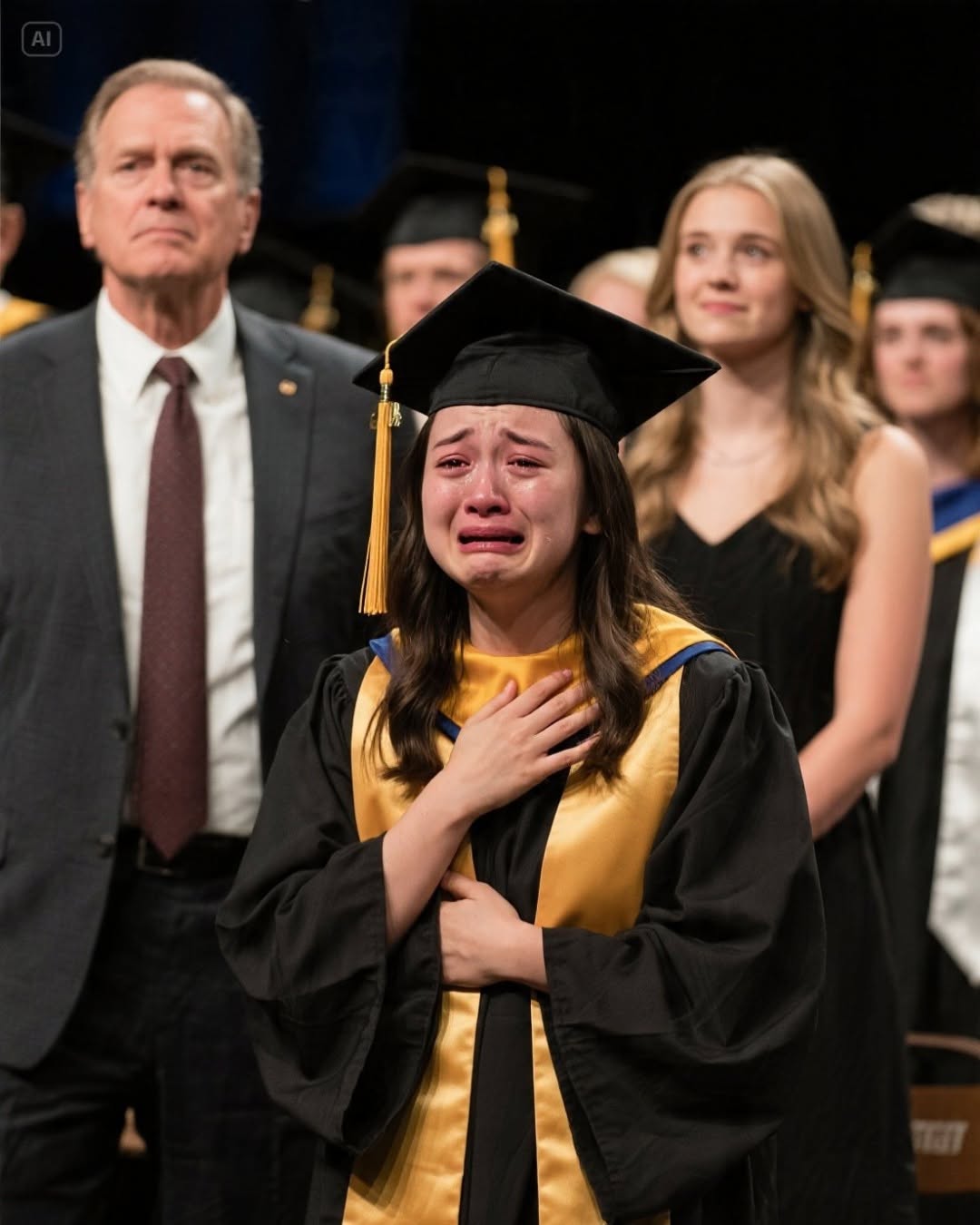
They Humiliated Me at Graduation and Watched Me Disappear — Then My Sister Found Me and Exposed Their Biggest Secret

I opened the folder.

Inside were screenshots of every message my father had sent me.

Every email.

Every bank transfer.

Every receipt.

For illustrative purposes only

And one scanned document claiming Monica needed emergency surgery.

Monica stared at the screen.

“That’s not my insurance number.”

“I know.”

She looked at me.

“Then whose is it?”

“I don’t know.”

Her breathing became shallow.

I clicked another file.

It was the bank statement showing exactly where my $15,000 had gone.

Not to a hospital.

Not to a surgeon.

Not to medication.

It had been transferred into an account belonging to my father.

Monica covered her mouth.

“He lied.”

I nodded.

“For years, I thought you knew.”

She shook her head violently.

“I didn’t.”

Then she looked at the rest of the folder.

“What happened to you after graduation?”

I smiled faintly.

“I disappeared.”

“No. You didn’t just disappear.”

She looked around my apartment.

There were awards on the wall.

A framed article about a company I had founded.

A podcast microphone on my desk.

And a photograph from a conference where I had stood onstage in front of thousands of people.

Monica stared at it.

“Julia…”

“I built a business.”

She looked stunned.

“What kind?”

“Audio production. Then podcasting. Then media consulting.”

“How much?”

I laughed softly.

“You’re still asking the wrong question.”

“What question should I ask?”

“Why did I never come back?”

Monica’s eyes filled with tears.

“Because we hurt you.”

“Yes.”

“But why didn’t you tell me?”

I looked down.

“Because every time I tried to tell you how much it hurt, Mom and Dad told me you were the one who deserved the attention.”

She started crying.

“I never wanted that.”

“I know.”

And that was the first time I truly believed her.

That evening, Monica stayed for dinner.

For the first time in seven years, we talked like sisters instead of competitors.

She told me about her PhD.

Her research.

Her failed relationship.

Her years of trying to become the daughter our parents could brag about.

Then she whispered,

“I thought being their favorite meant I had to keep winning.”

I reached across the table.

“And I thought being ignored meant I had to disappear.”

We sat in silence.

Then Monica asked,

“Do you want to confront them?”

I thought about the restaurant.

The applause.

My father’s raised glass.

My mother’s satisfied smile.

“No.”

She looked surprised.

“Why?”

“Because I don’t need them to admit I was successful.”

I paused.

“But you deserve to know what they did.”

She nodded.

“I do.”

Two weeks later, Monica went home.

She didn’t tell our parents where she had been.

Instead, she asked them one question.

“Where did Julia’s fifteen thousand dollars go?”

My father froze.

My mother immediately changed the subject.

That was enough.

Monica demanded the bank records.

Then she found something even worse.

The money hadn’t been used for her.

It had been used to cover my father’s failed investment.

The medical emergency had been completely fabricated.

And when I started asking questions, they had blocked my number so I couldn’t discover the truth.

Monica confronted them.

My father denied everything.

Until she placed the bank statement on the table.

Then he stopped talking.

My mother started crying.

“We were trying to protect the family.”

Monica shook her head.

“No.”

Her voice broke.

“You were protecting yourselves.”

A month later, Monica came to Portland again.

This time she wasn’t scared.

She brought a box.

Inside was my old graduation photograph.

The one where my father had raised his glass to her instead of me.

She handed it to me.

“I found this in Mom’s house.”

I stared at the picture.

Everyone was smiling.

Except me.

Then Monica pulled out another photograph.

It was from that same night.

But this one had been taken moments after I left.

My father was laughing.

My mother was smiling.

And Monica was staring at the empty chair where I had been sitting.

She looked devastated.

“I never noticed this before,” she whispered.

I looked at her.

“You were the only person in that room who knew it wasn’t funny.”

She started crying.

“So why did you forgive me?”

I thought about it.

“I didn’t forgive you for what you didn’t do.”

She looked confused.

“I forgave you for being a child who didn’t understand what was happening.”

She hugged me.

And for the first time in seven years, I let myself cry too.

I never went back to that restaurant.

I never needed my father’s apology.

He eventually sent one.

It was three pages long.

I read it once.

Then put it away.

Not because it didn’t matter.

Because it no longer controlled me.

Years earlier, my father had raised his glass and told everyone I would never measure up to my sister.

He was wrong.

But the biggest surprise wasn’t that I became successful.

It was that success stopped mattering to me.

I didn’t need to become richer than my father.

More respected than my sister.

Or more impressive than anyone at that table.

I only needed to become someone my younger self could be proud of.

And seven years after walking away from that graduation dinner, I finally understood something:

I hadn’t disappeared because I was a failure.

I disappeared because I finally chose myself.

For illustrative purposes only


Three days after Monica left Portland, she called me at six in the morning.

Her voice was barely above a whisper.

“Julia, you need to come home.”

I sat up in bed.

“What happened?”

“Dad found the folder.”

My stomach tightened.

“What folder?”

“The one with the bank records.”

I was silent.

Then Monica said something that made my blood run cold.

“He knows you kept copies.”

I got dressed and drove straight to the airport.

By the time I landed, Monica was waiting for me outside the terminal.

She looked exhausted.

“What happened?”

She shook her head.

“Dad confronted me last night. He wanted to know everything you told me.”

“And?”

“I didn’t tell him anything.”

I hugged her.

For the first time in our lives, she was protecting me.

Not because she was my sister.

Because she finally understood what had happened.

We drove directly to our parents’ house.

But when we arrived, the front door was open.

The living room had been turned upside down.

Drawers were pulled out.

Papers covered the floor.

My mother was sitting on the couch, crying.

My father was nowhere to be seen.

“What happened?” Monica demanded.

Mom looked at us.

“He took the documents.”

“What documents?”

“The ones from the safe.”

I froze.

“What safe?”

She pointed toward the hallway.

“Your grandmother’s.”

I had forgotten about it.

Years ago, my grandmother had told me there was something important hidden inside the old house.

I had never understood what she meant.

Until now.

Monica and I rushed upstairs.

Behind an old painting was a small metal safe.

The door was open.

Inside, there was only one envelope.

My name was written across it in my grandmother’s handwriting.

I opened it with trembling fingers.

There was a letter.

And a key.

The letter began with four words:

“If you are reading this…”

I stopped breathing.

My grandmother had known.

She had known what my parents were doing.

She had known they treated Monica like the golden child and me like the disappointment.

And she had left instructions.

Not for revenge.

For protection.

The key belonged to a safety deposit box.

Monica stared at me.

“What do you think is inside?”

“I don’t know.”

We went to the bank that afternoon.

The box contained photographs, legal documents, old financial records—and one final envelope.

Inside was a copy of a trust agreement.

My grandmother had quietly placed a large portion of her estate into a trust for me.

But there was a condition.

I could only access the full amount if I remained financially independent and refused to use the money to support my parents’ lifestyle.

My grandmother had understood them better than I ever had.

Monica started crying.

“She knew.”

I nodded.

“She knew everything.”

Then we found something else.

A handwritten list.

Names.

Dates.

Amounts.

Every time my parents had asked me for money.

Every lie they had told.

Every payment they had received.

And at the bottom was one sentence:

“Julia, don’t let them convince you that love means sacrificing yourself forever.”

For illustrative purposes only


I couldn’t speak.

For seven years, I had believed disappearing meant I had abandoned my family.

But my grandmother had understood the truth.

I hadn’t abandoned them.

I had escaped them.

That evening, my father finally came home.

He stopped when he saw us sitting at the dining table.

His face changed when he noticed the documents in front of me.

“You found it.”

“Yes.”

He looked at Monica.

“You shouldn’t have brought her into this.”

Monica stood.

“No, Dad.”

Her voice trembled, but she didn’t back down.

“You brought her into this the moment you lied about me being sick.”

My father looked at me.

“I was desperate.”

“You were dishonest.”

“I needed the money.”

“You could have asked.”

He looked away.

“I knew you wouldn’t give it to me.”

I stared at him.

“You never even gave me the chance.”

Silence filled the room.

Then my father said the words I had secretly wanted to hear for seven years.

“I was ashamed of you.”

My heart hurt.

But this time, I didn’t break.

He continued.

“You weren’t like Monica. You didn’t become a doctor. You didn’t become what I expected.”

I nodded slowly.

“And because I didn’t become what you wanted, you decided I wasn’t worth being proud of.”

He looked down.

“Yes.”

Monica began crying.

“Dad, you made us hate ourselves.”

My father didn’t answer.

I stood.

“I came here thinking I needed an apology.”

My father looked up.

“But I don’t.”

He looked confused.

“I needed to understand why.”

I placed my grandmother’s letter on the table.

“Now I do.”

My mother reached for my hand.

“Julia…”

I stepped back.

“I forgive you.”

She started crying.

“But forgiveness doesn’t mean I’m coming back.”

My father closed his eyes.

I continued.

“You taught me for years that I would never measure up.”

I looked at Monica.

“And you taught her that being loved meant being better than me.”

Monica wiped her tears.

“We’re done competing.”

I smiled at her.

“Yes.”

Then I turned back toward our parents.

“We’re sisters.”

My father stared at us.

“And that’s something you should have protected.”

A year later, Monica graduated with her doctorate.

I was sitting in the front row.

When her name was called, everyone stood and applauded.

I stood too.

And this time, I wasn’t jealous.

I was proud.

After the ceremony, Monica found me outside.

She hugged me tightly.

“Remember Dad’s graduation dinner?”

I laughed softly.

“How could I forget?”

She smiled.

“He raised his glass to me that night.”

“And humiliated me.”

“Yes.”

She took my hand.

“So I’m fixing it.”

She pulled a small glass from her purse.

I laughed.

“What are you doing?”

She raised it.

“To Julia.”

I shook my head.

“Monica…”

“No. Let me finish.”

She smiled through tears.

“To the sister who disappeared because she thought she wasn’t enough.”

Her voice cracked.

“And to the woman who came back knowing she never had anything to prove.”

I raised my glass.

“To us.”

We touched glasses.

And for the first time, there was no competition.

No comparison.

No favorite daughter.

Just two sisters who had finally found their way back to each other.

Years later, I still kept my grandmother’s letter in the top drawer of my desk.

I read it whenever I started doubting myself.

Especially the last line.

“You don’t have to become someone else to deserve love.”

For years, I thought my parents’ rejection was the worst thing that had ever happened to me.

I was wrong.

It was the beginning of my life.

Because the night my father raised his glass to my sister and told everyone I would never measure up…

I didn’t lose my family.

I finally stopped losing myself.