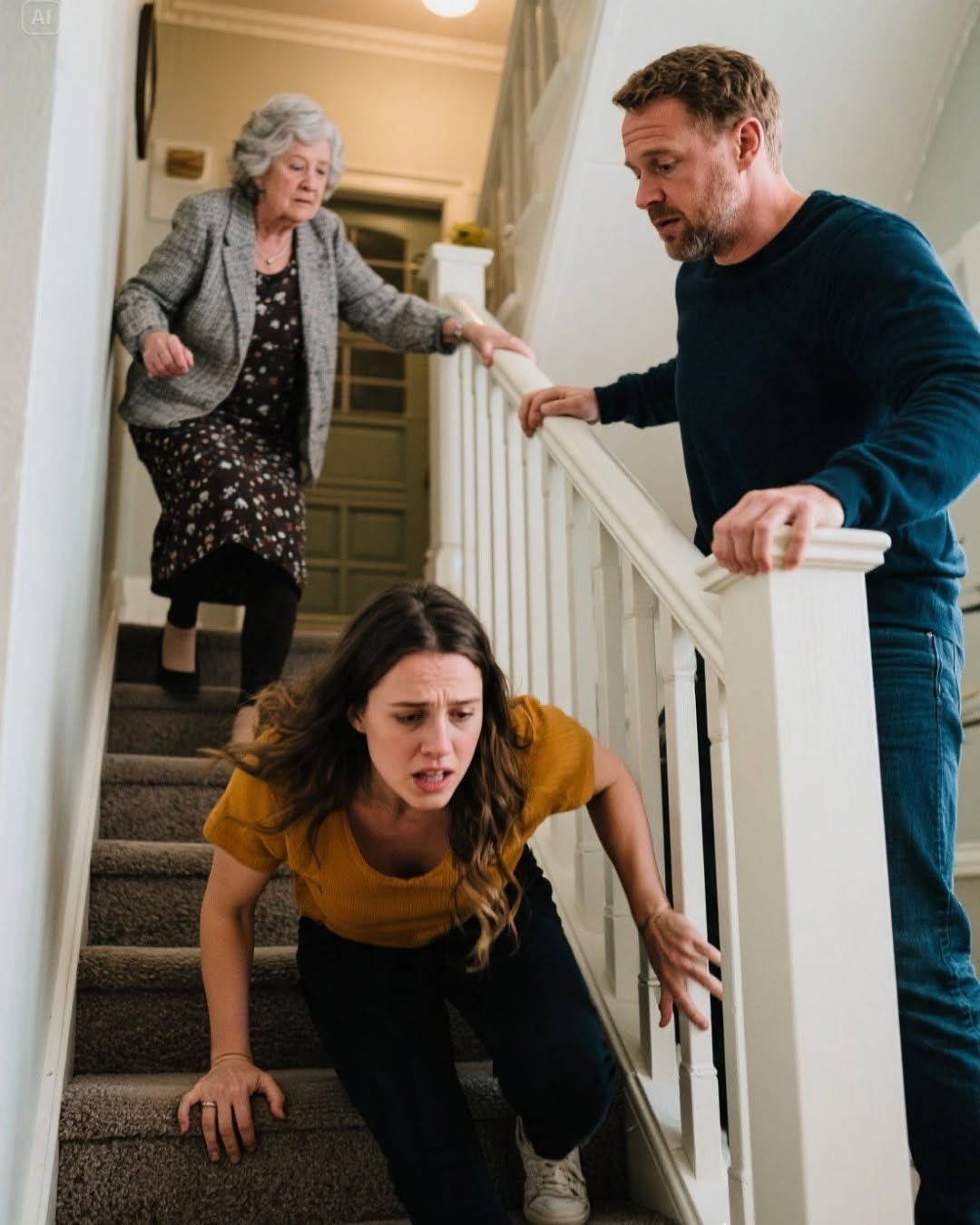
Before I could even turn around, my mother-in-law’s hand slammed into the space between my shoulder blades.
One second, I was standing there with the brass key to my grandfather’s basement cabinet in my hand.
The next, I was tumbling down twelve wooden steps while Judith Mercer watched from the top.
I hit the bottom with enough force to crack two ribs and tear a ligament in my left knee.
Beside the cabinet, which she had left open, were the papers she had been desperately searching for—tax statements, insurance documents, and an old copy of the trust for the lake house.
“Rachel?”

My husband, Colin, appeared behind his mother.
He rushed down the stairs and knelt beside me.
His eyes briefly moved toward the documents before settling on my face.
For one desperate second, I believed he was going to call 911.
Instead, he leaned toward me and whispered,
“You should have just given it to her.”
Judith started crying before the paramedics even arrived.
She told them I had slipped while trying to stop her from organizing the basement.
Colin backed up her story.
I said nothing.
Not until an EMT pulled us apart.
Then, quietly, I told the truth.
At the hospital, doctors told me I would need crutches for at least six weeks.
Three days later, Colin walked into my hospital room carrying divorce papers.
He wanted half of the lake house.
He demanded reimbursement for supposed “improvements.”
And he wanted exclusive use of the property while the divorce case was pending.
“Mom needs somewhere peaceful,” he said, placing the petition beside my pain medication.
“Don’t make this uglier than it is.”
I stared at the man I had loved for eleven years.
“Did you know she was looking for the deed?”
Colin said nothing.
His silence told me everything.
He had already emptied our joint checking account.
He had taken my car, claiming he needed it for work.
Then he changed the password to our home security app.
He thought my injuries had made me powerless.
He was wrong.
There was one thing neither of them remembered.
The lake house wasn’t connected to that security system.
Five years earlier, after a burglary, my grandfather Samuel had installed a separate camera in the basement.
The footage was automatically backed up to an account controlled by Dana Reeves, the independent trustee.
Colin had forgotten that camera existed.
From my hospital bed, I called Dana.
“Before you say anything,” she told me, “I saw the recording.”
I closed my eyes.
Then Dana said something that made my heart stop.
“And Rachel, the document Judith found was only a courtesy copy.”
I sat completely still.
“There is no deed for them to take,” she continued. “The trust owns the house.”
I swallowed.
Then she lowered her voice.
“And your grandfather wrote one very specific protection into Article Fourteen…”
Dana refused to explain Article Fourteen over the phone.
“Some things need to be explained in person,” she said.
The following morning, she arrived at the hospital carrying the original trust documents, a laptop, and a retired detective named Luis Ortega.
“I hired him to preserve the recording properly,” she explained.
I looked at the laptop.
“Is the video really that bad?”
Dana didn’t answer immediately.
Then she opened the footage.
Watching it again was somehow worse than remembering it.
Judith had spent eleven minutes digging through my grandfather’s cabinet.
She opened folders.
Moved documents.
Checked envelopes.
She wasn’t organizing anything.
She was searching.
Then I appeared.
I confronted her and demanded to know what she was doing.
Judith didn’t deny it.
Instead, she told me I needed to sign the lake house over to Colin before our divorce became complicated.
Then came the shove.
My body disappeared down the stairs.
Dana paused the video.
“There is something else,” she said.
She restarted the recording.
Forty-three seconds after I hit the floor, Colin entered the basement.
He looked at me.
Then at his mother.
Judith said, “She forced my hand.”
Colin didn’t question her.
He helped her construct the story that I had fallen.
I closed my eyes.
For eleven years, I had believed my husband would protect me.
The recording proved otherwise.
Dana opened the original trust.
“Your grandfather worried that someone might marry you because of this property.”
I looked at her.
“He actually thought about that?”
“He knew what the lake house was worth.”
She turned to Article Fourteen.
“Your grandfather gave the trustee discretion to sell the property if a spouse or relative attempted to obtain it through coercion, fraud, or violence.”
I stared at the page.
“And the money?”
“Remains your separate trust property.”
I swallowed.
“So Colin can’t claim half of it?”
“No.”

Dana closed the document.
“And the right to occupy the house ends the moment they make a claim against the title.”
A strange calm settled over me.
Colin’s divorce petition had already done exactly that.
His own filing had activated the clause he had never bothered to read.
I gave my recorded statement to the police.
I turned over my hospital records.
I filed for a protective order.
Dana notified Colin’s attorney that the trust rejected his claim.
But she didn’t tell them what we planned to do next.
We wanted everything documented.
Every step.
Every signature.
Every piece of evidence.
Two weeks after my fall, the cameras at the lake house came alive.
Colin and Judith arrived carrying suitcases, champagne, and rented gold chairs.
They had used my missing spare key.
By sunset, nearly sixty people were gathered across the deck.
A banner announced Colin’s “fresh start.”
Judith had even wrapped my grandmother’s silk robe over her party dress.
She proudly gave guests tours of what she called “her new home.”
Then Colin called me from the dock.
Music and laughter filled the background.
“You can stop fighting now,” he said. “Possession matters. My lawyer says judges don’t just throw husbands out of marital homes.”
I looked across Dana’s conference table at the court order sitting in front of me.
“Did your lawyer read the trust?”
Colin laughed.
“A house is a house, Rachel.”
I smiled faintly.
“Enjoy the party.”
The next morning, the photographs from the party became evidence.
Unauthorized occupancy.
Alcohol around the boats.
Damage to antique furniture.
And then Judith made an even bigger mistake.
She posted a video holding the courtesy copy of the trust.
“I finally got the family property,” she announced proudly.
She had just recorded her own motive.
The criminal investigator obtained an arrest warrant.
Dana secured an emergency possession order based on the assault footage, Colin’s divorce filing, and his recorded voicemail.
Then she did something I hadn’t expected.
She sold the lake house.
The buyer was the Pine County Land Conservancy.
The sale would preserve the cabin and shoreline instead of allowing the property to become the luxury development Judith had secretly discussed with a broker.
And I would retain lifetime visiting rights.
That Friday, Colin announced another party.
Apparently, he still believed he had won.
Dana slid the final court order across the table.
“Would you like to stay home?”
I looked at my crutches.
Then at the order.
“No.”
I stood carefully.
“I want him to hear Article Fourteen from me.”
The second party was even louder than the first.
When I arrived, Judith was pouring champagne beneath my grandfather’s mounted fishing photographs.
Colin saw me at the door.
He smiled.
“Rachel came to surrender the keys.”
I stepped inside.
Dana walked beside me.
Behind us came Detective Ortega, two sheriff’s deputies, and a representative from the conservancy.
The room went silent.
Even the music stopped.
Judith lifted her glass.
“You’re trespassing.”
Dana calmly stepped forward.
“Actually, you are.”
She handed Colin the emergency possession order.
His smile disappeared as he read the document.
Then his eyes stopped on the name of the trust.
“This is still a marital asset,” he protested. “My petition—”
“Triggered Article Fourteen,” I said.
He looked at me.
I continued.
“Grandpa called it the coercion clause.”

I took another step forward.
“The moment you tried to obtain the property through pressure, fraud, or violence, the trustee gained the authority to remove you and sell it for my sole benefit.”
The conservancy representative placed the recorded deed on the table.
The sale had closed that morning.
Two-point-four million dollars.
Every dollar was now held in my separate trust, beyond Colin’s claim.
I still had lifetime rights to visit the cabin.
But neither Colin nor Judith had permission to remain there another hour.
Colin slowly turned toward his mother.
“You said you found the deed.”
Judith’s face twisted with anger.
“I found papers!”
Detective Ortega stepped forward.
“Judith Mercer, you’re under arrest for felony assault.”
She stumbled backward.
“She fell!”
Ortega said nothing.
Dana opened her laptop.
The basement footage began playing on the television behind Judith.
The shove.
My fall.
Then Colin’s voice.
“You should have just given it to her.”
The room became completely still.
Several guests lowered their phones.
Others quietly moved toward the door.
Colin suddenly reached for my arm.
A deputy immediately pulled his hand away.
“Don’t touch her.”
I looked at Colin.
I didn’t flinch.
“You filed for divorce while I was learning to walk again.”
His face changed.
“So I accepted.”
His attorney eventually withdrew the claim to the lake house.
Once confronted with the video, bank records, and evidence of his false statements, Colin agreed to return the joint funds, pay my legal fees, and cover $38,000 in damage caused during the parties.
The divorce took seven months.
Not seven minutes.
Judith eventually pleaded guilty to aggravated assault and received jail time, probation, and a no-contact order.
Ten months later, I walked along the restored shoreline without crutches.
The surrounding acreage had become the Samuel Grant Preserve.
My grandfather’s cabin remained private under my lifetime-use agreement.
The forest beyond it would never become the luxury development Judith had secretly discussed with a broker.
Colin was living in a rented studio and making court-ordered payments.
Judith spent her weekends completing community service after her release.
One evening, I placed my grandfather’s old brass key on the mantel.
It no longer opened a cabinet.
It didn’t protect a deed.
It reminded me of something much more important.
They had mistaken my silence for surrender.
And by trying to take everything from me through violence and deception, they had activated the one promise my grandfather had left behind.
No one would ever push me out of my own life again.